
Lightweight durable agent kernel for product integrations

Project description
Monoid Agent Kernel
A lightweight durable agent kernel for embedding product-grade agents anywhere: contract-first, observable, permission-aware, and replaceable at every seam.



Monoid is the small runtime core you put inside a larger product when you need agents to run reliably. It owns the loop, durable artifacts, tool execution, permissions, observability, subagents, skills, and gateway contracts while leaving deployment choices to your platform. Models, tools, workspace storage, checkpoint stores, event sinks, capability brokers, memory, and gateway services are all replaceable contracts.
Throughout these docs, "your gateway" / "your backend platform" refers to the backend you operate — the credential boundary that hosts the LLM and Web gateways. The kernel never holds provider keys; it calls your gateway with a short-lived, scoped token.
See it run
The bundled Agent Studio reference app (monoid studio serve) drives the kernel
through its Python API behind a single-page UI. A profile chooses the model, reasoning
level, prompt instructions, and tool surface; each profile keeps its own chat history.
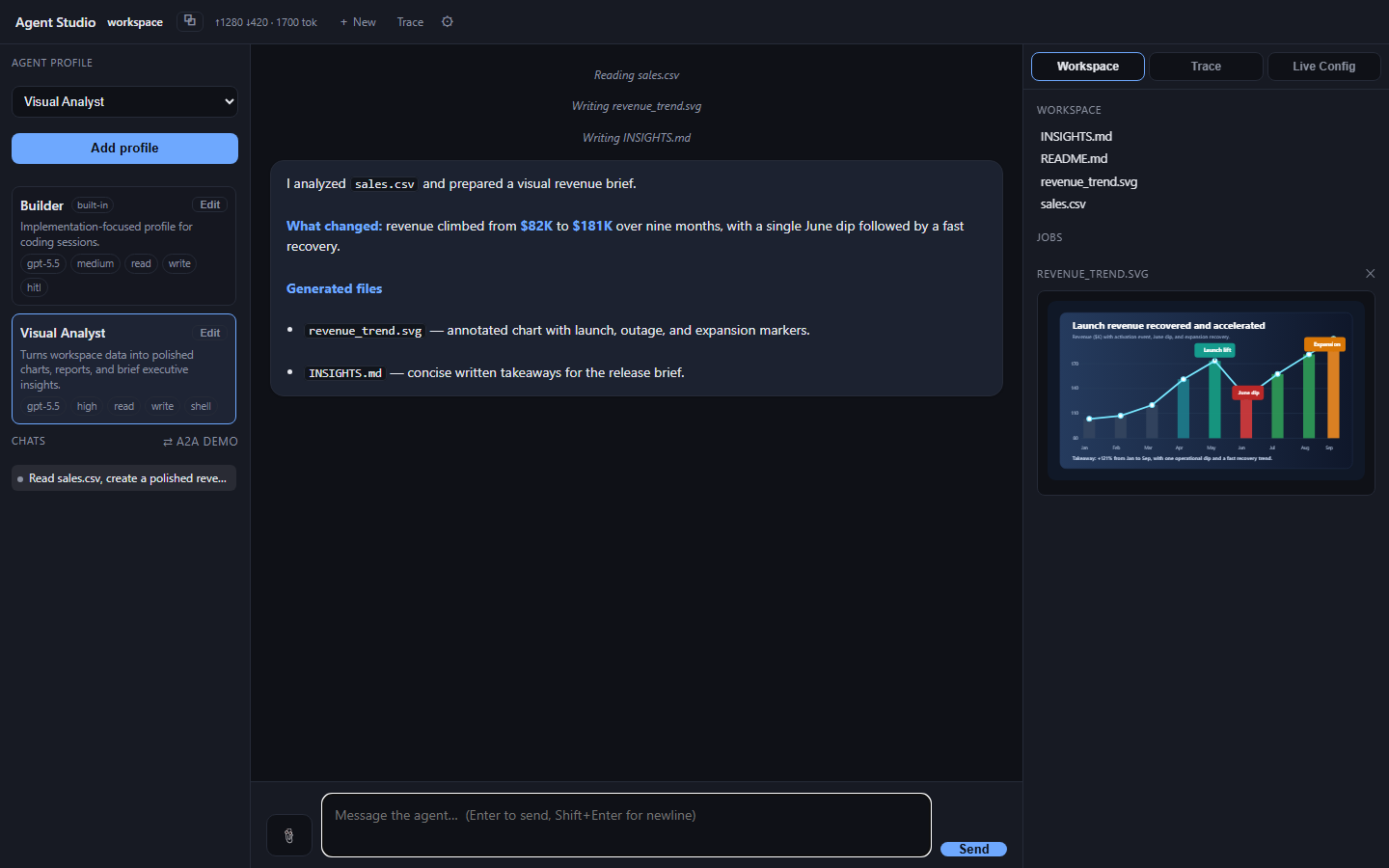
A real Studio run: the agent reads sales.csv, writes INSIGHTS.md, generates an
annotated revenue_trend.svg, and previews the artifact directly in the workspace panel.
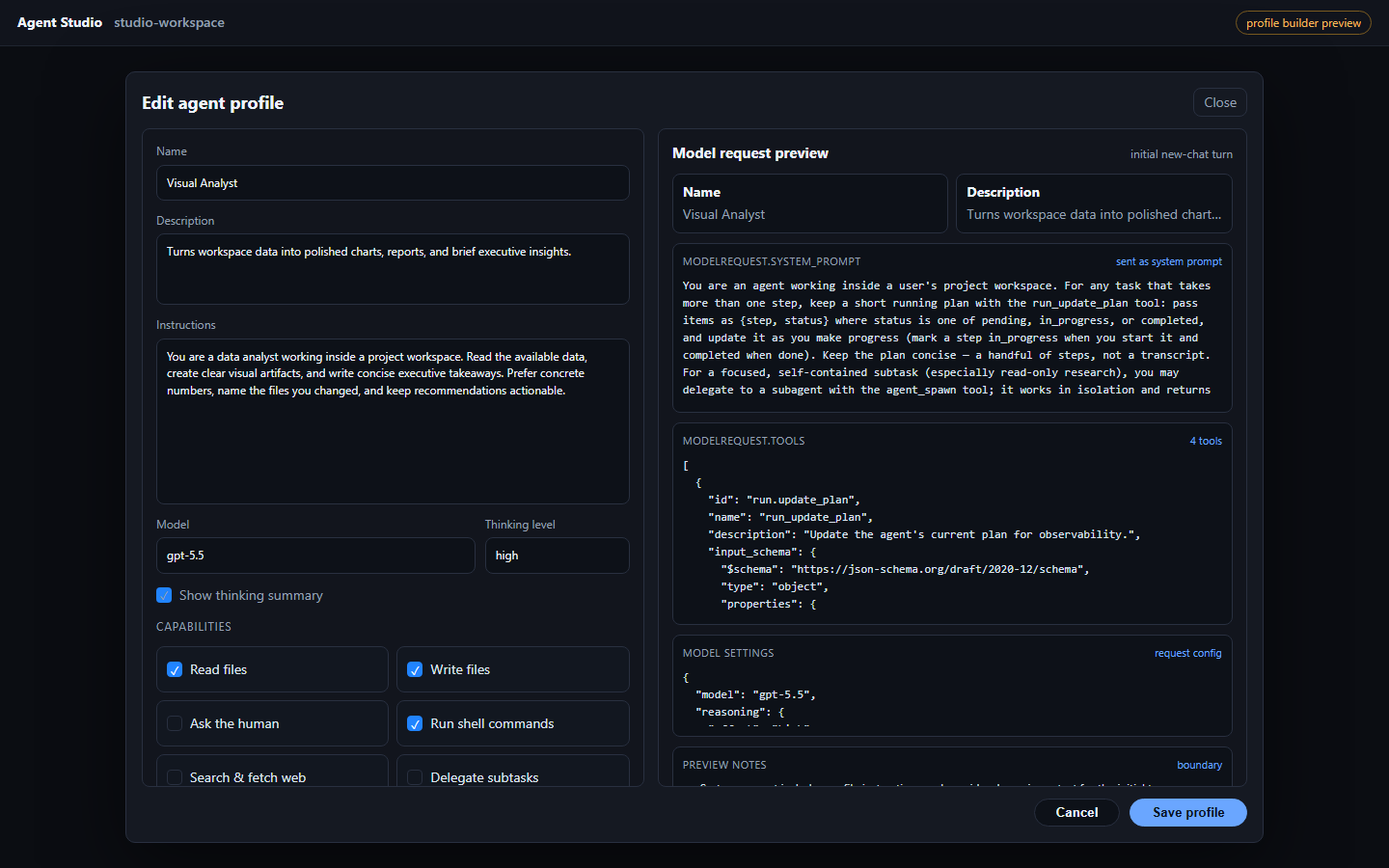
The profile editor shows the exact first-turn model request boundary: system prompt, tool schemas, model settings, and preview notes. Users can edit the profile on the left and see what the model will receive on the right.
Architecture: Contract / Conformance Test / Core Helper Kit / Reference
The package is organized around four roles:
- Contract — the stable integration surface, collected in
monoid_agent_kernel.contractsand re-exported from the top-levelmonoid_agent_kernel. These are the specs and protocols you depend on and implement:AgentLoop,AgentRunSpec,AgentRuntimeConfig,ModelAdapter,ToolSpec/@tool,EventSink,CheckpointStore,PermissionPolicy, and the rest. See docs/CONTRACTS.md for the Python, HTTP, wiring, and operational rules. - Conformance Test — profile-based tests that check contract behavior for a chosen runtime shape. See docs/CONFORMANCE.md for the profile model and docs/OPERATIONAL_RULE_COVERAGE.md for the rule-to-test and Phase 2S hardening coverage matrix.
- Core Helper Kit — the supported runtime and helper modules that make the contract easy to
satisfy (
loop.py,core/,providers/,tools/,workspace/, …). See docs/CORE_HELPER_KIT.md for the helper boundary and validation/library policy. - Reference — example services under
monoid_agent_kernel.reference(backend,llm_gateway,web_gateway,mcp_gateway,stores,studio,conformance) assembled from the public contract and helper kit. See docs/REFERENCE.md for the reference role, harnesses, and smoke targets.
For the dynamic binding-based tool surface, see docs/TOOL_SURFACE.md.
Memory and default tools
monoid_agent_kernel.memory provides an optional provider-backed Memory tool surface. The
kernel treats memory as ordinary tools and context supplied by a provider; the provider owns the
storage shape. The bundled LocalFilesystemMemoryProvider maps the Claude-style /memories
virtual tree to local files and exposes memory.search, memory.view, memory.create,
memory.str_replace, memory.insert, memory.delete, and memory.rename. Read tools default
to allow; write tools default to ask.
Memory providers are attached explicitly by an app, backend, or Studio profile. They are
available from monoid_agent_kernel.memory and stay out of the top-level contract exports and
builtin_tools(workspace).
The helper default_tool_bindings(...) in monoid_agent_kernel.tools.defaults creates the
standard read, write, shell, and artifact tool bundles used by Studio and the builder. The write
bundle includes fs.write, fs.patch, fs.mkdir, fs.copy, fs.move, and fs.delete;
fs.copy, fs.move, and fs.delete require approval by default.
Install
pip install monoid-agent-kernel
Core has no provider SDK dependency. The direct OpenAI adapter is for local smoke tests;
hosted/product runs use GatewayModelAdapter through your gateway:
pip install "monoid-agent-kernel[openai]"
Quickstart (no servers)
The smallest kernel run needs three of your objects — a spec, a model adapter, and a runtime
config — and from_config wires them in one call. FakeModelAdapter (a scripted model)
makes the first turn run offline, with no gateway or API key:
from pathlib import Path

from monoid_agent_kernel import AgentLoop, AgentRunSpec, AgentRuntimeConfig, RegistryToolRef, ToolBinding
from monoid_agent_kernel.providers.base import ModelTurn
from monoid_agent_kernel.providers.fake import FakeModelAdapter, fake_tool_call

workspace = Path("workspace")
run_root = Path("runs")
workspace.mkdir(exist_ok=True)
run_root.mkdir(exist_ok=True)
(workspace / "notes.md").write_text("alpha\nbeta\n", encoding="utf-8")

spec = AgentRunSpec(workspace_root=workspace, run_root=run_root, mode="apply")
config = AgentRuntimeConfig(
    definition_id="quickstart",
    tools=(
        ToolBinding(binding_id="fs.read", ref=RegistryToolRef("fs.read")),
        ToolBinding(binding_id="fs.write", ref=RegistryToolRef("fs.write")),
    ),
)
adapter = FakeModelAdapter(
    turns=[
        ModelTurn(tool_calls=(fake_tool_call("fs_read", {"path": "notes.md"}, "read1"),)),
        ModelTurn(
            tool_calls=(
                fake_tool_call(
                    "fs_write",
                    {"path": "SUMMARY.md", "content": "alpha and beta\n"},
                    "write1",
                ),
            )
        ),
        ModelTurn(final_text="Wrote SUMMARY.md."),
    ]
)

result = AgentLoop.from_config(spec, adapter, config).run_once("Summarize notes.md")
print(result.final_text)
print((workspace / "SUMMARY.md").read_text(encoding="utf-8"))
from_config's runtime_config accepts a bare AgentRuntimeConfig, a
RuntimeConfigProvider, or a callable(run_id) -> AgentRuntimeConfig (hot-reload). See
examples/minimal_quickstart.py for a complete file and
examples/custom_model_adapter.py for implementing
your own ModelAdapter. Author tools from typed functions with the @tool decorator
(see examples/custom_tools/word_count_tool.py);
generated_tool_bindings(...) then turns a set of ToolSpecs into bindings.
Stability
This package is pre-1.0 (0.x): the public surface may change between minor versions, but
breaking changes are called out in commit messages and this README.
- Stable Contract — the core engine and integration contracts exported from
monoid_agent_kernel.contracts:AgentLoop,AgentRunSpec,AgentRuntimeConfig/RuntimeConfigProvider,ModelAdapter,ToolSpec/@tool,EventSink,CheckpointStore,Workspace/workspace_factory, andPermissionPolicy. - Contract Extension — surfaces that are public but still settling: async task seams,
session lifecycle/control, capability leases, agent-as-tool delegation, Agent Skills,
output validation, and multimodal content parts.
ImagePartandDocumentPartare forwarded to multimodal-capable adapters.AudioPart/VideoPartare exported content contracts and round-trip through core JSON/checkpoint paths; provider forwarding is still adapter-specific. - Helper Kit — implementation helpers live under explicit modules such as
monoid_agent_kernel.core.*,monoid_agent_kernel.providers.*,monoid_agent_kernel.tools.*,monoid_agent_kernel.recorder, andmonoid_agent_kernel.observability. - Reference examples — everything under
monoid_agent_kernel.reference.*is example implementation code; build production services against the contracts.
Agent configuration is centered on AgentDefinition (the reusable blueprint) and the
mutable AgentRuntimeConfig (the current prompt and ToolBinding set). Backends can replace
runtime config mid-run; the kernel applies it at the next turn boundary.
Run
monoid run \
  --workspace examples/workspaces/edit_markdown_notes \
  --instruction "Read notes.md and create a clearer summary in SUMMARY.md." \
  --runtime-config-file examples/runtime-config.json \
  --llm-gateway-url http://127.0.0.1:8080/internal/llm/turns
Run spec and runtime config are separate. AgentRunSpec carries workspace,
limits, and permission boundary values — it no longer carries the instruction,
which is delivered as the first user turn (CLI --instruction, or
AgentLoop.run_once() / submit() programmatically). AgentRuntimeConfig
carries model, prompt, tool bindings, guidance, scope, quota, shell runtime, and
web runtime values. You can pass a run spec JSON file with a runtime config
file:
monoid run \
  --spec examples/run-spec.json \
  --instruction "Read notes.md and create a clearer summary in SUMMARY.md." \
  --runtime-config-file examples/runtime-config.json
Use the builder CLI to scaffold and preflight those files:
monoid builder init --target ./my-agent
monoid builder config validate \
  --runtime-config-file ./my-agent/runtime-config.json
monoid builder tools list \
  --runtime-config-file ./my-agent/runtime-config.json
monoid builder init --custom-tool-template also writes a small tools.py provider.
Pass it explicitly when validating or running custom tools:
monoid builder tools list \
  --tool-module ./my-agent/tools.py:get_tools \
  --runtime-config-file ./my-agent/runtime-config.json
Programmatic callers drive the run with AgentLoop.run_once(instruction) for the
one-shot case, or open() → submit(user_input)* → close() for a multi-turn
session in a single run. Each submit() settles when the model returns final
text with no tool calls; the workspace and model continuation thread across
submits. commit_checkpoint() re-baselines the proposal between turns when you
want incremental apply.
The default mode is propose, which means the kernel creates a proposal package
without committing to tenant source-of-truth storage. Local CLI runs default to
--workspace-backend overlay, so writes are staged in an overlay and emitted as
runs/<run_id>/diff.patch and runs/<run_id>/proposal.json without modifying
the workspace. Container/hosted runs can use --workspace-backend staging,
where tools and shell write directly to a staging workspace and the kernel
compares that workspace with workspace.base.json to generate the proposal.
Use --mode apply for local direct workspace writes.
Custom workspace backend
Monoid never touches the filesystem directly — it works through a Workspace
(the file-storage surface in monoid_agent_kernel.contracts). AgentLoop builds one
per run with workspace_factory(spec), defaulting to default_local_workspace_factory,
which returns the local-filesystem backend. Supply your own factory to back a run with a
different store — a git worktree, an object store, a remote or in-memory filesystem —
without changing the engine:
from monoid_agent_kernel import AgentLoop, Workspace

def my_workspace_factory(spec) -> Workspace:
    return MyWorkspace(spec.workspace_root, mode=spec.mode)

loop = AgentLoop.from_config(spec, adapter, config, workspace_factory=my_workspace_factory)
A custom backend must honor the Workspace contract suite
(tests/test_workspace_contract.py) to be a drop-in: add one pytest.param for your
factory and the existing invariants run against it.
The default model provider is gateway. Hosted runs should call an internal
LLM gateway with a short-lived run token. The kernel should not receive
OpenAI, Anthropic, or other provider API keys.
Web tools are also gateway-backed. web.search, web.fetch, and web.context
are available when runtime config binds those registry tools. The kernel calls
your WebGateway with a short-lived web_gateway token. The kernel does not
perform direct web egress and does not receive search-provider credentials.
web.context returns
LLM-ready grounding context through a provider-neutral ContextProvider contract.
Shell is available when runtime config binds shell.exec, which supports foreground
commands and run-scoped background jobs. A background call returns a job_id immediately;
the kernel feeds the job's result back to the model when it finishes (inspect jobs with the
jobs / job CLI commands below).
Path permission defaults are permissive: the kernel treats every root-contained file as a normal workspace file, including dotfiles and keys. Backends can explicitly deny or redact paths per run:
monoid run \
  --workspace examples/workspaces/edit_markdown_notes \
  --instruction "Inspect this workspace." \
  --runtime-config-file examples/runtime-config.json \
  --deny-path ".env" \
  --redact-path "*.key"
--permission-policy-file policy.json accepts:
{
  "deny_patterns": [".env", "*.key"],
  "redact_patterns": ["internal/**"]
}
deny_patterns blocks tool and shell access. redact_patterns masks paths in the public
event/status stream only; private run artifacts keep real paths and contents.
Public events keep file content out of the stream and mask redact_patterns paths.
Your backend owns any extra redaction for secret-bearing tool arguments or shell commands
(see Event Sinks).
Subagents, Skills, and capability gating
Three optional features on monoid run, each off unless its flag is set:
--agents-directory DIR— load subagent definitions (*.mdwith frontmatter) fromDIR, enabling theagent.spawntool so the model can delegate to isolated child runs.--skills-directory DIR— load Agent Skills (SKILL.mdwith frontmatter) fromDIR, enabling the progressive-disclosure skill tools.--capability-broker path.py:factory— load aCapabilityBrokerthat gates any tool declaringruntime.requires_leasebehind a scoped, short-lived lease. Required leases fail closed when no broker is configured. For local dev,--auto-grant-capabilitiesuses the built-inAutoGrantBroker(grants every request, scoped to its binding) instead. Pass at most one of the two.
For machine-readable real-time progress:
monoid run \
  --workspace examples/workspaces/edit_markdown_notes \
  --instruction "Read notes.md and create a clearer summary in SUMMARY.md." \
  --runtime-config-file examples/runtime-config.json \
  --llm-gateway-url http://127.0.0.1:8080/internal/llm/turns \
  --stream-json
--stream-json writes public redacted events to stdout as JSON Lines. Human
status output goes to stderr in this mode.
Watch
Replay or follow a run's public event stream:
monoid watch <run_id> --run-root ./runs --from-start --json
monoid watch <run_id> --run-root ./runs --follow
--json prints raw JSONL events. The default watch output is a compact human
view.
Inspect the current proposed output snapshot:
monoid proposal <run_id> --run-root ./runs
monoid proposal <run_id> --run-root ./runs --file SUMMARY.md --json
Inspect background shell jobs and logs:
monoid jobs <run_id> --run-root ./runs
monoid job status <job_id> --run <run_id> --run-root ./runs --json
monoid job logs <job_id> --run <run_id> --stream stdout --tail-bytes 4096
monoid job cancel <job_id> --run <run_id>
Backend (reference)
Reference example (
monoid_agent_kernel.reference.backend). Build production backends against the contracts in docs/CONTRACTS.md.
The reference backend issues run tokens, starts kernel runs, and exposes lifecycle,
result, event, and tenant usage APIs. Lifecycle payloads use state plus terminal;
ready result payloads keep status for the terminal AgentRunResult.status.
Provider API keys stay outside the Monoid backend.
Start a local LLM gateway. This process is the provider-credential boundary:
export MONOID_BACKEND_ADMIN_TOKEN="admin-dev-token"
export MONOID_LLM_GATEWAY_ADMIN_TOKEN="llm-admin-dev-token"
export MONOID_BACKEND_TOKEN_SECRET="replace-with-32-plus-random-bytes"

monoid llm-gateway serve \
  --host 127.0.0.1 \
  --port 8080
Start the Monoid backend in another process. It shares the token signing secret with the LLM and Web gateways so it can issue scoped gateway tokens:
Reference gateway tokens include a kid header. The shared TokenManager supports keyring-based
rotation with a grace window plus token-id and issued-before revocation checks.
monoid backend serve \
  --workspace-root /workspaces \
  --run-root ./runs \
  --llm-gateway-url http://127.0.0.1:8080/internal/llm/turns \
  --web-gateway-url http://127.0.0.1:8090
For local contract testing, start the reference fake WebGateway:
export MONOID_WEB_GATEWAY_ADMIN_TOKEN="web-admin-dev-token"

monoid web-gateway serve \
  --host 127.0.0.1 \
  --port 8090 \
  --provider fake
For a real search smoke, use Brave Search for web.search and the gateway's
direct HTTP fetcher for web.fetch. Add --context-provider brave-llm to use
Brave's LLM Context endpoint for web.context, or --context-provider search-fetch to build context from the configured search/fetch providers.
Provider credentials stay in the WebGateway process and are never passed to Monoid:
export BRAVE_SEARCH_API_KEY="..."

monoid web-gateway serve \
  --host 127.0.0.1 \
  --port 8090 \
  --provider brave-http \
  --context-provider brave-llm \
  --brave-api-key-env BRAVE_SEARCH_API_KEY
Create a run:
curl -sS -X POST http://127.0.0.1:8765/v1/runs \
  -H "Authorization: Bearer $MONOID_BACKEND_ADMIN_TOKEN" \
  -H "Content-Type: application/json" \
  -d '{
    "tenant_id": "tenant_a",
    "user_id": "user_a",
    "workspace_root": "/workspaces/demo",
    "instruction": "Read notes.md and create SUMMARY.md.",
    "mode": "propose",
    "runtime_config": {
      "definition_id": "markdown-editor",
      "config_version": 1,
      "model": {"provider": "gateway", "model": "gpt-5.5"},
      "tools": [
        {"binding_id": "read_file", "ref": {"kind": "registry", "tool_id": "fs.read"}},
        {"binding_id": "write_file", "ref": {"kind": "registry", "tool_id": "fs.write"}},
        {"binding_id": "finish", "ref": {"kind": "registry", "tool_id": "run.finish"}}
      ],
      "tool_search": {"enabled": true, "top_k": 5}
    }
  }'
The response includes a run_token. Use that token for:
curl -H "Authorization: Bearer $RUN_TOKEN" \
  http://127.0.0.1:8765/v1/runs/$RUN_ID/status

curl -H "Authorization: Bearer $RUN_TOKEN" \
  http://127.0.0.1:8765/v1/runs/$RUN_ID/result

curl -H "Authorization: Bearer $RUN_TOKEN" \
  http://127.0.0.1:8765/v1/runs/$RUN_ID/events

curl -H "Authorization: Bearer $RUN_TOKEN" \
  "http://127.0.0.1:8765/v1/runs/$RUN_ID/events?from_seq=1&limit=100"

curl -H "Authorization: Bearer $RUN_TOKEN" \
  "http://127.0.0.1:8765/v1/runs/$RUN_ID/diagnostics?event_limit=50"

curl -H "Authorization: Bearer $RUN_TOKEN" \
  http://127.0.0.1:8765/v1/runs/$RUN_ID/proposal

curl -H "Authorization: Bearer $RUN_TOKEN" \
  http://127.0.0.1:8765/v1/runs/$RUN_ID/proposal/files/SUMMARY.md

curl -H "Authorization: Bearer $RUN_TOKEN" \
  http://127.0.0.1:8765/v1/runs/$RUN_ID/runtime-config

# POST replaces the run's config (optimistic concurrency via expected_version); the kernel
# applies it at the next turn boundary. See docs/CONTRACTS.md for the request schema.
curl -sS -X POST http://127.0.0.1:8765/v1/runs/$RUN_ID/runtime-config \
  -H "Authorization: Bearer $RUN_TOKEN" \
  -H "Content-Type: application/json" \
  -d @new-runtime-config.json

curl -H "Authorization: Bearer $RUN_TOKEN" \
  http://127.0.0.1:8765/v1/runs/$RUN_ID/jobs

curl -H "Authorization: Bearer $RUN_TOKEN" \
  http://127.0.0.1:8765/v1/runs/$RUN_ID/jobs/$JOB_ID/logs?stream=stdout
/status returns lifecycle state, for example {"state":"running","terminal":false}.
/result returns ready=false with lifecycle state while a run is open; when ready=true,
its status field is the terminal result status (completed, failed, or limited).
Tenant usage is admin-scoped:
curl -H "Authorization: Bearer $MONOID_BACKEND_ADMIN_TOKEN" \
  http://127.0.0.1:8765/v1/tenants/tenant_a/usage
The backend generates a separate llm_gateway token for the kernel-to-gateway
call. That token is passed only to GatewayModelAdapter and is not returned from
the run APIs. For web-enabled runs, it also generates a separate web_gateway
token for WebGatewayClient.
The LLM gateway validates llm_gateway tokens, calls the provider adapter, and returns only
opaque turn_handle values to the kernel. The default by-value messages request is
forwarded statelessly; for handle-based continuation it stores provider continuation ids
server-side. The turn request carries the effective model from runtime config. Its usage endpoint is
admin-scoped:
curl -H "Authorization: Bearer $MONOID_LLM_GATEWAY_ADMIN_TOKEN" \
  http://127.0.0.1:8080/internal/llm/tenants/tenant_a/usage
The WebGateway validates web_gateway tokens, enforces signed token scope for brokered web
capabilities before calling a provider, and reports tenant usage. Payload-level domain, binding,
and call-limit values can narrow the signed scope; they cannot widen it. The reference ships a
deterministic fake provider plus Brave-backed search/fetch/context providers behind the
provider-neutral ContextProvider seam, so the search backend can be swapped without
changing kernel tools.
curl -H "Authorization: Bearer $MONOID_WEB_GATEWAY_ADMIN_TOKEN" \
  http://127.0.0.1:8090/internal/web/tenants/tenant_a/usage
Outputs
Each run writes:
events.jsonl: public redacted event streamtranscript.jsonl: private debug/replay transcript with full tool payloadsstatus.json: latest run lifecycle projection for polling (stateplusterminal)metrics.json: final counters and timingmanifest.json: run contract, agent config metadata, binding-aware tool surface, workspace backendworkspace.base.json: base snapshot used for proposal comparisonworkspace.index.json: context/index artifactdiff.patch: proposed or applied workspace diffproposal.json: proposed output snapshot metadataproposal/files/: materialized changed-file snapshotsartifacts/jobs/<job_id>/: background job status (job.json) andstdout.log/stderr.log
events.jsonl remains public/redacted. Proposed file contents are exposed only
through the run directory snapshot or run-token protected backend proposal APIs.
Studio adds studio.chat.jsonl inside each Studio run directory as the browser-facing chat
projection. The Studio UI restores user, assistant, and error messages from
/api/chat-transcript, then replays events.jsonl for trace and activity panels.
transcript.jsonl remains the private model-call log.
Event Sinks
Programmatic callers can pass sinks to
AgentLoop(..., runtime_config_provider=provider, event_sinks=(...)).
CLI callers can load sinks with:
monoid run \
  --workspace . \
  --instruction "Inspect this workspace." \
  --runtime-config-file examples/runtime-config.json \
  --event-sink-module ./my_sink.py:make_sink
The function must return an object with emit(event) and close() methods, or
an iterable of those objects.
examples/redacting_event_sink.py is a ready-to-copy sink that masks
secret-looking values before forwarding — the recommended place to add secret
redaction now that the core no longer guesses at secrets (see above):
monoid run \
  --workspace . \
  --instruction "Inspect this workspace." \
  --runtime-config-file examples/runtime-config.json \
  --llm-gateway-url http://127.0.0.1:8080/internal/llm/turns \
  --event-sink-module examples/redacting_event_sink.py:make_sink
Observability
Every run emits a structured event stream and a metrics artifact, and can mirror that stream to OpenTelemetry — all without the core capturing prompt/response content.
OpenTelemetry tracing. OtelEventSink is an event sink that turns the run's
run → model.turn → tool.call event tree into a GenAI-semantic-convention span tree:
invoke_agent
├── chat {model}          (one span per model turn)
└── execute_tool {tool}   (one span per tool call)
chat and execute_tool are siblings under invoke_agent (linked by a turn_id attribute,
not nested), and spans carry GenAI attributes (gen_ai.operation.name, gen_ai.request.model,
gen_ai.tool.name, token usage). Wire it in with one line:
from monoid_agent_kernel import AgentLoop
from monoid_agent_kernel.observability.otel import OtelEventSink

loop = AgentLoop.from_config(spec, adapter, config, event_sinks=(OtelEventSink(),))
OtelEventSink depends only on opentelemetry-api (a no-op until your app installs an SDK +
exporter). To actually export spans, install the SDK and an OTLP exporter and configure a global
TracerProvider:
pip install "monoid-agent-kernel[otel-export]"
examples/otel_tracing.py is a runnable, offline demo: it prints the
span tree to the console (via a local ConsoleSpanExporter, no collector) for a scripted run.
Live streaming. Beyond the durable event sinks, AgentLoop.astream(user_input) returns a
RunStream — an async context manager + iterator that yields AgentEvent (orchestration)
interleaved with ModelStreamChunk (token deltas: TextDelta / ReasoningDelta /
ToolCallDelta / TurnComplete) when the adapter exposes astream_turn. Read stream.result
after the stream drains. Gateway token streaming uses Server-Sent Events and needs the
[http-async] extra.
Metrics. Each run writes metrics.json (and emits a metrics.updated event per turn) with
final counters and timing: status, duration_s, tool_calls, shell/background-job counters,
web-call counters, and token usage (input_tokens, output_tokens, total_tokens,
reasoning_tokens). See Outputs for the full run-directory artifact set.
See also the design docs under docs/: SUBAGENT_DESIGN.md and
SKILLS_DESIGN.md for the delegation and skills surfaces.
Model Provider Boundary
GatewayModelAdapter is the default path. It sends normalized model-turn
requests to your LLM gateway and can authenticate with
MONOID_LLM_GATEWAY_TOKEN or --llm-gateway-token-file. Provider credentials stay
inside your backend platform, where tenant usage, budgets, and rate limits
can be enforced.
OpenAIModelAdapter is retained for local smoke tests. CLI use requires
runtime_config.model.provider="openai" and --allow-direct-provider-api.
To target your own LLM gateway, implement the ModelAdapter protocol or the
monoid.llm-turn.v1 HTTP contract documented in
docs/CONTRACTS.md. Current protocol and schema identifiers
use monoid.*; native-agent-runner.* identifiers are accepted during migration
for existing durable artifacts and gateway requests.
Defaults
- runtime config is required for CLI and backend runs
- default model provider inside
ModelConfig:gateway - default model inside
ModelConfig:gpt-5.5 - default reasoning effort inside
ModelConfig:medium - mode:
propose - default tool bundles are available through
monoid_agent_kernel.tools.defaults.default_tool_bindings - shell is available through exposed shell bindings such as
shell.exec - web.search/web.fetch/web.context are available through exposed web bindings and WebGateway
- file mutation tools include write, patch, mkdir, copy, move, and delete in
proposeandapplymodes when bound in runtime config - memory tools are available through an explicitly attached
MemoryProvider - no path deny/redact policy unless explicitly provided
Contributing
Issues and pull requests are welcome. See CONTRIBUTING.md for development setup and the lint/test workflow, and CODE_OF_CONDUCT.md. For security issues, follow SECURITY.md (do not open a public issue).
Fast local confidence checks:
python -m pytest tests/conformance -q
python -m pytest -q -n 4
python -m pytest -q --cov=monoid_agent_kernel --cov=native_agent_runner
CI keeps the serial suite as the required gate and runs xdist plus coverage as advisory checks while the test seams stabilize. See docs/PHASE_4_CLOSURE.md for the current Phase 4 structure closure and CI promotion criteria.
License
Licensed under the Apache License 2.0.


Download files
Download the file for your platform. If you're not sure which to choose, learn more about installing packages.
Source Distribution
Built Distribution
Filter files by name, interpreter, ABI, and platform.
If you're not sure about the file name format, learn more about wheel file names.
Copy a direct link to the current filters
File details
Details for the file monoid_agent_kernel-0.17.0.tar.gz.
File metadata
- Download URL: monoid_agent_kernel-0.17.0.tar.gz
- Upload date:
- Size: 1.5 MB
- Tags: Source
- Uploaded using Trusted Publishing? No
- Uploaded via: twine/6.2.0 CPython/3.11.9
File hashes
| Algorithm | Hash digest | |
|---|---|---|
| SHA256 |
0ec83631b268fdb04ed67358b86ab157936abfc66a8a447e09c9c7e8464f4026
|
|
| MD5 |
ad0facba2d4d1e10dc7f60acd83d8caa
|
|
| BLAKE2b-256 |
da299a1f7bf7f3be9ed827ba89844a157242520faf45156c0fde43a61ac88a4d
|
File details
Details for the file monoid_agent_kernel-0.17.0-py3-none-any.whl.
File metadata
- Download URL: monoid_agent_kernel-0.17.0-py3-none-any.whl
- Upload date:
- Size: 870.6 kB
- Tags: Python 3
- Uploaded using Trusted Publishing? No
- Uploaded via: twine/6.2.0 CPython/3.11.9
File hashes
| Algorithm | Hash digest | |
|---|---|---|
| SHA256 |
5bd0d6132896b52b59359a4a5e64224b03753e3cad54510ca6f36548524dbbcb
|
|
| MD5 |
58d14e549ba9e5bca767b7ce5d36c358
|
|
| BLAKE2b-256 |
6a75e96d25f975aca8c18ea461959f5e9cda27e0a69ae146a5e1df38e205fc40
|






