
Lightweight durable agent kernel for product integrations
Verified details
These details have been verified by PyPIProject links
GitHub Statistics
Maintainers

Project description
Monoid Agent Kernel
A lightweight durable agent kernel for embedding product-grade agents anywhere: contract-first, observable, permission-aware, and replaceable at every seam.



Monoid is the small runtime core you put inside a larger product when you need agents to run reliably. It owns the loop, durable artifacts, tool execution, permissions, observability, subagents, skills, and gateway contracts while leaving deployment choices to your platform. Models, tools, workspace storage, checkpoint stores, event sinks, capability brokers, memory, and gateway services are all replaceable contracts.
Throughout these docs, "your gateway" / "your backend platform" refers to the backend you operate — the credential boundary that hosts the LLM and Web gateways. The kernel never holds provider keys; it calls your gateway with a short-lived, scoped token.
New here? Run the Quickstart (no servers, no API key), then follow the Documentation map to the path for your role.
See it run
The bundled Agent Studio reference app (monoid studio serve) drives the kernel
through its Python API behind a single-page UI. A profile chooses the model, reasoning
level, prompt instructions, and capability surface; each profile keeps its own chat history.
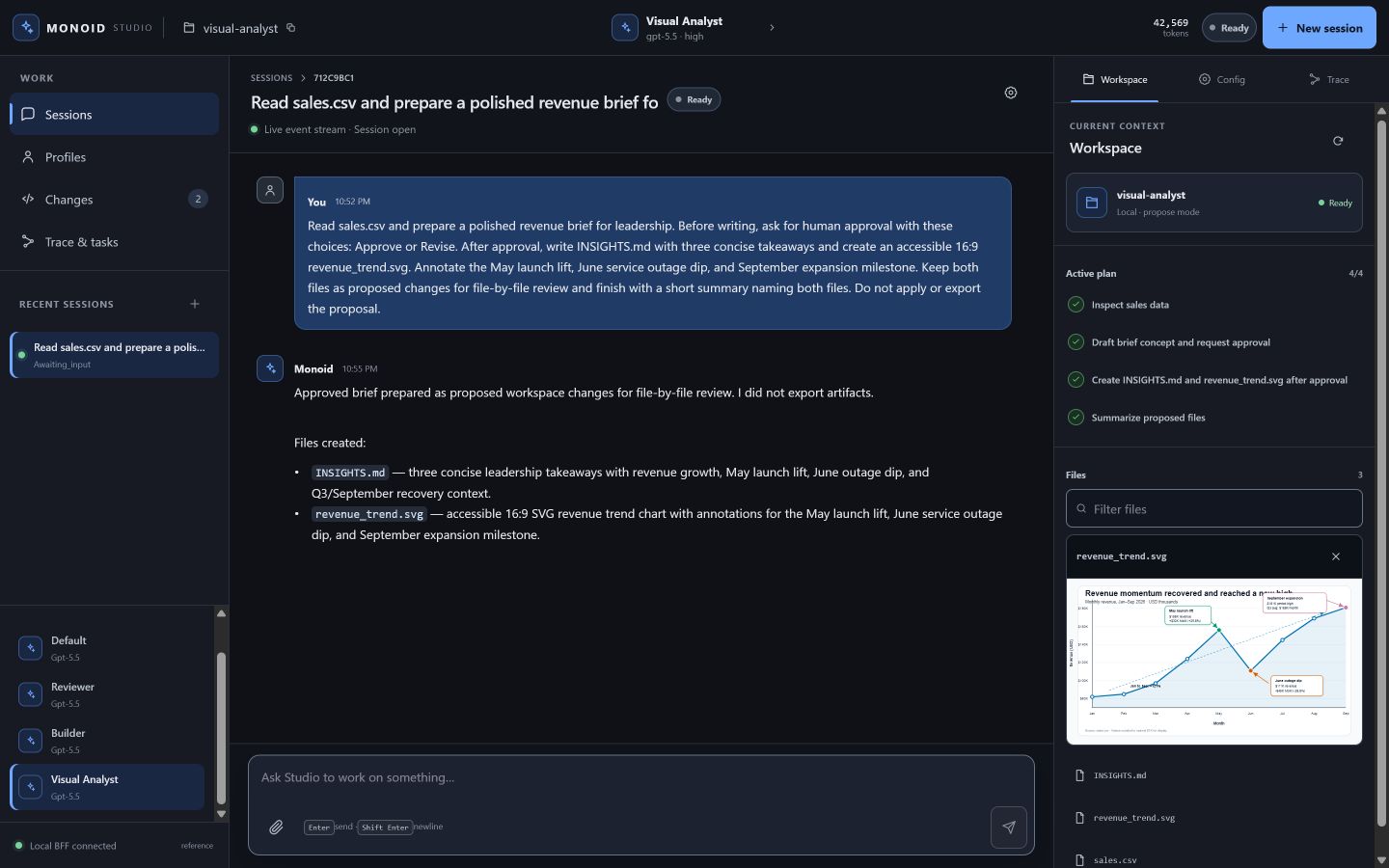
A real Studio run: the agent reads sales.csv, pauses for human approval, and stages
INSIGHTS.md and revenue_trend.svg for file-by-file review. The user applies the approved
files through Studio and previews the chart directly in the workspace panel.
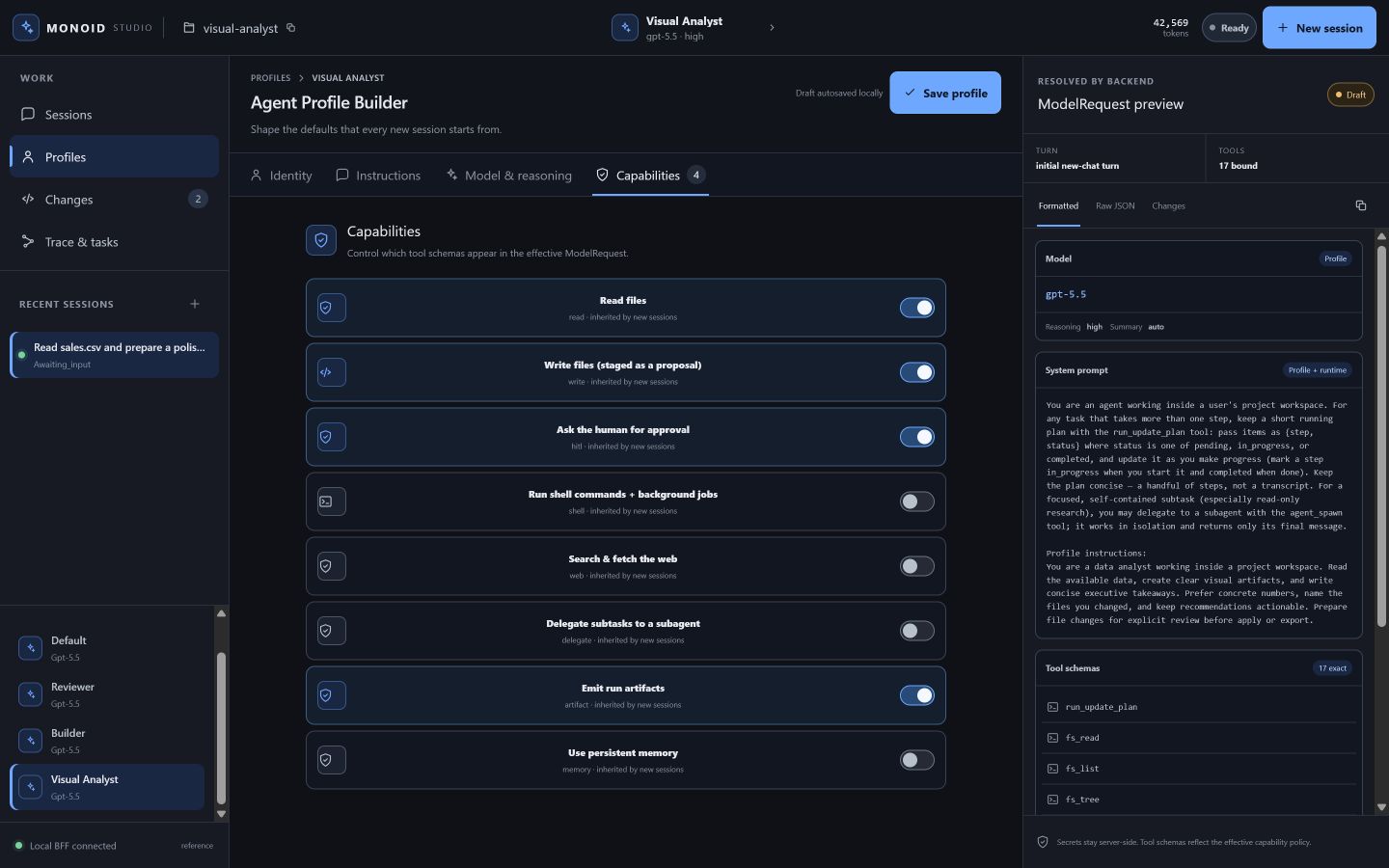
The Profile Builder places model, reasoning, and capability controls beside the
backend-resolved first-turn ModelRequest: system prompt, exact tool schemas, model
settings, and boundary notes.
Architecture: Contract / Conformance Test / Core Helper Kit / Reference
The package is organized around four roles:
- Contract — the stable integration surface, collected in
monoid_agent_kernel.contractsand re-exported from the top-levelmonoid_agent_kernel. These are the specs and protocols you depend on and implement:AgentLoop,AgentRunSpec,AgentRuntimeConfig,ModelAdapter,ToolSpec/@tool,EventSink,CheckpointStore,PermissionPolicy, and the rest. See docs/CONTRACTS.md for the Python, HTTP, wiring, and operational rules. - Conformance Test — profile-based tests that check contract behavior for a chosen runtime shape. See docs/CONFORMANCE.md for the profile model and docs/OPERATIONAL_RULE_COVERAGE.md for the rule-to-test and Phase 2S hardening coverage matrix.
- Core Helper Kit — the supported runtime and helper modules that make the contract easy to
satisfy (
loop.py,core/,providers/,tools/,workspace/, …). See docs/CORE_HELPER_KIT.md for the helper boundary and validation/library policy. - Reference — example services under
monoid_agent_kernel.reference(backend,llm_gateway,web_gateway,mcp_gateway,stores,studio,conformance) assembled from the public contract and helper kit. See docs/REFERENCE.md for the reference role, harnesses, and smoke targets.
For the dynamic binding-based tool surface, see docs/TOOL_SURFACE.md.
Install
pip install monoid-agent-kernel
The Studio UI ships as precompiled static assets. Running Studio does not install or require Node.js, Svelte, Vite, or Tailwind CSS; those tools are confined to frontend development and the release build.
The default install runs Studio with complete one-shot gateway turns. Add the async HTTP extra to render live token deltas in Studio:
pip install "monoid-agent-kernel[http-async]"
Core has no provider SDK dependency. The direct OpenAI adapter is for local smoke tests;
hosted/product runs use GatewayModelAdapter through your gateway:
pip install "monoid-agent-kernel[openai]"
Quickstart (no servers)
The smallest kernel run needs three of your objects — a spec, a model adapter, and a runtime
config — and from_config wires them in one call. FakeModelAdapter (a scripted model)
makes the first turn run offline, with no gateway or API key:
from pathlib import Path

from monoid_agent_kernel import AgentLoop, AgentRunSpec, AgentRuntimeConfig, RegistryToolRef, ToolBinding
from monoid_agent_kernel.providers.base import ModelTurn
from monoid_agent_kernel.providers.fake import FakeModelAdapter, fake_tool_call

workspace = Path("workspace")
run_root = Path("runs")
workspace.mkdir(exist_ok=True)
run_root.mkdir(exist_ok=True)
(workspace / "notes.md").write_text("alpha\nbeta\n", encoding="utf-8")

spec = AgentRunSpec(workspace_root=workspace, run_root=run_root, mode="apply")
config = AgentRuntimeConfig(
    definition_id="quickstart",
    tools=(
        ToolBinding(binding_id="fs.read", ref=RegistryToolRef("fs.read")),
        ToolBinding(binding_id="fs.write", ref=RegistryToolRef("fs.write")),
    ),
)
adapter = FakeModelAdapter(
    turns=[
        ModelTurn(tool_calls=(fake_tool_call("fs_read", {"path": "notes.md"}, "read1"),)),
        ModelTurn(
            tool_calls=(
                fake_tool_call(
                    "fs_write",
                    {"path": "SUMMARY.md", "content": "alpha and beta\n"},
                    "write1",
                ),
            )
        ),
        ModelTurn(final_text="Wrote SUMMARY.md."),
    ]
)

result = AgentLoop.from_config(spec, adapter, config).run_once("Summarize notes.md")
print(result.final_text)
print((workspace / "SUMMARY.md").read_text(encoding="utf-8"))
from_config's runtime_config accepts a bare AgentRuntimeConfig, a
RuntimeConfigProvider, or a callable(run_id) -> AgentRuntimeConfig (hot-reload). See
examples/minimal_quickstart.py for a complete file and
examples/custom_model_adapter.py for implementing
your own ModelAdapter. Author tools from typed functions with the @tool decorator
(see examples/custom_tools/word_count_tool.py);
generated_tool_bindings(...) then turns a set of ToolSpecs into bindings.
Memory and default tools
monoid_agent_kernel.memory provides an optional provider-backed Memory tool surface. The
kernel treats memory as ordinary tools and context supplied by a provider; the provider owns the
storage shape. The bundled LocalFilesystemMemoryProvider maps the Claude-style /memories
virtual tree to local files and exposes memory.search, memory.view, memory.create,
memory.str_replace, memory.insert, memory.delete, and memory.rename. Read tools default
to allow; write tools default to ask.
Memory providers are attached explicitly by an app, backend, or Studio profile. They are
available from monoid_agent_kernel.memory and stay out of the top-level contract exports and
builtin_tools(workspace).
The helper default_tool_bindings(...) in monoid_agent_kernel.tools.defaults creates the
standard read, write, shell, and artifact tool bundles used by Studio and the builder. The write
bundle includes fs.write, fs.patch, fs.mkdir, fs.copy, fs.move, and fs.delete;
fs.copy, fs.move, and fs.delete require approval by default.
Stability
This package is pre-1.0 (0.x): the public surface may change between minor versions, but
breaking changes are called out in commit messages and this README.
- Stable Contract — the core engine and integration contracts exported from
monoid_agent_kernel.contracts:AgentLoop,AgentRunSpec,AgentRuntimeConfig/RuntimeConfigProvider,ModelAdapter,ToolSpec/@tool,EventSink,CheckpointStore,Workspace/workspace_factory, andPermissionPolicy. - Contract Extension — surfaces that are public but still settling: async task seams,
session lifecycle/control, capability leases, agent-as-tool delegation, Agent Skills,
output validation, and multimodal content parts.
ImagePartandDocumentPartare forwarded to multimodal-capable adapters.AudioPart/VideoPartare exported content contracts and round-trip through core JSON/checkpoint paths; provider forwarding is still adapter-specific. - Helper Kit — implementation helpers live under explicit modules such as
monoid_agent_kernel.core.*,monoid_agent_kernel.providers.*,monoid_agent_kernel.tools.*,monoid_agent_kernel.recorder, andmonoid_agent_kernel.observability. - Reference examples — everything under
monoid_agent_kernel.reference.*is example implementation code; build production services against the contracts.
Agent configuration is centered on AgentDefinition (the reusable blueprint) and the
mutable AgentRuntimeConfig (the current prompt and ToolBinding set). Backends can replace
runtime config mid-run; the kernel applies it at the next turn boundary.
Running agents from the CLI
monoid run \
  --workspace examples/workspaces/edit_markdown_notes \
  --instruction "Read notes.md and create a clearer summary in SUMMARY.md." \
  --runtime-config-file examples/runtime-config.json \
  --llm-gateway-url http://127.0.0.1:8080/internal/llm/turns
- Run spec vs runtime config are separate.
AgentRunSpeccarries workspace, limits, and permission boundary; the instruction is delivered as the first user turn.AgentRuntimeConfigcarries model, prompt, tool bindings, guidance, scope, quota, and shell/web runtime. proposevsapply. The defaultproposemode stages writes and emits a proposal package (diff.patch,proposal.json) without mutating the workspace;--mode applywrites directly.- Permissions are permissive by default — dotfiles and keys are treated as normal files.
Pass
--deny-path/--redact-pathif the workspace holds secrets. See the Threat Model before exposing secret-bearing workspaces. - Optional surfaces, each off unless flagged:
--agents-directory(subagents viaagent.spawn),--skills-directory(Agent Skills),--capability-broker(leased tools).
Full CLI reference — run, builder, watch, proposal, jobs, custom workspace
backends, streaming JSON — is in docs/CLI.md.
Hosted backend and gateways
For hosted, multi-tenant runs over HTTP, the reference backend issues run tokens and starts kernel runs, while the LLM and Web gateways hold provider credentials and validate scoped tokens. The kernel never receives OpenAI, Anthropic, or search-provider keys.
The end-to-end walkthrough — starting the gateways, creating a run with curl, and polling
status/result/events/proposal — is in docs/BACKEND.md.
Model Provider Boundary
GatewayModelAdapter is the default path. It sends normalized model-turn
requests to your LLM gateway and can authenticate with
MONOID_LLM_GATEWAY_TOKEN or --llm-gateway-token-file. Provider credentials stay
inside your backend platform, where tenant usage, budgets, and rate limits
can be enforced.
OpenAIModelAdapter is retained for local smoke tests. CLI use requires
runtime_config.model.provider="openai" and --allow-direct-provider-api.
To target your own LLM gateway, implement the ModelAdapter protocol or the
monoid.llm-turn.v1 HTTP contract documented in
docs/CONTRACTS.md. Current protocol and schema identifiers
use monoid.*; native-agent-runner.* identifiers are accepted during migration
for existing durable artifacts and gateway requests.
Observability
Every run emits a structured event stream (events.jsonl) and durable artifacts, and can
mirror that stream to OpenTelemetry — all without the core capturing prompt/response content.
AgentLoop.astream(user_input) exposes live token deltas, and each run writes metrics.json
with counters, timing, and token usage.
The run-directory artifact set, custom event sinks (including secret redaction), OTel tracing, live streaming, and metrics are all documented in docs/OBSERVABILITY.md.
Defaults
- runtime config is required for CLI and backend runs
- default model provider inside
ModelConfig:gateway - default model inside
ModelConfig:gpt-5.5 - default reasoning effort inside
ModelConfig:medium - mode:
propose - default tool bundles are available through
monoid_agent_kernel.tools.defaults.default_tool_bindings - shell is available through exposed shell bindings such as
shell.exec - web.search/web.fetch/web.context are available through exposed web bindings and WebGateway
- file mutation tools include write, patch, mkdir, copy, move, and delete in
proposeandapplymodes when bound in runtime config - memory tools are available through an explicitly attached
MemoryProvider - no path deny/redact policy unless explicitly provided
Documentation
Start with docs/README.md — it routes you to the right docs by role (app developer, tool author, backend/gateway operator, security reviewer, contributor). Quick links:
- Use it: CLI reference · Hosted backend · Observability
- Build against it: Embedding handbook · Contracts · Tool surface · Conformance
- Extend it: Subagents · Skills · First skill tutorial
- Secure it: Security model · Threat model · Production checklist · Security policy
Contributing
Issues and pull requests are welcome. See CONTRIBUTING.md for development setup and the lint/test workflow, and CODE_OF_CONDUCT.md. For security issues, follow SECURITY.md (do not open a public issue).
Fast local confidence checks:
python -m pytest tests/conformance -q
python -m pytest -q -n 4 -m "(unit or contract) and not serial"
python -m pytest -q -m "(integration or serial) and not live"
python -m pytest -q -n 4 -m "(unit or contract) and not serial" \
  --cov=monoid_agent_kernel --cov=native_agent_runner --cov-report=
python -m pytest -q -m "(integration or serial) and not live" \
  --cov=monoid_agent_kernel --cov=native_agent_runner --cov-append --cov-fail-under=80
CI requires deterministic parallel unit/contract and serial integration shards on Python 3.11 and 3.12, an 80% branch-coverage floor, install smoke, and Windows/macOS smoke. See docs/PHASE_4_CLOSURE.md for the current Phase 4 structure closure and CI promotion criteria.
License
Licensed under the Apache License 2.0.
Project details
Verified details
These details have been verified by PyPIProject links
GitHub Statistics
Maintainers


Download files
Download the file for your platform. If you're not sure which to choose, learn more about installing packages.
Source Distribution
Built Distribution
Filter files by name, interpreter, ABI, and platform.
If you're not sure about the file name format, learn more about wheel file names.
Copy a direct link to the current filters
File details
Details for the file monoid_agent_kernel-0.19.0.tar.gz.
File metadata
- Download URL: monoid_agent_kernel-0.19.0.tar.gz
- Upload date:
- Size: 1.9 MB
- Tags: Source
- Uploaded using Trusted Publishing? Yes
- Uploaded via: twine/6.1.0 CPython/3.13.12
File hashes
| Algorithm | Hash digest | |
|---|---|---|
| SHA256 |
8c494fccc9355ce6249b4f79b8bc4428b559c3e1692cef5fc3bebe1924c73f52
|
|
| MD5 |
7562519a0eae766af2c03ef414a04a80
|
|
| BLAKE2b-256 |
a227a41b8b328c82b4d59ea92bf229087b06feaca39727e7cbda7ec760a74093
|
Provenance
The following attestation bundles were made for monoid_agent_kernel-0.19.0.tar.gz:
Publisher:
publish.yml on hoonseokyoon/monoid-agent-kernel
-
Statement:
-
Statement type:
https://in-toto.io/Statement/v1 -
Predicate type:
https://docs.pypi.org/attestations/publish/v1 -
Subject name:
monoid_agent_kernel-0.19.0.tar.gz -
Subject digest:
8c494fccc9355ce6249b4f79b8bc4428b559c3e1692cef5fc3bebe1924c73f52 - Sigstore transparency entry: 2163847295
- Sigstore integration time:
-
Permalink:
hoonseokyoon/monoid-agent-kernel@5f776cded5b3e3ad2acde17a9b33bb358aec00a2 -
Branch / Tag:
refs/tags/v0.19.0 - Owner: https://github.com/hoonseokyoon
-
Access:
public
-
Token Issuer:
https://token.actions.githubusercontent.com -
Runner Environment:
github-hosted -
Publication workflow:
publish.yml@5f776cded5b3e3ad2acde17a9b33bb358aec00a2 -
Trigger Event:
release
-
Statement type:
File details
Details for the file monoid_agent_kernel-0.19.0-py3-none-any.whl.
File metadata
- Download URL: monoid_agent_kernel-0.19.0-py3-none-any.whl
- Upload date:
- Size: 955.4 kB
- Tags: Python 3
- Uploaded using Trusted Publishing? Yes
- Uploaded via: twine/6.1.0 CPython/3.13.12
File hashes
| Algorithm | Hash digest | |
|---|---|---|
| SHA256 |
5f8965afd489cc031793595fcb1f308af3b85e18833507379157e9b78469d373
|
|
| MD5 |
e7662696701698c96ca42b6c8898acbd
|
|
| BLAKE2b-256 |
7dab676dedf35ae86eab53572da76c902da265487f8f626bcc1d0f4d75eec2a5
|
Provenance
The following attestation bundles were made for monoid_agent_kernel-0.19.0-py3-none-any.whl:
Publisher:
publish.yml on hoonseokyoon/monoid-agent-kernel
-
Statement:
-
Statement type:
https://in-toto.io/Statement/v1 -
Predicate type:
https://docs.pypi.org/attestations/publish/v1 -
Subject name:
monoid_agent_kernel-0.19.0-py3-none-any.whl -
Subject digest:
5f8965afd489cc031793595fcb1f308af3b85e18833507379157e9b78469d373 - Sigstore transparency entry: 2163847669
- Sigstore integration time:
-
Permalink:
hoonseokyoon/monoid-agent-kernel@5f776cded5b3e3ad2acde17a9b33bb358aec00a2 -
Branch / Tag:
refs/tags/v0.19.0 - Owner: https://github.com/hoonseokyoon
-
Access:
public
-
Token Issuer:
https://token.actions.githubusercontent.com -
Runner Environment:
github-hosted -
Publication workflow:
publish.yml@5f776cded5b3e3ad2acde17a9b33bb358aec00a2 -
Trigger Event:
release
-
Statement type:






