
Official implementation of MoVer: Motion Verification for Motion Graphics Animations
Verified details
These details have been verified by PyPIProject links
GitHub Statistics
Maintainers

Project description
MoVer: Motion Verification for Motion Graphics Animations
Jiaju Ma and
Maneesh Agrawala
ACM Transactions on Graphics (SIGGRAPH 2025), 44(4), August 2025.
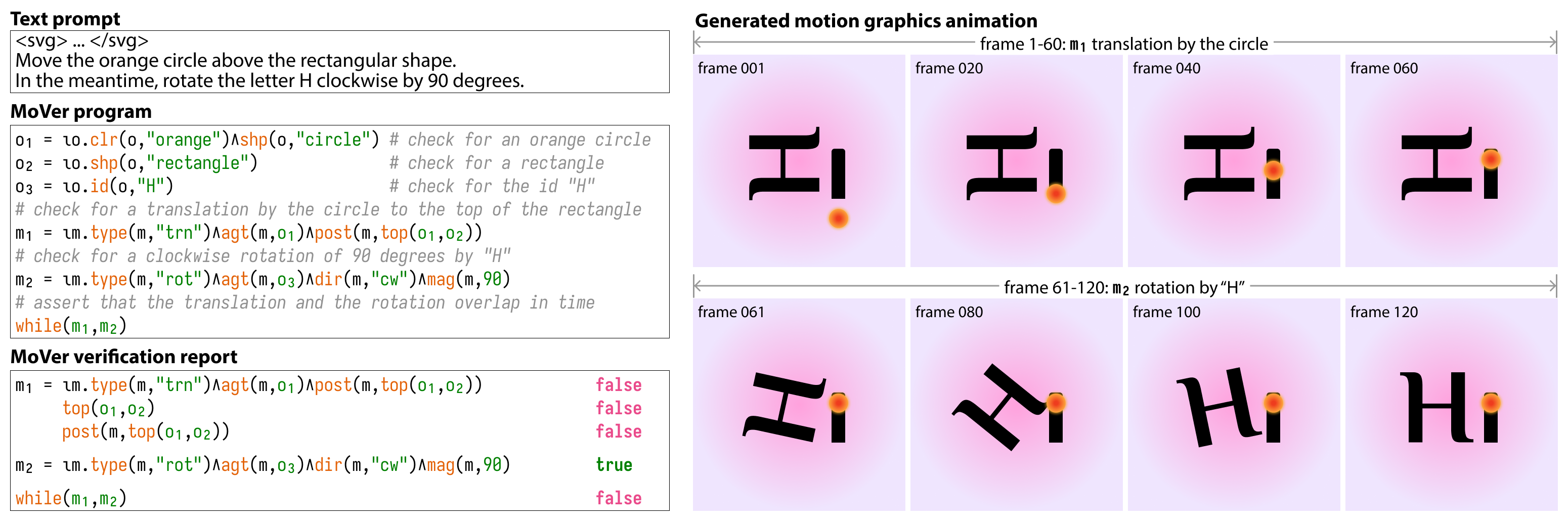



This repository contains the official implementation of MoVer, a domain-specific language based on first-order logic that can verify if various spatio-temporal properties of motion graphics are satisfied by an animation. We provide tools to use MoVer as part of an LLM-based motion graphics animation generation pipeline with verification.
MoVer also includes a converter that extracts animation data as JSON and renders GSAP-based HTML/SVG animations to PNG, SVG, MP4, and GIF.
Check out the project page for animation and benchmark results.
Dataset
The MoVer dataset of 5,600 prompts used in the paper can be found in mover_dataset/. Each prompt contains the ground truth MoVer program and information about the prompt's syntactic construction and whether an LLM is used as part of its generation.
We provide scripts to generate your own dataset of prompts with MoVer. See mover_dataset/create_dataset.py for details.
Installation
MoVer 0.2 supports Python 3.10–3.12.
Full pipeline installation
Install the complete MoVer animation-generation and verification pipeline, including the DSL, synthesis, NLG, default OpenAI/Groq model clients, and converter:
pip install "mover[full]"
python -m playwright install chromium
Or add it to a uv-managed project:
uv add "mover[full]"
uv run playwright install chromium
If you need a platform-specific PyTorch build, install the appropriate build
from pytorch.org before installing
mover[full].
Converter-only installation
If you only need the converter:
pip install mover
python -m playwright install chromium
When adding MoVer to a uv-managed project:
uv add mover
uv run playwright install chromium
Chromium is installed separately because Playwright must download a browser matching its Python package.
Model-provider and media extras
- The full profile includes OpenAI-compatible clients (OpenAI, Gemini, and
remote vLLM servers) and Groq. Set
OPENAI_API_KEY,GEMINI_API_KEY, orGROQ_API_KEYfor the provider you select. - Add Ollama with
pip install "mover[full,ollama]". - Add Google Vertex authentication with
pip install "mover[full,vertex]". - Provider-only extras
mover[openai]andmover[groq]are available for direct use of the model client. MoVer connects to vLLM over its OpenAI-compatible HTTP API; it does not install a vLLM server. - GIF output requires a working system installation of FFmpeg.
- MP4 output uses FFmpeg when available. For MP4 output without FFmpeg, install
the OpenCV fallback with
pip install "mover[media]". It is already included bymover[full].
Development installation
git clone https://github.com/jama1017/MoVer.git
cd MoVer

# pip
pip install -e ".[full]"

# or uv (also installs the development dependency group)
uv sync --extra full

python -m playwright install chromium
Full pipeline quick start
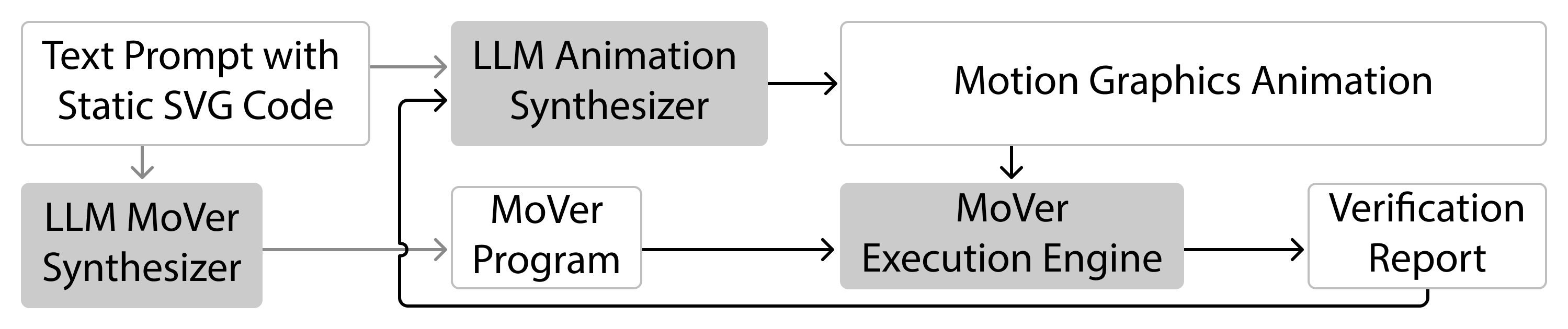
Starter Example
Once you have installed mover[full], clone this repository to get access to the examples/ directory, where we have prepared some examples for you to try out. By default, OpenAI models are used, so make sure you have stored your API key as environment variables (must be named OPENAI_API_KEY). Or you can change the config file to use other models (see examples/configs/ for examples).
First, to get things started, from the root directory of this repository, run the following command to generate some simple animations with the LLM-based MoVer pipeline (using examples/configs/config_starter.yaml):
python -m mover.pipeline examples/configs/config_starter.yaml
The MoVer pipeline takes in a YAML config file as input. Here, the prompts used are stored in examples/prompts/prompts_starter.json.
If you look at the JSON file, you can see that, for each prompt, we have populated the ground_truth_program field with the MoVer program for verification.
Running this command should create a directory called example_output/prompts_starter/, where you can find the iterations of generated animations with videos.
Teaser Hi Example

Next, let's recreate the teaser Hi example in the paper by running the following command (pre-generated results are available in examples/).
python -m mover.pipeline examples/configs/config_teaser.yaml
This time, we did not fill in the ground_truth_program field in the prompts, so the pipeline will generate a MoVer program for verification and store it in the example_output/prompts_teaser/ directory as a Python script.
To create your own animations with MoVer, modify the starter config file and write your own prompts in the following format:
[
    {
        "svg_name": "<name of the SVG file (then specify the directory in the config file)>",
        "svg_file_path": "<alternatively, you can specify the exact path to the SVG file>",
        "chat_id_name": "<unique identifier for the prompt>",
        "animation_prompt": "<describe the animation in detail. avoid fuzzy descriptions like 'make the square dance'>",
        "ground_truth_program": "(optional) <ground truth MoVer program>",
        "has_run": false
    }
]
Setting has_run to true will make the pipeline ignore this prompt.
Usage Guide
Tutorial
Check out the tutorial.ipynb for a walkthrough of each part of the MoVer pipeline (animation synthesis, MoVer program synthesis, and MoVer verification).
SVG Animation
To understand how MoVer's LLM-based animation synthesizer generates SVG animations using a simple JavaScript API based on GSAP, check out the synthesizer's system message sys_msg_animation_synthesizer.md and the API itself in api.js.
- To extend the API, make sure to update
api.jsand reflect the changes in the system message. Seetutorial.ipynbfor how to pass in your own system message. - Each SVG animation is saved as an HTML file (see
examples/). To properly render the HTML file, first get all the files insrc/mover/converter/assets/and put them in the same directory as the HTML file. Then open the HTML file in your browser to see the animation in action. - With
--create-video, the converter can render animation outputs with--format mp4,--format gif,--format png, or--format svg. PNG and SVG formats write per-frame files, and--video-fpscontrols both output frame sampling and JSON sampling.
Converter
Install the Chromium version matched to Playwright:
python -m playwright install chromium
Convert an animation using an available local port:
mover-convert animation.html 0 \
  --output-dir output \
  --save-keyframes \
  --save-for-comparison \
  --save-animated-properties
Port 0 asks the operating system to select an available local port. The
original python -m mover.converter.mover_converter invocation remains
supported.
Add --create-video --format mp4, gif, png, or svg to create media or
per-frame output. The default is 60 FPS; --video-fps controls JSON sampling
and rendered output sampling together.
The converter writes:
<stem>_data.json- Optional
<stem>_data_keyframes.json,<stem>_data_rendered.json, and<stem>_properties.json <stem>_animation.mp4or<stem>_animation.gif<stem>_animation_<fps>_png/or<stem>_animation_<fps>_svg/
The Python capture API also supports in-memory PNG frames as normalized NumPy arrays and in-memory SVG frames as text streams. Repeated capture restores the page’s capture state between runs.
MoVer preserves its existing selected-timeline behavior: vis.js assigns a
global tl to tl_to_use when tl exists, otherwise it uses
gsap.globalTimeline. Explicit caller-selected timelines and browser pooling
are not part of 0.2.0.
GIF output requires a working FFmpeg installation. MP4 uses FFmpeg when
available and otherwise uses the validated OpenCV fallback from mover[media]
or mover[full]. When the converter serves an HTML file, relative converter
assets come from the installed MoVer package.
MoVer DSL
The MoVer DSL is designed with predicates corresponding to spatial-temporal concepts that people commonly use in natural language to describe motions. For example, for the following animation prompt:
Translate the black square upwards by 100 px
We can write the corresponding MoVer program as:
o_1 = iota(Object, lambda o: color(o, "black") and shape(o, "square"))
m_1 = iota(Motion, lambda m: type(m, "translate") and direction(m, [0.0, 1.0]) and magnitude(m, 100.0) and agent(m, o_1))
Table 1 in the paper gives an overview of the predicates in the MoVer DSL. For more detailed documentations and examples of how they can be composed into MoVer programs, check out MoVer synthesizer's system message sys_msg_mover_synthesizer.md, figures in the paper, and the results page.
- To extend the DSL, update scripts in
src/mover/dsl/and reflect the changes in the system message.
Resolving references to similar objects and motions
For the animation prompt below, notice that we have two black squares in the scene, as well as two rightward translation motions (see the SVG here and the generated animation here).
"Translate the first black square to the right, then down, and then to the right. Translate the second black square up."
To refer to the second instances of repeated objects and motions, we can use the not predicate to exclude the first instance. This pattern generalizes to more instances of repetitions as well. For example, for the above animation prompt, we can write the corresponding MoVer program as:
o_1 = iota(Object, lambda o: color(o, "black") and shape(o, "square"))
## notice the use of not o_1 to refer to the second black square
o_2 = iota(Object, lambda o: color(o, "black") and shape(o, "square") and not o_1)

m_1 = iota(Motion, lambda m: type(m, "translate") and direction(m, [1.0, 0.0]) and agent(m, o_1))
m_2 = iota(Motion, lambda m: type(m, "translate") and direction(m, [0.0, -1.0]) and agent(m, o_1))
## notice the use of not m_1 to refer to the second rightward translation motion
m_3 = iota(Motion, lambda m: type(m, "translate") and direction(m, [1.0, 0.0]) and agent(m, o_1) and not m_1)
m_4 = iota(Motion, lambda m: type(m, "translate") and direction(m, [0.0, 1.0]) and agent(m, o_2))

t_before(m_1, m_2)
t_after(m_3, m_2)
License
This project is licensed under the Apache License 2.0 - see the LICENSE file for details.
Contact
Jiaju Ma
@jama1017
majiaju.io
hellojiajuma@gmail.com
Citation
If you find MoVer useful in your project, please cite our paper:
@article{ma2025mover,
    author = {Ma, Jiaju and Agrawala, Maneesh},
    title = {MoVer: Motion Verification for Motion Graphics Animations},
    year = {2025},
    issue_date = {August 2025},
    publisher = {Association for Computing Machinery},
    address = {New York, NY, USA},
    volume = {44},
    number = {4},
    issn = {0730-0301},
    url = {https://doi.org/10.1145/3731209},
    doi = {10.1145/3731209},
    journal = {ACM Trans. Graph.},
    month = jul,
    articleno = {33},
    numpages = {17},
}
Acknowledgments
We thank Yusong Wu for his help on getting this repository ready for release. This project builds on the wonderful foundation of the Concepts framework by Jiayuan Mao. The MoVer DSL parser and executor is based on LEFT by Joy Hsu and Jiayuan Mao. Our SVG animation API uses the one and only GSAP. The MoVer converter uses the ntc js (Name that Color JavaScript) library for converting hex colors to names.
Project details
Verified details
These details have been verified by PyPIProject links
GitHub Statistics
Maintainers
Release history Release notifications | RSS feed


Download files
Download the file for your platform. If you're not sure which to choose, learn more about installing packages.
Source Distribution
Built Distribution
Filter files by name, interpreter, ABI, and platform.
If you're not sure about the file name format, learn more about wheel file names.
Copy a direct link to the current filters
File details
Details for the file mover-0.2.0.tar.gz.
File metadata
- Download URL: mover-0.2.0.tar.gz
- Upload date:
- Size: 256.3 kB
- Tags: Source
- Uploaded using Trusted Publishing? Yes
- Uploaded via: twine/6.1.0 CPython/3.13.12
File hashes
| Algorithm | Hash digest | |
|---|---|---|
| SHA256 |
9ff35ceb71542e9c8b531663054f6c2ecfd856f135553b2f9aeca911c1317f8f
|
|
| MD5 |
4283f5541137e0fa1769821c53563fb0
|
|
| BLAKE2b-256 |
454345bbed33d00f3ff630c7c5f1802a7aa0b0eae5d040f9433514548c549483
|
Provenance
The following attestation bundles were made for mover-0.2.0.tar.gz:
Publisher:
release.yml on jama1017/MoVer
-
Statement:
-
Statement type:
https://in-toto.io/Statement/v1 -
Predicate type:
https://docs.pypi.org/attestations/publish/v1 -
Subject name:
mover-0.2.0.tar.gz -
Subject digest:
9ff35ceb71542e9c8b531663054f6c2ecfd856f135553b2f9aeca911c1317f8f - Sigstore transparency entry: 2159535513
- Sigstore integration time:
-
Permalink:
jama1017/MoVer@fda862dbf20e03c62fc3772cbcd044eb94967465 -
Branch / Tag:
refs/tags/v0.2.0 - Owner: https://github.com/jama1017
-
Access:
public
-
Token Issuer:
https://token.actions.githubusercontent.com -
Runner Environment:
github-hosted -
Publication workflow:
release.yml@fda862dbf20e03c62fc3772cbcd044eb94967465 -
Trigger Event:
release
-
Statement type:
File details
Details for the file mover-0.2.0-py3-none-any.whl.
File metadata
- Download URL: mover-0.2.0-py3-none-any.whl
- Upload date:
- Size: 273.1 kB
- Tags: Python 3
- Uploaded using Trusted Publishing? Yes
- Uploaded via: twine/6.1.0 CPython/3.13.12
File hashes
| Algorithm | Hash digest | |
|---|---|---|
| SHA256 |
fae2e2b95f873457260e2c0785ed2de866e115e7abeb77a1df807e648558d22d
|
|
| MD5 |
29c52c58a6f20646974dfe49f0200b6f
|
|
| BLAKE2b-256 |
6e84e66754cdf74c90b68eccb7a6d65d1d4bca32101d9d0470084b8f790029e4
|
Provenance
The following attestation bundles were made for mover-0.2.0-py3-none-any.whl:
Publisher:
release.yml on jama1017/MoVer
-
Statement:
-
Statement type:
https://in-toto.io/Statement/v1 -
Predicate type:
https://docs.pypi.org/attestations/publish/v1 -
Subject name:
mover-0.2.0-py3-none-any.whl -
Subject digest:
fae2e2b95f873457260e2c0785ed2de866e115e7abeb77a1df807e648558d22d - Sigstore transparency entry: 2159535631
- Sigstore integration time:
-
Permalink:
jama1017/MoVer@fda862dbf20e03c62fc3772cbcd044eb94967465 -
Branch / Tag:
refs/tags/v0.2.0 - Owner: https://github.com/jama1017
-
Access:
public
-
Token Issuer:
https://token.actions.githubusercontent.com -
Runner Environment:
github-hosted -
Publication workflow:
release.yml@fda862dbf20e03c62fc3772cbcd044eb94967465 -
Trigger Event:
release
-
Statement type:







