
MPDistil 🎓
Meta-Policy Knowledge Distillation for Training Compact Student Models


MPDistil is a teacher-student collaborative knowledge distillation framework that enables compact student models to outperform larger teacher models through meta-learning and curriculum learning.
Based on the ICLR 2024 paper: A Good Learner can Teach Better: Teacher-Student Collaborative Knowledge Distillation
🌟 Key Features
- 📊 Superior Performance: 6-layer BERT student outperforms 12-layer BERT teacher on 5/6 SuperGLUE tasks
- 🎯 4-Phase Training: Teacher fine-tuning → PKD → Meta-teacher → Curriculum learning
- 🚀 Simple API: Easy-to-use
.train()method with full control over all phases - 📏 Flexible Metrics: Built-in support for accuracy, F1, MCC, correlation via HuggingFace
evaluate - 🔧 Customizable: Works with any HuggingFace model and custom datasets
- 💻 Colab-Ready: GPU-optimized for Google Colab environments
- 📦 Easy Installation: Single pip command to get started
📈 Methodology
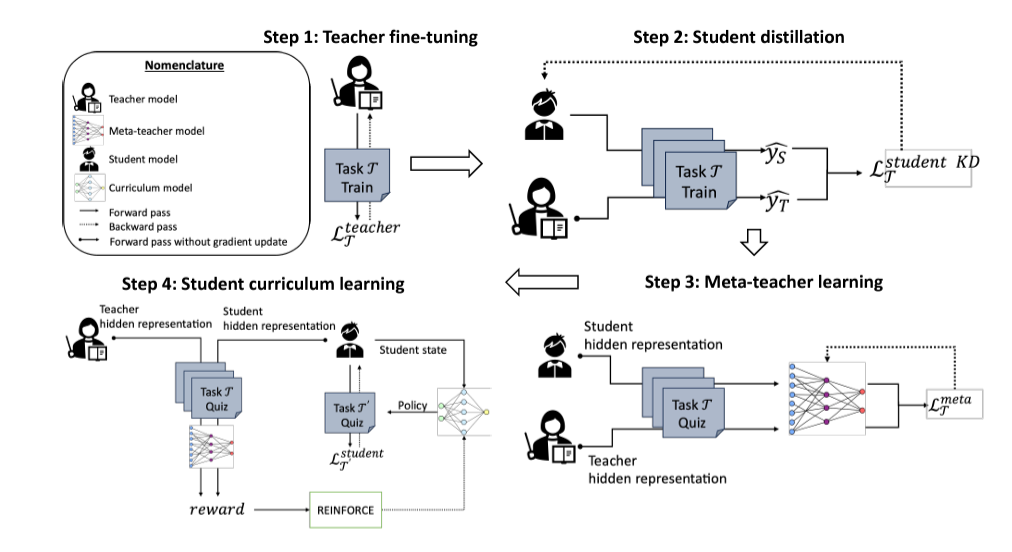
MPDistil consists of 4 training phases:
- Teacher Fine-tuning: Fine-tune teacher model on the target task
- Student PKD: Knowledge distillation with Patient Knowledge Distillation
- Meta-Teacher Learning: Collaborative or competitive loss for meta-learning
- Curriculum Learning: Reinforcement learning-based task selection
🚀 Installation
From GitHub (Recommended)
pip install git+https://github.com/parmanu-lcs2/mpdistil.git
From Source
git clone https://github.com/parmanu-lcs2/mpdistil.git
cd mpdistil
pip install -e .
💡 Quick Start
Basic Usage
from mpdistil import MPDistil, load_superglue_dataset

# Load data
loaders, num_labels = load_superglue_dataset('CB')

# Initialize MPDistil
model = MPDistil(
    task_name='CB',
    num_labels=num_labels,
    metric='f1',  # Options: 'accuracy', 'f1', 'mcc', 'correlation', 'auto'
    teacher_model='bert-base-uncased',
    student_model='bert-base-uncased',
    student_layers=6
)

# Train with all 4 phases
history = model.train(
    train_loader=loaders['train'],
    val_loader=loaders['val'],
    teacher_epochs=10,   # Phase 1
    student_epochs=10,   # Phase 2
    meta_epochs=1        # Phase 3 (NEW!)
)

# Save trained student
model.save_student('./my_student_model')

# Make predictions
predictions = model.predict(loaders['test'])
With Custom Data
from mpdistil import MPDistil, create_simple_dataloader

# Prepare your data
texts = [("This is text A", "This is text B"), ...]
labels = [0, 1, 0, ...]

# Create DataLoader
train_loader = create_simple_dataloader(
    texts=texts,
    labels=labels,
    tokenizer_name='bert-base-uncased',
    max_length=128,
    batch_size=8
)

# Train model
model = MPDistil(task_name='MyTask', num_labels=2, metric='accuracy')
history = model.train(train_loader, val_loader)
With Meta-Learning (Curriculum)
# Load multiple tasks for curriculum learning
cb_loaders, _ = load_superglue_dataset('CB')
rte_loaders, _ = load_superglue_dataset('RTE')
boolq_loaders, _ = load_superglue_dataset('BoolQ')

# Train with curriculum learning
history = model.train(
    train_loader=cb_loaders['train'],
    val_loader=cb_loaders['val'],
    meta_loaders={
        'RTE': rte_loaders['val'],
        'BoolQ': boolq_loaders['val']
    },
    teacher_epochs=10,   # Phase 1
    student_epochs=10,   # Phase 2
    meta_epochs=3,       # Phase 3 - can train for multiple epochs!
    num_episodes=200     # Phase 4 - curriculum learning episodes
)
📖 API Reference
MPDistil Class
Constructor
MPDistil(
    task_name: str,              # Name of the main task
    num_labels: int,             # Number of output classes
    metric: str = 'accuracy',    # Metric: 'accuracy', 'f1', 'mcc', 'correlation', 'auto'
    teacher_model: str = 'bert-base-uncased',  # HuggingFace model name
    student_model: str = 'bert-base-uncased',  # HuggingFace model name
    student_layers: int = 6,     # Number of layers for student
    device: str = 'auto',        # 'auto', 'cuda', or 'cpu'
    output_dir: str = './mpdistil_outputs'
)
Methods
| Method | Description |
|---|---|
train(train_loader, val_loader, **kwargs) |
Train the model (all 4 phases) |
predict(test_loader) |
Generate predictions |
save_student(path) |
Save student model in HuggingFace format |
load_student(path) |
Load a saved student model |
save_predictions(predictions, path, label_mapping) |
Save predictions to TSV |
TrainingConfig
Configure training hyperparameters:
from mpdistil import TrainingConfig

config = TrainingConfig(
    # Phase 1: Teacher
    teacher_epochs=10,
    teacher_lr=2e-5,

    # Phase 2: Student PKD
    student_epochs=10,
    student_lr=3e-5,
    alpha=0.5,          # Soft loss weight
    beta=100.0,         # PKD loss weight
    temperature=5.0,    # Distillation temperature

    # Phase 3: Meta-Teacher
    meta_epochs=3,      # NEW! Meta-teacher can train for multiple epochs
    meta_lr=1e-3,
    use_competitive_loss=False,  # Use collaborative loss

    # Phase 4: Curriculum
    num_episodes=200,
    reward_type='binary',  # or 'real'

    # General
    batch_size=8,
    seed=42,
    report_to=None      # Options: 'wandb', 'tensorboard', None
)

history = model.train(train_loader, val_loader, config=config)
Training Parameters
| Parameter | Type | Default | Description |
|---|---|---|---|
teacher_epochs |
int | 10 | Phase 1: Teacher training epochs |
student_epochs |
int | 10 | Phase 2: Student training epochs |
meta_epochs |
int | 1 | Phase 3: Meta-teacher training epochs (NEW!) |
num_episodes |
int | 200 | Phase 4: Curriculum learning episodes |
teacher_lr |
float | 2e-5 | Teacher learning rate |
student_lr |
float | 3e-5 | Student learning rate |
meta_lr |
float | 1e-3 | Meta-learning rate |
alpha |
float | 0.5 | Soft vs hard loss weight |
beta |
float | 100.0 | PKD loss weight |
temperature |
float | 5.0 | Distillation temperature |
use_competitive_loss |
bool | False | Competitive vs collaborative |
reward_type |
str | 'binary' | 'binary' or 'real' |
batch_size |
int | 8 | Batch size |
seed |
int | 42 | Random seed |
📊 Results
Performance on SuperGLUE tasks (BERT-base teacher → BERT-6L student):
| Model | BoolQ | CB | COPA | RTE | WiC | WSC |
|---|---|---|---|---|---|---|
| Teacher | 75.3 | 83.9 | 63.0 | 67.1 | 57.1 | 64.4 |
| Student (Undistilled) | 71.6 | 75.0 | 53.0 | 64.6 | 56.0 | 63.5 |
| MPDistil (Ours) | 73.4 | 83.9 | 70.0 | 67.5 | 59.6 | 65.4 |
✨ Student outperforms teacher on 5/6 tasks!
📝 Examples
See the examples/ directory for Jupyter notebooks:
- GLUE.ipynb: Usage with SuperGLUE
📊 Evaluation Metrics
MPDistil supports multiple evaluation metrics via HuggingFace evaluate library:
Available Metrics
| Metric | Use Case | Returns |
|---|---|---|
'accuracy' |
Standard classification (default) | {'acc': float} |
'f1' |
Imbalanced datasets, multi-class | {'acc': float, 'f1': float, 'acc_and_f1': float} |
'mcc' |
Binary classification, imbalanced | {'mcc': float} |
'correlation' |
Regression tasks (STS-B) | {'pearson': float, 'spearmanr': float} |
'auto' |
Auto-detect based on task | Task-specific metric |
Example: Using Different Metrics
# Accuracy (default)
model = MPDistil(task_name='BoolQ', num_labels=2, metric='accuracy')

# F1 score (recommended for CB, MultiRC)
model = MPDistil(task_name='CB', num_labels=3, metric='f1')

# Matthews Correlation (for binary with imbalance)
model = MPDistil(task_name='CoLA', num_labels=2, metric='mcc')

# Correlation (for regression)
model = MPDistil(task_name='STS-B', num_labels=1, metric='correlation', is_regression=True)

# Auto-detect
model = MPDistil(task_name='CB', num_labels=3, metric='auto')  # Uses F1 for CB
🔬 How It Works
Phase 1: Teacher Fine-tuning
Fine-tune a large teacher model (e.g., BERT-base) on your target task.
Phase 2: Student PKD
Train a smaller student model using:
- Soft targets from teacher (KL divergence)
- Hard labels (cross-entropy)
- Patient KD (intermediate feature matching)
Loss: α * soft_loss + (1-α) * hard_loss + β * pkd_loss
Phase 3: Meta-Teacher
Create a meta-teacher that learns from both teacher and student representations:
Collaborative loss (default):
L = 0.5 * CE(T'(h_teacher), y) + 0.5 * CE(T'(h_student), y)
Competitive loss:
L = -mean(P_teacher) + mean(P_student) + CE_loss
Phase 4: Curriculum Learning
Use reinforcement learning to select which auxiliary tasks help the student learn:
- Action model selects next task
- Reward based on student improvement over teacher
- REINFORCE algorithm updates policy
🛠️ Advanced Usage
Custom Model Architectures
model = MPDistil(
    task_name='MyTask',
    num_labels=3,
    teacher_model='roberta-large',
    student_model='distilbert-base-uncased',
    student_layers=6
)
Weights & Biases Logging
history = model.train(
    train_loader=train_loader,
    val_loader=val_loader,
    report_to='wandb',      # Options: 'wandb', 'tensorboard', None
    wandb_project='my-project',
    wandb_run_name='experiment-1'
)
Access Trained Models
# Access student model
student = model.student

# Access teacher model
teacher = model.teacher

# Use with HuggingFace
from transformers import AutoTokenizer, AutoModel

tokenizer = AutoTokenizer.from_pretrained('./my_student_model')
model = AutoModel.from_pretrained('./my_student_model')
📚 Citation
If you use MPDistil in your research, please cite:
@inproceedings{sengupta2024mpdistil,
  title={A Good Learner can Teach Better: Teacher-Student Collaborative Knowledge Distillation},
  author={Sengupta, Ayan and Dixit, Shantanu and Akhtar, Md Shad and Chakraborty, Tanmoy},
  booktitle={The Twelfth International Conference on Learning Representations},
  year={2024},
  url={https://openreview.net/forum?id=Ixi4j6LtdX}
}
📄 License
This project is licensed under the MIT License - see the LICENSE file for details.
🤝 Contributing
Contributions are welcome! Please feel free to submit a Pull Request.
🙏 Acknowledgments
- Original paper: ICLR 2024
- Built with PyTorch and HuggingFace Transformers
📧 Contact
For questions or issues, please open an issue on GitHub or contact the authors.
Made with ❤️ for the research community
1 maintainer

Release files for mpdistil 0.1.0
For a detailed explanation of source distributions (sdists) and built distributions (wheels), please see the package formats documentation.
Source distribution (sdist)
| File | Size | Uploaded | |
|---|---|---|---|
| mpdistil-0.1.0.tar.gz | 66.0 kB | Details |
Built distribution (wheel)
| File | Interpreter | ABI | Platform | Reset |
|---|---|---|---|---|
| mpdistil-0.1.0-py3-none-any.whl | Python 3 | none | any | Details |
Total release size: 100.2 kB
Release files / mpdistil-0.1.0.tar.gz
| Download URL | mpdistil-0.1.0.tar.gz |
|---|---|
| Size | 66.0 kB |
| Tags | Source |
|
SHA-256 checksum How to use checksums |
c7e2cfe12c917046e5c72a95e18e1c1ce3cc36c8ae8346e9e41922ad466020b6
|
|
BLAKE2b-256 checksum How to use checksums |
af92b181517327afb442e8de4baddfb5d26fa9cbbdcb461a882c5478b600dece
|
| Upload date | |
|
Uploaded using Trusted Publishing? What is trusted publishing? |
No |
| Uploaded via |
twine/6.2.0 CPython/3.12.9
|
Release files / mpdistil-0.1.0-py3-none-any.whl
| Download URL | mpdistil-0.1.0-py3-none-any.whl |
|---|---|
| Size | 34.1 kB |
| Tags | Python 3 |
|
SHA-256 checksum How to use checksums |
2fee1b95582f5f55bd04fcc5d74b86d28a0ea68f265042438df21c6a4670c903
|
|
BLAKE2b-256 checksum How to use checksums |
378370d3e9eea49a48144f8e434d7913383f38cee8c3c595eabefbc935356060
|
| Upload date | |
|
Uploaded using Trusted Publishing? What is trusted publishing? |
No |
| Uploaded via |
twine/6.2.0 CPython/3.12.9
|













