
napari-foambryo
A napari plugin over delaunay-watershed-3d and foambryo: reconstruct the multimaterial mesh of a 3-D segmentation, infer its relative surface tensions and cell pressures, show them on the tissue, and export the same files as the foambryo command.
Version 0.1.0, the first release (17 October 2026). Licence: GPL-3.0-or-later. What changed: the CHANGELOG.
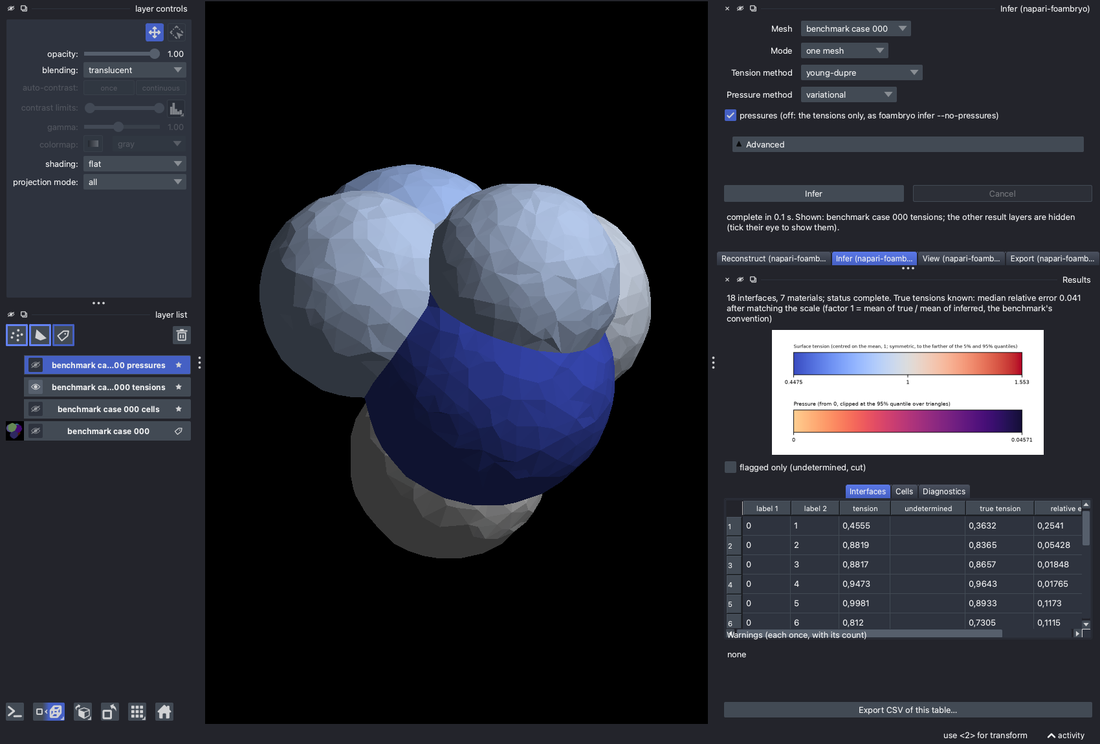
Benchmark case 000 (6 cells): the tensions of its outer interfaces on the reconstructed mesh (blue below the mean tension, grey at it, red above), the colour bars and the table, in which the true tensions of this simulated aggregate are shown beside the inferred ones. foambryo's Polyscope viewer shows the same colours for the same mesh.
What it does
- Reconstruct: a Labels layer, whoever made it (a file, napari's tools, another segmentation plugin), becomes a multimaterial mesh by delaunay-watershed-3d's default reconstruction, the one
foambryo meshruns. The voxel size comes from the layer, from another layer (the image that was segmented) or is typed: it is never guessed. Before the run the dock shows the estimated time and memory, and a report of the mask (cells, cells touching the image box, cells in several pieces, very small labels). The reconstruction runs in a separate process: Cancel stops it at once and frees its memory. - Infer: the tensions, then the pressures, by foambryo's
infer_forceswith the options and defaults offoambryo infer; or a seed ensemble (infer_tensions_over_seeds), whose spread over the seeds is a lower bound on the error. - Results: the tensions and pressures on the mesh, coloured as foambryo's own viewer colours them, the colour bars, and the tables. Select a row to see its interface or cell.
- Export:
mesh.rec,tensions.csv,pressures.csv,colour_bars.pngandrun.json, the files of thefoambryocommand, with the command lines that reproduce them.
One code path. The plugin computes nothing of its own: every number is one that a public function of foambryo returns for the same mask and options, the functions the foambryo command calls. The tests check this bit for bit, and check that the exported files are byte for byte those of the command.
Installation
In a virtual environment:
pip install "napari[all]" napari-foambryo
It needs delaunay-watershed-3d 0.7 and foambryo 0.7 (installed with it), and Python 3.11 or later.
Quickstart
- File › Open Sample › foambryo › Benchmark case 000.
- Plugins › foambryo › Reconstruct: the layer and its voxel size are chosen; click Reconstruct.
- Plugins › foambryo › Infer: click Infer. The tensions appear on the mesh.
- Plugins › foambryo › Results: the colour bars and the tables; case 000's true tensions are in the table.
- Plugins › foambryo › Export: choose a folder, click Export. If the folder already holds foambryo's files, a dialog lists them and asks before replacing them; other files are never touched.
- Plugins › foambryo › View: Explode moves the cells apart (each interface drawn on both cells' sides), Cut clips everything with a plane normal to z, y or x, to see the interfaces inside the tissue (3-D view), and Background paints the canvas black, dark grey, light grey, white or a custom colour (a colour that one background hides, another shows).
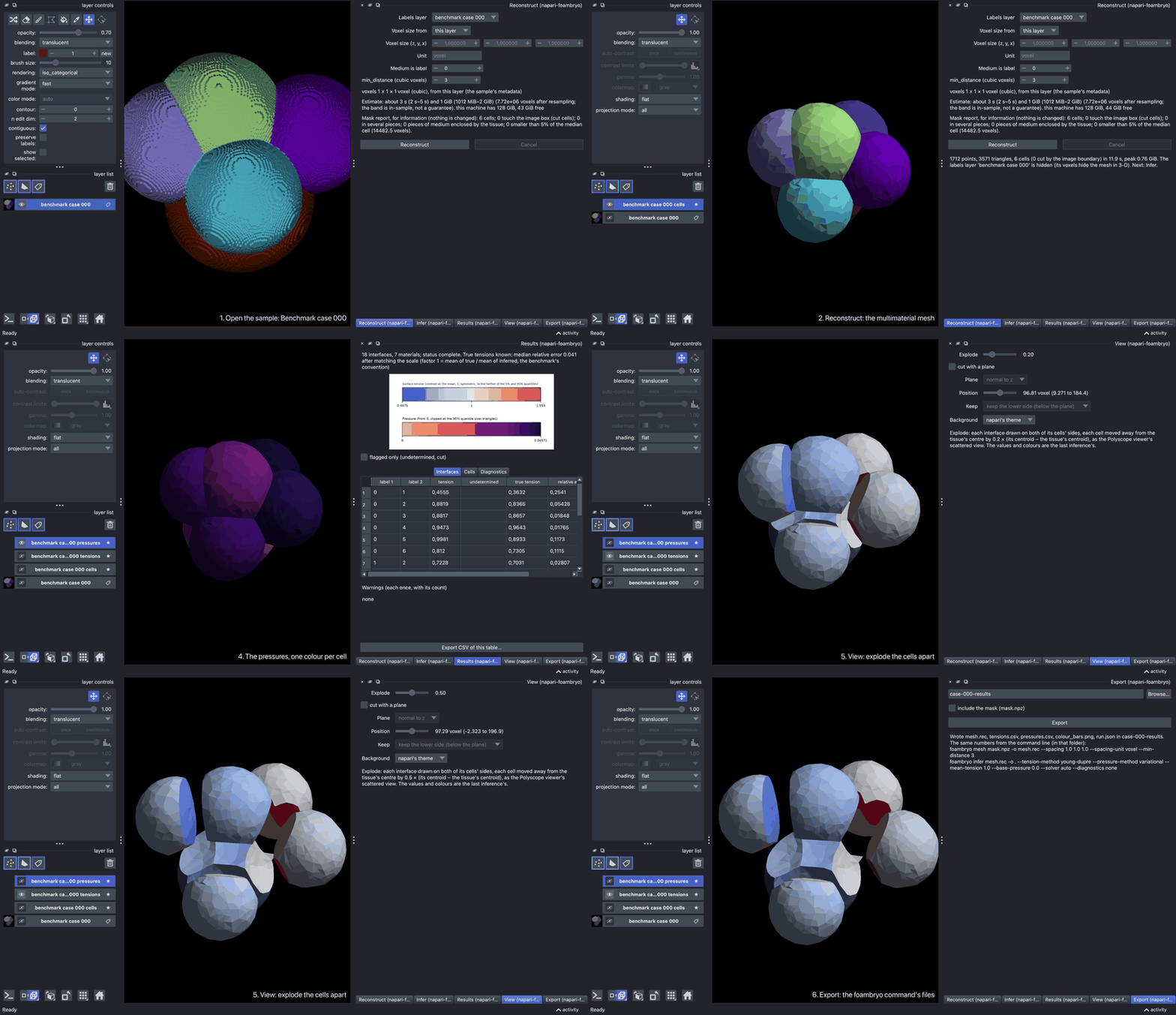
The quickstart on benchmark case 000, the whole napari window: the sample, Reconstruct, Infer (the tensions, then the colour bars and the table in Results), the pressures, View's explode slider, and Export.
The same, scripted: python examples/quickstart.py (add --close-when-done to close napari once the numbers are printed).
What the numbers mean
- Tensions are relative: they are gauged to a mean of 1 (Advanced › mean tension). Interfaces with no triple line are undetermined and reported as
nan: not filled, drawn as green outlines by their own layer. The tension colours run from blue (low) through light grey (the mean tension) to red (high). - Pressures are relative to the medium (label 0, base pressure 0), in units of tension per length of the voxel size's unit. Untick pressures in Infer for the tensions only (
foambryo infer --no-pressures). - Diagnostics (Infer › Advanced › Diagnostics:
basic, orspectrumfor the singular values too): the Results dock's Diagnostics tab lists every linear solve (rank, residual, condition number, …); Export writes them assolves.csvandspectra.npz. - Cut cells: where cells reach the image box, the mesh closes them with crop faces (see-through glass with their edges); the pressures of the cells they cut are
nan. Only pressure methods with a formulation for crop faces are offered. - Seed ensembles: the seed standard deviation is a lower bound on the error, not an error bar.
Large tissues
The estimate before a run is fitted to measured reconstructions (from a few seconds for a 6-cell aggregate to about 13 minutes and 39 GiB for a 1 866-cell tissue at cubic voxels); its range is that of the fit, not a guarantee. When the estimate exceeds the machine's memory, Reconstruct needs run anyway to be ticked: run foambryo mesh on a larger machine instead (same numbers) and open the .rec file here.
From a segmentation plugin to foambryo
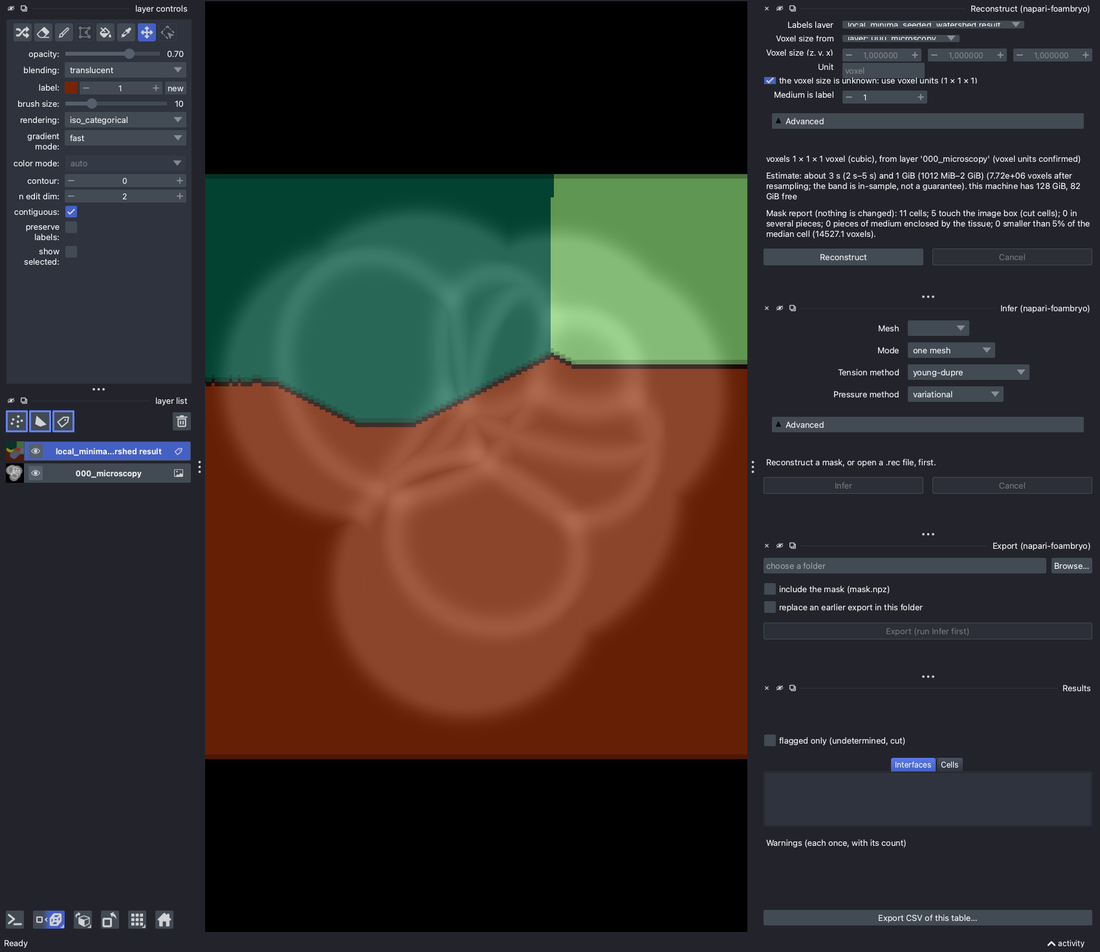
Segmentation plugins (Cellpose, PlantSeg, micro-sam, napari-segment-blobs-and-things-with-membranes, …) leave a Labels layer that often has no voxel size, and may label the background with something else than 0. In the Reconstruct dock:
- Voxel size from › layer: … the image that was segmented (or typed);
- Medium is label … the background's label: a copy of the layer with that label and 0 swapped is made and reconstructed (and exported, since the equivalent command needs it);
- read the mask report: a background split into several pieces shows up as extra cells touching the image box. Merge them into the background with napari's fill tool, then Reconstruct.
The results are marked out of date if the labels change after the reconstruction, and Export waits for a new one. Example: python examples/from_a_segmentation_plugin.py (with --close-when-done, it clicks Reconstruct and Infer itself and closes napari).
Reproducing a result without napari
run.json lists the command lines that rebuild the exported folder, for example
foambryo mesh mask.npz -o mesh.rec --spacing 1.0 1.0 1.0 --spacing-unit voxel --min-distance 3
foambryo infer mesh.rec -o . --tension-method young-dupre --pressure-method variational
(Tick include the mask in Export to get mask.npz.)
Credits, contact, citations
If you use this tool, please cite the associated article: Ichbiah S., Delbary F., McDougall A., Dumollard R., Turlier H. Embryo mechanics cartography: inference of 3D force atlases from fluorescence microscopy. Nature Methods 20(12), 1989–1999 (2023), doi:10.1038/s41592-023-02084-7. Benchmark case 000, shipped as sample data with its true tensions, comes from that article's benchmark.
Recent work on dw3d and foambryo is part of a collaboration with Alejandro Aguilera Castrejon (Janelia Research Campus, Howard Hughes Medical Institute). We thank him and his Janelia colleagues Adam L. Taylor, Wenhong Li and Francesco Roncato. Adam L. Taylor found the border-triangle winding defect fixed in 0.6.0 and pointed us to the seed-extraction and dense tension-solve bottlenecks on large tissues.
Licence
GNU General Public License, version 3 or (at your option) any later version (GPL-3.0-or-later); the text is in LICENSE. How the plugin works, dock by dock: docs/how-it-works.md.
2 maintainers


Metadata
2 maintainers
Release files for napari-foambryo 0.1.0
For a detailed explanation of source distributions (sdists) and built distributions (wheels), please see the package formats documentation.
Source distribution (sdist)
| File | Size | Uploaded | Provenance | Actions |
|---|---|---|---|---|
| napari_foambryo-0.1.0.tar.gz | 1.4 MB | Without provenance | Details for napari_foambryo-0.1.0.tar.gz |
Built distribution (wheel)
| File | Interpreter | ABI | Platform | Actions Reset |
|---|---|---|---|---|
| napari_foambryo-0.1.0-py3-none-any.whl | Python 3 | none | any | Details for napari_foambryo-0.1.0-py3-none-any.whl |
Total release size: 1.6 MB
Release files / napari_foambryo-0.1.0.tar.gz
| Download URL | napari_foambryo-0.1.0.tar.gz |
|---|---|
| Size | 1.4 MB |
| Tags | Source |
|
SHA-256 checksum How to use checksums |
56ee499973c8a040d98c0f1560b2d553f7332ec3db876f6c7405b9559b4eba5c
|
|
BLAKE2b-256 checksum How to use checksums |
ece84410addd4e61d534b90aa1a8bf06c3ddd8ecf94f450c0c712857ac9fc210
|
| Upload date | |
|
Uploaded using Trusted Publishing? What is trusted publishing? |
No |
| Uploaded via |
twine/7.0.0 CPython/3.12.13
|
Release files / napari_foambryo-0.1.0-py3-none-any.whl
| Download URL | napari_foambryo-0.1.0-py3-none-any.whl |
|---|---|
| Size | 143.8 kB |
| Tags | Python 3 |
|
SHA-256 checksum How to use checksums |
09f56ddc37c1fb5cf543b8db990a7cb544e94c7b329145fa08d701329d060a93
|
|
BLAKE2b-256 checksum How to use checksums |
e46187c7d654614d7fd329535f755da1c2c66b049e08e1397296a0a6ad335dfa
|
| Upload date | |
|
Uploaded using Trusted Publishing? What is trusted publishing? |
No |
| Uploaded via |
twine/7.0.0 CPython/3.12.13
|
Security for napari-foambryo 0.1.0
Provenance
Provenance describes where a file came from. On PyPI, provenance is shared via attestations, which provide a verifiable record of the build or publishing details. View details, limitations and caveats.
No provenance found
None of the files in this release were uploaded with provenance metadata.
A note on package security
PyPI is a repository for distributing packages, not a service for auditing them. While third-party security researchers and our staff do their best to detect and remove malicious packages, PyPI cannot guarantee the quality, security or suitability of any given package.
To learn more about protecting yourself from malicious actors, visit our package security documentation.














