
Process and analyze surfaces using open3d and vedo in napari

Project description
napari-process-points-and-surfaces (nppas)








Process and analyze surfaces using vedo in napari.

Usage
You find menus for surface generation, smoothing and analysis in the menu Tools > Surfaces and Tools > Points.
For detailed explanation of the underlying algorithms, please refer to the vedo documentation.
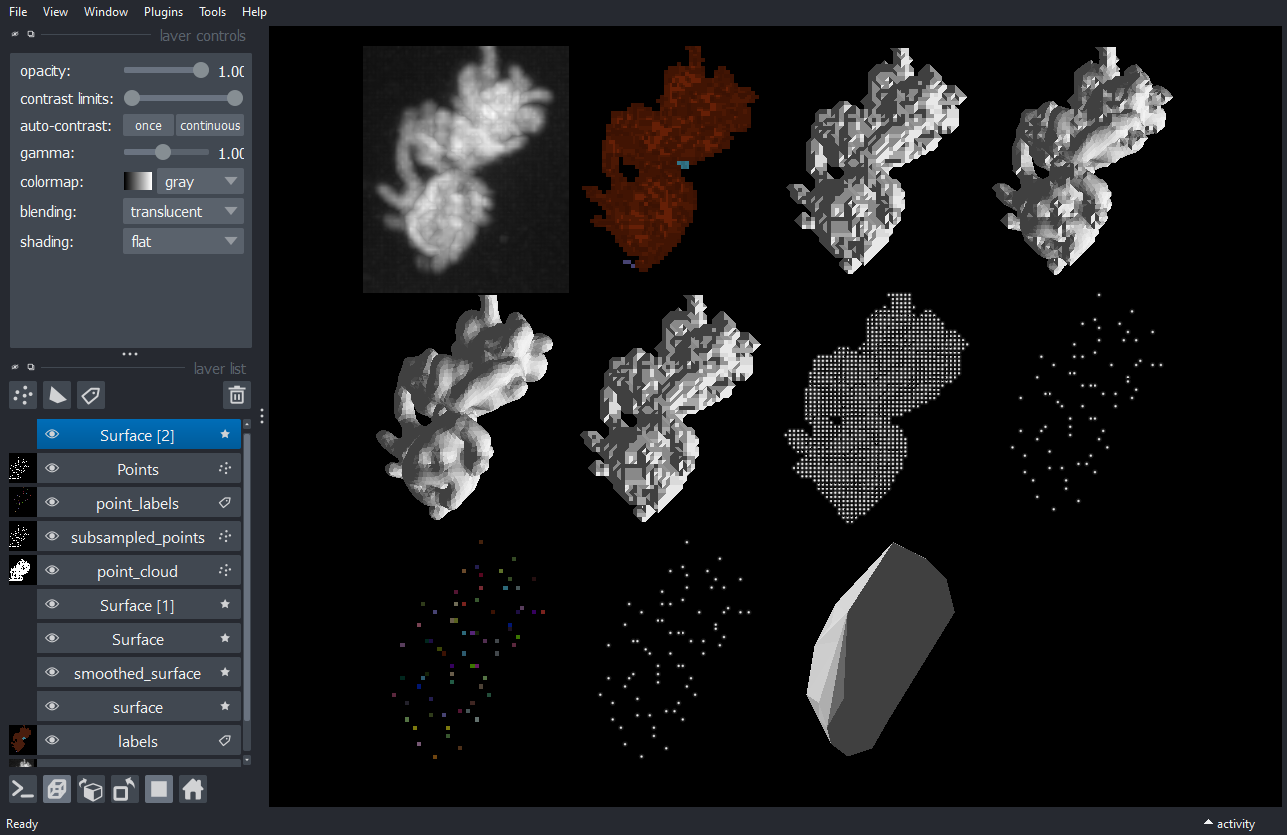
For processing meshes in Python scripts, see the demo notebook. There you also learn how this screenshot is made:
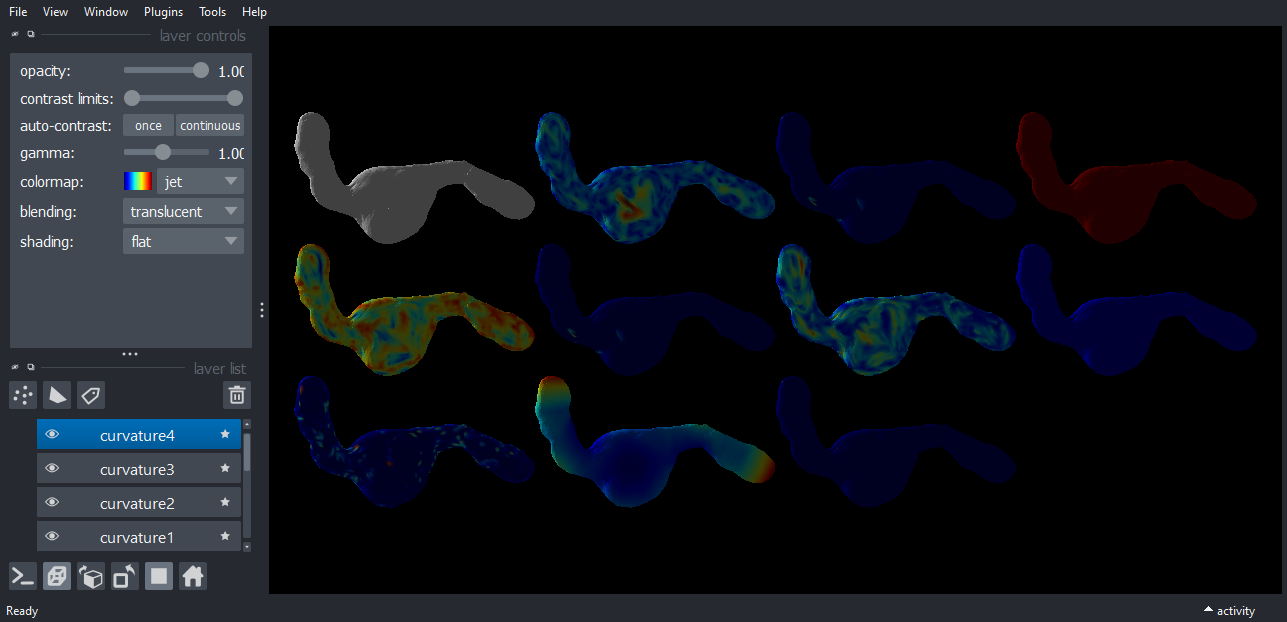
For performing quantitative measurements of surface in Python scripts, see the demo notebook. There you also learn how this screenshot is made:
Surface measurements and annotations
Using the menu Tools > Measurement tables > Surface quality table (vedo, nppas) you can derive quantiative measurements of
the vertices in a given surface layer.
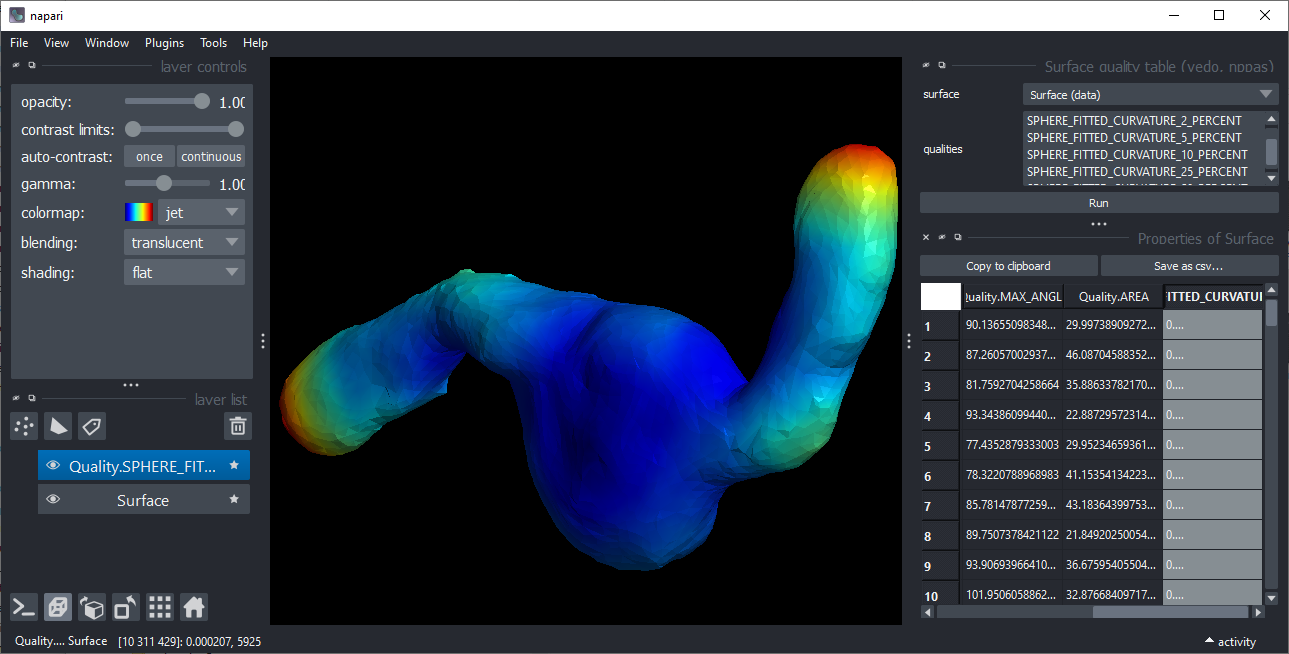
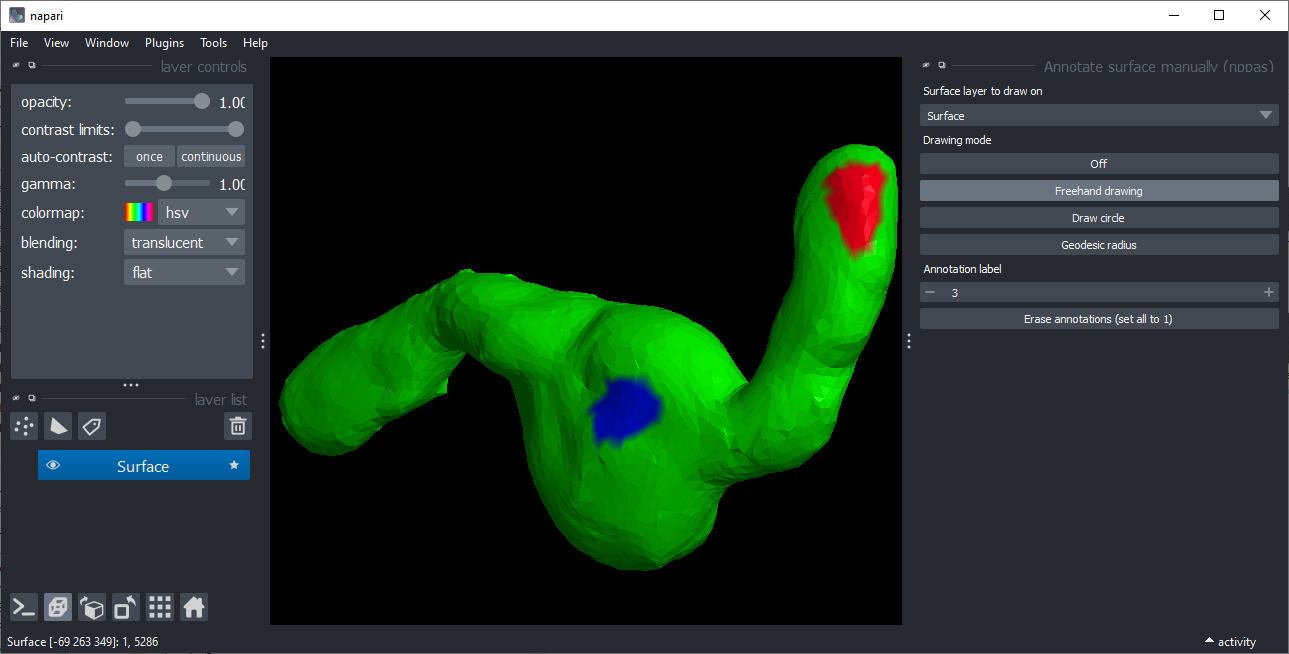
To differentiate regions when analyzing those measurements it is recommended to use the menu Tools > Surfaces > Annotate surface manually (nppas)
after measurements have been made. This tool allows you to draw annotation label values on the surface.
It is recommended to do activate a colorful colormap such as hsv before starting to draw annotations.
Furthermore, set the maximum of the contrast limit range to the number of regions you want to annotate + 1.
Annotations can be drawn as freehand lines and circles.
After measurements and annotations were done, you can save the annotation in the same measurement table using the menu
Tools > Measurement tables > Surface quality/annotation to table (nppas)
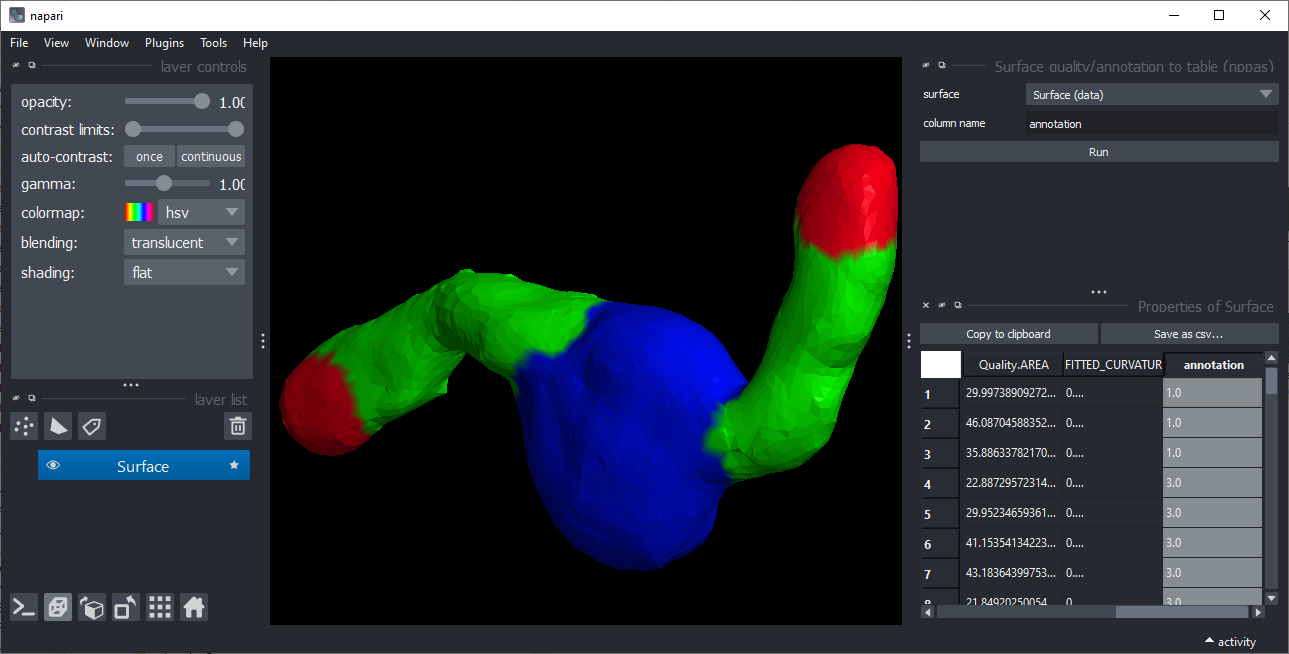
For classifying surface vertices using machine learning, please refer to the napari APOC documentation.
Measurement visualization
To visualize measurements on the surface, just double-click on the table column headers.

Installation
You can install napari-process-points-and-surfaces via mamba/conda and pip:
mamba install vedo vtk libnetcdf=4.7.4 -c conda-forge
pip install napari-process-points-and-surfaces
Troubleshooting: Open3d installation
Since version 0.4.0, nppas does no longer depend on open3d.
Some deprecated functions still use Open3d though.
Follow the installation instructions in the open3d documentation to install it and keep using those functions.
Also consider updating code and no longer using these deprecated functions.
See release notes for details.
See also
There are other napari plugins with similar / overlapping functionality
- morphometrics
- napari-accelerated-pixel-and-object-classification
- napari-pymeshlab
- napari-pyclesperanto-assistant
- napari-stress
And there is software for doing similar things:
Contributing
Contributions are very welcome. Tests can be run with tox, please ensure the coverage at least stays the same before you submit a pull request.
License
Distributed under the terms of the BSD-3 license, "napari-process-points-and-surfaces" is free and open source software
Acknowledgements
Some code snippets and example data were taken from the vedo and open3d repositories and documentation. See thirdparty licenses for licensing details. The Standford Bunny example dataset has been taken from The Stanford 3D Scanning Repository. The nppas gastruloid example is derived from AV Luque and JV Veenvliet (2023) which is licensed CC-BY and can be downloaded from here: https://zenodo.org/record/7603081
Issues
If you encounter any problems, please create a thread on image.sc along with a detailed description and tag @haesleinhuepf.
Release history Release notifications | RSS feed


Download files
Download the file for your platform. If you're not sure which to choose, learn more about installing packages.
Source Distribution
Built Distribution
Filter files by name, interpreter, ABI, and platform.
If you're not sure about the file name format, learn more about wheel file names.
Copy a direct link to the current filters
File details
Details for the file napari-process-points-and-surfaces-0.4.1.tar.gz.
File metadata
- Download URL: napari-process-points-and-surfaces-0.4.1.tar.gz
- Upload date:
- Size: 1.2 MB
- Tags: Source
- Uploaded using Trusted Publishing? No
- Uploaded via: twine/4.0.2 CPython/3.9.15
File hashes
| Algorithm | Hash digest | |
|---|---|---|
| SHA256 |
e88febcd65856dd5b35594f7d203631bc7f54f15ba40732dc9b16b5009dcea8d
|
|
| MD5 |
e2fb218436e20c0b482dee722574ce43
|
|
| BLAKE2b-256 |
e8cbfe2ec23dc1d9c7bce323cb97092149bbe9de08b21eeb9931d861f34f7ef6
|
File details
Details for the file napari_process_points_and_surfaces-0.4.1-py3-none-any.whl.
File metadata
- Download URL: napari_process_points_and_surfaces-0.4.1-py3-none-any.whl
- Upload date:
- Size: 1.2 MB
- Tags: Python 3
- Uploaded using Trusted Publishing? No
- Uploaded via: twine/4.0.2 CPython/3.9.15
File hashes
| Algorithm | Hash digest | |
|---|---|---|
| SHA256 |
c061e30d283611494145b5fc786438e06b4a01aec0d3c00866b552f5089e7be4
|
|
| MD5 |
4317989880d0d3210aecd6545fb6bbea
|
|
| BLAKE2b-256 |
10eb0e71e90c8b561a1488704edd58bfa11c7797c3895c85d9a12b3beec2f3eb
|






