

NeckCompass (neckcompass v1.1.0)
A Drosophila central-complex ring-attractor compass and GPS-denied path integrator that rejects magnetometer spikes and recovers from heading upsets, in Python and zero-heap, zero-float ANSI C99 (324 B state RAM, ~1 us/step on a desktop core).






Quick start · C99 core · Benchmarks · When to use it · Changelog
What it is
Boats, rovers and drones that work near steel hulls, sheet-pile docks, motor leads or buried cables see short magnetometer spikes of 70°–150° lasting 0.5–2 s. A textbook Kalman filter feeds those spikes into its heading and gyro-bias states; a complementary filter follows them.
NeckCompass ports the fruit-fly central complex into a small heading and homing library:
RingCompass: E-PG ring attractor. A 16-wedge (or 32-wedge) activity bump is rotated by the gyro (P-ENshifters). Magnetometer or sun cues pull the bump only when they fall inside a narrow attractor basin around the current estimate: half-width4° + cue_noise_deg, so 7° with the default 3° noise. Spikes outside the basin are ignored. A slow homeostatic loop learns the gyro bias. If a cue sits consistently outside the basin forreanchor_seconds(default 10 s), it is a real heading upset rather than a spike, and the bump re-anchors onto the averaged cue.PlasticLandmarkRing: R-neuron → E-PG plasticity. Learns a repeatable soft-iron or hard-iron warp of the magnetometer online, either from a reference heading (sun, visual or GNSS course) or self-supervised from the gyro while turning.FanBodyNavigator: CPU4 path integrator with PFL3/PFL2 steering. Integrates speed along the compass heading in 16 opponent columns and produces a bounded yaw-rate command that steers back to the start point when GNSS is unavailable.- C99 core (
csrc/). The compass and navigator inQ15/int32/int64fixed point: 324 bytes of state, 260 bytes of lookup tables, nomallocand no floating point.
What the benchmarks below show. NeckCompass is as accurate as a properly gated EKF (within about 0.05°) on spiky magnetometer data, both in Python and in the C99 core. It does not beat a gated EKF on accuracy. Its practical advantages are:
- it re-anchors after a large heading upset, where a gated EKF can lock itself out;
- its compass and homing core needs 324 B of RAM and no FPU.
flowchart LR
    IMU["Gyro yaw rate"] --> PEN["P-EN shifters"]
    PEN --> EPG["16-wedge E-PG ring attractor"]
    MAG["Magnetometer / sun azimuth"] --> RN["R-neurons (basin gate, plastic map)"]
    RN -->|"in-basin cues anchor drift; spikes ignored"| EPG
    EPG --> CPU4["16 opponent CPU4 columns (+ speed)"]
    CPU4 --> PFL3["PFL3 / PFL2 steering"]
    PFL3 --> HOME["Homebound yaw-rate command"]
Quick start
pip install neckcompass
# or from this repository:
pip install "git+https://github.com/indian-aman/necklink.git#subdirectory=packages/neckcompass"
1. Compass and homing
import math
from neckcompass import RingCompass, FanBodyNavigator

compass = RingCompass(n_wedges=16, initial_heading_rad=0.0, cue_noise_deg=3.0)  # your magnetometer's 1-sigma noise
nav = FanBodyNavigator(n_columns=16, compass=compass)

# One 50 Hz step (dt = 0.02 s). Feed raw gyro yaw rate, speed and magnetometer heading.
# A 125 deg hull spike lies outside the attractor basin, so it is ignored.
heading_rad, dist_m, home_bearing_rad = nav.step_with_compass(
    omega_rad_s=0.15,
    speed_m_s=1.5,
    dt=0.02,
    mag_heading_rad=math.radians(125.0),
)
print(f"heading={math.degrees(heading_rad):.2f} deg, gate={compass.diagnostics().mag_gate:.3f}")

# During a GPS blackout: bounded yaw-rate command that steers back to the start point.
yaw_rate_cmd = nav.steering_cmd(max_turn_rate=0.8)
Set cue_noise_deg to the 1-sigma noise of your calibrated magnetometer. The basin then has the right width: too narrow and genuine readings get rejected, too wide and the edges of each spike leak in.
2. Learning a harbor or soft-iron warp online (PlasticLandmarkRing)
Self-supervised, using only a biased gyro and a warped, noisy magnetometer:
import math
import numpy as np
from neckcompass import PlasticLandmarkRing, wrap_angle

def harbor_warp(psi):  # repeatable soft-iron distortion around a steel slip (up to 31 deg)
    return float(wrap_angle(psi + math.radians(20) * math.sin(psi) + math.radians(16) * math.sin(2 * psi)))

plastic = PlasticLandmarkRing(n_wedges=16, n_ring_neurons=32)
rng = np.random.default_rng(0)
dt, psi = 0.02, 0.0
for k in range(int(240 / dt)):  # 4 minutes of ordinary turning, no external reference
    omega = 0.6 + 0.3 * math.sin(0.05 * k * dt)                  # true yaw rate (rad/s)
    psi = float(wrap_angle(psi + omega * dt))
    gyro = omega + math.radians(0.9) + rng.normal(0, math.radians(1.5))  # biased, noisy gyro
    raw_mag = harbor_warp(psi) + rng.normal(0, math.radians(2.0))     # warped, noisy magnetometer
    heading = plastic.update(gyro, dt, raw_mag_heading_rad=raw_mag, learn=True)

grid = np.linspace(-math.pi, math.pi, 72, endpoint=False)
err = [abs(math.degrees(float(wrap_angle(plastic.map_raw_heading(harbor_warp(a))[0] - a)))) for a in grid]
print(f"learned un-warp error: mean {np.mean(err):.1f} deg, max {max(err):.1f} deg")
This prints learned un-warp error: mean 2.3 deg, max 6.2 deg (the raw warp is up to 31°). If you have an absolute reference (sun sensor, camera, GNSS course over ground), pass it as reference_heading_rad=. In supervised mode the test suite reaches < 2° RMSE after two turns. Self-supervised learning cannot observe a constant rotation of the whole map, so it keeps the learned correction zero-mean around the circle. Any constant offset, such as magnetic declination or a mounting error, has to come from a reference.
3. Command line
neckcompass demo               # 90 s GPS-denied survey + return home, with two 118-136 deg spikes
neckcompass benchmark-quick    # 120 s head-to-head against gated/ungated EKF, complementary, gyro-only
neckcompass benchmark-quick --json
Zero-heap, zero-float ANSI C99 core (csrc/)
Copy csrc/neckcompass.h and csrc/neckcompass.c into your firmware. They compile cleanly with -std=c99 -Wall -Wextra -pedantic -Werror and need no FPU and no heap.
make -C csrc clean all test # builds and runs the 7 self-tests
#include "neckcompass.h"

static nc_compass_t   comp;
static nc_navigator_t nav;

void autopilot_init(void) {
    nc_compass_init(&comp);                    /* defaults: 3.00 deg cue noise, 10 s re-anchor */
    nc_compass_set_cue_noise(&comp, 300);      /* your magnetometer's 1-sigma noise, centidegrees */
    nc_compass_reset(&comp, nc_cdeg_to_bam(0));
    nc_navigator_init(&nav, 1500);             /* 1.5 m arrival taper */
}

/* 50 Hz loop: gyro in centideg/s, magnetometer in centideg, speed in mm/s */
int32_t autopilot_step_50hz(int32_t gyro_cdeg_s, int32_t mag_cdeg, int32_t speed_mm_s) {
    nc_bam_t heading = nc_compass_update(
        &comp,
        nc_cdeg_to_bam(gyro_cdeg_s),           /* BAM/s */
        20u,                                   /* dt = 20 ms */
        nc_cdeg_to_bam(mag_cdeg), 1u, NC_Q15_ONE,
        0, 0u, 0                               /* optional sun / sky cue */
    );
    nc_navigator_update(&nav, speed_mm_s, 20u, heading);
    return nc_navigator_steering_cmd(&nav, heading, nc_cdeg_to_bam(4500)); /* BAM/s yaw command */
}
| Measured on the C99 core | Value | Source |
|---|---|---|
State RAM (sizeof(nc_compass_t) + sizeof(nc_navigator_t)) |
60 + 264 = 324 B |
self-test [1/7] |
Lookup tables in flash (sin + atan) |
260 B |
csrc/neckcompass.c |
| Compass + navigator + steering step | ~0.7–1.1 us |
self-test [6/7], desktop x86-64 at -O2 |
| Spiky-magnetometer heading RMSE (scenario B below) | 0.49° ± 0.03° |
benchmark, C core driven via ctypes |
| Recovery from a 90° upset (scenario D below) | 0.47° ± 0.06° RMSE |
same |
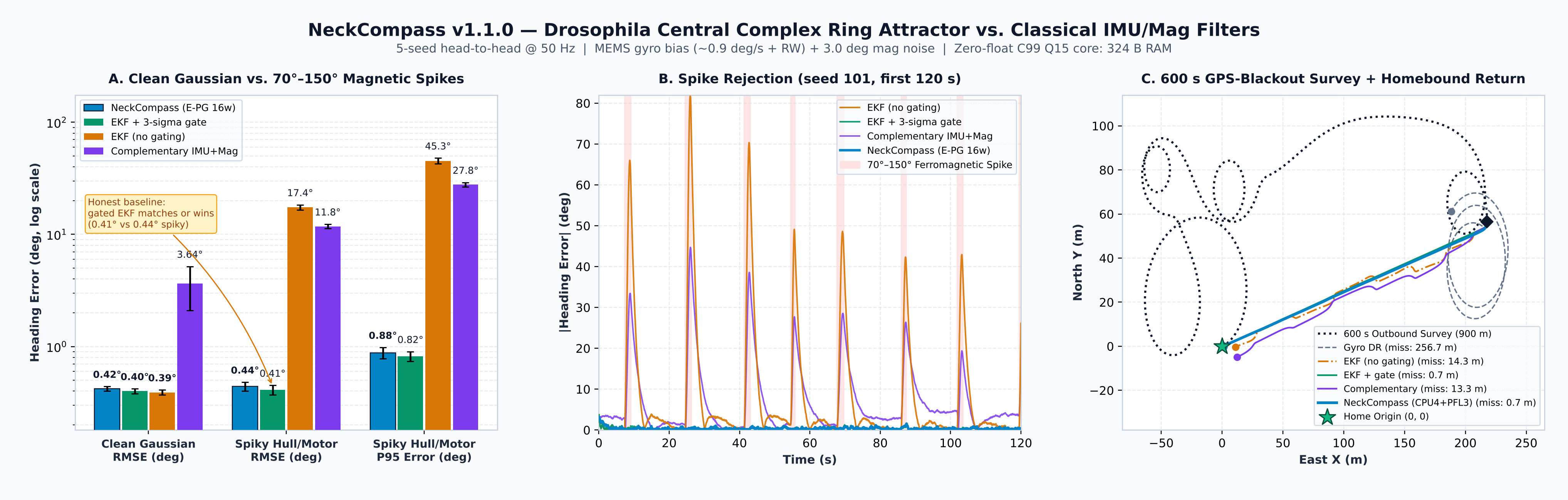
Benchmarks (5 seeds, 50 Hz)
Reproduce every number, plus results/benchmark_summary.json and the chart, with:
python scripts/benchmark_neckcompass.py # ~1 minute; needs matplotlib and a C compiler for the C99 rows
All estimators see identical sensor streams (seeds 101–105): MEMS gyro bias (0.75–1.15°/s plus 0.08°/s/√s random walk and 1.5°/s white noise) and 3° magnetometer noise. Both EKFs get the true noise covariances. "EKF + 3σ gate" is the strong classical baseline: it rejects measurements whose innovation exceeds 3× its predicted standard deviation, as production EKFs do. "EKF (no gating)" is the textbook form, kept to show what ungated filtering does with spikes.
Heading accuracy: clean vs. 70°–150° spikes (180 s runs, first 15 s excluded)
| Estimator | Clean RMSE | Clean P95 | Spiky RMSE | Spiky P95 | Spiky max |
|---|---|---|---|---|---|
| NeckCompass (Python) | 0.42° ± 0.02° |
0.84° |
0.44° ± 0.04° |
0.88° |
1.77° |
NeckCompass (C99 Q15) |
0.46° ± 0.02° |
0.90° |
0.49° ± 0.03° |
0.97° |
2.01° |
| EKF + 3σ gate | 0.40° ± 0.02° |
0.77° |
0.41° ± 0.04° |
0.82° |
1.89° |
| EKF (no gating) | 0.39° ± 0.02° |
0.77° |
17.42° ± 0.93° |
45.28° |
82.53° |
| Complementary IMU+Mag (τ = 2.5 s) | 3.64° ± 1.54° |
5.34° |
11.80° ± 0.54° |
27.77° |
47.45° |
| Gyro only | 90.22° ± 32.41° |
141.70° |
84.80° ± 30.74° |
139.91° |
145.98° |
On accuracy the gated EKF and NeckCompass are within about 0.05° of each other; the gated EKF is marginally better. NeckCompass is 40× better than an ungated EKF, but that is not a fair comparison for a production system.
Scenario D: recovery from a 90° heading upset (60 s, clean magnetometer, RMSE from t = 15 s)
| Estimator | RMSE |
|---|---|
| NeckCompass (Python) | 0.43° ± 0.08° |
| NeckCompass (C99) | 0.47° ± 0.06° |
| EKF + 3σ gate | 31.89° ± 22.20° (per seed: 43.5°, 8.8°, 50.3°, 1.7°, 55.2°: 3 of 5 runs still over 40° off after 60 s) |
| EKF (no gating) | 0.40° ± 0.08° |
This is where the attractor design earns its keep. A gated EKF that is confidently wrong keeps rejecting the correct readings as outliers. NeckCompass treats a cue that stays consistently off-basin for 10 s as a real upset and re-anchors onto it. Short spikes never qualify, because they last under 2 s.
Scenario C: 600 s survey with no GNSS, then autonomous return (~1,125 m path)
A 900 m multi-leg survey at 1.5 m/s with 2% speed noise, a biased gyro and spikes every ~20 s. Each estimator then steers its own simulated vehicle home on its own estimate.
| Navigation stack | Miss distance at home | Miss as % of path |
|---|---|---|
NeckCompass (RingCompass + FanBodyNavigator) |
0.68 ± 0.16 m |
0.06% |
| EKF + 3σ gate + dead reckoning | 0.70 ± 0.07 m |
0.06% |
| EKF (no gating) + dead reckoning | 14.29 ± 6.95 m |
1.28% |
| Complementary + dead reckoning | 13.31 ± 3.08 m |
1.19% |
| Gyro only + dead reckoning | 256.74 ± 52.38 m |
24.16% |
The C99 self-test ([5/7]) runs a shorter 158.6 m outbound-and-return mission entirely in fixed point and misses by 0.32 m.
Compute (desktop x86-64)
| Per step | Memory | |
|---|---|---|
| NeckCompass C99 core | ~1 us |
324 B state + 260 B tables |
| NeckCompass Python (compass + navigator + steering) | ~170–200 us |
~3.2 KB |
| 2-state EKF, Python | ~9–15 us |
~5.8 KB |
Python timings vary between runs; results/benchmark_summary.json records the latest values.
When to use NeckCompass, and when not to
Good fit:
- Microcontrollers without an FPU. The C core is a complete compass, path integrator and homing controller in 324 B of RAM.
- Heading upsets. NeckCompass re-anchors after a wrong initial heading, gyro saturation or a magnetometer re-calibration, where a gated EKF can lock itself out.
- Repeatable local magnetic warp (docks, robot bays).
PlasticLandmarkRinglearns it online, self-supervised or from a reference.
Use something else when:
- You already run a well-tuned EKF with innovation gating. On spike rejection alone it is as accurate, and slightly better in our runs.
- Your sensors are clean and Gaussian. The EKF is minimum-variance there (0.39–0.40° vs 0.42°).
- You need a high-rate Python loop. The Python implementation costs ~170 us per step (≈ 5–6 kHz max). Use the C core, or the EKF (~10 us).
- You need full 6-DOF pose. NeckCompass estimates yaw and a 2-D home vector only (
SO(2) + R²); it is not a VIO or SLAM system. - The disturbance is a long, steady offset. A disturbance lasting longer than
reanchor_secondslooks like a true heading change and will be adopted, for example parking next to a steel hull for minutes. Raisereanchor_seconds(or passNone) if your vehicle sits beside steel for long periods.
Repository layout
| Path | Contents |
|---|---|
neckcompass/ring_attractor.py |
RingCompass, PlasticLandmarkRing, basin_sigma_for_noise |
neckcompass/path_integrator.py |
FanBodyNavigator (CPU4 integrator + PFL3/PFL2 steering) |
neckcompass/cli.py |
neckcompass demo, neckcompass benchmark-quick |
csrc/ |
C99 core (neckcompass.h, neckcompass.c), Makefile, 7 self-tests |
scripts/benchmark_neckcompass.py |
Reproducible benchmark (Python and C core) and chart generator |
tests/ |
30 tests (including every README example): wrap-around, spike rejection at 1.5–6° noise, re-anchoring, plasticity, homing, CLI, and C-vs-Python agreement |
Changelog
1.1.0
- Fix: re-anchoring after a heading upset never fired with realistic magnetometer noise. It compared per-sample
d(mag)/dtagainst the gyro, and 3° of noise at 50 Hz looks like ~3.7 rad/s of motion. It now tracks the low-passed off-basin innovation. - Fix:
PlasticLandmarkRingself-supervised learning drifted. With 2° magnetometer noise the error grew to 56° over 4 minutes, and with a 0.9°/s gyro bias it reached 33°. The map is now kept zero-mean until a reference is seen, and the learning rate is gated by the gyro rather than by raw magnetometer differences. - Improvement: the attractor basin is set from
cue_noise_deg(half-width4° + noise), replacing the fixed ~28° basin. Spiky-magnetometer RMSE improved from1.70°to0.44°. - C99 core: matching basin (
nc_compass_set_cue_noise) and re-anchoring (nc_compass_set_reanchor_ms). State grows from 316 B to 324 B. - Benchmark: added the 3σ-gated EKF baseline, the C99 core (via
ctypes), scenario D, and local C measurements. The 1.0.0 README compared only against an ungated EKF (its "10.2× lower error" claim), and its C timings were hard-coded rather than measured.
Scientific foundations
- Seelig, J. D. & Jayaraman, V. (2015). Neural dynamics for landmark orientation and angular path integration. Nature, 521, 186–191.
- Stone, T. et al. (2017). An anatomically constrained model for path integration in the bee brain. Current Biology, 27(20), 3069–3085.
- Turner-Evans, D. et al. (2017). Angular velocity integration in a fly heading circuit. eLife, 6, e23496.
- Fisher, Y. E., Lu, J., D'Alessandro, I. & Wilson, R. I. (2019). Sensorimotor experience remaps visual input to a heading network. Nature, 576, 121–125.
- Kim, S. S., Hermundstad, A. M., Romani, S., Abbott, L. F. & Jayaraman, V. (2019). Generation of stable heading representations in diverse visual scenes. Nature, 576, 126–131.
- Lyu, C., Abbott, L. F. & Maimon, G. (2022). Building an allocentric travelling direction signal via vector computation. Nature, 601, 92–97.
- Westeinde, E. A. et al. (2024). Transforming a head direction signal into a goal-oriented steering command. Nature, 626, 819–826.
License
Released under the MIT License. Copyright (c) 2026 Amandeep Singh Bains.
1 maintainer

Metadata
1 maintainer
Release files for neckcompass 1.1.0
For a detailed explanation of source distributions (sdists) and built distributions (wheels), please see the package formats documentation.
Source distribution (sdist)
| File | Size | Uploaded | Provenance | Actions |
|---|---|---|---|---|
| neckcompass-1.1.0.tar.gz | 42.7 kB | Without provenance | Details for neckcompass-1.1.0.tar.gz |
Built distribution (wheel)
| File | Interpreter | ABI | Platform | Actions Reset |
|---|---|---|---|---|
| neckcompass-1.1.0-py3-none-any.whl | Python 3 | none | any | Details for neckcompass-1.1.0-py3-none-any.whl |
Total release size: 68.1 kB
Release files / neckcompass-1.1.0.tar.gz
| Download URL | neckcompass-1.1.0.tar.gz |
|---|---|
| Size | 42.7 kB |
| Tags | Source |
|
SHA-256 checksum How to use checksums |
7955e791a0c9cb6e7f62a6511af93fe251f01accd462fe28c78542775c059a62
|
|
BLAKE2b-256 checksum How to use checksums |
dba727bd9a581459e663ee903cf0cb7c4e828eb67f86062798e270fd5b2d74ea
|
| Upload date | |
|
Uploaded using Trusted Publishing? What is trusted publishing? |
No |
| Uploaded via |
twine/7.0.0 CPython/3.12.10
|
Release files / neckcompass-1.1.0-py3-none-any.whl
| Download URL | neckcompass-1.1.0-py3-none-any.whl |
|---|---|
| Size | 25.4 kB |
| Tags | Python 3 |
|
SHA-256 checksum How to use checksums |
3fe2f59c67a970e98fbe0fdc7418f9ac905e80d7de8df45880d8b2389e712369
|
|
BLAKE2b-256 checksum How to use checksums |
4c56ec1973ef2273347ebc740893c3bcdd06f8ab9ce71650919138e09ed68546
|
| Upload date | |
|
Uploaded using Trusted Publishing? What is trusted publishing? |
No |
| Uploaded via |
twine/7.0.0 CPython/3.12.10
|
Security for neckcompass 1.1.0
Provenance
Provenance describes where a file came from. On PyPI, provenance is shared via attestations, which provide a verifiable record of the build or publishing details. View details, limitations and caveats.
No provenance found
None of the files in this release were uploaded with provenance metadata.
A note on package security
PyPI is a repository for distributing packages, not a service for auditing them. While third-party security researchers and our staff do their best to detect and remove malicious packages, PyPI cannot guarantee the quality, security or suitability of any given package.
To learn more about protecting yourself from malicious actors, visit our package security documentation.














