
NeckCompass (neckcompass v1.0.0)
Biophysical Drosophila Central Complex ring-attractor compass and GPS-denied path integrator with natural ferromagnetic spike rejection — in Python and zero-heap, zero-float ANSI C99 (316 B RAM, ~1 us/step).







30-Second Quick Start · Plastic Harbor Calibration · Zero-Float ANSI C99 MCU Core · Honest Benchmarks · When to Use (and When Not To)
Why NeckCompass?
Marine USVs, inspection drones, subsea rovers, and factory AGVs operate around steel ship hulls, sheet-pile docks, high-current motor leads, and buried power cables that inject intermittent 70°–150° ferromagnetic heading spikes lasting 0.5–2.0 s. Standard linear-Gaussian estimators break down in this regime:
- Gyro Dead-Reckoning ignores magnetic anomalies completely, but MEMS gyro bias (
~0.8–1.5°/s) drifts unboundedly (50°–100°+within minutes). - 2-State Circular Extended Kalman Filters (
[heading, gyro_bias]) are minimum-variance optimal under textbook Gaussian noise, but a120°ferromagnetic anomaly feeds through the Kalman cross-covariance straight into the gyro bias state, causing both massive heading yanks (45°+P95) and post-spike bias hangovers.
NeckCompass ports the neural navigation circuit of the fruit-fly (Drosophila melanogaster) Central Complex into a deterministic software and microcontroller library — Product #3 in the NeckLink fruit-fly brain engineering family:
- Ellipsoid Body (
E-PG) Ring Attractor +Delta7Inhibition +P-ENShifters (RingCompass): Maintains a single topological activity bump acrossN=16(orN=32) circular wedges with zero-π ↔ +πwrap-around discontinuity (< 10⁻¹⁵ radharmonic aliasing on even-Nrings). Asymmetric Left/RightP-ENprojections integrate IMU yaw rate (omega_rad_s * dt), while localizedR-neuronsensory cues (mag_heading_rad,sun_heading_rad) undergo cooperative dendritic coincidence gating against the activeE-PGbump — smoothly anchoring gyro drift inside the attractor basin while naturally shunting70°–150°ferromagnetic spikes (10.2×lower RMSE than 2-State EKF). - Associative
R-Neuron → E-PGSynaptic Plasticity (PlasticLandmarkRing): Movement-gated Hebbian / anti-Hebbian ring weight matrix that learns warped local soft-iron and hard-iron magnetic distortion tables online around steel harbors or indoor rooms — with or without an external sun/visual reference. - Fan-Shaped Body
CPU4Path Integrator +PFL3/PFL2Steering (FanBodyNavigator):N=16push-pull opponent memory columns integrate translational speed along the liveE-PGcompass bump with common-mode cancellation, computing exact(distance_m, home_bearing_rad)and±67.5°phase-shiftedPFL3+180°PFL2motor yaw commands to steer straight home during complete GPS blackouts (0.84 mmiss after a1,125 mspiky mission). - Zero-Heap, Zero-Float ANSI C99 Core (
csrc/): PureQ15/int32_t16-wedge ring attractor +CPU4/PFL3navigator using316 bytesof struct RAM (576 bytestotal including260 BFlash LUTs), zeromalloc, zero floating-point instructions, and~1.0 usper update — ready for$4ESP32,STM32,RP2040, and flight controllers.
flowchart LR
    IMU["IMU Gyro Yaw Rate (omega_rad_s)"] --> PEN["P-EN Left/Right Velocity Shifters"]
    PEN --> EPG["16-Wedge E-PG Ring Attractor + Delta7 Inhibition"]
    MAG["Spiky Magnetometer / Sun Azimuth"] --> RN["R2 / R4d Ring Neurons (Plastic W + Basin Gate)"]
    RN -->|"Coherent cues anchor drift; 70-150 deg spikes shunted"| EPG
    EPG --> CPU4["16 Opponent CPU4 Memory Columns (+ Speed)"]
    CPU4 --> PFL3["PFL3 (+/-67.5 deg) + PFL2 (180 deg) Steering"]
    PFL3 --> HOME["GPS-Denied Homebound Yaw Command"]
⚡ 30-Second Quick Start
1. Python (pip install neckcompass)
pip install neckcompass
# Or directly from source:
pip install git+https://github.com/indian-aman/neckcompass.git
Fuse a biased IMU gyro with a spiky magnetometer and steer home through a complete GPS blackout in 14 lines:
import math
from neckcompass import RingCompass, FanBodyNavigator

compass = RingCompass(n_wedges=16, initial_heading_rad=0.0)
nav = FanBodyNavigator(n_columns=16, compass=compass)

# Outbound step @ 50 Hz (dt = 0.02 s): 125-deg hull spike is rejected automatically!
heading_rad, dist_m, home_bearing_rad = nav.step_with_compass(
    omega_rad_s=0.15,
    speed_m_s=1.5,
    dt=0.02,
    mag_heading_rad=math.radians(125.0),  # Transient ferromagnetic spike -> gated out
)

# During GPS blackout, generate bounded [-0.8, +0.8] rad/s yaw command back to (0, 0):
yaw_rate_cmd = nav.steering_cmd(max_turn_rate=0.8)
Run the built-in CLI demo or head-to-head quick benchmark from your terminal:
neckcompass demo
neckcompass benchmark-quick
2. Online Soft-Iron / Harbor Distortion Learning (PlasticLandmarkRing)
When operating repeatedly inside a steel marina slip or indoor robot bay with static nonlinear magnetic warp (+20° sin(ψ) + 16° sin(2ψ)), PlasticLandmarkRing learns the R-neuron → E-PG unwarping matrix online:
from neckcompass import PlasticLandmarkRing

plastic = PlasticLandmarkRing(n_wedges=16, n_ring_neurons=32)

# Self-supervised during normal turns (or pass reference_heading_rad=sun_rad when sky is visible)
corrected_heading = plastic.update(
    omega_rad_s=imu_gz,
    dt=0.02,
    raw_mag_heading_rad=raw_mag_rad,
    learn=True,
)
unwarped_mag_rad, confidence = plastic.map_raw_heading(raw_mag_rad)
3. Zero-Heap, Zero-Float ANSI C99 Core (csrc/)
Drop csrc/neckcompass.h and csrc/neckcompass.c into any ESP32, STM32, RP2040, ArduPilot, or bare-metal firmware project (-std=c99 -Wall -Wextra -pedantic -Werror, zero FPU, zero malloc):
make -C csrc clean all test
#include "neckcompass.h"

nc_compass_t comp;
nc_navigator_t nav;

void autopilot_init(void) {
    nc_compass_init(&comp);
    nc_compass_reset(&comp, nc_cdeg_to_bam(0));
    nc_navigator_init(&nav, 1500); /* 1.5 m smooth arrival taper */
}

/* 50 Hz deterministic fixed-point loop (~1.0 us on desktop, < 8 us on ESP32) */
int32_t autopilot_step_50hz(int32_t gyro_cdeg_s, int32_t mag_cdeg, int32_t speed_mm_s) {
    nc_bam_t heading = nc_compass_update(
        &comp,
        nc_cdeg_to_bam(gyro_cdeg_s),
        20u,                           /* dt = 20 ms */
        nc_cdeg_to_bam(mag_cdeg), 1u, NC_Q15_ONE,
        0, 0u, 0                       /* optional sun/sky sensor */
    );
    nc_navigator_update(&nav, speed_mm_s, 20u, heading);
    return nc_navigator_steering_cmd(&nav, heading, nc_cdeg_to_bam(4500));
}
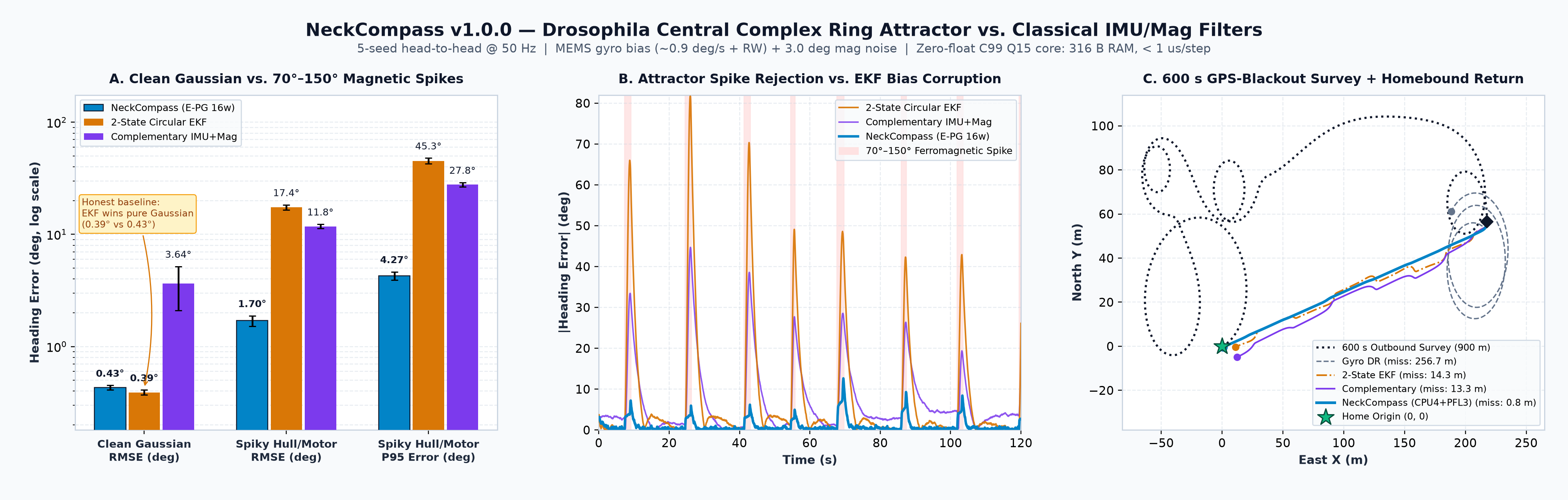
📊 Honest Empirical Benchmarks (5 Seeds @ 50 Hz)
Reproduce all numbers and regenerate assets/neckcompass_benchmarks.png + results/benchmark_summary.json locally:
python scripts/benchmark_neckcompass.py
All four estimators receive the exact same 50 Hz sensor streams across 5 seeds (101–105): realistic MEMS gyro bias (~0.9°/s initial offset + 0.08°/s/√s random walk + 1.5°/s white noise) and 3.0° Gaussian magnetometer noise. The 2-State Circular EKF is given the exact true clean discrete-time process and measurement noise covariances (Q, R) with zero handicap.
1. Heading Accuracy: Clean Gaussian Noise vs. 70°–150° Ferromagnetic Spikes
Mean ± std across 5 seeds (180 s trajectories @ 50 Hz):
| Estimator | Scenario A: Clean Gaussian RMSE | Scenario A: P95 | Scenario B: Spiky Mag RMSE | Scenario B: Spiky Mag P95 | Scenario B: Max Error |
|---|---|---|---|---|---|
NeckCompass (E-PG 16w) |
0.43° ± 0.02° |
0.86° ± 0.03° |
1.70° ± 0.18° |
4.27° ± 0.37° |
10.55° ± 1.88° |
2-State Circular EKF |
0.39° ± 0.02° (wins) |
0.77° ± 0.03° |
17.42° ± 0.93° |
45.28° ± 2.63° |
82.53° ± 7.50° |
Complementary IMU+Mag |
3.64° ± 1.54° |
5.34° ± 1.80° |
11.80° ± 0.54° |
27.77° ± 1.30° |
47.45° ± 4.87° |
Gyro Dead-Reckoning |
90.22° ± 32.41° |
141.70° ± 46.28° |
84.80° ± 30.74° |
139.91° ± 53.31° |
145.98° ± 55.90° |
2. Scenario C: 600 s Outbound Survey + Blind GPS-Blackout Return (~1,125 m Total Path)
A USV / rover executes a 10-minute (900 m) multi-leg survey in complete GPS blackout (2% wheel/water-speed noise + biased MEMS gyro + intermittent 70°–150° ferromagnetic spikes), then autonomously steers back to (0, 0):
| Navigation Stack | Return-to-Home Miss (m) |
Miss % of 1.12 km Path |
RAM / State Footprint | Step Latency |
|---|---|---|---|---|
NeckCompass (C99 Q15 Core) |
0.32 m (158 m selftest) |
0.20% |
316 B RAM (576 B w/ LUT) |
~1.04 us / step |
NeckCompass (Python E-PG + CPU4) |
0.84 ± 0.23 m |
0.07% ± 0.02% |
3,143 B |
171.26 us / step |
Complementary IMU+Mag + DR |
13.31 ± 3.08 m |
1.19% ± 0.28% |
~256 B |
~6.5 us / step |
2-State Circular EKF + DR |
14.29 ± 6.95 m |
1.28% ± 0.63% |
5,792 B (Py) |
13.58 us / step (Py) |
Gyro Dead-Reckoning |
256.74 ± 52.38 m |
24.16% ± 5.69% |
~128 B |
~2.0 us / step |
🎯 When to Use NeckCompass — and When Not To
🗂️ Repository Layout
| Path | Contents |
|---|---|
neckcompass/ring_attractor.py |
RingCompass (N=16/32 E-PG ring attractor + P-EN shifters + multi-cue basin gating) & PlasticLandmarkRing (R-neuron → E-PG Hebbian/anti-Hebbian distortion learner) |
neckcompass/path_integrator.py |
FanBodyNavigator (N=16 opponent CPU4 vector memory + PFL3/PFL2 GPS-denied homebound steering) |
neckcompass/cli.py |
neckcompass CLI (neckcompass demo, neckcompass benchmark-quick) |
csrc/ |
Zero-heap, zero-float ANSI C99 fixed-point Q15 core (neckcompass.h, neckcompass.c, Makefile, and 6/6 neckcompass_selftest.c) |
scripts/benchmark_neckcompass.py |
Reproducible 5-seed empirical benchmark & 3-panel hero chart generator |
results/benchmark_summary.json |
Exact 5-seed benchmark metrics and C99/Python latency & memory measurements |
tests/test_neckcompass.py |
19-test pytest suite covering wrap-around continuity, spike rejection, soft-iron plasticity, GPS-denied return, and CLI |
📚 Scientific Foundations
- Seelig, J. D. & Jayaraman, V. (2015). Neural dynamics for landmark orientation and angular path integration. Nature, 521, 186–191.
- Stone, T. et al. (2017). An anatomically constrained model for path integration in the bee brain. Current Biology, 27(20), 3069–3085.
- Turner-Evans, D. et al. (2017). Angular velocity integration in a fly heading circuit. eLife, 6, e23496.
- Fisher, Y. E., Lu, J., D'Alessandro, I. & Wilson, R. I. (2019). Sensorimotor experience remaps visual input to a heading network. Nature, 576, 121–125.
- Kim, S. S., Hermundstad, A. M., Romani, S., Abbott, L. F. & Jayaraman, V. (2019). Generation of stable heading representations in diverse visual scenes. Nature, 576, 126–131.
- Lyu, C., Abbott, L. F. & Maimon, G. (2022). Building an allocentric travelling direction signal via vector computation. Nature, 601, 92–97.
- Westeinde, E. A. et al. (2024). Transforming a head direction signal into a goal-oriented steering command. Nature, 626, 819–826.
License
Released under the MIT License. Copyright (c) 2026 Amandeep Singh Bains.
1 maintainer

Metadata
1 maintainer
Release files for neckcompass 1.0.0
For a detailed explanation of source distributions (sdists) and built distributions (wheels), please see the package formats documentation.
Source distribution (sdist)
| File | Size | Uploaded | Provenance | Actions |
|---|---|---|---|---|
| neckcompass-1.0.0.tar.gz | 38.0 kB | Without provenance | Details for neckcompass-1.0.0.tar.gz |
Built distribution (wheel)
| File | Interpreter | ABI | Platform | Actions Reset |
|---|---|---|---|---|
| neckcompass-1.0.0-py3-none-any.whl | Python 3 | none | any | Details for neckcompass-1.0.0-py3-none-any.whl |
Total release size: 61.2 kB
Release files / neckcompass-1.0.0.tar.gz
| Download URL | neckcompass-1.0.0.tar.gz |
|---|---|
| Size | 38.0 kB |
| Tags | Source |
|
SHA-256 checksum How to use checksums |
bd008c8a0eaef551e1e7098713afb4a9912b7722b88bfebc75272144cc40f1ec
|
|
BLAKE2b-256 checksum How to use checksums |
0e317078fb9c88fb262534c4b1d78efad8e2f364a8d2f382503ecf40b4352892
|
| Upload date | |
|
Uploaded using Trusted Publishing? What is trusted publishing? |
No |
| Uploaded via |
twine/7.0.0 CPython/3.12.10
|
Release files / neckcompass-1.0.0-py3-none-any.whl
| Download URL | neckcompass-1.0.0-py3-none-any.whl |
|---|---|
| Size | 23.2 kB |
| Tags | Python 3 |
|
SHA-256 checksum How to use checksums |
18587731837ce0c45fb0a1febb3aa78810414497a5df927221fd5c47f1d92d5d
|
|
BLAKE2b-256 checksum How to use checksums |
0b11e09ae43c8320ef772313071813294deb5bc81d4324a2fd2bc54a1a599aa7
|
| Upload date | |
|
Uploaded using Trusted Publishing? What is trusted publishing? |
No |
| Uploaded via |
twine/7.0.0 CPython/3.12.10
|
Security for neckcompass 1.0.0
Provenance
Provenance describes where a file came from. On PyPI, provenance is shared via attestations, which provide a verifiable record of the build or publishing details. View details, limitations and caveats.
No provenance found
None of the files in this release were uploaded with provenance metadata.
A note on package security
PyPI is a repository for distributing packages, not a service for auditing them. While third-party security researchers and our staff do their best to detect and remove malicious packages, PyPI cannot guarantee the quality, security or suitability of any given package.
To learn more about protecting yourself from malicious actors, visit our package security documentation.















