

NeckCord (neckcord v1.1.0)
A 4-byte motor-command frame, a self-healing six-leg gait generator and a fault-tolerant thruster allocator, modelled on the fruit-fly neck and ventral nerve cord, in Python and zero-heap, zero-float ANSI C99 (322 B of state).





Quick start · Python API · C99 core · Benchmarks · When to use it · Changelog
What it is
In the fruit fly, about 1,300 descending neurons cross the neck and carry compact intent: steer, go forward, reverse, freeze. The ventral nerve cord (VNC) turns that intent into rhythm, load monitoring and injury compensation (BANC / MANC connectomes). NeckCord copies that split for robots:
neckcord.cervical: a 4-byte command frame. Forward drive, yaw, sway, gait mode, a freeze flag, a 2-bit sequence counter and a 4-bit CRC in 32 bits. That is400 B/sat 100 Hz, and it decodes identically in Python and C.neckcord.cpg.SegmentalCPGCord: a six-leg gait generator. Coupled phase oscillators switch between wave, tetrapod and tripod gaits from one drive value. When a leg fails it re-forms a five-leg rhythm (Δφ = 72°, duty0.82) that keeps the centre of mass inside the support polygon.neckcord.allocator.ShuntingThrusterCord: a fault-tolerant allocator for 4–8 thrusters. It compares commanded against measured per-thruster thrust to estimate each thruster's health. It cuts drive to a failed thruster (≈ 40 ms in our simulation) and re-solvesW H Wᵀ + λIso surge, sway and yaw are kept on the survivors.
flowchart LR
    A["Planner / operator"] -->|"4-byte frame, 100 Hz, CRC-4"| B["Link (UART / CAN / NLTP)"]
    B --> C["SegmentalCPGCord (tripod / tetrapod / wave / 5-leg)"]
    B --> D["ShuntingThrusterCord (4..8 thrusters)"]
    E["Per-thruster thrust or RPM feedback"] -->|"health estimate"| D
    F["Leg load / contact"] -->|"limb fault"| C
Quick start
pip install neckcord
# or from this repository:
pip install "git+https://github.com/indian-aman/necklink.git#subdirectory=packages/neckcord"

neckcord demo                 # codec -> CPG with a jammed leg -> thruster fault isolation
neckcord benchmark-quick      # short USV fault benchmark
Python API
1. 4-byte command frame (neckcord.cervical)
from neckcord import DescendingFrame, GaitMode, encode_descending_4b, decode_descending_4b

tx = DescendingFrame(
    drive_fwd=0.82,     # forward (+1) / reverse (-1)
    turn_yaw=-0.25,     # steering [-1, +1]
    strafe_lat=0.10,    # sway / crab [-1, +1]
    gait_mode=GaitMode.AUTO,
    freeze_reflex=False,
    seq=2,
)

raw = encode_descending_4b(tx)           # b'\x68\xe0\x0c\x20'  (4 bytes)
rx = decode_descending_4b(raw, expected_seq=2)
wrench = rx.to_wrench(max_surge=60.0, max_sway=40.0, max_yaw=25.0)  # [Fx, Fy, Tz]
print(raw.hex(), round(rx.drive_fwd, 3), wrench.round(2))
| Bits | Field | Encoding |
|---|---|---|
[31:24] |
drive_fwd |
8-bit symmetric -127..+127 (step 0.0079; exact 0 and ±1) |
[23:16] |
turn_yaw |
8-bit symmetric -127..+127 |
[15:9] |
strafe_lat |
7-bit symmetric -63..+63 (step 0.0159) |
[8:7] |
gait_mode |
0 AUTO, 1 TRIPOD, 2 TETRAPOD, 3 WAVE |
[6] |
freeze_reflex |
zero wrench, all legs in stance |
[5:4] |
seq |
2-bit rolling counter |
[3:0] |
crc4 |
x⁴ + x + 1, init 0x9, xorout 0x5 |
What the integrity check does and does not do (measured, and covered by the test suite):
- Catches: 100% of single-bit flips, plus the stuck-bus words
0x00000000and0xFFFFFFFF. - Misses: about 4% of 2-bit errors and 6% of random corrupted words. Any 4-bit check lets roughly 1 in 16 random corruptions through.
- What to do: send frames over a link with its own integrity check, such as NLTP's AEAD, a CAN CRC-15 or a UART frame CRC-16. Treat the CRC-4 as a last-line sanity check.
The 2-bit sequence counter counts lost frames modulo 4, so losing exactly 4 frames in a row is invisible to it. Pair it with a receive timeout.
2. Six-leg gait generator (neckcord.cpg)
from neckcord import DescendingFrame, SegmentalCPGCord

cpg = SegmentalCPGCord(adapt_to_damage=True)
cmd = DescendingFrame(drive_fwd=0.85)   # fast forward -> tripod; slow -> metachronal wave

for _ in range(100):
    state = cpg.step(cmd, dt=0.01)
print(state.active_gait)                 # tripod

cpg.inject_limb_fault("L2")             # middle-left leg jams mid-stride
for _ in range(100):
    state = cpg.step(cmd, dt=0.01)

assert state.active_gait == "adaptive_pentapod"
assert state.is_statically_stable       # CoM inside the >= 3-leg support polygon
3. Fault-tolerant thruster allocator (neckcord.allocator)
import numpy as np
from neckcord import ShuntingThrusterCord

# 4-thruster X-vectored USV / ROV (0 Port-Fore, 1 Stbd-Fore, 2 Port-Aft, 3 Stbd-Aft)
cord = ShuntingThrusterCord.usv_vectored_4(
    lx=0.45, ly=0.35, cant_deg=45.0, u_max=35.0,
    probe_interval_s=2.0,       # re-test an isolated thruster every 2 s (default: never)
)

w_des = np.array([35.0, 0.0, 0.0])            # pure surge [Fx, Fy, Tz]
alloc = cord.step(w_des, dt=0.02)

# Port-Aft thruster fouled by kelp: it now delivers only 10% of what it is commanded.
# feedback_thrust is per-thruster measured thrust (load cell, or an RPM/current-based estimate).
true_effectiveness = np.array([1.0, 1.0, 0.10, 1.0])
for _ in range(4):
    alloc = cord.step(w_des, feedback_thrust=true_effectiveness * alloc.commands, dt=0.02)

assert alloc.isolated_mask[2] and alloc.commands[2] == 0.0
print(alloc.commands.round(2), alloc.predicted_wrench.round(2))  # surge from the two fore thrusters, no sway or yaw

# Once the prop is cleared, the probe (or cord.reinstate_actuator(2)) returns T2 to service.
An isolated thruster is commanded 0 N, so feedback alone can never show that it has recovered. Either:
- set
probe_interval_sto re-test it periodically. A still-dead thruster is re-isolated within a couple of ticks; in the C self-test it was isolated 489 of 500 ticks with a 2 s probe. - or call
reinstate_actuator(i)once you know the fault is cleared.
Zero-heap, zero-float ANSI C99 core (csrc/)
csrc/neckcord.h and csrc/neckcord.c implement the codec, the CPG and the allocator in Q15 / Q14 / 16-bit BAM integer arithmetic:
- no
mallocor floating point; - a 65-entry
Q15sine table and an exactint643×3 solver; 322 bytesfor all five state and result structs together (sizeof, self-test 1);- byte-identical frames with Python (golden vector
0x68E00C20); - the recovery probe:
nc_shunting_set_probe_interval()andnc_shunting_reinstate().
make -C csrc clean all test # gcc -O2 -std=c99 -Wall -Wextra -pedantic -Werror; 11 self-tests
Benchmarks
python scripts/benchmark_neckcord.py # ~10 s; writes results/benchmark_summary.json and the chart
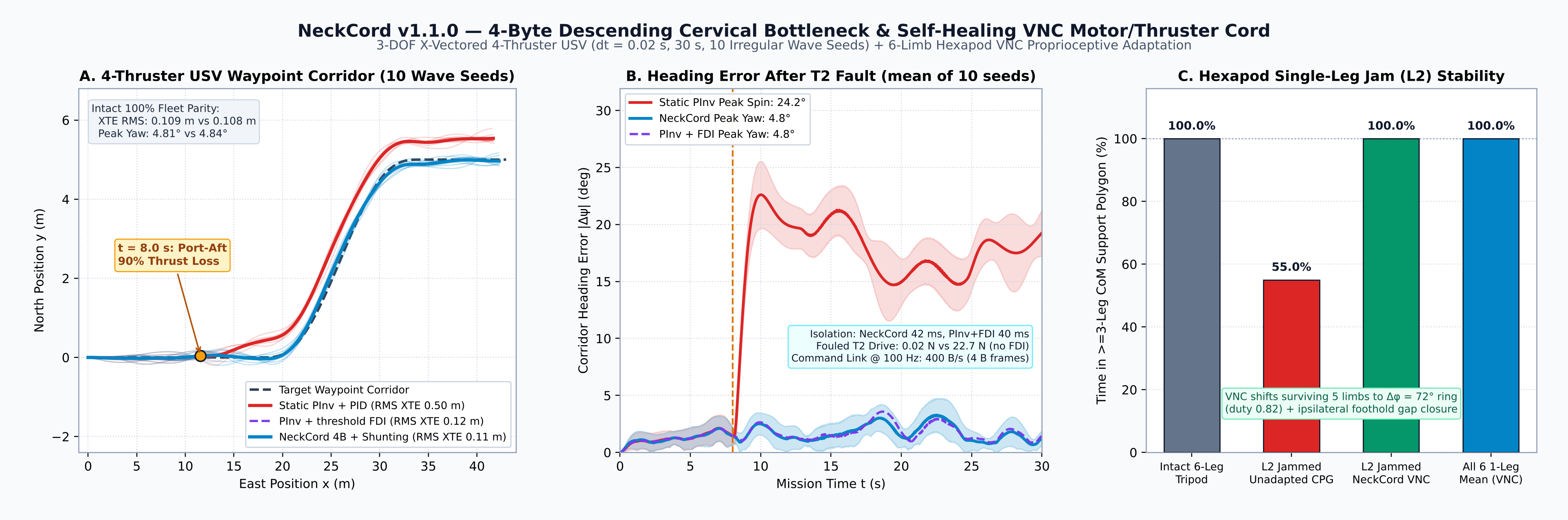
1. 4-thruster USV corridor tracking with a thruster fault (dt = 0.02 s, 30 s, 10 wave seeds)
A 3-DOF Fossen-style hull follows a waypoint corridor under irregular waves, with the same LOS + PID outer loop for every allocator. At t = 8 s the Port-Aft thruster (T2) loses 90% of its thrust. Thrust feedback carries 0.4 N of noise.
| Metric | Static pseudo-inverse (no fault detection) | Pseudo-inverse + threshold FDI (same feedback as NeckCord) | NeckCord |
|---|---|---|---|
| Intact: RMS cross-track | 0.108 m |
0.108 m |
0.109 m |
| Intact: peak heading error | 4.84° ± 0.94° |
4.84° ± 0.94° |
4.81° ± 0.79° |
| Intact: runs with a false isolation | 0 / 10 |
0 / 10 |
0 / 10 |
| Fault: peak heading error | 24.19° ± 2.28° |
4.84° ± 0.95° |
4.77° ± 0.65° |
| Fault: RMS cross-track | 0.498 m |
0.116 m |
0.112 m |
| Fault: time to isolate T2 | never | 40 ms |
42 ms |
| Fault: mean drive sent to dead T2 | 22.70 N |
0.03 N |
0.02 N |
The "threshold FDI" baseline drops a thruster when measured/commanded thrust stays below 0.5 for 3 ticks, then recomputes the pseudo-inverse: about 15 lines of code. It performs the same as NeckCord. The 5× heading improvement is real only against an allocator with no fault detection at all. NeckCord's value is a packaged, tested allocator that has:
- graded health, not just on/off;
- yaw/sway-priority desaturation;
- recovery probing;
- a zero-float C99 port.
2. Hexapod single-leg jam at fast drive (0.85)
Kinematic support-polygon simulation (no rigid-body dynamics): the share of time the centre of mass lies inside the polygon of ≥ 3 grounded feet.
| Condition | Time statically stable | Minimum CoM margin |
|---|---|---|
| Intact six-leg tripod | 100.0% |
+6.80 cm |
| L2 jammed, CPG not adapted | 55.0% |
negative (CoM leaves the polygon every half-stride) |
| L2 jammed, NeckCord adaptive | 100.0% |
+2.24 cm |
| Each of the 6 single-leg faults, adaptive | 100.0% |
+1.89 cm (front legs) to +2.24 cm |
3. Bandwidth
At 100 Hz the frame is 400 B/s. That is 6× smaller than sending four float32 values plus an 8-byte header (2,400 B/s). But quantising the same three axes to int8 would also fit in about 4 bytes. The frame's value is its fixed layout, flags, sequence counter and integrity check, not compression.
When to use NeckCord, and when not to
Good fit:
- 4–8 thruster vectored USVs and ROVs with per-thruster feedback (thrust, RPM or current) that need a fault-tolerant allocator, with a tested C99 port for the flight controller.
- Compact fixed-format command links, carried inside an authenticated or CRC-protected transport.
- Hexapods that need one-parameter gait changes and a five-leg fallback.
Use something else when:
- You already have FDI plus re-allocation. As the benchmark shows, a simple threshold detector with a pseudo-inverse performs the same.
- You have no per-thruster feedback. No allocator can detect a thruster fault it cannot see.
- The vessel has two fixed parallel thrusters and no bow thruster or rudder. Losing one leaves
rank(W) = 1, and no allocator can produce surge without yaw. - Thrusters are unidirectional, or the problem is 6-DOF with tight actuator bounds. NeckCord assumes bidirectional
[-u_max, +u_max]thrust in 3-DOF; use a QP allocator (OSQP, proxqp). - You need dynamic stability guarantees for a legged robot. The hexapod results are kinematic support-polygon checks only.
Repository layout
| Path | Contents |
|---|---|
neckcord/cervical.py |
DescendingFrame, encode_descending_4b, decode_descending_4b, compute_crc4, CervicalBottleneckLink |
neckcord/cpg.py |
SegmentalCPGCord gait generator with five-leg fallback |
neckcord/allocator.py |
ShuntingThrusterCord health estimation, shunting, recovery probe, W H Wᵀ + λI allocation |
neckcord/cli.py |
neckcord demo, neckcord benchmark-quick |
csrc/ |
C99 core and 11 self-tests |
scripts/benchmark_neckcord.py |
USV and hexapod benchmark, chart generator |
tests/ |
31 tests, including every README example, the probe, the CRC escape rate and C source checks |
Changelog
1.1.0
- New: recovery probing for isolated thrusters (
probe_interval_s,reinstate_actuator(); C:nc_shunting_set_probe_interval(),nc_shunting_reinstate()). Before this, a thruster isolated by a transient brownout stayed off for the rest of the mission. - Fix:
CervicalBottleneckLink.pack()no longer overwrites the caller'sframe.seq. - Benchmark: added the pseudo-inverse + threshold-FDI baseline and false-isolation counts. 1.0.0 compared only against an allocator with no fault detection. Added the intact hexapod margin (
6.80 cm; 1.0.0 listed3.90 cm, a value from a faulted demo run). - Docs: the CRC-4's multi-bit escape rate, the need for thrust feedback, and the sequence-counter limit are now stated. Every Python example runs as written.
License
Released under the MIT License. Copyright (c) 2026 Amandeep Singh Bains.
1 maintainer

Metadata
1 maintainer
Release files for neckcord 1.1.0
For a detailed explanation of source distributions (sdists) and built distributions (wheels), please see the package formats documentation.
Source distribution (sdist)
| File | Size | Uploaded | Provenance | Actions |
|---|---|---|---|---|
| neckcord-1.1.0.tar.gz | 47.9 kB | Without provenance | Details for neckcord-1.1.0.tar.gz |
Built distribution (wheel)
| File | Interpreter | ABI | Platform | Actions Reset |
|---|---|---|---|---|
| neckcord-1.1.0-py3-none-any.whl | Python 3 | none | any | Details for neckcord-1.1.0-py3-none-any.whl |
Total release size: 75.6 kB
Release files / neckcord-1.1.0.tar.gz
| Download URL | neckcord-1.1.0.tar.gz |
|---|---|
| Size | 47.9 kB |
| Tags | Source |
|
SHA-256 checksum How to use checksums |
b956a03ef04fc6df59c5da3554b36211f0c8adadabead8a55768ea17bb0ffae4
|
|
BLAKE2b-256 checksum How to use checksums |
2a0a55bdfc83dbf04a1fcad4e56bd475b44e97191afd4c4d2b11ad43de6296b0
|
| Upload date | |
|
Uploaded using Trusted Publishing? What is trusted publishing? |
No |
| Uploaded via |
twine/7.0.0 CPython/3.12.10
|
Release files / neckcord-1.1.0-py3-none-any.whl
| Download URL | neckcord-1.1.0-py3-none-any.whl |
|---|---|
| Size | 27.8 kB |
| Tags | Python 3 |
|
SHA-256 checksum How to use checksums |
30a58221d153fced91e2e0afea02cb82f14596bec48dd0ae9d0bce9594ad2575
|
|
BLAKE2b-256 checksum How to use checksums |
14b2de874431931a63df48ec0dfb3af89743bd662eedd0d3d7cb72d22ddc2506
|
| Upload date | |
|
Uploaded using Trusted Publishing? What is trusted publishing? |
No |
| Uploaded via |
twine/7.0.0 CPython/3.12.10
|
Security for neckcord 1.1.0
Provenance
Provenance describes where a file came from. On PyPI, provenance is shared via attestations, which provide a verifiable record of the build or publishing details. View details, limitations and caveats.
No provenance found
None of the files in this release were uploaded with provenance metadata.
A note on package security
PyPI is a repository for distributing packages, not a service for auditing them. While third-party security researchers and our staff do their best to detect and remove malicious packages, PyPI cannot guarantee the quality, security or suitability of any given package.
To learn more about protecting yourself from malicious actors, visit our package security documentation.














