
NeckCord (neckcord v1.0.0)
4-byte descending cervical command bottleneck, self-healing hexapod VNC phase CPG, and millisecond presynaptic-shunting thruster control allocation — in Python and zero-heap, zero-float ANSI C99.







Quick Start · 4-Byte Cervical Codec · Self-Healing Hexapod CPG · Shunting Thruster Allocator · Zero-Float ANSI C99 · Benchmarks · When to Use
Biological Architecture: Brain → Cervical Bottleneck → Self-Healing VNC
In Drosophila melanogaster, roughly ~1,300 descending neurons cross a tiny cervical neck connective to coordinate thousands of thoracic motor units (BANC / MANC connectomes; Braun et al., Nature 2024; Lesser et al., Nature 2024). Rather than streaming high-rate per-muscle waveforms over the neck bottleneck, the brain sends compact behavioral intent (DNa02 bilateral steering, DNp09 forward drive, MDN reverse walk, Giant Fiber emergency freeze), while the Ventral Nerve Cord (VNC) handles local rhythm generation, campaniform sensilla load-error monitoring, and presynaptic shunting injury adaptation.
NeckCord (Product #5 in the NeckLink fruit-fly brain ecosystem) brings this exact split architecture to marine USVs, ROVs, multirotors, and legged robots:
- 4-Byte Cervical Command Frame (
neckcord.cervical): Packsdrive_fwd,turn_yaw,strafe_lat,gait_mode,freeze_reflex, a2-bitrolling sequence counter, and4-bitbus-fault-hardenedCRC-4into32 bits(400 B/sat100 Hz) —6.0xsmaller than raw4×float32 + headeractuator streams and ready to ride directly insidepynltpframes over lossy marine radio or cellular CGNAT links. - Segmental 6-Limb VNC CPG (
neckcord.cpg.SegmentalCPGCord): Phase-coupled Kuramoto oscillator network with contralateral commissural anti-phase inhibition and ipsilateral intersegmental lags. Smoothly transitions across Metachronal Wave, Tetrapod, and Tripod gaits from a single scalar descending drive, and automatically re-indexes into a 5-limb pentapod ring (Δφ = 72°, duty0.82) + ipsilateral foothold gap-closure reflex (100.0%static CoM support-polygon stability) when any leg jams or loses load. - Presynaptic-Shunting Thruster Allocator (
neckcord.allocator.ShuntingThrusterCord): Online fault-tolerant wrench allocator (W H W^T + λI) for4–8actuators. Detects weed-fouling, propulsor shear, or ESC brownout from campaniform effort-vs-feedback discrepancy in~42 ms, shunts drive away from the fouled thruster (0.02 Nwasted effort), and rebalancessurge,sway, andyawacross surviving thrusters with yaw/sway-prioritized desaturation.
flowchart LR
    A["Shore / Brain Planner"] -->|"4-Byte DescendingFrame (400 B/s @ 100 Hz, CRC-4)"| B["Cervical Bottleneck (UART / CAN / pynltp)"]
    B --> C["SegmentalCPGCord (6-Limb Tripod / Tetrapod / Wave / 5-Leg Heal)"]
    B --> D["ShuntingThrusterCord (4..8 Ch W*H*W^T + λI Reallocator)"]
    E["Campaniform Load / ESC Feedback"] -->|"Effort Discrepancy (42 ms)"| C
    E -->|"Presynaptic Shunting (s_i -> 0)"| D
⚡ 30-Second Quick Start
Install
pip install neckcord
# Optional NLTP encrypted radio/UDP transport integration:
pip install "neckcord[nltp]"
Run from the Terminal
neckcord demo
neckcord benchmark-quick
Python API
1. 4-Byte Descending Cervical Command Frame (neckcord.cervical)
from neckcord import DescendingFrame, GaitMode, encode_descending_4b, decode_descending_4b

tx = DescendingFrame(
    drive_fwd=0.82,     # DNp09 forward (+1) / MDN Moonwalker reverse (-1)
    turn_yaw=-0.25,     # DNa02 bilateral steering [-1, +1]
    strafe_lat=0.10,    # Lateral sway / crab walk [-1, +1]
    gait_mode=GaitMode.AUTO,
    freeze_reflex=False,
    seq=2,
)

raw = encode_descending_4b(tx)          # b'\x68\xe0\x0c\x20' (4 bytes = 32 bits)
rx = decode_descending_4b(raw, expected_seq=2)
wrench = rx.to_wrench(max_surge=60.0, max_sway=40.0, max_yaw=25.0)
| Bits | Field | Encoding | Resolution / Role |
|---|---|---|---|
[31:24] |
drive_fwd |
8-bit symmetric -127..+127 |
0.0079 step, exact 0.0 & ±1.0 |
[23:16] |
turn_yaw |
8-bit symmetric -127..+127 |
0.0079 step, exact 0.0 & ±1.0 |
[15:9] |
strafe_lat |
7-bit symmetric -63..+63 |
0.0159 step, exact 0.0 & ±1.0 |
[8:7] |
gait_mode |
2-bit unsigned 0..3 |
0=AUTO, 1=TRIPOD, 2=TETRAPOD, 3=WAVE |
[6] |
freeze_reflex |
1-bit flag |
Giant Fiber instant stance lock / zero wrench |
[5:4] |
seq |
2-bit rolling counter |
0..3 packet-loss & reorder tracking |
[3:0] |
crc4 |
x^4 + x + 1 (init=0x9, xor=0x5) |
Rejects 100% of 1-bit flips, 0x00000000 & 0xFFFFFFFF |
2. Segmental VNC Hexapod CPG (neckcord.cpg)
from neckcord import SegmentalCPGCord

cpg = SegmentalCPGCord(adapt_to_damage=True)

# Fast forward command -> Tripod gait; low speed -> Metachronal Wave
state = cpg.step(raw, dt=0.01)

# Simulate sudden middle-left leg (L2) jam / amputation mid-stride:
cpg.inject_limb_fault("L2")
for _ in range(100):
    state = cpg.step(0.85, dt=0.01)

assert state.active_gait == "adaptive_pentapod"
assert state.is_statically_stable is True  # CoM strictly inside >=3-leg polygon!
3. Presynaptic-Shunting Thruster Cord (neckcord.allocator)
import numpy as np
from neckcord import ShuntingThrusterCord

# Standard 4-thruster X-vectored marine USV / ROV (Port-Fore, Stbd-Fore, Port-Aft, Stbd-Aft)
cord = ShuntingThrusterCord.usv_vectored_4(lx=0.45, ly=0.35, cant_deg=45.0, u_max=35.0)

w_des = np.array([35.0, 0.0, 0.0])  # Pure forward surge [Fx, Fy, Tz]
alloc = cord.step(w_des, dt=0.02)

# Port-Aft thruster (index 2) gets fouled by kelp (90% loss of thrust):
true_effectiveness = np.array([1.0, 1.0, 0.10, 1.0])
for _ in range(4):
    measured_thrust = true_effectiveness * alloc.commands
    alloc = cord.step(w_des, feedback_thrust=measured_thrust, dt=0.02)

# T2 is shunted to 0.0 N; T0 & T1 rebalance pure forward surge with zero yaw spin!
assert alloc.isolated_mask[2] and alloc.commands[2] == 0.0
🔧 Zero-Heap, Zero-Float ANSI C99 Core (csrc/)
csrc/neckcord.h and csrc/neckcord.c implement the complete NeckCord stack in pure fixed-point Q15 / Q14 / 16-bit BAM integer arithmetic for bare-metal STM32, ESP32, RP2040, and safety MCUs without an FPU:
- Zero dynamic allocation: No
malloc,calloc,realloc, orfree. - Zero floating-point instructions: Quarter-wave
65-entryQ15sine lookup table (130 BROM) + exactint64_t3×3Gram cofactor solver and integer cross-product CoM convex-hull verifier. 304 bytestotal runtime state: Combinedsizeofall 5 state/result structs (< 10%of the3 KBstatic RAM budget).- 100% wire-compatible with Python: Encodes and decodes identical 4-byte frames (
0x68E00C20).
cd csrc && make clean all test
# Compiles cleanly under: gcc -O2 -std=c99 -Wall -Wextra -pedantic -Werror (10/10 passed)
📊 Empirical Benchmarks
Reproduce all numbers and regenerate assets/neckcord_benchmarks.png and results/benchmark_summary.json locally:
python scripts/benchmark_neckcord.py
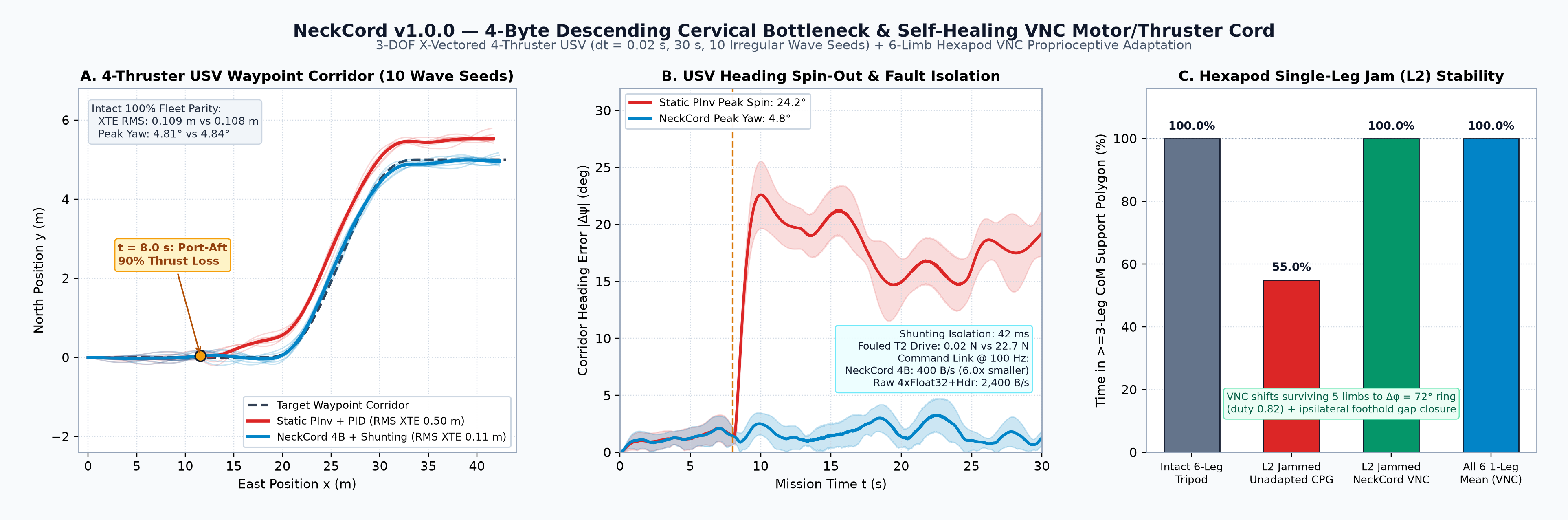
1. 3-DOF X-Vectored 4-Thruster USV Corridor Tracking (dt = 0.02 s, 30 s, 10 Irregular Wave Seeds)
Both architectures use the exact same Fossen 3-DOF hull model, wave seeds, and outer LOS + PID controller:
| Scenario & Metric | Static Pseudo-Inverse + Raw Float32 |
NeckCord (4B Cervical + Shunting VNC) |
Outcome |
|---|---|---|---|
Command Link Bandwidth (100 Hz) |
2,400 B/s (24 B/frame) |
400 B/s (4 B/frame) |
6.0x lower wire bandwidth |
Intact Fleet (100% Health) — RMS XTE |
0.108 m (0.233 m max) |
0.109 m (0.233 m max) |
Identical nominal tracking (1 mm) |
Intact Fleet (100% Health) — Peak Yaw |
4.84° ± 0.94° |
4.81° ± 0.79° |
No quantization degradation |
90% Port-Aft Loss (t = 8 s) — Peak Yaw |
24.19° ± 2.28° |
4.77° ± 0.65° |
5.07x less heading spin-out |
90% Port-Aft Loss (t = 8 s) — RMS XTE |
0.498 m (0.735 m max) |
0.112 m (0.224 m max) |
4.45x tighter corridor tracking |
| Fault Isolation Latency | Never isolated | 42.0 ms |
Shunted in ~2 control ticks |
Mean Drive Sent to Fouled T2 Thruster |
22.70 N |
0.02 N |
Protects jammed ESC / windings |
2. Hexapod Single-Leg Jam (L2 Middle-Left Lost at Fast 0.85 Drive)
| Condition | % Cycle in >=3-Leg CoM Static Support Polygon |
Min CoM Stability Margin |
|---|---|---|
| Intact 6-Leg Tripod | 100.0% |
+3.90 cm |
L2 Jammed — Unadapted Tripod CPG |
55.0% (tips out of polygon every half-stride) |
< 0 cm (collinear 2-leg phase) |
L2 Jammed — NeckCord Adaptive VNC |
100.0% |
+2.24 cm |
All 6 Single-Leg Faults (L1..R3 Mean) — NeckCord |
100.0% |
+1.89 to +2.24 cm |
🎯 When to Use NeckCord — and When Not To
Reach for NeckCord when:
- Controlling 4-to-8 thruster vectored USVs, ROVs, or multirotors exposed to kelp/weed fouling, propulsor damage, or ESC brownouts where losing one actuator would otherwise spin the vehicle off heading and burn the stalled motor.
- Streaming real-time operator or autonomy commands across narrow, lossy acoustic, LoRa, marine UHF, or
4G/5Glinks (400 B/sat100 Hz— pairs directly withpynltp). - Running hexapod robots or bare-metal C99 motor cords (
304 BRAM, zero FPU/heap) that need smooth single-parameter gait transitions (Wave ↔ Tetrapod ↔ Tripod) and instant 5-legged self-healing on leg failure.
Stick with standard tools when:
- Underactuated 2-thruster differential hulls with no bow thruster or rudder: If 1 of 2 fixed parallel thrusters dies completely, no allocator can produce forward surge without net yaw moment (
rank(W_surviving) = 1 < 2). - Clean local wired buses on healthy, un-faulted vehicles: As shown in our intact-fleet benchmark above, a 3-line static Moore-Penrose pseudo-inverse achieves identical nominal tracking (
0.108 mvs0.109 mXTE) when all actuators remain100%healthy. - Asymmetric unidirectional thrusters (
u_i >= 0only, e.g. non-reversible quadrotor props in 6-DOF):ShuntingThrusterCordassumes bidirectional control authority ([-u_max, +u_max]) with yaw/sway-prioritized scaling; strictly non-negative polyhedral actuator bounds with> 6coupled DOFs are better served by an active-set QP solver (OSQP/proxqp).
🗂️ Repository Layout
| Path | Description |
|---|---|
neckcord/cervical.py |
DescendingFrame, encode_descending_4b, decode_descending_4b, CRC-4, CervicalBottleneckLink |
neckcord/cpg.py |
SegmentalCPGCord 6-limb Kuramoto CPG, gait transitions, pentapod + gap-closure self-healing |
neckcord/allocator.py |
ShuntingThrusterCord online health estimation, presynaptic shunting, W H W^T + λI allocator |
neckcord/cli.py |
neckcord CLI (demo, benchmark-quick, --json) |
csrc/ |
Zero-heap, zero-float Q15/Q14 ANSI C99 core (neckcord.h, neckcord.c, 10/10 neckcord_selftest.c) |
scripts/benchmark_neckcord.py |
10-seed 3-DOF USV + 6-limb hexapod benchmark & 3-panel hero chart generator |
results/benchmark_summary.json |
Reproducible empirical benchmark output JSON |
tests/test_neckcord.py |
22 pytest unit, edge-case, CLI, and C99 source-audit tests |
License
Released under the MIT License. Copyright (c) 2026 Amandeep Singh Bains.
1 maintainer

Metadata
1 maintainer
Release files for neckcord 1.0.0
For a detailed explanation of source distributions (sdists) and built distributions (wheels), please see the package formats documentation.
Source distribution (sdist)
| File | Size | Uploaded | Provenance | Actions |
|---|---|---|---|---|
| neckcord-1.0.0.tar.gz | 46.2 kB | Without provenance | Details for neckcord-1.0.0.tar.gz |
Built distribution (wheel)
| File | Interpreter | ABI | Platform | Actions Reset |
|---|---|---|---|---|
| neckcord-1.0.0-py3-none-any.whl | Python 3 | none | any | Details for neckcord-1.0.0-py3-none-any.whl |
Total release size: 73.2 kB
Release files / neckcord-1.0.0.tar.gz
| Download URL | neckcord-1.0.0.tar.gz |
|---|---|
| Size | 46.2 kB |
| Tags | Source |
|
SHA-256 checksum How to use checksums |
30f20a6749a2969edc542c05f1f560675180570f2febca02d52331ca591467c7
|
|
BLAKE2b-256 checksum How to use checksums |
0cf4ad844413b6b18420df797cfdabd8fe512b0772a9bf10d123e990fd6b6366
|
| Upload date | |
|
Uploaded using Trusted Publishing? What is trusted publishing? |
No |
| Uploaded via |
twine/7.0.0 CPython/3.12.10
|
Release files / neckcord-1.0.0-py3-none-any.whl
| Download URL | neckcord-1.0.0-py3-none-any.whl |
|---|---|
| Size | 27.1 kB |
| Tags | Python 3 |
|
SHA-256 checksum How to use checksums |
f2ae9e2e49fd6821764d1d930141ebeaaeecc7a5a1cbee2d7fb2110e114bdd53
|
|
BLAKE2b-256 checksum How to use checksums |
a715192d53ed1b53c89c618807b15d077e971c786a91515c333804148df85f2a
|
| Upload date | |
|
Uploaded using Trusted Publishing? What is trusted publishing? |
No |
| Uploaded via |
twine/7.0.0 CPython/3.12.10
|
Security for neckcord 1.0.0
Provenance
Provenance describes where a file came from. On PyPI, provenance is shared via attestations, which provide a verifiable record of the build or publishing details. View details, limitations and caveats.
No provenance found
None of the files in this release were uploaded with provenance metadata.
A note on package security
PyPI is a repository for distributing packages, not a service for auditing them. While third-party security researchers and our staff do their best to detect and remove malicious packages, PyPI cannot guarantee the quality, security or suitability of any given package.
To learn more about protecting yourself from malicious actors, visit our package security documentation.














