
Model Context Protocol server for OME-Zarr image conversion

Project description
ngff-zarr MCP Server
ngff-zarr-mcp is a Model Context Protocol (MCP) server that provides AI agents
with the ability to convert images to OME-Zarr format using the ngff-zarr
library.
Features
Tools
- convert_images_to_ome_zarr: Convert various image formats to OME-Zarr with full control over metadata, compression, and multiscale generation
- read_ome_zarr_store: Read OME-Zarr data with support for remote storage options
- get_ome_zarr_info: Inspect existing OME-Zarr stores and get detailed information
- validate_ome_zarr_store: Validate OME-Zarr structure and metadata
- optimize_ome_zarr_store: Optimize existing stores with new compression and chunking
Resources
- supported-formats: List of supported input/output formats and backends
- downsampling-methods: Available downsampling methods for multiscale generation
- compression-codecs: Available compression codecs and their characteristics
Input Support
- Local files (all formats supported by ngff-zarr)
- Local directories (Zarr stores)
- Network URLs (HTTP/HTTPS)
- S3 URLs (with optional s3fs dependency)
- Remote storage with authentication (AWS S3, Google Cloud Storage, Azure)
Advanced Features
- RFC 4 - Anatomical Orientation: Support for medical imaging orientation systems (LPS, RAS)
- Method Metadata: Enhanced multiscale metadata with downsampling method information
- Storage Options: Cloud storage authentication and configuration support
- Multiscale Type Tracking: Automatic detection and preservation of downsampling methods
Output Optimization
- Multiple compression codecs (gzip, lz4, zstd, blosc variants)
- Configurable compression levels
- Flexible chunk sizing
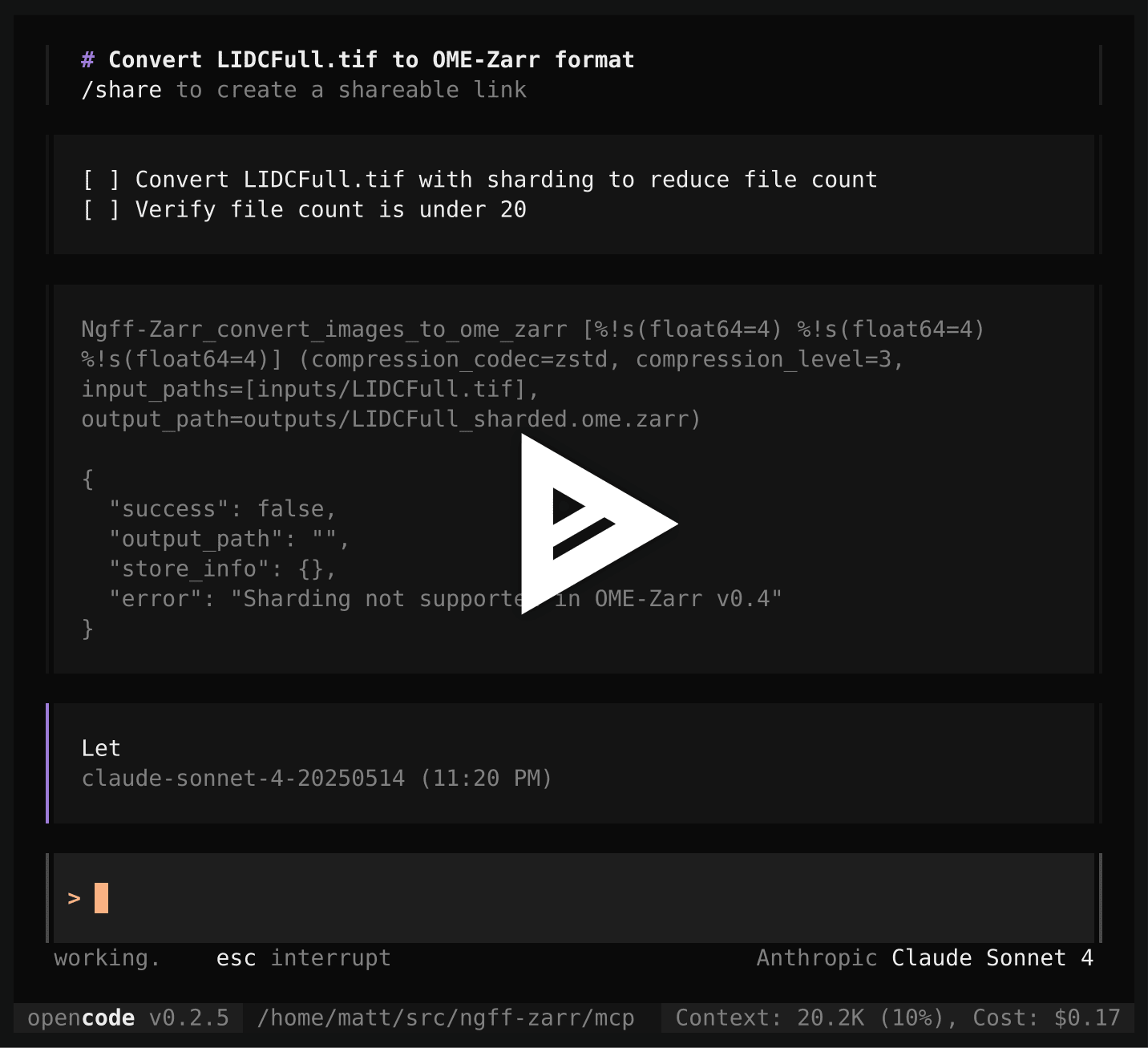
- Sharding support (Zarr v3/OME-Zarr v0.5)
- OME-Zarr version selection (0.4 or 0.5)
Installation
Requirements
- Python >= 3.10
- Cursor, Windsurf, Claude Desktop, VS Code, or another MCP Client
Quick Install
The easiest way to use ngff-zarr MCP server is with uvx:
# Install uvx if not already installed
pip install uvx

# Run the MCP server directly from PyPI
uvx ngff-zarr-mcp
Install in Cursor
Go to: Settings -> Cursor Settings -> MCP -> Add new global MCP server
Pasting the following configuration into your Cursor ~/.cursor/mcp.json file
is the recommended approach. You may also install in a specific project by
creating .cursor/mcp.json in your project folder. See
Cursor MCP docs for
more info.
Using uvx (recommended)
{
  "mcpServers": {
    "ngff-zarr": {
      "command": "uvx",
      "args": ["ngff-zarr-mcp"]
    }
  }
}
Using direct Python
{
  "mcpServers": {
    "ngff-zarr": {
      "command": "python",
      "args": ["-m", "pip", "install", "ngff-zarr-mcp", "&&", "ngff-zarr-mcp"]
    }
  }
}
Install in Windsurf
Add this to your Windsurf MCP config file. See Windsurf MCP docs for more info.
Using uvx (recommended)
{
  "mcpServers": {
    "ngff-zarr": {
      "command": "uvx",
      "args": ["ngff-zarr-mcp"]
    }
  }
}
SSE Transport
{
  "mcpServers": {
    "ngff-zarr": {
      "url": "http://localhost:8000/sse",
      "description": "ngff-zarr server running with SSE transport"
    }
  }
}
Install in VS Code
Add this to your VS Code MCP config file. See VS Code MCP docs for more info.
Using uvx (recommended)
"mcp": {
  "servers": {
    "ngff-zarr": {
      "command": "uvx",
      "args": ["ngff-zarr-mcp"]
    }
  }
}
Using pip install
"mcp": {
  "servers": {
    "ngff-zarr": {
      "command": "python",
      "args": ["-c", "import subprocess; subprocess.run(['pip', 'install', 'ngff-zarr-mcp']); import ngff_zarr_mcp.server; ngff_zarr_mcp.server.main()"]
    }
  }
}
Install in OpenCode
OpenCode is a Go-based CLI application that provides an AI-powered coding assistant in the terminal. It supports MCP servers through JSON configuration files. See OpenCode MCP docs for more details.
Add this to your OpenCode configuration file (~/.config/opencode/config.json
for global or opencode.json for project-specific):
Using uvx (recommended)
{
  "$schema": "https://opencode.ai/config.json",
  "mcp": {
    "ngff-zarr": {
      "type": "local",
      "command": ["uvx", "ngff-zarr-mcp"],
      "enabled": true
    }
  }
}
Using pip install
{
  "mcp": {
    "ngff-zarr": {
      "type": "local",
      "command": [
        "python",
        "-c",
        "import subprocess; subprocess.run(['pip', 'install', 'ngff-zarr-mcp']); import ngff_zarr_mcp.server; ngff_zarr_mcp.server.main()"
      ],
      "enabled": true
    }
  }
}
After adding the configuration, restart OpenCode. The ngff-zarr tools will be available in the terminal interface with automatic permission prompts for tool execution.
Install in Claude Desktop
Add this to your Claude Desktop claude_desktop_config.json file. See
Claude Desktop MCP docs for
more info.
Using uvx (recommended)
{
  "mcpServers": {
    "ngff-zarr": {
      "command": "uvx",
      "args": ["ngff-zarr-mcp"]
    }
  }
}
Using direct installation
{
  "mcpServers": {
    "ngff-zarr": {
      "command": "ngff-zarr-mcp"
    }
  }
}
Install in Claude Code
Run this command. See Claude Code MCP docs for more info.
Using uvx
claude mcp add ngff-zarr -- uvx ngff-zarr-mcp
Using pip
claude mcp add ngff-zarr -- python -m pip install ngff-zarr-mcp && ngff-zarr-mcp
Install in Gemini CLI
Add this to your .gemini/settings.json Gemini CLI MCP configuration. See the Gemini CLI configuration docs for more info.
Using uvx (recommended)
{
  "mcpServers": {
    "ngff-zarr": {
      "command": "uvx",
      "args": ["ngff-zarr-mcp"]
    }
  }
}
Install in Cline
- Open Cline.
- Click the hamburger menu icon (☰) to enter the MCP Servers section.
- Add a new server with the following configuration:
Using uvx (recommended)
{
  "mcpServers": {
    "ngff-zarr": {
      "command": "uvx",
      "args": ["ngff-zarr-mcp"]
    }
  }
}
Install in BoltAI
Open the "Settings" page of the app, navigate to "Plugins," and enter the following JSON:
{
  "mcpServers": {
    "ngff-zarr": {
      "command": "uvx",
      "args": ["ngff-zarr-mcp"]
    }
  }
}
Once saved, you can start using ngff-zarr tools in your conversations. More information is available on BoltAI's Documentation site.
Install in Zed
Add this to your Zed settings.json. See
Zed Context Server docs for
more info.
{
  "context_servers": {
    "ngff-zarr": {
      "command": "uvx",
      "args": ["ngff-zarr-mcp"]
    }
  }
}
Install in Augment Code
A. Using the Augment Code UI
- Click the hamburger menu.
- Select Settings.
- Navigate to the Tools section.
- Click the + Add MCP button.
- Enter the following command:
uvx ngff-zarr-mcp - Name the MCP: ngff-zarr.
- Click the Add button.
B. Manual Configuration
- Press Cmd/Ctrl Shift P or go to the hamburger menu in the Augment panel
- Select Edit Settings
- Under Advanced, click Edit in settings.json
- Add the server configuration:
"augment.advanced": {
  "mcpServers": [
    {
      "name": "ngff-zarr",
      "command": "uvx",
      "args": ["ngff-zarr-mcp"]
    }
  ]
}
Install in JetBrains AI Assistant
See JetBrains AI Assistant Documentation for more details.
- In JetBrains IDEs go to
Settings->Tools->AI Assistant->Model Context Protocol (MCP) - Click
+ Add. - Click on
Commandin the top-left corner of the dialog and select the As JSON option from the list - Add this configuration and click
OK
{
  "command": "uvx",
  "args": ["ngff-zarr-mcp"]
}
- Click
Applyto save changes.
Install in Qodo Gen
See Qodo Gen docs for more details.
- Open Qodo Gen chat panel in VSCode or IntelliJ.
- Click Connect more tools.
- Click + Add new MCP.
- Add the following configuration:
{
  "command": "uvx",
  "args": ["ngff-zarr-mcp"]
}
Install in Roo Code
Add this to your Roo Code MCP configuration file. See Roo Code MCP docs for more info.
{
  "mcpServers": {
    "ngff-zarr": {
      "command": "uvx",
      "args": ["ngff-zarr-mcp"]
    }
  }
}
Install in Amazon Q Developer CLI
Add this to your Amazon Q Developer CLI configuration file. See Amazon Q Developer CLI docs for more details.
{
  "mcpServers": {
    "ngff-zarr": {
      "command": "uvx",
      "args": ["ngff-zarr-mcp"]
    }
  }
}
Install in Zencoder
To configure ngff-zarr MCP in Zencoder, follow these steps:
- Go to the Zencoder menu (...)
- From the dropdown menu, select Agent tools
- Click on the Add custom MCP
- Add the name and server configuration from below, and make sure to hit the Install button
{
  "command": "uvx",
  "args": ["ngff-zarr-mcp"]
}
Once the MCP server is added, you can easily continue using it.
Install in Warp
See Warp Model Context Protocol Documentation for details.
- Navigate
Settings>AI>Manage MCP servers. - Add a new MCP server by clicking the
+ Addbutton. - Paste the configuration given below:
{
  "ngff-zarr": {
    "command": "uvx",
    "args": ["ngff-zarr-mcp"]
  }
}
- Click
Saveto apply the changes.
Development Installation
For development work, use pixi (recommended) or pip:
Using pixi (Recommended)
# Install pixi if not already installed
curl -fsSL https://pixi.sh/install.sh | bash

# Clone and setup environment
git clone <repository>
cd mcp/
pixi install

# Development environment (includes all dev tools)
pixi shell -e dev

# Run development server
pixi run dev-server

# Run tests and checks
pixi run test
pixi run lint
pixi run typecheck
Using pip
# Clone and install in development mode
git clone <repository>
cd mcp/
pip install -e ".[all]"

# Run the server
ngff-zarr-mcp
Usage
As MCP Server
The server can be run in different transport modes:
# STDIO transport (default)
ngff-zarr-mcp

# Server-Sent Events transport
ngff-zarr-mcp --transport sse --host localhost --port 8000
Transport Options
- STDIO: Default transport for most MCP clients
- SSE: Server-Sent Events for web-based clients or when HTTP transport is preferred
See the installation section above for client-specific configuration examples.
Examples
Convert a Single Image
# Through MCP client, the agent can:
result = await convert_images_to_ome_zarr(
    input_paths=["image.tif"],
    output_path="output.ome.zarr",
    ome_zarr_version="0.4",
    scale_factors=[2, 4, 8],
    method="itkwasm_gaussian",
    compression_codec="zstd"
)
Convert with Metadata
result = await convert_images_to_ome_zarr(
    input_paths=["image.nii.gz"],
    output_path="brain.ome.zarr",
    dims=["z", "y", "x"],
    scale={"z": 2.0, "y": 0.5, "x": 0.5},
    units={"z": "micrometer", "y": "micrometer", "x": "micrometer"},
    name="Brain MRI",
    scale_factors=[2, 4]
)
Optimize Existing Store
result = await optimize_ome_zarr_store(
    input_path="large.ome.zarr",
    output_path="optimized.ome.zarr",
    compression_codec="blosc:zstd",
    chunks=[64, 64, 64]
)
Get Store Information
info = await get_ome_zarr_info("data.ome.zarr")
print(f"Size: {info.size_bytes} bytes")
print(f"Scales: {info.num_scales}")
print(f"Dimensions: {info.dimensions}")
Supported Formats
Input Formats
- ITK/ITK-Wasm: .nii, .nii.gz, .mha, .mhd, .nrrd, .dcm, .jpg, .png, .bmp, etc.
- TIFF: .tif, .tiff, .svs, .ndpi, .scn, etc. via tifffile
- Video: .webm, .mp4, .avi, .mov, .gif, etc. via imageio
- Zarr: .zarr, .ome.zarr
Output Formats
- OME-Zarr (.ome.zarr, .zarr)
Performance Options
Memory Management
- Set memory targets to control RAM usage
- Use caching for large datasets
- Configure Dask LocalCluster for distributed processing
Compression
- Choose from multiple codecs: gzip, lz4, zstd, blosc variants
- Adjust compression levels for speed vs. size tradeoffs
- Use sharding to reduce file count (Zarr v3)
Chunking
- Optimize chunk sizes for your access patterns
- Configure sharding for better performance with cloud storage
Development
Using pixi (Recommended)
Pixi provides reproducible, cross-platform environment management. All Python
dependencies are defined in pyproject.toml and automatically managed by pixi.
# Clone and setup environment
git clone <repository>
cd mcp/
pixi install

# Development environment (includes all dev tools)
pixi shell -e dev

# Run tests
pixi run test
pixi run test-cov

# Lint and format code
pixi run lint
pixi run format
pixi run typecheck

# Run all checks
pixi run all-checks
Pixi Environments
- default: Runtime dependencies only (from
[project.dependencies]) - dev: Development tools (pytest, black, mypy, ruff)
- cloud: Cloud storage support (s3fs, gcsfs)
- all: Complete feature set (all ngff-zarr dependencies + cloud)
pixi shell -e dev      # Development work
pixi shell -e cloud    # Cloud storage testing
pixi shell -e all      # Full feature testing
Using traditional tools
# Clone and install in development mode
git clone <repository>
cd mcp/
pip install -e ".[all]"

# Run tests
pytest

# Lint code
black .
ruff check .
Dependencies
Core
- mcp: Model Context Protocol implementation
- ngff-zarr: Core image conversion functionality
- pydantic: Data validation
- httpx: HTTP client for remote files
- aiofiles: Async file operations
Optional
- s3fs: S3 storage support
- gcsfs: Google Cloud Storage support
- dask[distributed]: Distributed processing
🚨 Troubleshooting
Python Version Issues
The ngff-zarr-mcp server requires Python 3.10 or higher. If you encounter version errors:
# Check your Python version
python --version

# Use uvx to automatically handle Python environments
uvx ngff-zarr-mcp
Package Not Found Errors
If you encounter package not found errors with uvx:
# Update uvx
pip install --upgrade uvx

# Try installing the package explicitly first
uvx install ngff-zarr-mcp
uvx ngff-zarr-mcp
Permission Issues
If you encounter permission errors during installation:
# Use user installation
pip install --user uvx

# Or create a virtual environment
python -m venv venv
source venv/bin/activate  # On Windows: venv\Scripts\activate
pip install ngff-zarr-mcp
Memory Issues with Large Images
For large images, you may need to adjust memory settings:
# Start server with memory limit
ngff-zarr-mcp --memory-target 8GB

# Or use chunked processing in your conversion calls
# convert_images_to_ome_zarr(chunks=[512, 512, 64])
Network Issues with Remote Files
If you have issues accessing remote files:
# Test basic connectivity
curl -I <your-url>

# For S3 URLs, ensure s3fs is installed
pip install s3fs

# Configure AWS credentials if needed
aws configure
General MCP Client Errors
- Ensure your MCP client supports the latest MCP protocol version
- Check that the server starts correctly:
uvx ngff-zarr-mcp --help - Verify JSON configuration syntax in your client config
- Try restarting your MCP client after configuration changes
- Check client logs for specific error messages
License
MIT License - see LICENSE file for details.
Release history Release notifications | RSS feed


Download files
Download the file for your platform. If you're not sure which to choose, learn more about installing packages.
Source Distribution
Built Distribution
Filter files by name, interpreter, ABI, and platform.
If you're not sure about the file name format, learn more about wheel file names.
Copy a direct link to the current filters
File details
Details for the file ngff_zarr_mcp-0.6.0.tar.gz.
File metadata
- Download URL: ngff_zarr_mcp-0.6.0.tar.gz
- Upload date:
- Size: 6.7 MB
- Tags: Source
- Uploaded using Trusted Publishing? No
- Uploaded via: twine/6.2.0 CPython/3.14.2
File hashes
| Algorithm | Hash digest | |
|---|---|---|
| SHA256 |
468c4187deca5512559123524a691582390c136585455944699957efb58601d1
|
|
| MD5 |
94a641147d749b41925de788eb50d6a8
|
|
| BLAKE2b-256 |
9ddef16b531c6ddbe8d6e1a4dc5dfe310780ad76920e519fbb342898334b9065
|
File details
Details for the file ngff_zarr_mcp-0.6.0-py3-none-any.whl.
File metadata
- Download URL: ngff_zarr_mcp-0.6.0-py3-none-any.whl
- Upload date:
- Size: 22.1 kB
- Tags: Python 3
- Uploaded using Trusted Publishing? No
- Uploaded via: twine/6.2.0 CPython/3.14.2
File hashes
| Algorithm | Hash digest | |
|---|---|---|
| SHA256 |
911ef92cdbf051dd71dacfd3c6eb243d1e8c329f4445b6b692650306fae9fa10
|
|
| MD5 |
d7c194e11af4c438608ccc73a3d04fe2
|
|
| BLAKE2b-256 |
1a26d849ba4b66904fb0a50a45485b668842f312830b9085de7d13ad3385f0e8
|






