

NNEditor
Inspect, understand, edit, optimize, and trace neural-network artifacts without loading an entire model into memory or executing artifact-provided code.
NNEditor 2.1 is a capability-aware neural-network workspace for ONNX, PyTorch, safetensors, GGUF, Hugging Face snapshots, and textual StableHLO artifacts. It combines semantic graph navigation, lazy tensor access, reversible editing, validated export, and desktop activation tracing in one application.
NNEditor in action
Bonsai 27B: native Windows quick start
This video records the Windows desktop app using the checkpoint at
../npu/models/bonsai2-27b/Ternary-Bonsai-2-27B-PQ2_0.gguf.
Install the current checkout with python -m pip install -e ., then launch
python -m nneditor.

Watch or download the native walkthrough (MP4, 2:03) | Captions | Recorded results
- Choose Open model and select the Bonsai 27B GGUF above.
- Open Generate test input, select Text tokens and the Pangram sample, and keep GGUF embedded vocabulary (open model) as the tokenizer.
- Leave the sequence length blank, use NT layout and int64, and choose
npz. Click Generate, save & assign to save the named
tokensarray. - Return to Model graph and open Trace. Review the CPU tracer, capture scope, time limit, and RAM limit, then choose Approve & run trace.
- In Traced model, search for
logitsand click the output port below Language model head. Use Inspect next-token predictions, Statistics, and Visualization to examine the captured output.
The saved input contains the prompt
The quick brown fox jumps over the lazy dog. as an int64 array of shape
(1, 10). Generate fresh token IDs when using a different checkpoint.
This CPU NumPy run captured all 132 activations in full. Its float32 logits
have shape (1, 10, 248320). The video omits idle time and native file dialogs,
and shows the inference wait at 16x speed, with instructions below the app.
The predictions describe a single forward pass at the last prompt position.
Ternary Bonsai 2 27B: from GGUF to captured logits
The embedded-tokenizer and NPZ workflow shown here is available in the current
source checkout; install it with python -m pip install -e ..
This example opens the real Ternary-Bonsai-2-27B-PQ2_0.gguf checkpoint. Its GGUF
metadata describes a Qwen3.5 hybrid decoder with 64 blocks, 248,320
vocabulary entries, and about 6.7 GiB of weights. NNEditor reads the
container, tokenizer, and tensor catalog lazily, then exposes the attention,
recurrent, and feed-forward structure for inspection.

Watch or download the Bonsai walkthrough (MP4) · Captions · Recorded results
The recording shows opening the GGUF, generating and assigning its prompt input, approving a trace, opening a captured output port, decoding token candidates, checking statistics and visualizations, and running a Python analysis. Native file dialogs are omitted, and the CPU inference wait is shown at 8× speed. The model execution, captures, decoded vocabulary pieces, and Python plots are computed from this checkpoint in the recorded session.
Prepare the model's own token IDs. Open Generate test input, enter
Hello world!, and leave GGUF embedded vocabulary (open model) selected.
NNEditor reads tokenizer.ggml.tokens, tokenizer.ggml.merges, and the declared
qwen35 pre-tokenizer rules from this file. For this checkpoint, the prompt
encodes to [9419, 1814, 0]. Its add_bos_token flag is false, so no BOS token is
inserted. Output format → npz saves a named tokens array; Generate, save &
assign validates it against the model input and assigns it to the next trace.
The recorded NPZ input can be inspected with:
import numpy as np

with np.load("examples/bonsai/hello-world.npz", allow_pickle=False) as inputs:
    print(inputs["tokens"])  # [[9419, 1814, 0]], int64, shape (1, 3)
These IDs belong to this GGUF vocabulary. When opening a different checkpoint, generate its input from that checkpoint's embedded tokenizer.
Trace and inspect the block ports. In Trace, review the input, selected tracer, capture scope, and limits, then choose Approve & run trace. The Traced model pane preserves the model's block structure and connections. This recorded run captured all 132 activations in full. Click a small input or output ellipse to inspect its captured tensor, or use Find a block or tensor to jump to Logits.

Decode and analyze the output. The final language-model head produces
float32 logits with shape (1, 3, 248320) for this prompt. In View, choose
Inspect next-token predictions to see the top candidates and probabilities
for a captured position. The overlay identifies the source GGUF and vocabulary
size. Its gpt2 algorithm label describes byte decoding; the token strings and
IDs come from Bonsai's embedded vocabulary. The top candidate in this run is
ĊĊ, representing two newline characters, with about 24.84% probability.

Statistics reports the captured tensor's counts and numerical distribution; Visualization provides plots such as a histogram. These controls operate on the captured forward pass. The next-token candidates are predictions at one position, rather than a generated conversation or an autoregressive completion.
Use Python for a custom analysis. The Python tab supplies the captured
tensor, metadata, NumPy, SciPy, scikit-learn, math, and Matplotlib. The
script used in the recording selects the
last prompt position, computes a softmax, prints the top IDs, plots their
probabilities, and returns the entropy in nats (3.8754 for this captured
position):
logits = np.asarray(tensor)[0, -1].astype(np.float64)
probs = scipy.special.softmax(logits)
top = np.argsort(probs)[-10:][::-1]
print("Top token IDs:", top.tolist())
plt.bar(top.astype(str), probs[top])
plt.xlabel("Token ID")
plt.ylabel("Next-token probability")
plt.tight_layout()
float(scipy.stats.entropy(probs))

Use Run script or Ctrl+Enter to execute a fresh process. Printed output, the last expression's result, and Matplotlib figures appear below the editor. Stop, timeout, and RAM controls bound a run. Processing uses a private copy, so in-place array operations preserve the original captured tensor.
This recording uses the CPU NumPy GGUF tracer. GPU support depends on the selected tracer: installing CuPy or CUDA-enabled PyTorch does not change this tracer's execution device. ONNX accelerator backends and plugins declaring GPU support provide their own device execution.
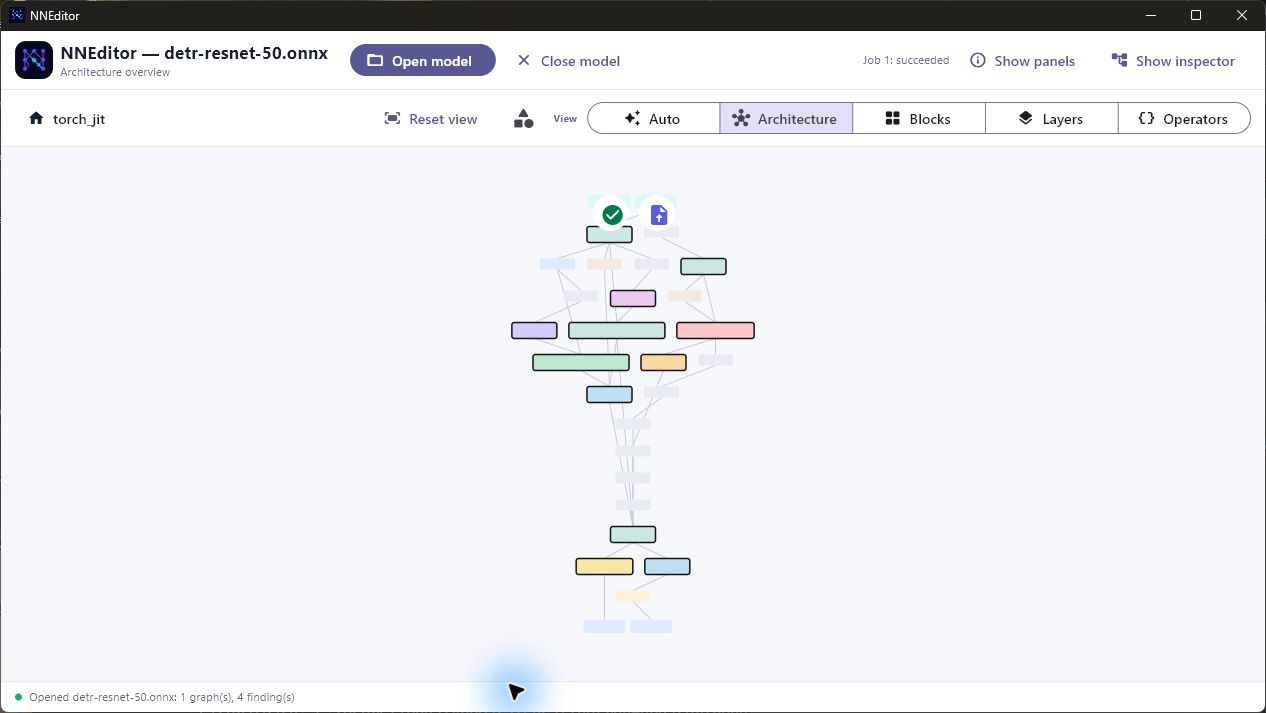
ONNX example: DETR ResNet-50
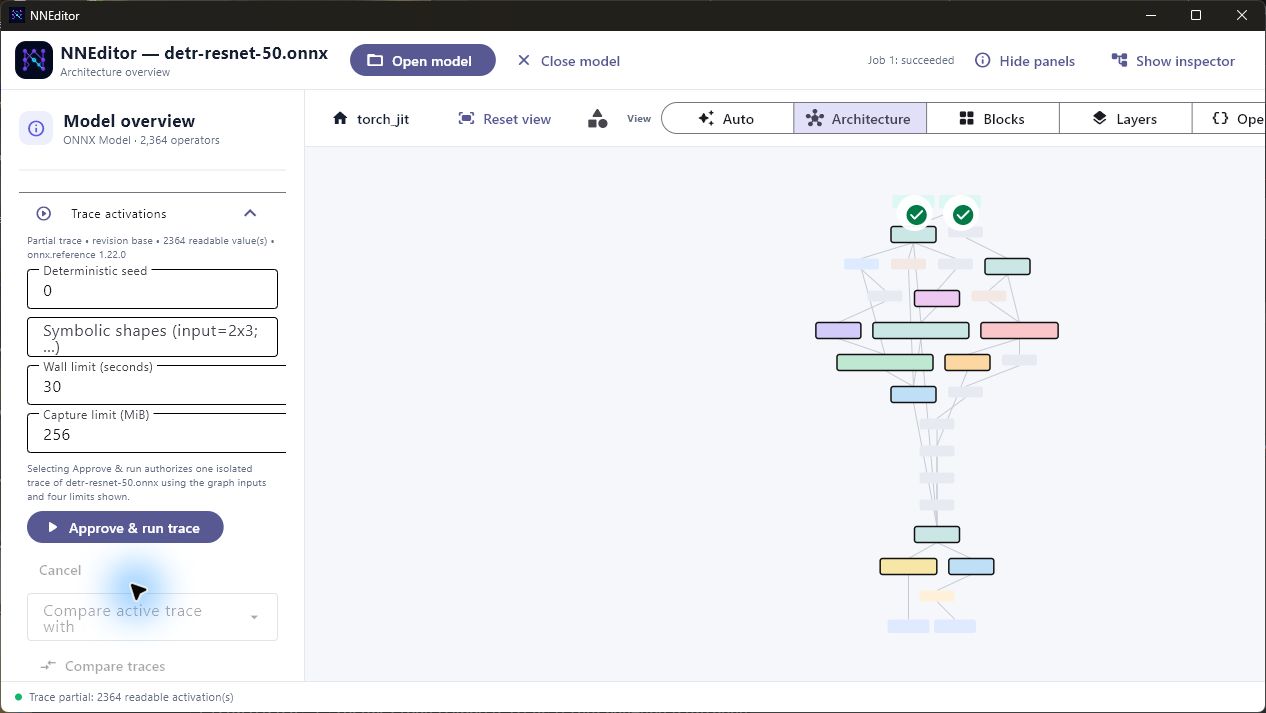
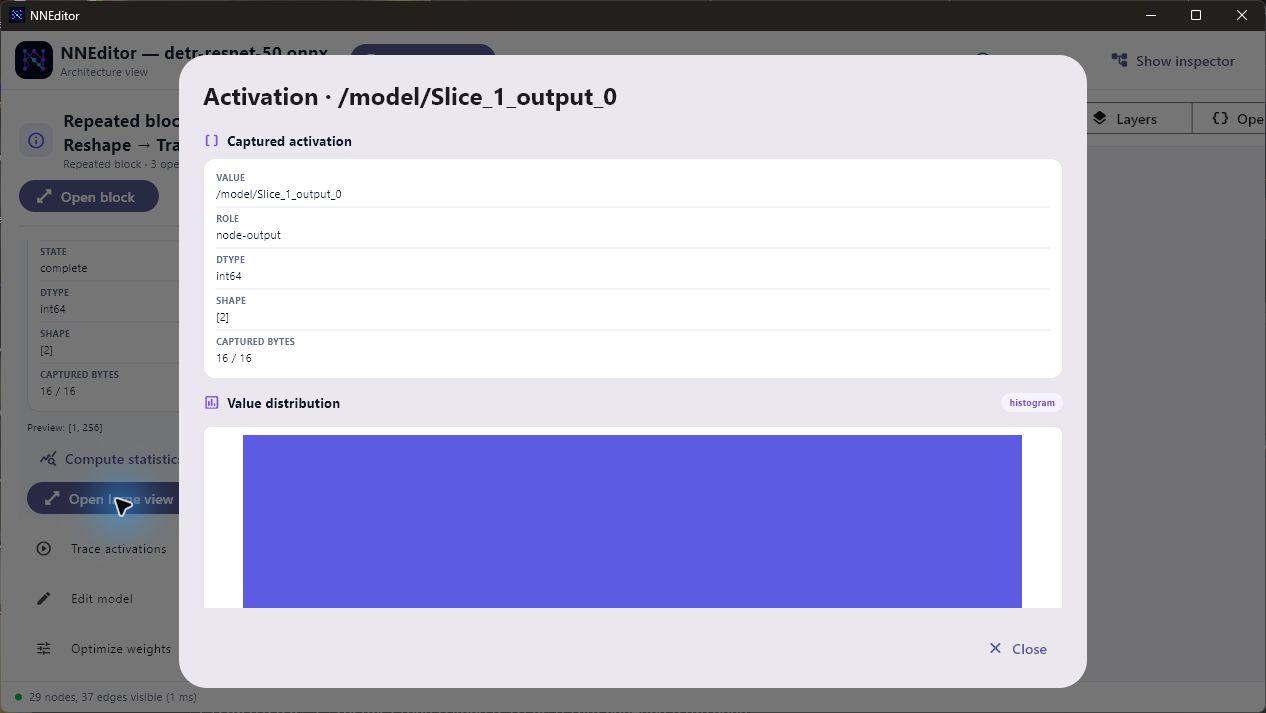
These screenshots come from a real desktop session with the 2,364-operator
detr-resnet-50.onnx model. The trace used the included fox image tensor and an
automatically generated all-valid pixel mask. It reached the approved 256 MiB
capture bound, so NNEditor reported an honest partial result while retaining
2,364 readable activations.
Navigate a model by architecture
Run a bounded activation trace
Open activation data in a large view
Highlights
- Navigate large graphs through architecture, block, layer, and operator views.
- Detect attention, feed-forward, convolutional, repeated, and structural regions with retained evidence and explanations.
- Read embedded and external tensors lazily through bounded byte ranges.
- Inspect tensor metadata, decoded previews, heatmaps, streaming statistics, and paged hexadecimal data.
- Apply reversible graph and tensor changes without modifying the source artifact.
- Save only when needed through a dirty-aware top-bar action, or close the current model without quitting the application.
- Generate safe
.npyor named.npztest inputs from images, masks, CSV data, synthetic time series, text token ids, or generic tensor patterns. Model inputs are detected and preconfigured automatically, and the complete generated set can be assigned in one action. - Tokenize prompt text into language-model input ids through a selectable
codebook: byte level, Unicode code points, or hashed words with no external
files, plus GPT-2/RoBERTa byte-level BPE loaded from a HuggingFace
vocab.jsonandmerges.txtor a singletokenizer.json, plus model-bound encoding from embedded GGUF vocabularies and merge tables. Every codebook states how faithful its ids are to the model's own tokenizer. - Preview quantization and pruning before committing them.
- Export validated ONNX revisions or clearly labelled weights-only artifacts.
- Trace ONNX activations in an isolated desktop worker and inspect values by clicking nodes, blocks, connections, inputs, or outputs.
- Add tracing runtimes through folder-based plugins, with ready-to-edit LLM, Mamba/Mamba2 SSM, and Stable Diffusion UNet templates.
- Inspect captured tensors through clickable ports in the Traced model pane, decode token IDs and logits, or process values in the Python tab with NumPy, SciPy, scikit-learn, and Matplotlib preloaded.
- Explain every unavailable action through an explicit artifact capability contract.
Supported artifacts
NNEditor identifies artifacts by their contents, not only by their extension. The table describes the built-in readers and the strongest release-level workflow available for each artifact.
| Artifact | Inspection | Editing | Export | Activation tracing |
|---|---|---|---|---|
| ONNX model, including external data | Graphs, weights, metadata | Validated graph and tensor subset | ONNX with validation and provenance | Available on desktop |
| PyTorch exported program | Graph, parameters, buffers, constraints | Parameter and buffer bytes | Weights-only safetensors | Unavailable |
| PyTorch state dictionary | Weights and tensor metadata | Tensor-level changes | Weights-only artifact | Unavailable |
| PyTorch FX graph module | Partial topology and metadata | Unavailable | Unavailable | Unavailable |
| Safetensors | Weights and header metadata | Tensor-level changes | Safetensors | Unavailable |
| Flax or Orbax checkpoint | Weights and tensor metadata | Tensor-level changes | Weights-only artifact | Unavailable |
| Textual StableHLO | Functions, regions, operations, attributes | Inspection only | Unavailable | Unavailable |
| Qualcomm DLC container | Decoded graph, typed weights, quantization encodings, container index | Unavailable | Unavailable | Unavailable |
| Core ML package (.mlpackage) | Manifest, model header, feature names, typed weight blobs | Unavailable | Unavailable | Unavailable |
| GGUF (v1, v2, v3, including big-endian) | Synthetic LLM graph, lazy weights, architecture metadata | Tensor-level changes | Unavailable | Supported decoder configurations on desktop |
| Hugging Face snapshot directory | LLM/SSM or supported Diffusers UNet graph, config, tokenizer, lazy safetensors shards | Tensor-level changes | Weights-only safetensors | Supported decoders; Mamba/Mamba2 and Stable Diffusion UNet through plugins |
Support is intentionally capability-specific. For example, opening a checkpoint does not imply that NNEditor can reconstruct a model graph, and reading StableHLO does not imply that NNEditor can write the dialect back. Unavailable actions explain the format-specific reason directly in the interface.
Ternary Bonsai 2 files using the qwen35 hybrid decoder, Prism PQ2_0 or
PTQ1_0 packed weights, and Hadamard transforms (including a version 2 tied
output head) support desktop tracing. The decoder implements gated full attention, partial text MRoPE,
causal convolution, and GatedDeltaNet recurrence. Weights stream in bounded
chunks, including the vocabulary projection; recurrent states reset for each
prompt. Select Prepare prompt input, generate or assign token IDs, then
select Approve & run trace. Word-hash inputs exercise the network; use
IDs from the model's tokenizer for a faithful text prompt.
Installation
NNEditor requires Python 3.12, 3.13, or 3.14.
python -m pip install nneditor==2.1.0
Start the desktop application with either command:
nneditor
python -m nneditor
Open a model directly from the command line:
nneditor path/to/model.onnx
On Windows, select File types in the top bar to register NNEditor for
.onnx, .pb, .pt2, .pt, .pth, .ckpt, .bin, .safetensors,
.mlir, .stablehlo, .dlc, and .gguf files. NNEditor then opens Windows Default apps,
where you choose which extensions should launch it. Registration is per-user
and never replaces a protected Windows default without that explicit choice.
First run
- Select Open model and choose a supported artifact. NNEditor detects its
format from the file contents. Directory bundles such as a Core ML
.mlpackageor a Hugging Face snapshot open through Open folder on the desktop shell, or directly from the command line. - Start in the architecture view, then open a block or change the detail level to move through blocks, layers, and operators.
- Select a node to inspect its ports, attributes, weights, and capability information.
- Use search, breadcrumbs, the hierarchy explorer, keyboard navigation, and the minimap to move around large models.
- Prepare edits or transformations in the left panel. NNEditor validates a preview before enabling Commit.
- After a commit, Save changes… appears in the top bar. Select it to export the current revision to a new destination; it disappears after a successful save and returns after another change.
- Select Close model to release the current artifact and return to the start screen without quitting NNEditor.
The opened source remains unchanged throughout this workflow. A recovered sidecar revision is treated as unsaved and offers Save changes… immediately.
Large imports, statistics, exports, and traces run as cancellable background jobs. The interface reports partial or unavailable data instead of presenting it as complete.
Activation tracing
Desktop tracing is available for ONNX models, GGUF files, and Hugging Face snapshots.
- Open Generate test input. NNEditor detects every model input and creates
a preset from its name, dtype, and shape. Symbolic or unknown extents default
to 1 and this assumption is shown in the input plan. Automatic from input
is the default input source and generates deterministic values directly from
that preset. Select an image, text, CSV, time-series, mask, or generic tensor
source when you want to provide the values instead. When every input has a
supported dtype and declared shape,
use Generate & assign all detected inputs to create and validate the
complete input set in one directory. You can also click the
tensor-picker button inside an input node and choose an existing safe NumPy
.npytensor or.npzarchive. NPZ arrays match inputs by name; a single-array archive can also be assigned directly. Image dimensions are shown and applied as height then width, matching tensor shape conventions. Fixed Qwen3-VLpixel_valuesinputs automatically use the model-compatible flattened-patch profile. Required*_maskinputs left unchanged use an automatically generated all-valid mask; other inputs use deterministic random data. GGUF files and Hugging Face snapshots open the Text tokens source with a catalog of sample prompts. Sequence length left blank keeps the prompt's natural token length. GGUF models default to their embedded vocabulary, BPE merge table, declared pre-tokenizer, and special-token insertion flags; npz output stores an array named for the selected model input. Supported embedded byte-BPE rules include GPT-2, Qwen2, Qwen3.5/Bonsai, and Llama 3. Missing or unsupported GGUF tokenizer data produces an explicit error; synthetic codebooks remain an explicit smoke-test choice. A Hugging Facetokenizer.jsonis used when it is a complete byte-level BPE; otherwise its prompt preparation offers a clearly labelled hashed-word smoke test. - Open Trace activations, review the execution backend, execution device,
input specification, and wall-clock, memory, capture, and chunk limits.
For ONNX, Automatic tries installed GPU and NPU execution providers
before CPU; an explicit GPU or NPU choice is strict and never silently runs
on CPU. Automatic backend mode falls back from ONNX Runtime to NNEditor's
axis-aware ONNX reference evaluator when no compatible runtime provider is
available. The normalized reference option rewrites nonzero
Scanaxes with semantics-preserving transposes inside the private worker model. GGUF and Hugging Face traces run a numpy decoder-only forward pass on CPU. ONNX Runtime is not a backend for those formats. - Select Approve & run trace. This click creates an approval bound to the current model, inputs, and limits for that run only.
- A successful trace opens the Traced model pane. It keeps the model graph's block structure and connections, adding small clickable ellipse ports: inputs on top of each block and outputs below. Hover over a port for its tensor name, shape, and capture status. Click a block to open its contents; Parent block returns through the same hierarchy as Model graph.
- Click a port to open its tensor overlay. View shows a bounded table of
values with row, column, and leading-axis slice controls. Statistics and
Visualization load on demand and reuse cached results. Visualizations
include histograms, line views, heatmaps, feature maps, and attention views
where applicable. Export captured values as
.npyand raster views as PNG. Python provides a script editor with the capturedtensor,metadata, NumPy (np),math, SciPy (scipy), scikit-learn (sklearn, alsoscikit), and Matplotlib (matplotlib,plt) preloaded. Printed output, the last expression or a variable namedresult, and figures appear below the script. Run script or Ctrl+Enter starts a fresh process; Stop cancels it. Timeout and RAM controls bound a run. Scripts may import other installed libraries and save files using absolute paths. In-place processing leaves the captured tensor intact. A partial capture is exposed as a flat prefix, with the original shape inmetadata['shape'].
The View tab also offers Decode captured tokens on token inputs and
Inspect next-token predictions on language-model logits. It uses the model's
GGUF vocabulary or Hugging Face tokenizer.json, supports batch and position
selection, and can retain special tokens. Logits show the greedy candidate and
top token probabilities for a complete captured vocabulary row. This is a
forward-pass prediction, rather than an autoregressively generated response.
Missing tokenizer data and incomplete logit rows are reported explicitly.
Hashed-word smoke-test inputs cannot recover their original prompt text.
For GGUF models, the overlay identifies the file and its embedded vocabulary
size. A gpt2 decoding label means the byte-decoding algorithm declared by the
file; token IDs still use that GGUF's own tokenizer.ggml.tokens table, including
model-specific Qwen or Bonsai tokens. No external GPT-2 vocabulary is substituted.
Use the trace picker to revisit a captured run. Drag the graph to pan, scroll
to zoom, or search for a block or tensor and press Enter to jump to a match.
Fit graph shows the whole structure; Readable view restores a closer
view. Wide block signatures collect extra tensors into a + port that opens
a tensor chooser. Preview and unavailable captures are marked explicitly.
After a model edit, older traces remain inspectable in Captured tensors;
run another trace to show ports on the changed graph. The Model graph
inspector and its existing activation views also remain available.
The top-right device indicator shows the provider that actually completed the latest trace. NNEditor recognizes ONNX Runtime's CUDA, TensorRT, DirectML, OpenVINO GPU, MIGraphX, and ROCm GPU providers, plus OpenVINO NPU, Qualcomm QNN HTP, and AMD Vitis AI NPU providers.
The base NNEditor installation ships no ONNX Runtime: every accelerator family
publishes its own distribution and all of them own the same onnxruntime
import name, so a fixed dependency on one would block the others. Install
exactly one runtime extra for the hardware you want to trace on:
| Install | Runtime |
|---|---|
pip install nneditor[runtime] |
CPU |
pip install nneditor[runtime-gpu] |
NVIDIA CUDA / TensorRT |
pip install nneditor[runtime-directml] |
Any Windows GPU via DirectML |
pip install nneditor[runtime-qnn] |
Qualcomm NPU (QNN HTP) |
pip install nneditor[runtime-openvino] |
Intel GPU and NPU via OpenVINO |
Without a runtime, automatic backend selection uses NNEditor's axis-aware ONNX reference evaluator on CPU and says so; an explicit ONNX Runtime, GPU, or NPU request fails with the extra to install. Accelerators additionally need their vendor drivers in the same environment; follow the provider vendor's compatibility and installation instructions.
Ready-made image and time-series tensors are available in examples/trace-inputs.
Input tensors are checked against the model's declared dtype and shape. Approval is created only when Approve & run trace is selected, so a changed input or limit cannot reuse stale consent. The UI captures graph inputs and operator outputs by default so inspection does not depend on the selection that was active when the trace began.
Tracing uses an isolated, resource-limited process. ONNX traces use ONNX Runtime or NNEditor's axis-aware reference evaluator. GGUF and Hugging Face traces use a numpy decoder-only worker that streams one layer at a time (Llama-style RMSNorm, RoPE, grouped-query attention, and SwiGLU, plus GPT-2-style fused projections where tensor names allow). Packed ggml types without a decoder, other SSM architectures, scaled RoPE, sliding-window attention, pickle shards, and in-memory edits are refused before execution. Unsupported models remain available for inspection. Captures stream to disk as layers complete; the trace panel guides prompt preparation and shows the CPU backend.
GGUF Qwen3.5 dense text traces also support Prism's g128 ternary packings, explicit Hadamard signs, inverse embedding transforms, and grouped recurrent output projections. Matrix products use decoded float32 weights and activations; results can differ from optimized runtimes that additionally quantize activations. Multimodal inputs and MoE decoders are not implemented. The approved memory ceiling limits host RAM; device memory remains under the accelerator provider and driver. A failed or cancelled run publishes no trace. Desktop subprocess isolation is not a multi-tenant security boundary, so tracing is disabled in the browser application until a dedicated worker service is available.
Tracing plugins and extensions
A tracing plugin connects an execution runtime to NNEditor's imported model graph. It receives the prepared inputs, runs a forward pass, and publishes activations against graph value names or IDs. NNEditor supplies plugin discovery, the approved worker process, resource limits, capture storage, and the tensor inspection UI. The same plugin can handle a model family when the checkpoints share the execution semantics it implements.
Plugins are ordinary folders containing a JSON manifest and a Python entry point. No NNEditor source changes or Python package registration are needed to add a runtime for an existing imported graph. A new artifact format or graph structure also needs an appropriate model reader; a tracing plugin does not register readers or create graph topology.
NNEditor 2.1.0 uses tracing API version 1. Keep api_version: 1 in plugin
manifests. The application version, SDK API version, and each plugin's own
version are separate.
Available tracers
| Tracer | Supported artifacts and execution | Runtime installation |
|---|---|---|
| ONNX tracing, built in | ONNX Runtime or the reference evaluator; CPU and supported accelerators | Optional nneditor[runtime] or the appropriate accelerator extra |
| NumPy LLM decoder, built in | Supported GGUF and Hugging Face Llama, GPT-2, Qwen, and Bonsai decoder configurations on CPU | Included in nneditor |
| Mamba / Mamba2 SSM, bundled plugin | Local Hugging Face Mamba and Mamba2 safetensors checkpoints on CPU | nneditor[tracer-ssm] |
| Stable Diffusion UNet, bundled plugin | Diffusers UNet2DConditionModel and UNet2DModel components on CPU |
nneditor[tracer-diffusion] |
| LLaVA, Qwen2-VL, and Gemma 3, bundled plugin | Local vision-language snapshots on CPU | nneditor[tracer-modalities] |
| BitNet, bundled plugin | Local BitNet snapshots and float32 BitNet GGUF files on CPU | nneditor[tracer-modalities] |
| GGUF vision and Whisper, bundled plugin | CLIP vision and Whisper GGUF files, including Q4 and Q8 weights, on CPU | nneditor[tracer-modalities] |
| SD3 and Flux, bundled plugin | Local SD3 and Flux transformer folders on CPU | nneditor[tracer-modalities] |
| CogVideoX and Wan, bundled plugin | Local video transformer folders on CPU | nneditor[tracer-modalities] |
| Whisper, bundled plugin | Local Whisper checkpoints on CPU | nneditor[tracer-modalities] |
| T5, bundled plugin | Local T5 checkpoints on CPU | nneditor[tracer-modalities] |
| RWKV, bundled plugin | Local RWKV checkpoints on CPU | nneditor[tracer-modalities] |
Whisper and vision-language tracing runs one CPU forward pass. Automatic from
input prepares coordinated synthetic inputs for diagnostics: Whisper mel
features at the configured frame count and a decoder start token, or image
tensors with matching image placeholders and grid metadata. These inputs do not
represent a recording, photograph, or user prompt. For real media, prepare named
.npy or .npz tensors with the checkpoint's processor and assign the complete
input set using the graph's input names. Generic image resizing does not replace
model-specific preprocessing.
GGUF Whisper requires decoder-start or BOS metadata for an automatic prefix.
If it is absent, assign the decoder tokens explicitly.
Captured stages distinguish Whisper convolutions, positional embeddings, encoder and decoder blocks, and final logits. Vision-language graphs expose feature selection and image/text merging. GGUF CLIP exposes each vision block, the pooled output, and a separate sequence output. These tracers load the model in float32 on CPU. They do not perform autoregressive transcription or caption generation.
Install optional runtimes in the same Python environment as NNEditor:
python -m pip install "nneditor[tracer-ssm]==2.1.0"
python -m pip install "nneditor[tracer-diffusion]==2.1.0"
python -m pip install "nneditor[tracer-modalities]==2.1.0"
Mamba / Mamba2 SSM: open the checkpoint folder and prepare integer token IDs. The plugin captures embeddings, complete SSM blocks, final normalization, and logits, with fresh recurrent state for each run.
Stable Diffusion UNet: open the pipeline's unet folder containing
config.json and safetensors weights. Supported configurations include Stable
Diffusion 1.x, 2.x, and SDXL base/refiner conditioning. The graph exposes noisy
latents, timesteps, conditioning embeddings, down/up blocks, the bottleneck,
and actual skip tensors. SDXL adds pooled-text embeddings and time IDs. Supply
.npy inputs or use deterministic random tensors for a smoke test. A trace runs
one denoising forward pass and captures the latent/noise prediction; text
encoders, scheduler iterations, and VAE image decoding belong to the surrounding
pipeline.
Both bundled plugins refuse missing or incompatible weights. Their numerical tests compare captured outputs with native model forwards. Unsupported UNet configurations remain available for weight inspection. Example open-weight checkpoints are Mamba 130M, Mamba2 130M, and the UNet components of Stable Diffusion 1.5 and Stable Diffusion XL.
Install and use a plugin
-
Install the plugin's runtime dependencies in NNEditor's Python environment.
-
In Trace, choose Install a tracer folder, or run:
nneditor --install-tracer ./my-tracer
nneditor --list-tracers
-
If NNEditor is already open, choose Reload tracer extensions. Select the tracer in Trace. The panel explains incompatible architectures, operators, weight types, and missing dependencies before execution.
-
Prepare inputs, select the device and resource limits, and choose Approve & run trace.
-
Inspect the captured run in Traced model. Click the small ellipse input or output ports to open View, Statistics, Visualization, or Python. Compatible token and logits captures also offer decoded text.
Installation validates and copies the folder into the per-user tracer directory
printed by --list-tracers. It does not import the plugin's Python code and
refuses to overwrite an existing installation. Bundled plugins are discovered
automatically; only their optional runtimes need installation.
Author a new plugin
1. Generate a working template. Choose the implementation closest to your model family:
nneditor --create-tracer ./my-llm-tracer --tracer-template llm
nneditor --create-tracer ./my-ssm-tracer --tracer-template ssm
nneditor --create-tracer ./my-diffusion-tracer --tracer-template diffusion
The llm template is the default when --tracer-template is omitted. It delegates
to NNEditor's existing NumPy decoder. The ssm and diffusion templates copy the
working bundled implementations. Each command creates a new folder:
my-llm-tracer/
  nneditor-tracer.json
  tracer.py
Add helper modules or small data files alongside the entry point as needed.
Relative sibling imports, such as from .helpers import forward, are supported.
Keep installed runtime packages and model weights outside the plugin folder;
plugin folders are limited to 32 MiB and 1,024 files and cannot contain symlinks.
2. Set the plugin identity and compatibility. Give every installed plugin a
unique lowercase id, a readable name, and its own version. Generated SSM
and diffusion copies use example.* IDs to avoid colliding with bundled plugins;
replace them before distributing your plugin. A working NumPy-decoder manifest
can be as small as:
{
  "api_version": 1,
  "id": "mycompany.numpy-decoder",
  "name": "My NumPy decoder",
  "version": "0.1.0",
  "entry_point": "tracer.py:trace",
  "artifact_kinds": ["gguf_model", "huggingface_model"],
  "architectures": ["llama", "gpt2", "qwen2", "qwen3", "qwen35"],
  "devices": ["cpu"],
  "streaming_weights": true
}
| Manifest field | Meaning |
|---|---|
api_version |
Required SDK version; currently 1. |
id, name, version |
Required plugin identity, display name, and implementation version. The builtin.* ID namespace is reserved. |
entry_point |
Required relative Python file and callable, such as tracer.py:trace or runtime/tracer.py:trace. |
artifact_kinds |
Required nonempty list of imported artifact kinds, such as gguf_model, huggingface_model, or onnx_model. |
architectures |
Optional allowlist matching the GGUF architecture, Hugging Face model_type, or Diffusers _class_name. |
element_types, operators |
Optional allowlists for weight element types and graph operator names the runtime supports. |
devices |
Concrete devices: cpu, gpu, or npu. Defaults to CPU. The plugin implements execution on its declared devices. |
python_modules |
Optional list of top-level import names to check before execution, such as torch and diffusers. Dependencies are installed separately. |
install_extra |
Optional missing-dependency hint for an existing NNEditor extra, used by the bundled plugins. It does not install packages or define a new extra. |
streaming_weights |
Defaults to false, with whole-model RAM defaults. Use true only if the implementation loads bounded weight portions at a time. |
description |
Optional explanation displayed in the trace panel. |
Compatibility filters describe what the implementation can execute. Adding an architecture to the manifest does not implement its forward pass or guarantee that a quantized weight format is supported.
3. Implement trace(context). Import the public SDK from
nneditor.tracing.sdk. This complete entry point works with the manifest above:
from nneditor.tracing.sdk import TraceContext, TraceOutcome


def trace(context: TraceContext) -> TraceOutcome:
    return context.trace_numpy_decoder()
For a new runtime, replace the delegation with your model's forward pass.
Validate the configuration and checkpoint weights, call
context.capture_inputs(), and publish intermediate and output arrays as soon
as they are ready. These are the public integration points:
| SDK member | Purpose |
|---|---|
context.document |
Imported graph and tensor references. Use main_graph.values to inspect capture IDs and names. |
context.inputs |
Prepared NumPy arrays keyed by model input names. |
context.metadata |
GGUF metadata or the Hugging Face/Diffusers configuration. |
context.tensors |
Lazy weight store; read(...) supports bounded byte ranges. |
context.load_weight(name_or_id) |
Decode one supported weight. Read slices instead when a whole decoded tensor would exceed your budget. |
context.device, context.limits |
Selected execution device and approved resource limits. |
context.capture_inputs() |
Publish declared input arrays. |
context.capture(value_name_or_id, array) |
Publish a real numeric NumPy activation against one existing graph value. |
context.trace_numpy_decoder() |
Reuse NNEditor's built-in streaming LLM implementation. |
Capture names must identify a unique value in context.document.main_graph;
use value IDs if names are ambiguous. Emit each value once per forward pass.
For example, a compatible decoder can publish
context.capture("lm-head", logits_array) when its graph contains that value.
NNEditor applies capture selection and byte budgets; missing requested values
are visibly marked as dropped. Return TraceOutcome(provider="my-runtime", notes=("Runtime build 1.0",)) to identify execution details, or return None.
Raise TracePluginError for an actionable configuration or runtime error.
Custom plugins execute source artifacts; the built-in ONNX tracer also supports
edited revisions.
4. Develop without reinstalling. Point discovery at your source folder:
# Linux/macOS; multiple paths are separated by a colon.
export NNEDITOR_TRACE_PLUGIN_PATH="$PWD/my-llm-tracer"
nneditor --list-tracers
nneditor path/to/model.gguf
# PowerShell; multiple paths are separated by a semicolon.
$env:NNEDITOR_TRACE_PLUGIN_PATH = (Resolve-Path .\my-llm-tracer).Path
nneditor --list-tracers
nneditor path/to/model.gguf
A search path can name one plugin folder or a directory containing plugin
folders. Use Reload tracer extensions after edits. For a distributable
installation, share the folder containing the manifest and source, document its
runtime dependencies, and use --install-tracer. Increment the plugin's
version when shipping changes. To update an installed copy, first locate its
folder with --list-tracers, back it up or remove it, then install the new copy.
5. Validate with a small real model. Check input and output shapes, compare captured outputs with the runtime's native forward pass, and confirm that every intended graph port is captured. Exercise an incompatible configuration, a missing dependency, cancellation, and the selected resource limits. The plugin tests and Mamba/Stable Diffusion numerical tests show working test patterns. Core contributors can run them with:
uv run python -m pytest tests/unit/test_trace_plugins.py tests/unit/test_family_graphs.py
uv run python -m pytest tests/integration/test_family_tracers.py
Discovery and execution behavior
Discovery reads manifests and fingerprints plugin files without importing their
Python entry points. Duplicate plugin IDs disable the conflicting entries;
malformed manifests appear in --list-tracers diagnostics. A disabled trace
button should be resolved through the displayed compatibility or installation
message, then by reloading plugins and preparing the required inputs.
Approvals and capture identities bind the plugin version, code fingerprint, and NNEditor version. NNEditor snapshots the approved code before execution; edits require a fresh selection and approval. Plugin code runs in the resource-limited worker with timeout, cancellation, and capture handling. These limits are not an operating-system security sandbox: install trusted plugin code. Artifact files are never treated as plugins.
Editing and optimization
Validated ONNX editing
The 1.0 release supports a deliberately bounded entry-graph edit surface:
- rename nodes;
- edit supported scalar and list attributes;
- replace compatible operators;
- insert or remove validated unary operators;
- reconnect compatible inputs; and
- replace same-length tensor byte ranges.
Every change is prepared as a transaction, checked against the graph and ONNX schema, and committed as a reversible revision. Undo, redo, recovery, diff previews, and export provenance use the same revision chain.
Quantization and pruning
NNEditor can preview and commit:
- 8-bit signed or unsigned, symmetric or asymmetric weight conversion;
- per-tensor and per-channel quantization;
- portable ONNX QuantizeLinear/DequantizeLinear insertion;
- threshold, mask, and exact
N:Mlogical pruning; and - a shape-proven terminal
MatMulchannel-pruning pattern.
The UI distinguishes a mathematical conversion from storage reduction or runtime acceleration. Logical sparsity alone is never advertised as a smaller or faster model.
Safety and data integrity
NNEditor is safe-artifact-first:
- Import parses artifact bytes without importing or executing Python stored in the artifact.
- Pickle-based PyTorch containers are inspected through a restricted, non-executing reader.
- Source artifacts are immutable and identified by cryptographic content hashes.
- External tensor files are verified before their bytes are used.
- Tensor reads, caches, statistics, capture storage, and writes are bounded.
- Unsupported or ambiguous edits are rejected rather than approximated.
- Exports are staged, validated, and published as new artifacts.
- Inference requires explicit per-run approval and enforced resource limits.
Large-model design
NNEditor avoids eager model materialization during normal inspection. Its ONNX reader indexes protobuf wire ranges directly, tensor storage uses range reads and bounded caches, and semantic graph levels keep the visible working set manageable. The renderer is behind a toolkit-neutral contract and uses culling, persistent shapes, and deterministic aggregation.
These choices make ordinary navigation responsive without pretending that an unaggregated view containing tens of thousands of visible operators is cheap.
Platform support
The desktop application targets:
- 64-bit Windows 10 and 11;
- macOS 12 or newer; and
- Debian 10–12 and Ubuntu 20.04, 22.04, and 24.04 LTS.
CI exercises Python 3.12, 3.13, and 3.14 on Linux and Python 3.14 on Windows. The dynamic Flet browser application supports model inspection and editing, but desktop-only tracing and browser multi-file export packaging remain unavailable. Mobile packaging is outside the 1.0 release.
Known boundaries
- Structural editing is limited to validated ONNX entry-graph cases.
- Custom or unknown operator schemas may be inspected but are not guessed during editing or tracing.
- PyTorch graph re-serialization and ONNX conversion are not included.
- Textual StableHLO is inspection-only.
- Weights-only exports do not contain executable topology.
- Browser tracing is disabled pending multi-user worker isolation.
- Text tokenization ships no vocabularies: byte, code-point, and hashed-word codebooks are self-contained, while BPE needs the model's own vocabulary files. The BPE pre-tokenizer approximates GPT-2's, so ids can differ from the reference tokenizer on unusual scripts or symbol runs; each codebook reports its own fidelity and the generated tensor records it.
- The original Python, module definitions, and training code cannot be reconstructed from serialized artifacts.
Author
NNEditor was developed by Imed Bouazizi.
License
NNEditor is licensed under the Apache License 2.0. Attribution and copyright information is provided in NOTICE.
Development
The development environment is managed with uv:
uv sync --locked --group dev
Run the desktop application:
uv run flet run src/main.py
Run the browser application:
uv run flet run --web src/main.py
On Windows, a moved or restored checkout can leave stale console-script paths
inside .venv. If uv run flet reports Failed to canonicalize script path,
repair the environment with uv sync --locked --group dev --reinstall before
launching it again. Python-backed quality gates use module invocation below so
they do not depend on those script shims.
Run the release quality gates:
uv run ruff format --check .
uv run ruff check .
uv run python -m mypy
uv run python -m pytest -m "not performance" \
  --cov=nneditor \
  --cov-report=term-missing \
  --cov-fail-under=90
uv run python -m pytest -m performance tests/performance
Build and validate the distributions:
uv build --clear
uvx twine check --strict dist/*
1 maintainer

Metadata
1 maintainer
Release files for nneditor 2.1.0
For a detailed explanation of source distributions (sdists) and built distributions (wheels), please see the package formats documentation.
Source distribution (sdist)
| File | Size | Uploaded | Provenance | Actions |
|---|---|---|---|---|
| nneditor-2.1.0.tar.gz | 1.3 MB | With provenance | Details for nneditor-2.1.0.tar.gz |
Built distribution (wheel)
| File | Interpreter | ABI | Platform | Actions Reset |
|---|---|---|---|---|
| nneditor-2.1.0-py3-none-any.whl | Python 3 | none | any | Details for nneditor-2.1.0-py3-none-any.whl |
Total release size: 2.7 MB
Release files / nneditor-2.1.0.tar.gz
| Download URL | nneditor-2.1.0.tar.gz |
|---|---|
| Size | 1.3 MB |
| Tags | Source |
|
SHA-256 checksum How to use checksums |
a9ff095b31b675bc8e19ac1556d091bd8f7851d8596e8ebed351ff5024fc0b19
|
|
BLAKE2b-256 checksum How to use checksums |
3a5f3cd43d5725df16991ad7d1185e80c97e1c3066969eb14272437f9fc9ff4f
|
| Upload date | |
|
Uploaded using Trusted Publishing? What is trusted publishing? |
Yes |
| Uploaded via |
twine/7.0.0 CPython/3.13.16
|
Provenance
Provenance describes where a file came from. On PyPI, provenance is shared via attestations, which provide a verifiable record of the build or publishing details. View details, limitations and caveats.


PyPI Publish Attestation
PyPI verified that this artifact, at this checksum, originated from the publisher listed below.
Signed by GitHub Actions, verified by PyPI on Nov 2, 2026.
Transparency logRelease files / nneditor-2.1.0-py3-none-any.whl
| Download URL | nneditor-2.1.0-py3-none-any.whl |
|---|---|
| Size | 1.4 MB |
| Tags | Python 3 |
|
SHA-256 checksum How to use checksums |
0b505888f2d9b287a4f1049056d73704d05e5826de58e9a6be0f02416744f135
|
|
BLAKE2b-256 checksum How to use checksums |
b5604f347a7ac98fa97cb56a3b628943c93cda3f2bcb51c153b18e612e4d1178
|
| Upload date | |
|
Uploaded using Trusted Publishing? What is trusted publishing? |
Yes |
| Uploaded via |
twine/7.0.0 CPython/3.13.16
|
Provenance
Provenance describes where a file came from. On PyPI, provenance is shared via attestations, which provide a verifiable record of the build or publishing details. View details, limitations and caveats.
PyPI Publish Attestation
PyPI verified that this artifact, at this checksum, originated from the publisher listed below.
Signed by GitHub Actions, verified by PyPI on Nov 2, 2026.
Transparency logSecurity for nneditor 2.1.0
Provenance
Provenance describes where a file came from. On PyPI, provenance is shared via attestations, which provide a verifiable record of the build or publishing details. View details, limitations and caveats.
Full provenance
All 2 files in this release have been uploaded with provenance metadata.
Attestation for nneditor-2.1.0.tar.gz
PyPI Publish Attestation
PyPI verified that this artifact, at this checksum, originated from the publisher listed below.
Signed by GitHub Actions, verified by PyPI on Nov 2, 2026.
Transparency logA note on package security
PyPI is a repository for distributing packages, not a service for auditing them. While third-party security researchers and our staff do their best to detect and remove malicious packages, PyPI cannot guarantee the quality, security or suitability of any given package.
To learn more about protecting yourself from malicious actors, visit our package security documentation.














