
npcpy is the premier open-source library for integrating LLMs and Agents into python systems.

Project description

npcpy
npcpy is a library that provides key functional primitives for conducting research in multimodal language models, agentic AI, and knowledge graphs. This flexible framework makes it easy to develop and engineer powerful AI applications, with support for local (ollama, llama.cpp, omlx, LM Studio) and cloud providers. Build multi-agent teams and simplify your context engineering through the NPC Context-Agent-Tool data layer with compliance engineered natively rather than an afterthought.
pip install npcpy
Quick Examples
Create and use personas
from npcpy import NPC

simon = NPC(
    name='Simon Bolivar',
    primary_directive='Liberate South America from the Spanish Royalists.',
    model='qwen3.5:9b',
    provider='ollama'
)
response = simon.get_llm_response("What is the most important territory to retain in the Andes?")
print(response['response'])
My friend, you speak of the highlands where our liberty is carved in stone. If we must speak of the most critical territory to hold within these mountains, it is the **Viceroyalty of Peru** and the heart of the **Republic of Gran Colombia** united.
To lose the passes of the Andes or the cities of Lima and Quito would be to hand the crown its final stronghold in the south. The Spanish crown built its power upon the wealth and control of these highlands. If the Andes are to be truly ours, the people of the **Peruvian** and **New Grancolombian** highlands must stand as one, free from the Bourbons.
The mountain peaks themselves are the fortress we guard. Without the full liberation of the southern Andes, our revolution is incomplete. We fight not for land's sake, but for the soul of the continent. Every square mile of the Andes that bears the name of the Republic is a step forward in our quest for eternal freedom.
*Long live the liberty of the Andes!*
Direct LLM call
from npcpy import get_llm_response


response = get_llm_response("Who was the celtic god that helped cuchulainn in his time of need as the forces of medb descended upon the men of ulster?", model='gemma4:31b', provider='ollama')
print(response['response'])
Cú Chulainn was primarily aided by his divine father, the god Lugh, and his foster-father, the warrior-god Fergus mac Róich, as well as the magical support of his teacher Scáthach.
# try ollama's cloud models
alicanto_test = get_llm_response('what does alicanto the bird show travelers in the night?', model='minimax-m2.7:cloud', provider='ollama',)

print(alicanto_test['response'])
The legend of the **Alicanto** says that at night the bird’s feathers glow like lanterns.
When a traveler sees that soft, phosphorescent light, it isn’t just a pretty sight – it’s a sign‑post.
The bird **shows the way to hidden water (and sometimes to buried silver or gold)** in the Atacama Desert.
Agent with tools
The Agent class in npcpy comes with a set of default tools (sh, python, edit_file, web_search, etc.)
from npcpy import Agent
agent = Agent(name='File Operator', model='qwen3.5:2b', provider='ollama')
print(agent.run("Find all Python files over 500 lines in this repo and list them"))
The following Python files contain more than 500 lines:
 - `./npcpy/npc_sysenv.py` (1486 lines)
 - `./npcpy/memory/knowledge_graph.py` (1449 lines)
 - `./npcpy/memory/kg_vis.py` (767 lines)
 - `./npcpy/memory/kg_population.py` (618 lines)
...
ToolAgent
Attach custom tools to a ToolAgent.
Here is an example which lets an agent generate images, fine-tune diffusion models, and then use the fine-tuned models for generation.
from npcpy import ToolAgent, gen_image
from npcpy.ft.diff import train_diffusion, generate_image, DiffusionConfig
from datasets import load_dataset
import os

def fetch_image_dataset(dataset_name: str, split: str = "train", max_images: int = 100) -> list:
    """Fetch images from a HuggingFace dataset.

    Args:
        dataset_name: HuggingFace dataset name (e.g., 'cifar10', 'oxford-iiit-pet')
        split: Dataset split to use
        max_images: Maximum number of images to fetch

    Returns:
        List of paths to saved images
    """
    dataset = load_dataset(dataset_name, split=f"{split}[:{max_images}]")
    os.makedirs("training_images", exist_ok=True)
    image_paths = []

    for i, item in enumerate(dataset):
        if 'image' in item:
            img = item['image']
        elif 'img' in item:
            img = item['img']
        else:
            continue
        path = f"training_images/img_{i:04d}.png"
        img.save(path)
        image_paths.append(path)

    return image_paths

def finetune_diffusion_model(
    image_paths: list,
    captions: list = None,
    output_path: str = "my_diffusion_model",
    num_epochs: int = 50,
) -> str:
    """Fine-tune a diffusion model on a set of images.

    Args:
        image_paths: List of paths to training images
        captions: Optional captions for each image
        output_path: Where to save the trained model
        num_epochs: Number of training epochs

    Returns:
        Path to the trained model
    """
    if captions is None:
        captions = ["an image"] * len(image_paths)

    config = DiffusionConfig(
        image_size=64,
        channels=128,
        num_epochs=num_epochs,
        batch_size=8,
        learning_rate=1e-4,
        checkpoint_frequency=10,
        output_model_path=output_path,
    )

    model_path = train_diffusion(image_paths, captions, config=config)
    return model_path

# Create an agent with image generation and fine-tuning capabilities
creative_agent = ToolAgent(
    name='creative_diffusion',
    primary_directive="""
        You help users generate images and fine-tune diffusion models.
        You can: 1) Generate images using gen_image() with various prompts,
        2) Fetch image datasets from HuggingFace,
        3) Fine-tune diffusion models on custom image sets.
        When a user submits an image or describes a style they like,
        offer to fetch similar images from a dataset and fine-tune a model.
    """,
    tools=[fetch_image_dataset, finetune_diffusion_model, gen_image],
    model='qwen3.5:2b',
    provider='ollama'
)

# Example 1: Generate images
print(creative_agent.run("Generate 3 images of geometric patterns with circles and triangles"))

# Example 2: User submits an image and wants similar ones
# The agent can fetch a dataset of patterns and fine-tune a model
print(creative_agent.run("I like abstract geometric patterns. Can you fetch the cifar10 dataset and fine-tune a diffusion model that can generate images like these patterns?"))
CodingAgent — auto-executes code blocks from LLM responses
from npcpy import CodingAgent

coder = CodingAgent(name='coder', language='python', model='qwen3.5:2b', provider='ollama')
print(coder.run("Write a script that finds duplicate files by hash in the current directory"))
#The script has been created and executed successfully. Here's a summary of the findings:

## Duplicate Files Found

| Group | Hash (truncated) | Size | Files |
|-------|------------------|------|-------|
| 1 | `2b517326bf7c31b7...` | 81 bytes | `npcpy/main.py` ↔ `build/lib/npcpy/main.py` |
| 2 | `d41d8cd98f00b204...` | 0 bytes (empty) | 15 empty `__init__.py` files across `npcpy/`, `build/lib/npcpy/`, `examples/`, and `tests/` || 3 | `0d591b661cb1c619...` | 9,019 bytes | `npcpy/mix/debate.py` ↔ `build/lib/npcpy/mix/debate.py` |
| 4 | `a5059f37eb682a16...` | 747 bytes | SQL files in `examples/factory/` ↔ `examples/npc_team/factory/` |
### Multi-Agent Debate with NPCArray

To run a true multi-agent debate where agents react to each other's responses:

```python
from npcpy.npc_compiler import NPC
from npcpy.npc_array import NPCArray

# Create a debate team with role-based personas
roles = [
    ("MathSolver", "You are a meticulous math solver. Show all steps clearly."),
    ("Skeptic", "You critically check for errors and assumptions."),
    ("Analyst", "You identify the core mathematical structure."),
    ("Verifier", "You confirm the final answer is correct.")
]

npcs = [
    NPC(name=role, primary_directive=directive, model="qwen3.5:cloud", provider="ollama")
    for role, directive in roles
]

team = NPCArray.from_npcs(npcs)

# Run parallel debate on a complex problem
problem = "GSM8k: James buys a jar of hot sauce with 5 peppers and triples the peppers every year. How many after 4 years?"

# Get initial responses in parallel (one prompt per NPC)
initial_responses = team.infer(f"Solve this problem:\n{problem}").collect()

for npc, response in zip(npcs, initial_responses.data):
    print(f"[{npc.name}] {response[:200]}...")

# True debate: each agent gets a personalized prompt with other agents' responses
def create_debate_prompt(previous_responses, my_idx, agent_name, problem_text):
    """Create a personalized debate prompt for a specific agent"""
    my_response = previous_responses[my_idx]
    other_responses = [
        f"[{npcs[j].name}]: {previous_responses[j][:500]}"
        for j in range(len(npcs)) if j != my_idx
    ]
    debate_prompt = f"""Original problem: {problem_text}

        Your previous response: {my_response[:300]}...

        Other agents\' responses:""" + "\n\n".join(other_responses) + """
        Critique the other approaches. Did they make different assumptions?
        What did they see that you missed? Refine your solution."""

    return debate_prompt
# Debate rounds
responses_data = initial_responses.data.tolist()
problem_text = problem

for round_num in range(3):
    print(f"\n=== Debate Round {round_num + 1} ===")

    # Create personalized prompts for each agent
    personalized_prompts = [
        create_debate_prompt(responses_data, i, npcs[i].name, problem_text)
        for i in range(len(npcs))
    ]

    # Run inference with different prompts per agent
    # Shape: (n_models, n_prompts) - extract diagonal for each agent's response to its own prompt
    responses = team.infer(personalized_prompts).collect()

    # Extract each model's response to its own personalized prompt
    responses_data = [responses.data[i, i] for i in range(len(npcs))]

    # Print each agent's refined response
    for i, npc in enumerate(npcs):
        response = responses_data[i]
        print(f"[{npc.name}] {response[:200]}...")

# Alternative: use reduce to get consensus
consensus = team.infer(responses_data[0]).consensus(axis=0).collect()
print(f"\nFinal consensus: {consensus.data[0][:500]}...")
For iterative refinement (same prompt to all agents, updating each round):
# Simple chain refinement: all agents see same synthesis
from npcpy.npc_array import NPCArray

def synthesis_round(all_responses):
    return f"""Given these perspectives:
{chr(10).join([f'- {r[:200]}...' for r in all_responses])}

Re-solve the problem incorporating insights from all approaches."""

# Chain runs the synthesis function on all responses, then feeds result back
refined = team.infer(f"Solve: {problem}").chain(
    synthesis_round,
    n_rounds=3
).collect()
Knowledge Graph with Sleep/Dream Lifecycle
from npcpy.memory.knowledge_graph import (
    kg_initial, kg_evolve_incremental, kg_sleep_process, kg_dream_process
)
from npcpy.llm_funcs import get_llm_response

# Initialize KG from text corpus
content_text = """Pirate Prentice is in the lavatory stands pissing. Then he threads himself into a wool robe he wears inside out.
The day feels like rain."""

kg = kg_initial(content_text, model="gemma3:4b", provider="ollama")

# Evolve with new content
new_content = """The phone call, when it comes, rips easily across the room.
Pirate knows it's got to be for him."""

kg, _ = kg_evolve_incremental(kg, new_content, model="gemma3:4b", provider="ollama")

# Sleep - consolidate and prune
kg, sleep_report = kg_sleep_process(kg, model="gemma3:4b", provider="ollama")

# Dream - generate speculative connections
kg, dream_report = kg_dream_process(kg, model="gemma3:4b", provider="ollama", num_seeds=3)

print(f"KG has {len(kg['facts'])} facts and {len(kg['concepts'])} concepts")
Flask Serving for NPC Teams
from npcpy.serve import start_flask_server
import os

# Serve your NPC team via REST API
if __name__ == "__main__":
    is_dev = not getattr(os.sys, 'frozen', False)
    port = os.environ.get('INCOGNIDE_PORT', '5437' if is_dev else '5337')
    frontend_port = os.environ.get('FRONTEND_PORT', '7337' if port == '5437' else '6337')

    start_flask_server(
        port=port,
        cors_origins=f"localhost:{frontend_port}",
        db_path=os.path.expanduser('~/npcsh_history.db'),
        user_npc_directory=os.path.expanduser('~/.npcsh/npc_team'),
        debug=False
    )
Streaming
from npcpy import get_llm_response
from npcpy.streaming import parse_stream_chunk

response = get_llm_response("Explain quantum entanglement.", model='qwen3.5:2b', provider='ollama', stream=True)
for chunk in response['response']:
    content, _, _ = parse_stream_chunk(chunk, provider='ollama')
    if content:
        print(content, end='', flush=True)

# Works the same with any provider
response = get_llm_response("Explain quantum entanglement.", model='gemini-2.5-flash', provider='gemini', stream=True)
for chunk in response['response']:
    content, _, _ = parse_stream_chunk(chunk, provider='gemini')
    if content:
        print(content, end='', flush=True)
JSON output
Include the expected JSON structure in your prompt. With format='json', the response is auto-parsed — response['response'] is already a dict or list.
from npcpy import get_llm_response

response = get_llm_response(
    '''List 3 planets from the sun.
    Return JSON: {"planets": [{"name": "planet name", "distance_au": 0.0, "num_moons": 0}]}''',
    model='qwen3.5:2b', provider='ollama',
    format='json'
)
for planet in response['response']['planets']:
    print(f"{planet['name']}: {planet['distance_au']} AU, {planet['num_moons']} moons")

response = get_llm_response(
    '''Analyze this review: 'The battery life is amazing but the screen is too dim.'
    Return JSON: {"tone": "positive/negative/mixed", "key_phrases": ["phrase1", "phrase2"], "confidence": 0.0}''',
    model='qwen3.5:2b', provider='ollama',
    format='json'
)
result = response['response']
print(result['tone'], result['key_phrases'])
Pydantic structured output
Pass a Pydantic model and the JSON schema is sent to the LLM directly.
from npcpy import get_llm_response
from pydantic import BaseModel
from typing import List

class Planet(BaseModel):
    name: str
    distance_au: float
    num_moons: int

class SolarSystem(BaseModel):
    planets: List[Planet]

response = get_llm_response(
    "List the first 4 planets from the sun.",
    model='qwen3.5:2b', provider='ollama',
    format=SolarSystem
)
for p in response['response']['planets']:
    print(f"{p['name']}: {p['distance_au']} AU, {p['num_moons']} moons")
Image, audio, and video generation
from npcpy.llm_funcs import gen_image, gen_video
from npcpy.gen.audio_gen import text_to_speech

# Image — OpenAI, Gemini, Ollama, or diffusers
images = gen_image("A sunset over the mountains", model='gemma3:4b', provider='ollama')
images[0].save("sunset.png")

# Audio — OpenAI, Gemini, ElevenLabs, Kokoro, gTTS
audio_bytes = text_to_speech("Hello from npcpy!", engine="gtts")
with open("hello.wav", "wb") as f:
    f.write(audio_bytes)

# Video — Gemini Veo
result = gen_video("A cat riding a skateboard", model='veo-3.1-fast-generate-preview', provider='gemini')
print(result['output'])
Multi-agent team
from npcpy import NPC, Team

team = Team(team_path='./npc_team')
result = team.orchestrate("Analyze the latest sales data and draft a report")
print(result['output'])
Or define a team in code:
from npcpy import NPC, Team

coordinator = NPC(name='lead', primary_directive='Coordinate the team. Delegate to @analyst and @writer.')
analyst = NPC(name='analyst', primary_directive='Analyze data. Provide numbers and trends.', model='gemini-2.5-flash', provider='gemini')
writer = NPC(name='writer', primary_directive='Write clear reports from analysis.', model='qwen3:8b', provider='ollama')

team = Team(npcs=[coordinator, analyst, writer], forenpc='lead')
result = team.orchestrate("What are the trends in renewable energy adoption?")
print(result['output'])
Team from files — .npc, .jinx, team.ctx
team.ctx:
context: |
  Research team for analyzing scientific literature.
  The lead delegates to specialists as needed.
forenpc: lead
model: qwen3.5:2b
provider: ollama
output_format: markdown
max_search_results: 5
mcp_servers:
  - path: ~/.npcsh/mcp_server.py
lead.npc:
#!/usr/bin/env npc
name: lead
primary_directive: |
  You lead the research team. Delegate literature searches to @searcher,
  data analysis to @analyst. Synthesize their findings into a coherent summary.
jinxes:
  - {{ Jinx('sh') }}
  - {{ Jinx('python') }}
  - {{ Jinx('delegate') }}
  - {{ Jinx('web_search') }}
searcher.npc:
#!/usr/bin/env npc
name: searcher
primary_directive: |
  You search for scientific papers and extract key findings.
  Use web_search and load_file to find and read papers.
model: gemini-2.5-flash
provider: gemini
jinxes:
  - {{ Jinx('web_search') }}
  - {{ Jinx('load_file') }}
  - {{ Jinx('sh') }}
Jinxes can reference a specific NPC to always run under that persona, and access ctx variables from team.ctx:
jinxes/search_and_summarize.jinx:
#!/usr/bin/env npc
jinx_name: search_and_summarize
description: Search for papers and summarize findings using the searcher NPC.
npc: {{ NPC('searcher') }}
inputs:
  - query
steps:
  - name: search
    engine: natural
    code: |
      Search for papers about {{ query }}.
      Return up to {{ ctx.max_search_results }} results.
  - name: summarize
    engine: natural
    code: |
      Summarize the findings in {{ ctx.output_format }} format:
      {{ output }}
The npc: field binds the jinx to a specific NPC — when this jinx runs, it always uses the searcher persona regardless of which NPC invoked it. Any custom keys in team.ctx (like output_format, max_search_results) are available as {{ ctx.key }} in Jinja templates and as context['key'] in Python steps.
my_project/
├── npc_team/
│   ├── team.ctx
│   ├── lead.npc
│   ├── searcher.npc
│   ├── analyst.npc
│   ├── jinxes/
│   │   └── skills/
│   └── models/
├── agents.md             # Optional: define agents in markdown
└── agents/               # Optional: one .md file per agent
    └── translator.md
.npc and .jinx files are directly executable:
./npc_team/lead.npc "summarize the latest arxiv papers on transformers"
./npc_team/jinxes/lib/sh.jinx bash_command="echo hello"
MCP server integration
Add MCP servers to your team for external tool access:
team.ctx:
forenpc: assistant
mcp_servers:
  - path: ./tools/db_server.py
  - path: ./tools/api_server.py
db_server.py:
from mcp.server.fastmcp import FastMCP

mcp = FastMCP("Database Tools")

@mcp.tool()
def query_orders(customer_id: str, limit: int = 10) -> str:
    """Query recent orders for a customer."""
    # Your database logic here
    return f"Found {limit} orders for customer {customer_id}"

@mcp.tool()
def search_products(query: str) -> str:
    """Search the product catalog."""
    return f"Products matching: {query}"

if __name__ == "__main__":
    mcp.run()
The team's NPCs automatically get access to MCP tools alongside their jinxes.
Agent definitions in markdown & Skills
agents.md — multiple agents in one file:
## summarizer
You summarize long documents into concise bullet points.
Focus on key findings, methodology, and conclusions.

## fact_checker
You verify claims against reliable sources and flag inaccuracies.
Always cite your sources.
agents/translator.md — one file per agent with optional frontmatter:
---
model: gemini-2.5-flash
provider: gemini
---
You translate content between languages while preserving tone and idiom.
Skills are knowledge-content jinxes that provide instructional sections to agents on demand.
npc_team/jinxes/skills/code-review/SKILL.md:
---
name: code-review
description: Use when reviewing code for quality, security, and best practices.
---
# Code Review Skill

## checklist
- Check for security vulnerabilities (SQL injection, XSS, etc.)
- Verify error handling and edge cases
- Review naming conventions and code clarity

## security
Focus on OWASP top 10 vulnerabilities...
Reference in your NPC:
jinxes:
  - {{ Jinx('skills/code-review') }}
CLI tools
# The NPC shell — the recommended way to use NPC teams
npcsh                        # Interactive shell with agents, tools, and jinxes

# Scaffold a new team
npc-init

# Launch AI coding tools as an NPC from your team
npc-claude --npc corca       # Claude Code
npc-codex --npc analyst      # Codex
npc-gemini                   # Gemini CLI (interactive picker)
npc-opencode / npc-aider / npc-amp

# Register MCP server + hooks for deeper integration
npc-plugin claude
NPCArray — parallel jinx across multiple NPCs
Run any jinx in parallel across a list of NPC instances and collect results as an array:
from npcpy import NPC
from npcpy.npc_array import NPCArray

# Three NPCs with different models/providers
npcs = [
    NPC(name='gramsci_1930', primary_directive='''
        You are Antonio Gramsci writing in his Prison Notebook in 1930.
        Defend the concept of hegemony as the predominance of one social group
        over others through cultural and ideological leadership rather than
        mere force. Argue that consent is more durable than coercion.
    ''', model='qwen3:4b', provider='ollama'),
    NPC(name='critic_1970', primary_directive='''
        You are a post-structuralist critic in 1970 responding to Gramsci.
        Question whether hegemony can truly explain contemporary power structures
        or if it relies on an outdated base-superstructure model that
        underestimates the autonomy of cultural production.
    ''', model='qwen3:4b', provider='ollama'),
    NPC(name='historian_present', primary_directive='''
        You are a contemporary historian with access to the complete Prison
        Notebooks and subsequent scholarship. Evaluate both Gramsci's original
        formulation and the post-structuralist critique in light of the
        collapse of actually existing socialism and the rise of neoliberalism.
    ''', model='qwen3:4b', provider='ollama'),
]

arr = NPCArray.from_npcs(npcs)

# Run the same jinx on all three in parallel, collect results
results = arr.jinx('analyze', inputs={'topic': 'Has the concept of hegemony become more or less relevant in the age of digital platforms and algorithmic governance?'}).collect()
for npc, result in zip(npcs, results.data):
    print(f"[{npc.name}] {result}")
You can also pass a list directly to jinx.execute():
from npcpy.npc_compiler import load_jinx_from_file

jinx = load_jinx_from_file('npc_team/jinxes/analyze.jinx')
results = jinx.execute({'topic': 'rate limiting'}, npc=npcs)  # list → parallel NPCArray run
Knowledge graphs
Build, evolve, and search knowledge graphs from text. The KG grows through waking (assimilation), sleeping (consolidation), and dreaming (speculative synthesis).
from npcpy.memory.knowledge_graph import (
    kg_initial, kg_evolve_incremental, kg_sleep_process,
    kg_dream_process, kg_hybrid_search,
)

# Seed the KG with Gramsci's Prison Notebooks
kg = kg_initial(
    content="""
        The crisis consists precisely in the fact that the old is dying and the new
        cannot be born. In this interregnum a great variety of morbid symptoms appear.
        The traditional ruling class has lost its consensus, that is, the consent of
        those over whom it rules. Force alone is not sufficient; what is needed is the
        construction of a new hegemony, the creation of a new collective will.
    """,
    model="qwen3:4b", provider="ollama",
)

# Assimilate more content on organic vs traditional intellectuals
kg, _ = kg_evolve_incremental(
    kg,
    new_content_text="""
        The distinction between organic and traditional intellectuals is fundamental.
        Traditional intellectuals conceive of themselves as autonomous from ruling
        groups, yet every social group has its own category of organic intellectuals
        that give it homogeneity and awareness of its own function. The organic
        intellectual emerges from within the class itself, while the traditional
        sees himself as existing above the social structure.
    """,
    model="qwen3:4b", provider="ollama", get_concepts=True,
)

# Consolidate — merge redundant nodes, strengthen high-frequency edges
kg, sleep_report = kg_sleep_process(kg, model="qwen3:4b", provider="ollama")

# Dream — generate speculative connections between loosely related concepts
kg, dream_report = kg_dream_process(kg, model="qwen3:4b", provider="ollama")

# Search across facts, concepts, and speculative edges
results = kg_hybrid_search(kg, "What constitutes hegemony in Gramsci's framework?",
                           model="qwen3:4b", provider="ollama")
for r in results:
    print(r['score'], r['text'])
print(f"{len(kg['facts'])} facts, {len(kg['concepts'])} concepts")
Extract structured memories:
from npcpy.llm_funcs import get_facts

prison_notebooks = """
    Civil society is the sphere of hegemony, the terrain where the dominant
    group exercises consent through cultural and ideological leadership.
    Unlike political society which operates through coercion and state apparatus,
    civil society comprises the church, schools, trade unions, and media.
    The ruling class maintains power not merely through force but through the
    production of consent, shaping common sense itself through cultural institutions.
    War of position requires patient trench warfare on this terrain, building
    counter-hegemonic institutions rather than frontal assault on the state.
"""

facts = get_facts(prison_notebooks, model="qwen3:4b", provider="ollama")
for f in facts:
    print(f"[{f.get('type', 'general')}] {f['statement']}")
Sememolution — population-based KG evolution
Maintain a population of KG variants that evolve independently. Each individual has Poisson-sampled search parameters, producing different traversals each query. Selection pressure from response ranking drives convergence toward useful graph structures.
from npcpy.memory.kg_population import SememolutionPopulation

pop = SememolutionPopulation(population_size=100, sample_size=10)
pop.initialize()

pop.assimilate_text("""
    The debate over lunar resource extraction has intensified since the discovery
    of water ice in permanently shadowed regions at the lunar poles. While some
    researchers argue that commercial mining could fund further exploration,
    others warn that unregulated extraction could contaminate scientifically
    valuable sites that have remained pristine for billions of years. The
    Artemis Accords attempt to establish a framework for international
    cooperation, but major spacefaring nations have yet to reach consensus
    on property rights and environmental protection standards.
""")
pop.assimilate_text("""
    Tidal acceleration gradually increases the orbital distance between Earth
    and Moon at a rate of approximately 3.8 centimeters per year. This
    phenomenon results from angular momentum transfer via gravitational
    interaction, simultaneously slowing Earth's rotation and lengthening the
    day. Paleontological evidence from tidal rhythmites suggests that 620
    million years ago, a day lasted only 21.9 hours and the lunar month was
    just 27.5 days. Projections indicate that in approximately 600 million
    years, tidal effects will no longer support total solar eclipses.
""")

# Sleep/dream cycle — each individual consolidates according to its genome
pop.sleep_cycle()

# Query: sample 10 individuals, generate competing responses, rank them
rankings = pop.query_and_rank("What are the central themes connecting these documents?")
for rank, entry in enumerate(rankings[:3], 1):
    print(f"#{rank} (individual {entry['id']}, score {entry['score']:.3f}): {entry['response'][:120]}...")

# Selection + reproduction — top performers breed, bottom are replaced
pop.evolve_generation()

stats = pop.get_stats()
print(f"Generation {stats['generation']} | avg fitness {stats['avg_fitness']:.3f} | "
      f"best fitness {stats['best_fitness']:.3f} | diversity {stats['diversity']:.3f}")
Fine-tuning (SFT, RL, MLX)
RL Training with DPO for Tool-Calling Agents
from npcpy.npc_compiler import NPC
from npcpy.ft.rl import RLConfig, train_with_dpo, load_rl_model
import json

def npcsh_reward(trace):
    """Reward function for shell assistant responses."""
    output = trace.get('final_output', '')
    completed = trace.get('completed', False)
    score = 0.0
    if completed:
        score += 2.0
    if 50 < len(output) < 1500:
        score += 1.0
    if '```' in output:
        score += 1.0
    if any(cmd in output.lower() for cmd in ['ls', 'cd', 'cat', 'grep', 'find', 'pip', 'git']):
        score += 0.3
    return max(0.0, min(10.0, score + 5.0))

# Load preference pairs from agent traces
traces = []
with open('preference_pairs.jsonl', 'r') as f:
    for line in f:
        pair = json.loads(line)
        traces.append({
            'task_prompt': pair['prompt'],
            'final_output': pair['chosen'],
            'reward': pair.get('chosen_score', 8.0),
            'completed': True
        })
        traces.append({
            'task_prompt': pair['prompt'],
            'final_output': pair['rejected'],
            'reward': pair.get('rejected_score', 3.0),
            'completed': False
        })

config = RLConfig(
    base_model_name="Qwen/Qwen2.5-0.5B-Instruct",
    adapter_path="./npcsh_adapter",
    num_train_epochs=3,
    per_device_train_batch_size=2,
    learning_rate=5e-5,
    beta=0.1
)

adapter_path = train_with_dpo(traces, config)
print(f"Trained adapter saved to: {adapter_path}")
SFT for Scientific Writing Style Transfer
from npcpy.llm_funcs import get_llm_response
from npcpy.ft.sft import SFTConfig, run_sft

# Generate scientific writing dataset from style samples
def generate_scientific_trace(question, reasoning_model, converter_model, style_chunks):
    """Generate native reasoning then rewrite in scientific voice."""
    # Step 1: Get reasoning trace
    native_prompt = f"""Answer this question with detailed reasoning.
Question: {question}
Provide your step-by-step reasoning and final answer."""
    native_response = get_llm_response(native_prompt, model=reasoning_model, provider='ollama')
    native_trace = native_response['response']

    # Step 2: Rewrite in scientific style
    style_context = '\n\n---\n\n'.join(style_chunks[:8])
    rewrite_prompt = f"""Rewrite the following reasoning trace in the scientific writing style demonstrated by the excerpts below.
Original Reasoning Trace:
{native_trace}

SCIENTIFIC PAPER EXCERPTS:
{style_context}

Task:
1. Rewrite the reasoning in the style of the scientific paper excerpts
2. Use LaTeX notation where appropriate
3. Preserve the logical flow and factual content
4. Match the prose density and intellectual register"""

    rewritten = get_llm_response(rewrite_prompt, model=converter_model, provider='ollama')
    return rewritten['response']

# Train on generated examples
X_train = ["What is the relationship between quantum contextuality and natural language interpretation?"]
y_train = [generate_scientific_trace(X_train[0], 'qwen3:8b', 'qwen3:8b', style_chunks)]

sft_config = SFTConfig(
    base_model_name="Qwen/Qwen3-4B",
    output_model_path="models/scientific-writer",
    device='mlx',
    num_train_epochs=100,
    per_device_train_batch_size=1,
    lora_r=128,
    lora_alpha=256
)

model_path = run_sft(X_train, y_train, config=sft_config, format_style="llama")
Features
- Agents (NPCs) — Agents with personas, directives, and tool calling. Subclasses:
Agent(default tools),ToolAgent(custom tools + MCP),CodingAgent(auto-execute code blocks) - Multi-Agent Teams — Team orchestration with a coordinator (forenpc)
- Jinx Workflows — Jinja Execution templates for multi-step prompt pipelines
- Skills — Knowledge-content jinxes that serve instructional sections to agents on demand
- NPCArray — NumPy-like vectorized operations over model populations
- Image, Audio & Video — Generation via Ollama, diffusers, OpenAI, Gemini, ElevenLabs
- Knowledge Graphs — Build and evolve knowledge graphs from text with sleep/dream lifecycle
- Sememolution — Population-based KG evolution with genetic selection and Poisson-sampled search
- Memory Pipeline — Extract, approve, and backfill memories with self-improving quality feedback
- Fine-Tuning & Evolution — SFT, USFT, RL/DPO, diffusion, genetic algorithms, MLX on Apple Silicon
- Serving — Flask server for deploying teams via REST API
- ML Functions — Scikit-learn grid search, ensemble prediction, PyTorch training
- Streaming & JSON — Streaming responses, structured JSON output, message history
Providers
Works with all major LLM providers through LiteLLM: ollama, openai, anthropic, gemini, deepseek, airllm, openai-like, and more.
Installation
pip install npcpy              # base
pip install npcpy[lite]        # + API provider libraries
pip install npcpy[local]       # + ollama, diffusers, transformers, airllm
pip install npcpy[yap]         # + TTS/STT
pip install npcpy[all]         # everything
System dependencies
Linux:
sudo apt-get install espeak portaudio19-dev python3-pyaudio ffmpeg libcairo2-dev libgirepository1.0-dev
curl -fsSL https://ollama.com/install.sh | sh
ollama pull qwen3.5:2b
macOS:
brew install portaudio ffmpeg pygobject3 ollama
brew services start ollama
ollama pull qwen3.5:2b
Windows: Install Ollama and ffmpeg, then ollama pull qwen3.5:2b.
API keys go in a .env file:
export OPENAI_API_KEY="your_key"
export ANTHROPIC_API_KEY="your_key"
export GEMINI_API_KEY="your_key"
Read the Docs
Full documentation, guides, and API reference at npcpy.readthedocs.io.
Links
- Incognide — Desktop environment with AI chat, browser, file viewers, code editor, terminal, knowledge graphs, team management, and more (download)
- NPC Shell — Command-line shell for interacting with NPCs
- Newsletter — Stay in the loop
Research
- A Quantum Semantic Framework for natural language processing: arxiv, accepted at QNLP 2025
- Simulating hormonal cycles for AI: arxiv
- TinyTim: A Family of Language Models for Divergent Generation arxiv
- The production of meaning in the processing of natural language: arxiv
- ALARA for Agents: Least-Privilege Context Engineering Through Portable Composable Multi-Agent Teams: arxiv
Has your research benefited from npcpy? Let us know!
Support
Monthly donation | Merch | Consulting: info@npcworldwi.de
Contributing
Contributions welcome! Submit issues and pull requests on the GitHub repository.
License
MIT License.
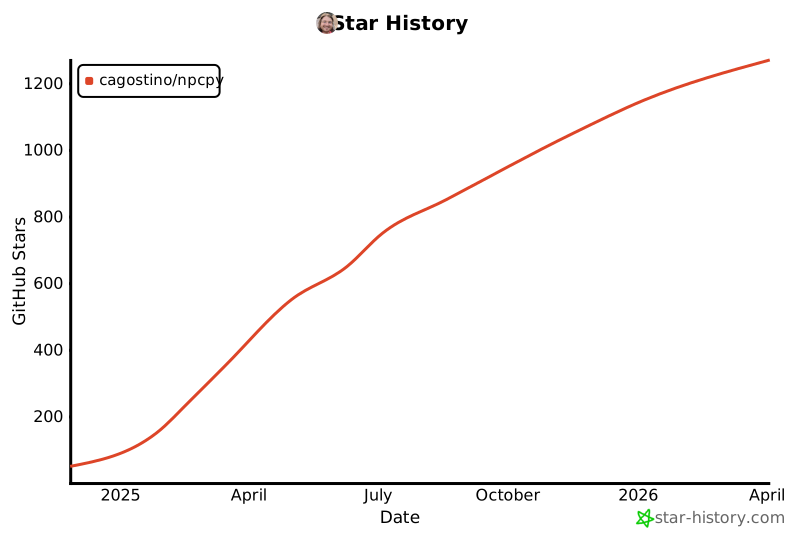
Star History
Release history Release notifications | RSS feed


Download files
Download the file for your platform. If you're not sure which to choose, learn more about installing packages.
Source Distribution
Built Distribution
Filter files by name, interpreter, ABI, and platform.
If you're not sure about the file name format, learn more about wheel file names.
Copy a direct link to the current filters
File details
Details for the file npcpy-1.4.22.tar.gz.
File metadata
- Download URL: npcpy-1.4.22.tar.gz
- Upload date:
- Size: 434.9 kB
- Tags: Source
- Uploaded using Trusted Publishing? No
- Uploaded via: twine/6.2.0 CPython/3.9.25
File hashes
| Algorithm | Hash digest | |
|---|---|---|
| SHA256 |
46cddc7b10eb336e746a9f7c2758423213bc6a466d86d80c2238e3ecaa87894e
|
|
| MD5 |
52be69880f920a86367e625903c847de
|
|
| BLAKE2b-256 |
acabee88a0d01c088c44760b5306c4a46b4aaea2cc6f1cd9d07350322bb032c6
|
File details
Details for the file npcpy-1.4.22-py3-none-any.whl.
File metadata
- Download URL: npcpy-1.4.22-py3-none-any.whl
- Upload date:
- Size: 383.0 kB
- Tags: Python 3
- Uploaded using Trusted Publishing? No
- Uploaded via: twine/6.2.0 CPython/3.9.25
File hashes
| Algorithm | Hash digest | |
|---|---|---|
| SHA256 |
5183f85f69b412eaf6d4f47c7e345a1de4365f9efabc9cb2a4a8fd94b3334868
|
|
| MD5 |
bc2bc6d2a45f0618b28f829ad6e5cc6e
|
|
| BLAKE2b-256 |
f7dfec7f430ca0240158a2b541b9619a779896ce761134a39925653a6e8c2d4c
|






