
Nuc2D: Visualize RNA and DNA secondary structures
The output is SVG, so a figure stays sharp at any size and remains editable in tools such as Illustrator or Inkscape: it can be adjusted without being redrawn.
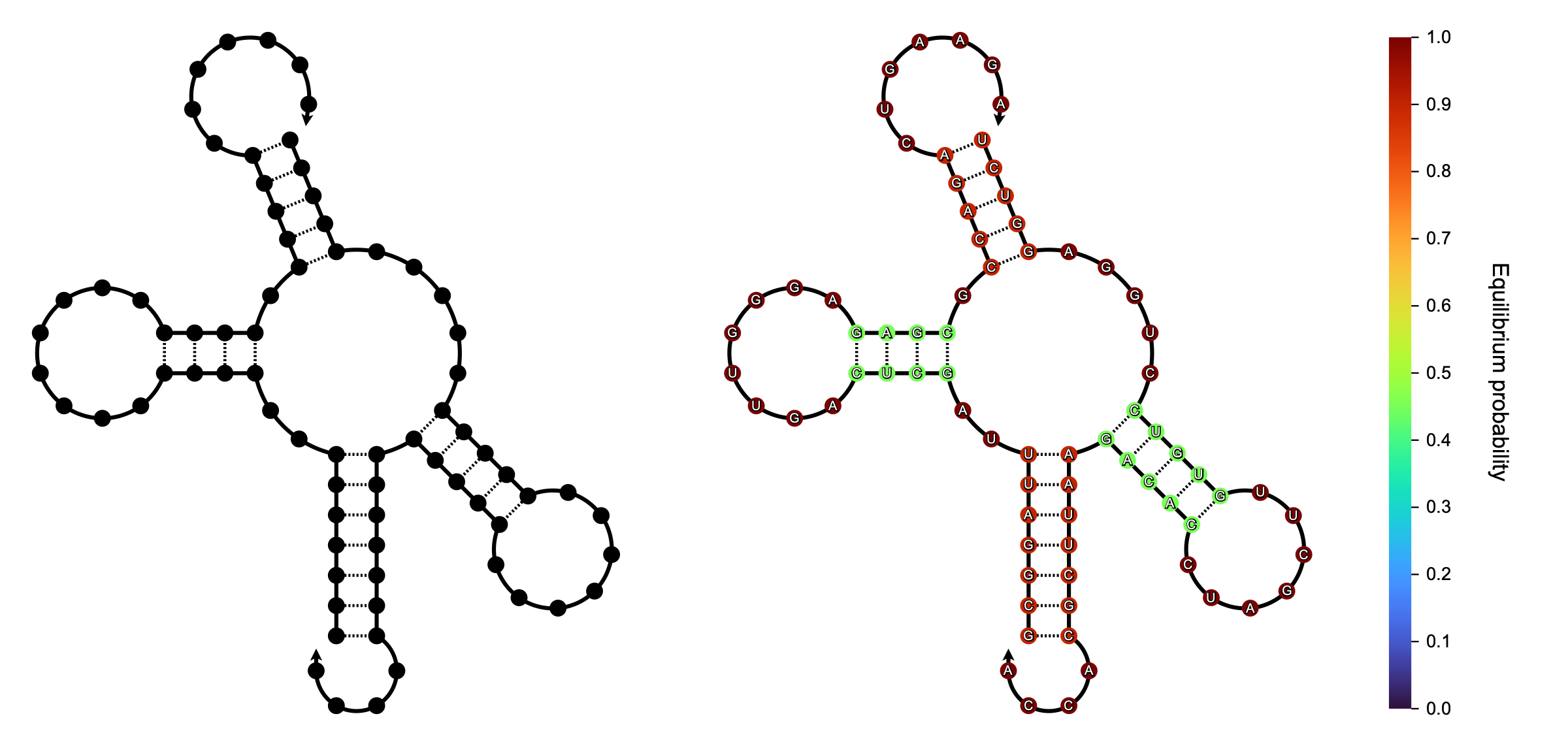
One structure, drawn twice: on its own, and with its sequences and the probability of each nucleotide being in the state the structure puts it in.

An introductory notebook, written in Japanese. It runs in Google Colab, so there is nothing to set up on your own machine.
Installation
pip install nuc2d
Quick start
from nuc2d import draw_svg

# A tRNA cloverleaf, split into two strands.
CLOVERLEAF = "(((((((..((((........)))).(((((.......+))))).....(((((.......))))))))))))...."

drawing = draw_svg(dot_bracket=CLOVERLEAF)

drawing.saveas("output.svg")
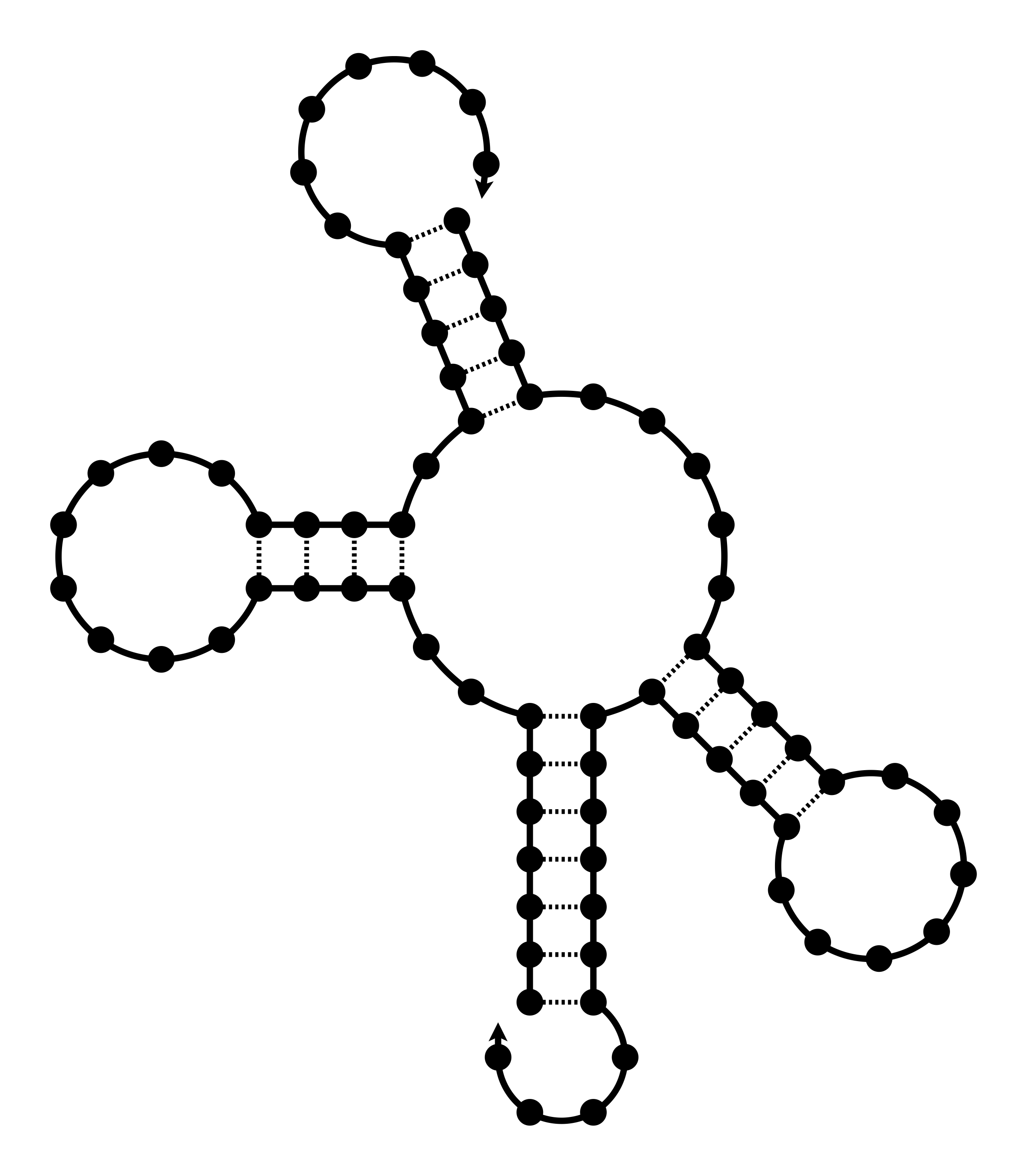
Structures are written with ( and ) for the two halves of a base pair,
. for an unpaired nucleotide, and + for a break between strands. An arrow
marks each 3' terminus.
In Jupyter Notebook or JupyterLab the result can be displayed directly:
from IPython.display import SVG, display

display(SVG(drawing.tostring()))
An input that is not a well-formed structure raises ParseError:
from nuc2d import ParseError

try:
    draw_svg("(((")
except ParseError as error:
    print(error)
Sequence annotation
Nucleotide sequences can be provided through the sequences argument, one per
strand, in the order the strands appear in the structure.
SEQUENCES = [
    "GCGGAUUUAGCUCAGUUGGGAGAGCGCCAGACUGAAGA",
    "UCUGGAGGUCCUGUGUUCGAUCCACAGAAUUCGCACCA",
]

drawing = draw_svg(dot_bracket=CLOVERLEAF, sequences=SEQUENCES)
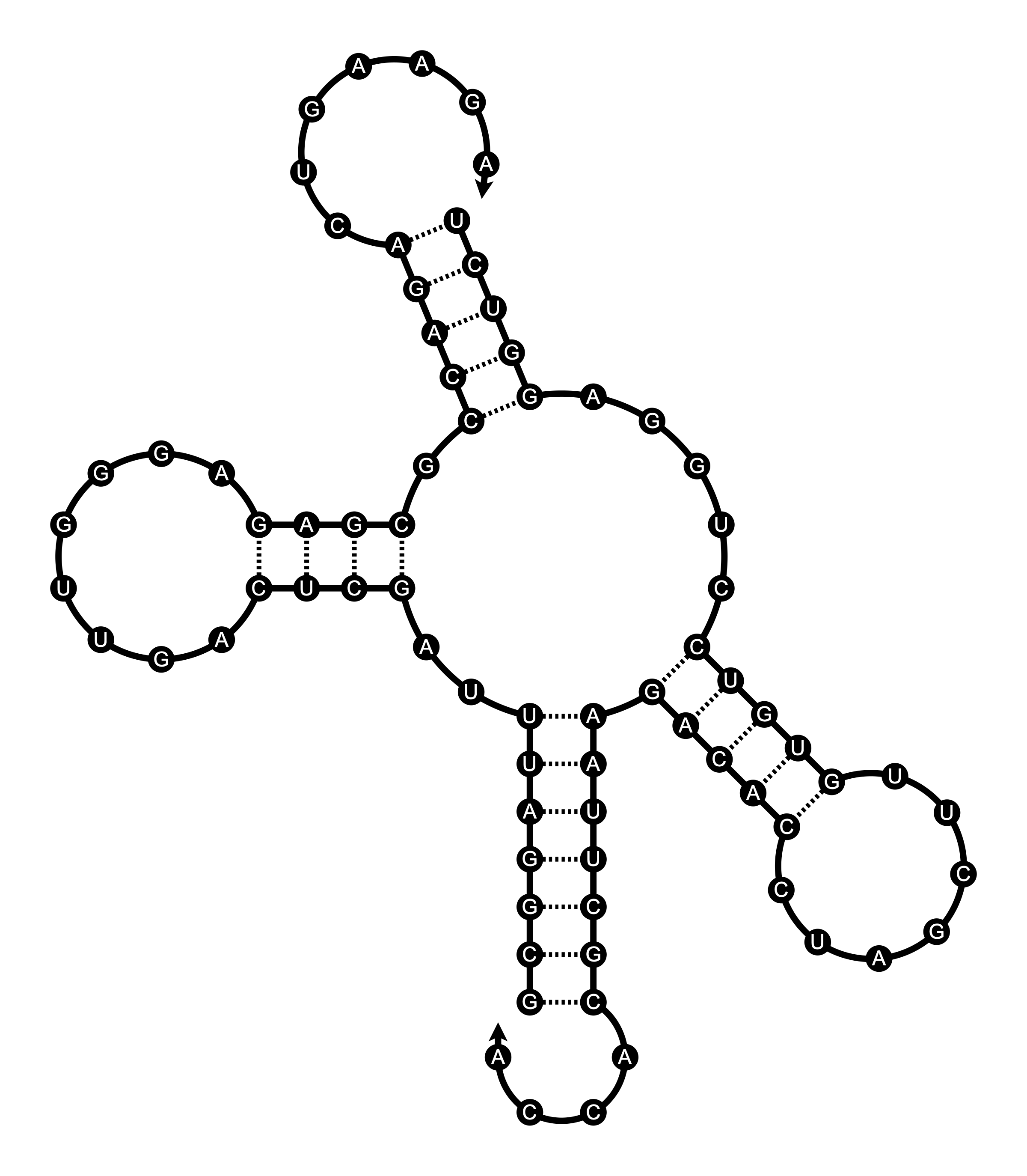
A wrong number of sequences, or a sequence that is not as long as its strand,
raises ValueError rather than drawing something misleading.
Equilibrium probability visualization
Base-pair probabilities are visualized by passing a symmetric probability
matrix through the probs argument. A colorbar is placed beside the structure.
probs[i][j] is how likely nucleotides i and j are to be paired with each
other, and probs[i][i] how likely nucleotide i is to be left unpaired. A
real matrix comes from a structure prediction tool; the one below is made up,
which is enough to see what the drawing does.
import numpy as np

flat = CLOVERLEAF.replace("+", "")
probs = np.zeros((len(flat), len(flat)))

stack = []
for i, char in enumerate(flat):
    if char == "(":
        stack.append(i)
    elif char == ")":
        left = stack.pop()
        # Made up: the acceptor and anticodon stems are the certain ones.
        probs[left][i] = probs[i][left] = 0.9 if left < 8 or 25 < left < 32 else 0.45

# Whatever is left over is the probability of staying unpaired.
probs[np.diag_indices_from(probs)] = 1.0 - probs.sum(axis=1)

drawing = draw_svg(dot_bracket=CLOVERLEAF, sequences=SEQUENCES, probs=probs)
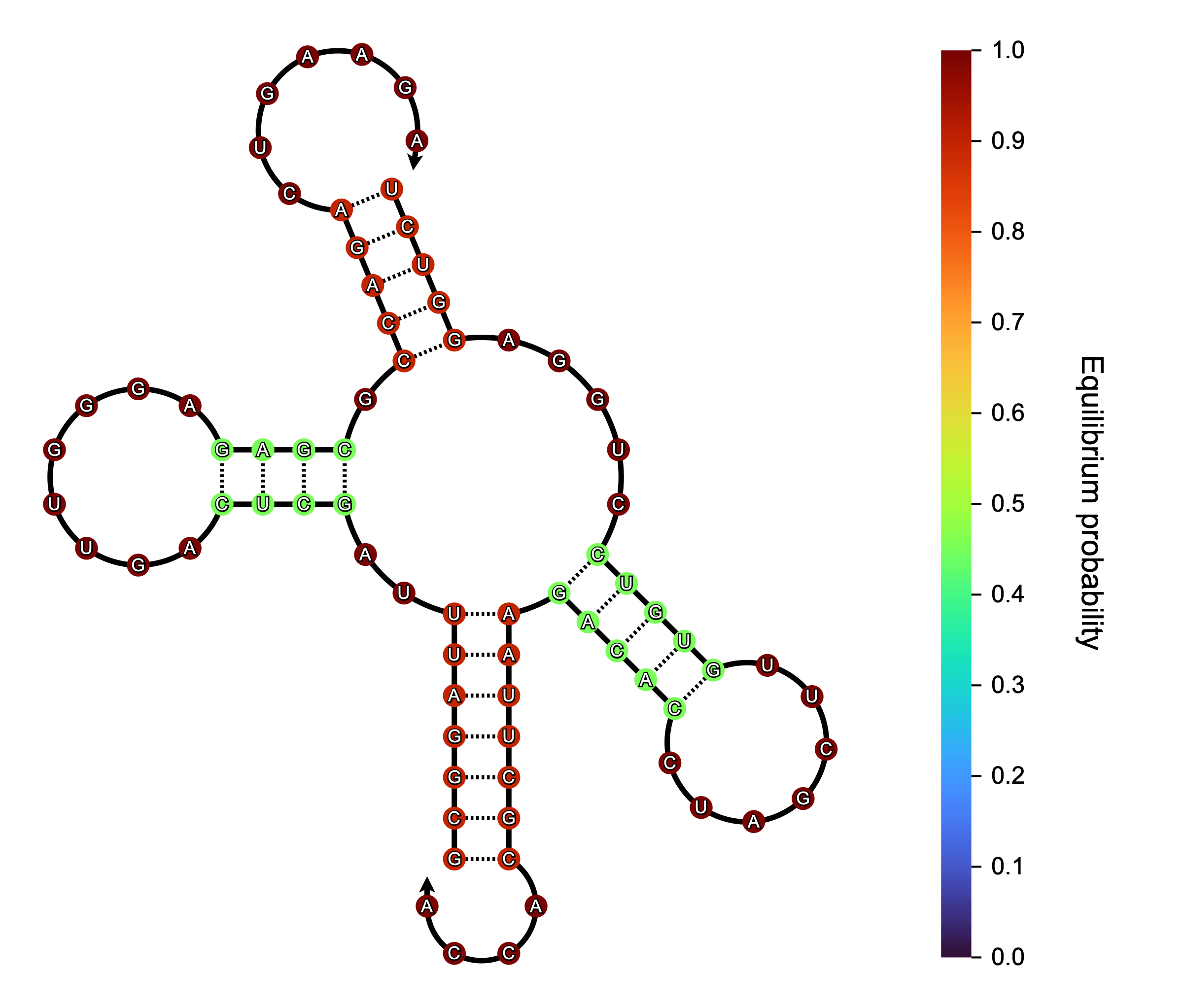
Each nucleotide is colored by the probability of the state the structure puts it in: of pairing with its partner if it is paired, and of being unpaired if it is not.
The colorbar is labelled Equilibrium probability unless another label is
given:
drawing = draw_svg(
    dot_bracket=CLOVERLEAF,
    probs=probs,
    colorbar_label="Pairing probability",
)
Output size
# One of the two: the other follows from the aspect ratio of the drawing.
drawing = draw_svg(dot_bracket=CLOVERLEAF, width_px=600)

# Both: used as written.
drawing = draw_svg(dot_bracket=CLOVERLEAF, width_px=600, height_px=600)
Giving neither defaults the height to 500 px. Giving both keeps the drawing's own proportions and centres it in the box, with space above and below or at the sides, rather than stretching it to fit.
Style and layout
DrawingStyle controls appearance — colors, stroke widths, node size, fonts,
and the colormap used for probabilities. RadialLayoutEngine controls
geometry — how far apart nucleotides are placed.
import matplotlib as mpl

from nuc2d import DrawingStyle, RadialLayoutEngine

drawing = draw_svg(
    dot_bracket=CLOVERLEAF,
    sequences=SEQUENCES,
    probs=probs,
    style=DrawingStyle(
        backbone_color="#333333",
        basepair_color="crimson",
        node_radius=5.0,
        cmap=mpl.colormaps["viridis"],
    ),
    layout_engine=RadialLayoutEngine(
        backbone_spacing=18.0,
        loop_spacing=24.0,
    ),
)
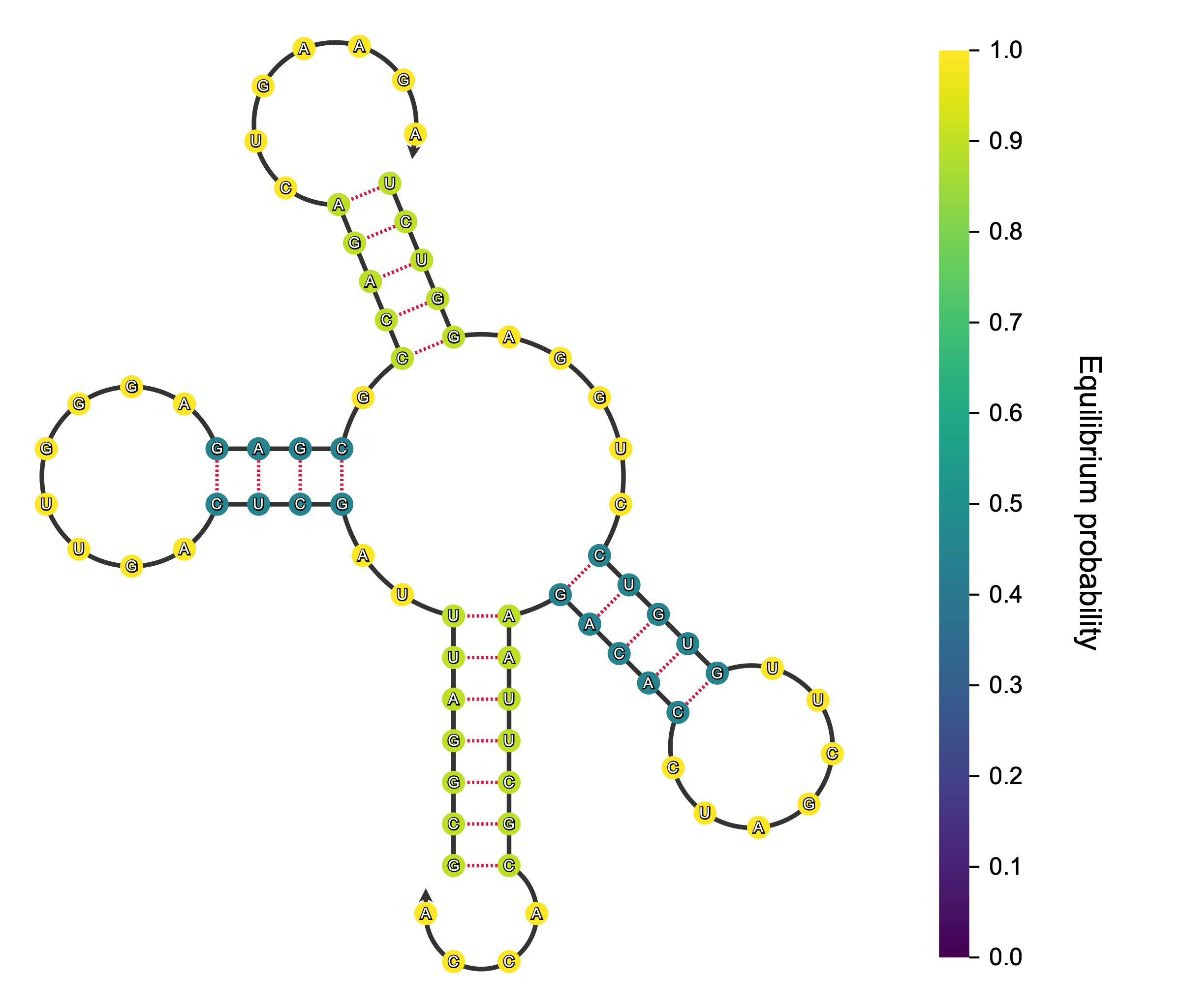
Combining several structures
draw_component renders one structure into an SVG component without deciding
where it goes, so several structures can share a single drawing. Each component
carries the bounding box it occupies, and compose collects placed components
into one group whose bounding box encloses them all.
This is how the picture at the top of this page is drawn:
import svgwrite

from nuc2d import Placement, compose, draw_component

drawing = svgwrite.Drawing()

components = [
    draw_component(drawing, dot_bracket=CLOVERLEAF),
    draw_component(
        drawing, dot_bracket=CLOVERLEAF, sequences=SEQUENCES, probs=probs
    ),
]

# Lay the components out in a row, aligned on their tops, with a gap between.
placements, cursor_x = [], 0.0
for component in components:
    box = component.bbox
    placements.append(
        Placement(component=component, x=cursor_x - box.xmin, y=-box.ymin)
    )
    cursor_x += box.width + 20.0

panel = compose(drawing.g(), placements)

drawing.add(panel.group)
drawing.viewbox(*panel.bbox.to_viewbox())
drawing["width"] = f"{panel.bbox.width}px"
drawing["height"] = f"{panel.bbox.height}px"
drawing.saveas("panel.svg")
Placement.x and Placement.y say how far to move a component after scaling
it, so aligning an edge means subtracting the scaled edge of its bounding box.
Versioning
Nuc2D follows Semantic Versioning. What a version promises is the public API: the names the package exports, the arguments they take, and the exceptions they raise. Those change only in a major release.
The drawing is not part of that promise. A minor release may place a nucleotide differently, enclose a structure more tightly, or write the same shape as different SVG, so a figure regenerated under a newer version can come out different. Text is measured with the font installed on the machine, so a drawing can differ between two machines running the same version as well. An SVG already saved to disk is of course unaffected.
Changes
Release notes for every version are on the releases page.
License
This project is licensed under the MIT License.
1 maintainer

Release files for nuc2d 1.1.0
For a detailed explanation of source distributions (sdists) and built distributions (wheels), please see the package formats documentation.
Source distribution (sdist)
| File | Size | Uploaded | |
|---|---|---|---|
| nuc2d-1.1.0.tar.gz | 38.0 kB | Details |
Built distribution (wheel)
| File | Interpreter | ABI | Platform | Reset |
|---|---|---|---|---|
| nuc2d-1.1.0-py3-none-any.whl | Python 3 | none | any | Details |
Total release size: 68.0 kB
Release files / nuc2d-1.1.0.tar.gz
| Download URL | nuc2d-1.1.0.tar.gz |
|---|---|
| Size | 38.0 kB |
| Tags | Source |
|
SHA-256 checksum How to use checksums |
f0af0fa580f29cbe70f853208c0529771dc3a3e398177a93a8d3f72cf2cca965
|
|
BLAKE2b-256 checksum How to use checksums |
0e5028d19cb7212478cabcd6081fe8f6e0c49588ecf880829dee05991987f754
|
| Upload date | |
|
Uploaded using Trusted Publishing? What is trusted publishing? |
No |
| Uploaded via |
uv/0.12.15 {"installer":{"name":"uv","version":"0.12.15","subcommand":["publish"]},"python":null,"implementation":{"name":null,"version":null},"distro":{"name":"macOS","version":null,"id":null,"libc":null},"system":{"name":null,"release":null},"cpu":null,"openssl_version":null,"setuptools_version":null,"rustc_version":null,"ci":null}
|
Release files / nuc2d-1.1.0-py3-none-any.whl
| Download URL | nuc2d-1.1.0-py3-none-any.whl |
|---|---|
| Size | 30.0 kB |
| Tags | Python 3 |
|
SHA-256 checksum How to use checksums |
61e4e1df47feb7cb20b43f112f4e45eec2424bea01bc709484ac770ecace3665
|
|
BLAKE2b-256 checksum How to use checksums |
f723c7023c0b471a20a4e61da75040f612ebfd84ffd58cef23caf8bf645b4a75
|
| Upload date | |
|
Uploaded using Trusted Publishing? What is trusted publishing? |
No |
| Uploaded via |
uv/0.12.15 {"installer":{"name":"uv","version":"0.12.15","subcommand":["publish"]},"python":null,"implementation":{"name":null,"version":null},"distro":{"name":"macOS","version":null,"id":null,"libc":null},"system":{"name":null,"release":null},"cpu":null,"openssl_version":null,"setuptools_version":null,"rustc_version":null,"ci":null}
|














