
nytimes-games






An unofficial Python client for the New York Times Games APIs: Wordle, Connections, Strands, Spelling Bee, Letter Boxed and the Daily, Mini, Midi and Bonus crosswords, plus your own stats and game progress.
NYT doesn't publish documentation or an API spec for these endpoints. This
package wraps them in one client with typed, validated
Pydantic models, so you can build archives,
stats dashboards, bots or your own games without reverse engineering NYT's
APIs first. Optional extras add the nytg command line tool, an MCP server
for AI agents, and a REST API.
Installation
pip install nytimes-games
The package installs as nytimes-games and is imported as nytgames.
Python 3.10 or newer is required.
Quick start
from nytgames import NYTGamesClient

client = NYTGamesClient()

client.wordle("2025-06-12").solution
client.connections("2025-06-12").categories
client.crossword("mini")                  # today's Mini
client.crossword("daily", "1993-11-21")   # any Daily back to 1993
Your stats and game progress need your NYT session cookie:
client = NYTGamesClient(cookies="NYT-S=...")

stats = client.player_stats().stats
stats.wordle.calculatedStats.currentStreak
stats.connections.puzzles_won
stats.crossword_daily.dailyStats["monday"].avgTimeSeconds
What's available
Puzzles don't need cookies. Everything about you does.
Puzzles
| Game | Method | Available from | What you get | Spoilers |
|---|---|---|---|---|
| Wordle | wordle(date) |
2021-06-19 | Puzzle number, editor | solution |
| Connections | connections(date) |
2023-06-12 | The 16 cards (words or pictures) and starting board | categories (the groups) |
| Strands | strands(date) |
2024-03-04 | Theme clue and letter board | spangram, themeWords, word paths |
| Spelling Bee | spelling_bee_puzzle(date) |
2018-05-06 | Letters, word and pangram counts, forum-style hints | answers, pangrams |
| Letter Boxed | letter_boxed(date) |
2018-12-17 | Sides, par, every accepted word | ourSolution |
| Crossword | crossword(publish_type, date=None) |
Daily 1993-11-21, Mini 2014-08-21, Midi 2026-02-25, Bonus 1997 | Grid, clues, entries, rebus, circles and shading | cell answers |
| Crossword by ID | crossword_by_id(puzzle_id) |
Any crossword, e.g. both puzzles on a date with two | Same as crossword |
cell answers |
| Crossword schedule | crossword_oracle(publish_type) |
Current and next puzzle | Puzzle IDs and publish times | |
| WordleBot summary | wordlebot_summary(date) |
2021-06-19 | How everyone did: average guesses, skill and luck by mode, guess distributions, skill percentiles | guesses (the bot's solve paths) |
| Bonus Puzzles | bonus_week(date), bonus_weeks(date_start, date_end), bonus_puzzle(listing) |
2026-08-26 | Each Wednesday's drop: Wordle in 1, Connections 3x3, Colorful Strands and bonus crosswords (Mystery Mini, Easy Mode, Special), with titles, bylines, IDs and slugs | Wordle in 1 solutions, and as for each game |
| Puzzle list | archive(game, date_start, date_end) |
Wordle, Connections, Strands, Daily, Mini, Midi | Puzzle IDs and dates for a range | Wordle solution |
You (needs your NYT-S cookie)
| Data | Method | What you get |
|---|---|---|
| Stats | player_stats() |
Streaks, win rates and distributions for every game you've played |
| Crossword progress | crossword_game(puzzle_ids, publish_type) |
Your filled squares, time, gold star, revealed and checked squares (up to 30 puzzles per call) |
| Crossword list | crossword_puzzles(publish_type, date_start=..., date_end=...) |
Daily, Mini and Bonus puzzles with your solved status and star (90 days or less per call) |
| Wordle progress | wordle_latest(puzzle_ids) |
Your guesses and result |
| Connections progress | connections_latest(puzzle_ids) |
Your guesses, mistakes and solved groups, and whether you won (up to 30 puzzles per call) |
| Strands progress | strands_latest(puzzle_ids) |
Your found words, other words and whether you solved it (up to 30 puzzles per call) |
| WordleBot | wordlebot() |
Your luck and skill for today's Wordle, overall and by round (today only, after you've opened WordleBot) |
| Spelling Bee progress | spelling_bee_latest(puzzle_ids) |
Words you found and your rank (up to 30 puzzles per call) |
| Bonus Puzzles progress | wordle_in_one_latest(puzzle_ids), connections_latest(puzzle_ids, bonus=True), strands_latest(puzzle_ids, bonus=True), crossword_game(puzzle_ids, "bonus") |
Your saved bonus games, by the id in a week's listing |
| Badges | badges(games), trophy_case(game) |
Every Wordle, Connections, Strands and Spelling Bee badge, earned or not, with your level and progress. Each badge's info has its name, description and artwork |
The *_latest() results also include badges_trophy_shelf, the three badges
NYT features for that game. Badge names, descriptions and artwork come from a
copy of the games app's own table in nytgames.badges (badge_info(id),
all_badges()), since NYT doesn't serve them from an API:
for game, trophies in client.badges().trophies.items():
    for badge in trophies.badges:
        info = badge.info
        print(game, badge.name, badge.progress, badge.next_level,
              info.image_url(badge.level or badge.next_level, earned=badge.is_earned) if info else "")
NYT doesn't record individual solve events, so progress means your saved game: the current state and totals, not a history of each move.
Dates are YYYY-MM-DD strings. publish_type is daily, mini, midi or
bonus, and date=None returns today's puzzle. NYT usually serves the next
day's puzzle a day early.
archive() is the quickest way to get puzzle IDs for a date range, for
example to check your progress on a month of puzzles:
midis = client.archive("crossword_midi", "2026-09-01", "2026-09-30")
client.crossword_game([p.id for p in midis], "midi")   # up to 30 IDs per call
Read-only
The library never writes anything to NYT. Every request it makes is a GET, so it can't change your saved games, stats or streaks. The test suite checks that every request is a GET.
Puzzle structure
The models include helpers for working with a puzzle's structure, for crossword research, trainers or solvers:
puzzle = client.crossword("daily", "2025-06-12")

for entry in puzzle.entries():
    entry.id            # "50-Across"
    entry.clue          # "Major basketball feat … or a feature shared by 3-, 6- and 9-Down"
    entry.answer        # "QUADRUPLEDOUBLE", with rebus squares' full answers
    entry.coordinates   # ((11, 0), (11, 1), …): (row, col) of each square
    entry.crossings     # ("50-Down", "51-Down", …)
    entry.references    # ("9-Down", "3-Down", "6-Down")
    entry.rebus         # True if the answer is longer than its squares

puzzle.squares()        # every square: answer, label, rebus, circled, shaded

client.strands(date).words()          # theme words and spangram with their paths
client.connections(date).board()      # the 4x4 starting board
Special puzzles are kept as they are: text square labels, extra clue lists
such as "Around" (entry IDs like Around-1), and entries that turn corners.
Crossword files
Export crosswords to the standard formats other crossword apps use, with your saved progress if you like:
from nytgames import formats

puzzle = client.crossword("daily", "2025-06-12")
game = client.crossword_game(puzzle.id, "daily")      # optional: your progress

open("daily.puz", "wb").write(formats.to_puz(puzzle, game))     # Across Lite
formats.to_ipuz(puzzle, game)                                    # ipuz, as a dict
open("daily.xml", "w").write(formats.to_xml(puzzle, game))      # Crossword Compiler XML
formats.export(puzzle, "ipuz")                                   # any format, as bytes
| Format | Notes |
|---|---|
.puz |
Across Lite, the most widely supported. Rebus squares, circles, your fill, revealed squares and the timer. Shaded squares are shown as circles, and text must fit Latin-1 (typographic quotes and dashes are converted) |
.ipuz |
The open ipuz JSON format. Rebus, circles, shading and your fill |
.xml |
Crossword Compiler rectangular-puzzle XML. Rebus, circles, shading, your fill and revealed or penciled squares |
A few special puzzles use gimmicks these formats can't represent, such as
squares labeled with text or clues that wind around the grid. Exporting them
raises NYTGamesExportError, whose reasons say why; export_problems(puzzle, fmt) returns the reasons without exporting. fidelity(puzzle, fmt) lists
what an export approximates, such as italics in clues or shading shown as
circles in .puz. Exported files are for personal
use: the puzzles are copyrighted by The New York Times.
Spelling Bee extras:
from nytgames import spelling_bee_hints

puzzle = client.spelling_bee_puzzle("2026-10-03")
spelling_bee_hints(puzzle)      # Spelling Bee Forum style hints: counts, pairs, points
client.spelling_bee_puzzles()   # every puzzle on the game page (about two weeks)
Cookies
To get your NYT-S cookie, log in at nytimes.com, open your browser's
developer tools, and find the NYT-S cookie for .nytimes.com (Application
tab in Chrome, Storage tab in Firefox). Treat it like a password: it gives
access to your NYT account.
cookies can be:
- a
Cookieheader string:"NYT-S=...; nyt-a=..." - a dict:
{"NYT-S": "..."} - a list of cookie objects with
nameandvaluekeys, such as a JSON export from the Cookie-Editor browser extension - either of those as a JSON string, so
NYT_COOKIES="$(cat cookies.json)"works with an export file
Cookies that can't be sent (for example with line breaks in a value) raise
ValueError before any request is made, and error messages never include
cookie values.
Errors
HTTP errors from NYT are raised as NYTGamesHTTPError, with the HTTP status
as .status_code and the httpx.Response as .response:
| Exception | When |
|---|---|
NYTGamesAuthenticationError |
401 or 403, usually a missing or expired NYT-S cookie |
NYTGamesNotFoundError |
404, for example a date with no puzzle |
NYTGamesRateLimitError |
429 after retrying; retry_after has NYT's suggested wait, if any |
NYTGamesHTTPError |
any other HTTP error |
NYTGamesParseError |
NYT's response or page wasn't in the expected format (a ValueError); the message names the fields, never their values |
from nytgames import NYTGamesNotFoundError

try:
    client.wordle("1900-01-01")
except NYTGamesNotFoundError:
    print("No puzzle that day")
Network behavior
Failed connections, timeouts, rate limits (429) and NYT server errors are
retried up to 3 times with exponential backoff (up to 60 seconds between
tries). Adjust with NYTGamesClient(retries=5, backoff=1.0, timeout=60), or
turn retries off with retries=0.
NYT's Retry-After is always honored: the client waits as long as it asks,
up to 5 minutes. If it asks for longer, the client doesn't retry early; it
raises the error at once, and NYTGamesRateLimitError.retry_after says how
many seconds to wait.
You can pass your own httpx.Client (or httpx.AsyncClient for the async
client) as http_client, for example to add caching or a proxy. The client
doesn't close it, and still retries as above.
Cookies are sent only to NYT (or the base_url you set) and are never logged.
Models
Every method returns Pydantic models from nytgames.models. Fields NYT adds
later are kept rather than rejected, so new NYT fields don't break your code.
Use .model_dump() to get plain dicts, and by_alias=True to keep NYT's
original keys, such as "Queen Bee" in the Spelling Bee ranks.
Examples
examples/ has small projects built on the package: an
alternative Letter Boxed solver using the
day's accepted words, clue reuse across recent
crosswords, your solve times by weekday and
constructor, and your own REST API in Docker.
Async apps
AsyncNYTGamesClient has every method of NYTGamesClient, awaited. Both use
httpx, so there's no extra to install:
import asyncio
from nytgames import AsyncNYTGamesClient


async def main():
    async with AsyncNYTGamesClient(cookies="NYT-S=...") as client:
        wordle = await client.wordle("2026-10-11")
        stats = await client.player_stats()
        # Fetch several at once; keep it modest to be polite to NYT.
        week = await asyncio.gather(*(client.connections(f"2026-10-0{d}") for d in range(1, 8)))


asyncio.run(main())
Errors, retries and cookie handling are the same as the sync client's. Pass
your own httpx.AsyncClient as http_client to control transport details;
it isn't closed when the client is. Both clients
run the same code for every endpoint, so they always have the same methods.
FastAPI: use AsyncNYTGamesClient in async def routes, or the sync
client in plain def routes (FastAPI runs those in a thread pool). The
routes in nytgames.api use the sync client this way.
Home Assistant: use AsyncNYTGamesClient with Home Assistant's shared
httpx client (get_async_client(hass)) as http_client.
Command line
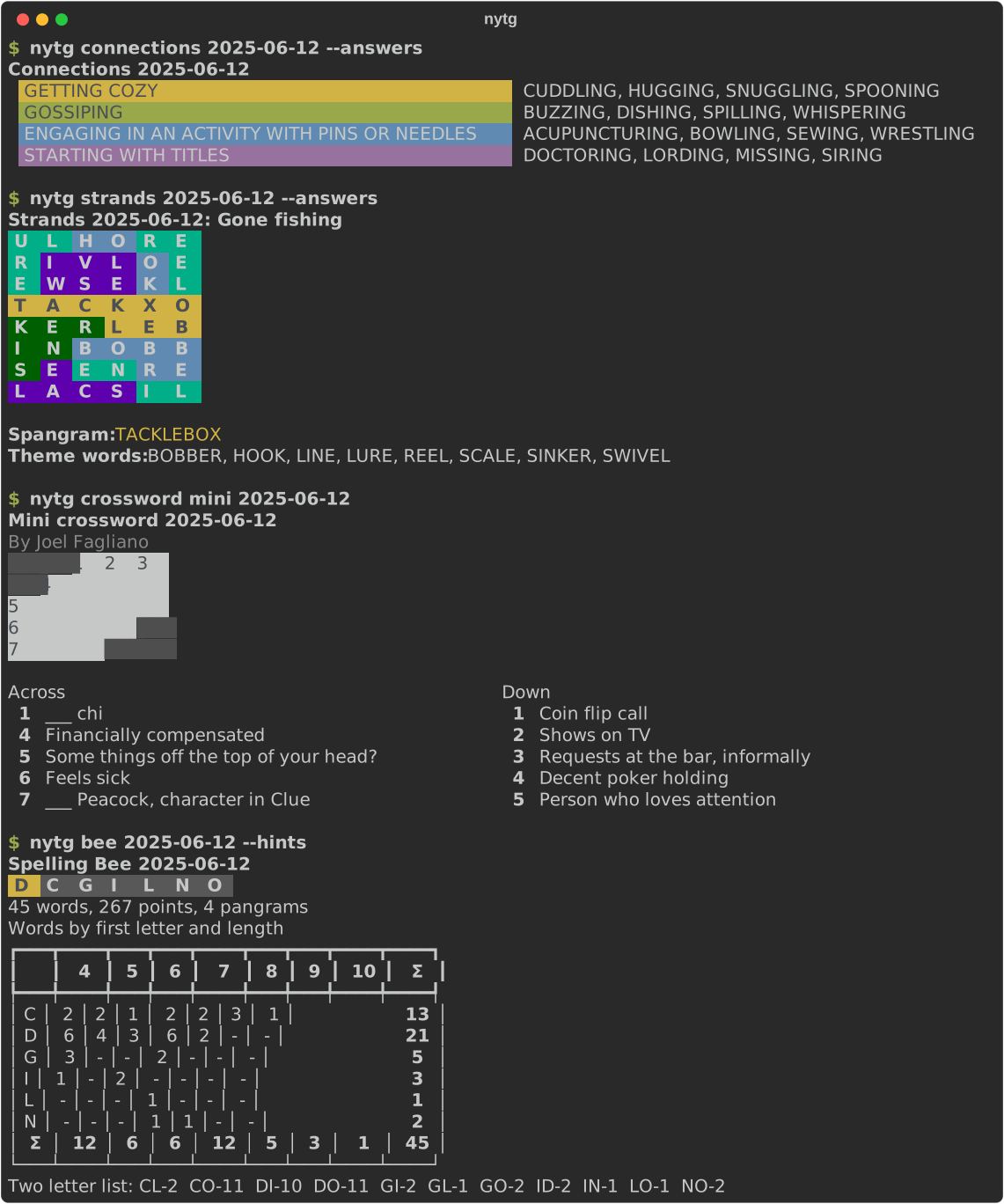
The optional cli extra installs nytg:
pipx install "nytimes-games[cli]" # or: pip install "nytimes-games[cli]"
nytg wordle                      # today's Wordle, without the answer
nytg wordle yesterday --answers
nytg connections friday -a       # the groups, in their colors
nytg strands 2025-06-12
nytg bee --hints                 # Spelling Bee Forum style hints
nytg letter-boxed
nytg crossword mini              # the grid and clues
nytg crossword daily 1993-11-21 --answers
nytg crossword mini --save mini.puz     # or .ipuz, or .xml (Crossword Compiler)
nytg crossword daily yesterday --save daily.ipuz --progress   # with your progress
nytg bonus week                  # this week's Bonus Puzzles (any day in the week works)
nytg bonus wordle-in-one         # each round's starting guess
nytg bonus connections -a        # Connections 3x3
nytg bonus strands 2026-09-30
nytg bonus crossword mini        # or easy, or special; --save works here too
Answers are hidden unless you pass --answers, in every output format.
Dates can be YYYY-MM-DD, today, yesterday, tomorrow or a weekday, and
first for the first puzzle in nytg archive.
Your stats and history
Log in once with your NYT-S cookie (see Cookies):
nytg auth login                  # paste the cookie; it's checked, then saved
nytg auth status
nytg stats                       # every game at a glance
nytg stats crossword             # averages, bests and streaks by weekday
nytg today                       # which of today's games you've played
nytg wordlebot                   # your WordleBot luck and skill vs. everyone (any date for everyone)
nytg history crossword --from 2026-01-01 -f csv > solves.csv
nytg history wordle --from monday
nytg history connections         # won or lost, mistakes and groups found
nytg history strands
nytg history bee
nytg history bonus               # the weekly Bonus Puzzles you've played
nytg badges                      # every badge, earned or not, and your progress
nytg badges wordle --earned
Cookies are read from --cookies, then the NYT_COOKIES environment
variable, then the active profile.
Archiving
nytg archive connections --from first --out puzzles/
saves each date as puzzles/connections/YYYY-MM-DD.json. For the few dates
with two crosswords (a special puzzle alongside the daily), each
is saved as YYYY-MM-DD-ID.json. Run it again to
resume: saved dates are skipped. A manifest.json records when each file was
fetched, NYT's update time and a hash; with --overwrite, puzzles NYT has
since changed keep their previous version in revisions/. Crosswords can be archived as crossword files
with --as puz, --as ipuz or --as xml; puzzles that can't be saved in that
format are listed as unsupported. Games: wordle, connections, strands,
spelling-bee, letter-boxed, crossword-daily, crossword-mini and
crossword-midi.
Output formats
Every command takes --format (-f), like gcloud:
| Format | Output |
|---|---|
table |
Tables and grids (the default) |
json, yaml |
All the data |
csv |
One row per item, nested fields as dotted columns |
value(FIELD,...) |
Tab separated values for scripts, e.g. value(categories[0].title) |
nytg wordle --answers -f "value(solution)"
nytg stats -f json | jq '.[] | select(.game == "Wordle")'
Profiles and settings
Settings are saved per profile in ~/.config/nytg/config.ini, similar to
gcloud configurations. On Linux and macOS the file is readable only by you
(0600, in a 0700 folder); on Windows it relies on your user folder's
permissions. Saves are atomic, so an interrupted save keeps the previous
settings:
nytg config set format json      # default output format for this profile
nytg config list
nytg --profile alice auth login  # a second NYT account
nytg config profiles activate alice
nytg config profiles list
--profile or NYTG_PROFILE picks a profile for one command. Run
nytg --install-completion for shell completion.
Building your own command line
nytgames.cli.extension lets you build a command line with every nytg
command plus your own, sharing its root options (--profile, --cookies,
--format), output formats and error messages:
import typer
from nytgames.cli.extension import FormatOption, create_app, emit, get_client, run

app = create_app(name="mytool", help="My NYT tools.", version="1.0.0")
db = typer.Typer(help="Query my archive.")
app.add_typer(db, name="db")


@db.command("midis")
def midis(fmt: FormatOption = None) -> None:
    """September's Midi crosswords."""
    puzzles = get_client().archive("crossword_midi", "2026-09-01", "2026-09-30")
    emit([{"date": p.print_date, "by": p.byline} for p in puzzles], fmt)


def main() -> None:   # point your [project.scripts] entry here
    run(app)
Each create_app() call returns an independent app. emit(data, fmt, table) prints JSON-compatible data in the requested format, with an optional
function that renders the table format. get_client() returns a client with
the cookies nytg would use. The other modules in nytgames.cli are
internal.
MCP server for AI agents
The optional mcp extra installs nytg-mcp, a local
Model Context Protocol server, so coding
agents and other MCP clients can use the NYT Games directly: ask Claude Code
for a Connections hint, your Saturday solve times, or to export yesterday's
crossword to .puz.
# Claude Code
claude mcp add nytimes-games -- uvx --from "nytimes-games[mcp]" nytg-mcp
For other clients (Claude Desktop, Cursor, VS Code and so on), add a stdio
server with the command uvx and the arguments
--from nytimes-games[mcp] nytg-mcp, or install the package and use the
command nytg-mcp.
| Tools | What they do |
|---|---|
wordle, connections, strands, spelling_bee, letter_boxed, crossword |
Puzzles for any date; crosswords include each entry's clue, position and crossings |
wordlebot_summary, puzzle_archive |
How everyone did on a Wordle; puzzle IDs for a date range |
bonus_week, bonus_puzzle |
The weekly Bonus Puzzles: Wordle in 1, Connections 3x3, Colorful Strands and bonus crosswords |
stats, today, crossword_history, wordle_history, spelling_bee_history, bonus_history, wordlebot, badges |
Your stats, progress, WordleBot analysis and badges (need cookies) |
export_crossword |
Save a crossword as .puz, .ipuz or .xml, optionally with your progress |
- Answers are hidden unless the agent passes
include_answers, and the server tells agents to leave them hidden while you're still solving. - Your own data uses the same cookies as
nytg:nytg auth login, or setNYT_COOKIESin the server's environment. Cookie values are never returned or logged. - Every tool is read-only except
export_crossword, which only writes the file you ask for and won't overwrite one unless asked.
REST API
The optional api extra serves everything as a REST API with
FastAPI, including interactive docs at
/docs.
pip install "nytimes-games[api]"
uvicorn nytgames.api:app
To customize it, write your own main.py:
from nytgames.api import create_app

app = create_app(title="My NYT Games API")   # any FastAPI settings
Or mount the routes in an existing FastAPI app:
from fastapi import FastAPI
from nytgames.api import add_exception_handlers, router

app = FastAPI()
app.include_router(router, prefix="/nyt")
add_exception_handlers(app)   # NYT errors become 404s and 403s instead of 500s
By default each request is made with the NYT-S cookie sent to the API. Other
cookies, such as your own app's session cookie, are never passed on to NYT:
curl -H "Cookie: NYT-S=..." http://localhost:8000/player/stats
To use your own cookies for every request instead, override the client:
from nytgames import NYTGamesClient
from nytgames.api import get_client

app.dependency_overrides[get_client] = lambda: NYTGamesClient(cookies="NYT-S=...")
Anyone who can reach that API can then see your stats and progress, so keep it private.
examples/api has a complete main.py and Dockerfile for
running your own instance in a container.
Endpoints
| Route | NYT endpoint |
|---|---|
GET /archive/{game}/{date_start}/{date_end} |
svc/games/v1/archive/{game}/{date_start}/{date_end} |
GET /badges |
svc/games/badges/trophy-case/{game} for each game |
GET /badges/{game} |
svc/games/badges/trophy-case/{game} |
GET /bonus/week/{date} |
svc/games/bonus/week/v1/{date}.json |
GET /bonus/wordle-in-one/{slug} |
svc/wordle-in-one/v1/bonus/{slug}.json |
GET /bonus/connections/{slug} |
svc/connections/v2/bonus/{slug}.json |
GET /bonus/strands/{slug} |
svc/strands/v2/bonus/{slug}.json |
GET /bonus/{wordle-in-one,connections,strands}/latest |
svc/games/state/{wordle_in_one,connections_bonus,strands_bonus}/latests |
GET /connections/latest |
svc/games/state/connections/latests |
GET /connections/{date} |
svc/connections/v2/{date}.json |
GET /crosswords/daily/today |
svc/crosswords/v6/puzzle/daily.json |
GET /crosswords/daily/{date} |
svc/crosswords/v6/puzzle/daily/{date}.json |
GET /crosswords/mini/today |
svc/crosswords/v6/puzzle/mini.json |
GET /crosswords/mini/{date} |
svc/crosswords/v6/puzzle/mini/{date}.json |
GET /crosswords/midi/today |
svc/crosswords/v6/puzzle/midi.json |
GET /crosswords/midi/{date} |
svc/crosswords/v6/puzzle/midi/{date}.json |
GET /crosswords/bonus/{date} |
svc/crosswords/v6/puzzle/bonus/{date}.json |
GET /crosswords/{publish_type}/{date}/download?format=puz |
A .puz, .ipuz or .xml file (&progress=true adds your progress) |
GET /crosswords/puzzles |
svc/crosswords/v3/puzzles.json |
GET /crosswords/id/{puzzle_id} |
svc/crosswords/v6/puzzle/{puzzle_id}.json |
GET /crosswords/oracle/{publish_type} |
svc/crosswords/v2/oracle/{publish_type}.json |
GET /crosswords/game/{game_id}?publish_type=daily |
svc/games/state/crossword_{publish_type}/latests |
GET /letter-boxed/{date} |
svc/letter-boxed/v1/{date}.json |
GET /player/stats |
svc/games/state/wordleV2/latests?puzzle_ids=0 |
GET /spelling-bee |
Scraped from puzzles/spelling-bee |
GET /spelling-bee/latest |
svc/games/state/spelling_bee/latests |
GET /spelling-bee/{date} |
svc/spelling-bee/v1/{date}.json |
GET /spelling-bee/{date}/hints |
Computed from the puzzle above |
GET /strands/latest |
svc/games/state/strands/latests |
GET /strands/{date} |
svc/strands/v2/{date}.json |
GET /wordlebot |
svc/int/run/cubby/public-api/v1/responses/wordlebot/reader (today, needs cookies) |
GET /wordlebot/{date}/summary |
static01.nyt.com/newsgraphics/2022/wordlebot/{solution}-{date}/summary.json |
GET /wordle/latest |
svc/games/state/wordleV2/latests |
GET /wordle/{date} |
svc/wordle/v2/{date}.json |
NYT errors are returned with NYT's status code, for example 404 for a date with no puzzle.
How it works
NYT's games load their puzzles and your saved games from JSON endpoints on www.nytimes.com, none of which need a login for puzzles:
- Puzzles come from one endpoint per game and date, such as
/svc/wordle/v2/2025-06-12.json. - Your saved games and stats come from the games' state endpoint,
/svc/games/state/{game}/latests, with yourNYT-Scookie. - Spelling Bee's game page embeds the current puzzles in a script.
- WordleBot's summaries are static files on static01.nyt.com.
docs/endpoints.md has the details: endpoints, limits and quirks.
Staying current with NYT
NYT changes these APIs without notice. Every morning a live check fetches a real puzzle from every game and endpoint, exports today's Mini to every file format and runs the live tests. The NYT live check badge above shows the latest result and date, and failures open an issue automatically.
Contributing
NYT changes these APIs without notice, so bug reports with the failing date and error are very welcome. See CONTRIBUTING.md to set up a development environment.
License
MIT. This project is not affiliated with or endorsed by The New York Times. NYT puzzles are copyrighted by The New York Times; please respect their terms of service and don't republish puzzle content.
1 maintainer

Metadata
1 maintainer
Release files for nytimes-games 0.11.5
For a detailed explanation of source distributions (sdists) and built distributions (wheels), please see the package formats documentation.
Source distribution (sdist)
| File | Size | Uploaded | |
|---|---|---|---|
| nytimes_games-0.11.5.tar.gz | 176.7 kB | Details |
Built distribution (wheel)
| File | Interpreter | ABI | Platform | Reset |
|---|---|---|---|---|
| nytimes_games-0.11.5-py3-none-any.whl | Python 3 | none | any | Details |
Total release size: 271.7 kB
Release files / nytimes_games-0.11.5.tar.gz
| Download URL | nytimes_games-0.11.5.tar.gz |
|---|---|
| Size | 176.7 kB |
| Tags | Source |
|
SHA-256 checksum How to use checksums |
80fb92b465c4e9084d36126cd19065ff8ede11024af884239fc1334aaf391189
|
|
BLAKE2b-256 checksum How to use checksums |
942e0348f5d5928c741ba7f88415dc25fa8ce14c622918dc3ab8af936b9e4f2c
|
| Upload date | |
|
Uploaded using Trusted Publishing? What is trusted publishing? |
Yes |
| Uploaded via |
twine/7.0.0 CPython/3.13.14
|
Provenance
Provenance describes where a file came from. On PyPI, provenance is shared via attestations, which provide a verifiable record of the build or publishing details. View details, limitations and caveats.


PyPI Publish Attestation
PyPI verified that this artifact, at this checksum, originated from the publisher listed below.
Signed by GitHub Actions, verified by PyPI on Oct 13, 2026.
Transparency logRelease files / nytimes_games-0.11.5-py3-none-any.whl
| Download URL | nytimes_games-0.11.5-py3-none-any.whl |
|---|---|
| Size | 95.0 kB |
| Tags | Python 3 |
|
SHA-256 checksum How to use checksums |
48ae9abd6da04c07d2fffe62892b3f0be3e2a3908a95d46c5d1ba2c6152e1e27
|
|
BLAKE2b-256 checksum How to use checksums |
187a5bb6883e80572294071e4f242acd8a87fa8f5fc1799658b8dbc97c8ce757
|
| Upload date | |
|
Uploaded using Trusted Publishing? What is trusted publishing? |
Yes |
| Uploaded via |
twine/7.0.0 CPython/3.13.14
|
Provenance
Provenance describes where a file came from. On PyPI, provenance is shared via attestations, which provide a verifiable record of the build or publishing details. View details, limitations and caveats.
PyPI Publish Attestation
PyPI verified that this artifact, at this checksum, originated from the publisher listed below.
Signed by GitHub Actions, verified by PyPI on Oct 13, 2026.
Transparency log













