
obniz sdk for python

Project description
obniz.py: sdk for python
This sdk is currently out of maintenance.
- You can use this on obnizOS 1.X.X or 2.X.X, but cannot use 3.X.X.
- You can use only with obniz board / obniz Board 1Y. Other devices is not supported.

obniz sdk for python. You can use obnizBoard or obnizOS.
Control obniz from python.
This sdk works with obniz api.
Compatible with Python 3.8+.
Usage
    import asyncio

    from obniz import Obniz


    async def onconnect(obniz):
        obniz.io0.drive("5v")
        obniz.io0.output(True)
        obniz.io1.pull("3v")
        obniz.io1.drive("open-drain")
        obniz.io1.output(False)
        obniz.io2.drive("3v")
        obniz.io2.output(True)

        def callback(voltage):
            print("change to {} v".format(voltage))

        obniz.ad3.start(callback)

        pwm = obniz.get_free_pwm()
        pwm.start({"io": 4})
        pwm.freq(1000)
        pwm.duty(50)

        uart = obniz.getFreeUart()
        uart.start({"tx": 5, "rx": 6, "baud": 9600})

        def onreceive(data, text):
            print(data)

        uart.onreceive = onreceive

        uart.send("Hello")


    obniz = Obniz('0000-0000')
    obniz.onconnect = onconnect

    asyncio.get_event_loop().run_forever()
Installation
Install obniz via pip
pip install obniz
and import it on python file.
from obniz import Obniz
Connect
Details on doc/connection
To use obniz, instantiate obniz with obniz id. and set onconnect callback function. It will be called when connected to obniz successfully.
    import asyncio


    async def onconnect(obniz):
        pass


    obniz = Obniz('0000-0000')
    obniz.onconnect = onconnect

    asyncio.get_event_loop().run_forever()
You are able to use everything on obniz after connect.
    async def onconnect(obniz):
        obniz.io0.drive("5v")
        obniz.io0.output(True)
        obniz.io1.pull("3v")
        obniz.io1.drive("open-drain")
        obniz.io1.output(False)
        obniz.io2.drive("3v")
        obniz.io2.output(True)

        def callback(voltage):
            print("change to {} v".format(voltage))

        obniz.ad3.start(callback)

        pwm = obniz.get_free_pwm()
        pwm.start({"io": 4})
        pwm.freq(1000)
        pwm.duty(50)

        uart = obniz.getFreeUart()
        uart.start({"tx": 5, "rx": 6, "baud": 9600})

        def onreceive(data, text):
            print(data)

        uart.onreceive = onreceive

        uart.send("Hello")
Example
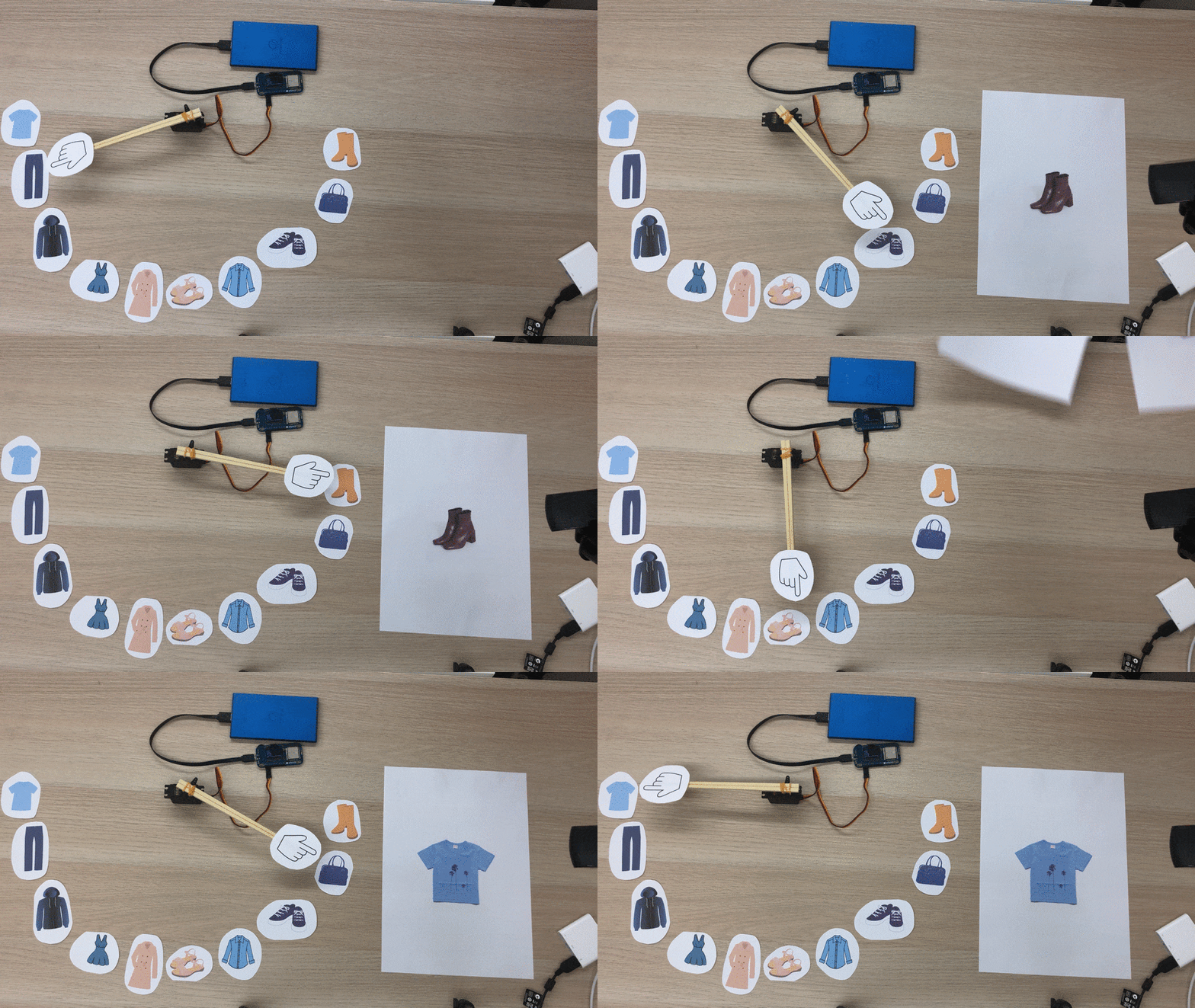
Easy to integrate python libraries like TensorFlow.
(need to install tensorflow and opencv-python)
    import asyncio

    from obniz import Obniz

    import cv2
    import numpy as np
    import tensorflow as tf
    from tensorflow import keras

    class_names = ['T-shirt/top', 'Trouser', 'Pullover', 'Dress', 'Coat',
                'Sandal', 'Shirt', 'Sneaker', 'Bag', 'Ankle boot']

    fashion_mnist = keras.datasets.fashion_mnist

    (train_images, train_labels), (test_images, test_labels) = fashion_mnist.load_data()

    train_images = train_images / 255.0

    test_images = test_images / 255.0

    model = keras.Sequential([
        keras.layers.Flatten(input_shape=(28, 28)),
        keras.layers.Dense(128, activation=tf.nn.relu),
        keras.layers.Dense(10, activation=tf.nn.softmax)
    ])

    model.compile(optimizer=tf.train.AdamOptimizer(),
                loss='sparse_categorical_crossentropy',
                metrics=['accuracy'])

    model.fit(train_images, train_labels, epochs=5)

    test_loss, test_acc = model.evaluate(test_images, test_labels)

    print('Test accuracy:', test_acc)

    def set_angle(pwm, angle):
        max = 2.4
        min = 0.5
        val = ((max - min) * angle) / 180.0 + min
        pwm.pulse(val)


    async def onconnect(obniz):
        obniz.io0.output(False)
        obniz.io1.output(True)

        pwm = obniz.get_free_pwm()
        pwm.start({"io": 2})
        pwm.freq(50)

        cap = cv2.VideoCapture(0)

        prev = None

        while True:
            ret, frame = cap.read()

            frame = cv2.cvtColor(frame, cv2.COLOR_BGR2GRAY)

            ret, frame = cv2.threshold(frame, 127, 255, cv2.THRESH_BINARY_INV)

            height, width = frame.shape
            x = height if height < width else width
            y = height if height < width else width
            square= np.zeros((x, y), np.uint8)

            x1 = int((width-x)/2)
            x2 = int(width-(width-x)/2)
            y1 = int((height-y)/2)
            y2 = int(height-(height-y)/2)
            square = frame[y1:y2, x1:x2]

            cv2.imshow("frame", square)

            img = cv2.resize(square, (28, 28), interpolation = cv2.INTER_AREA)

            img = (np.expand_dims(img / 255.0, 0))

            predictions_single = model.predict(img)

            answer = np.argmax(predictions_single[0])

            if prev != answer:
                print("answer: {}".format(class_names[answer]))
                set_angle(pwm, answer / 9 * 180)

            prev = answer

            if cv2.waitKey(1) & 0xFF == ord('q'):
                asyncio.get_event_loop().stop()
                break

            await asyncio.sleep(0.1)

        cap.release()
        cv2.destroyAllWindows()

    obniz = Obniz('0000-0000')
    obniz.debugprint = True
    obniz.onconnect = onconnect

    asyncio.get_event_loop().run_forever()
Documentation
You can find the documentation on the website.
Release history Release notifications | RSS feed


Download files
Download the file for your platform. If you're not sure which to choose, learn more about installing packages.
Source Distribution
Built Distribution
Filter files by name, interpreter, ABI, and platform.
If you're not sure about the file name format, learn more about wheel file names.
Copy a direct link to the current filters
File details
Details for the file obniz-0.7.0.tar.gz.
File metadata
- Download URL: obniz-0.7.0.tar.gz
- Upload date:
- Size: 13.8 MB
- Tags: Source
- Uploaded using Trusted Publishing? No
- Uploaded via: twine/6.2.0 CPython/3.13.13
File hashes
| Algorithm | Hash digest | |
|---|---|---|
| SHA256 |
08ece906ed6846ff205a1ef621dd8802c7e53002bdad1234d292e6dcd9097e60
|
|
| MD5 |
743d1ce02499d5fa5f04b423bcce7e68
|
|
| BLAKE2b-256 |
bf1e1158715f3f79bb6340c20e311e2796ddf99a015153f9ae3e71a766e682fe
|
File details
Details for the file obniz-0.7.0-py3-none-any.whl.
File metadata
- Download URL: obniz-0.7.0-py3-none-any.whl
- Upload date:
- Size: 14.1 MB
- Tags: Python 3
- Uploaded using Trusted Publishing? No
- Uploaded via: twine/6.2.0 CPython/3.13.13
File hashes
| Algorithm | Hash digest | |
|---|---|---|
| SHA256 |
47364efced69076dd0be6f3d81e2d616b09c9df6b9e0097016b3b689b698bc88
|
|
| MD5 |
39519990f09f1612ad43ca8ab4396ad6
|
|
| BLAKE2b-256 |
888e81f49bc0e8181944064d7663a51e44f4ef61634b3e97b77f4654c65f9852
|






