
Convert Obsidian notes into an AI-maintained wiki using local or cloud LLMs
Verified details
These details have been verified by PyPIProject links
GitHub Statistics
Maintainers

Project description
obsidian-llm-wiki
Turn your raw notes into a self-improving, interlinked wiki — powered by a local LLM.
Drop a markdown file into a folder. The pipeline reads it, extracts concepts, and creates or updates wiki articles with the new knowledge. Reject a draft and explain why — the next compile addresses your feedback. Over time your wiki compounds: every note you add (and every draft you review) makes the whole smarter.
Local-first, provider-flexible. Runs 100% locally with Ollama by default. Also works with any OpenAI-compatible endpoint — Groq, Together AI, LM Studio, vLLM, Azure OpenAI, and more.
The idea (Karpathy's LLM Wiki)
This project is a practical implementation of the pattern described by Andrej Karpathy in "The LLM Wiki" — a vision for a personal knowledge base where:
"The LLM doesn't just store what you tell it — it synthesizes, cross-references, and keeps everything current. You add raw material; it does the bookkeeping."
The key insight: treat your notes as source material, not as the final artifact. The LLM compiles them into a structured wiki that grows smarter as you add more. Unlike a chatbot that forgets, the wiki persists and compounds.
You write raw notes  →  LLM extracts concepts  →  Wiki articles created/updated
     raw/                    (automatic)                    wiki/
  quantum.md          "Qubit", "Superposition"       Qubit.md   ←──┐
  ml-basics.md        "Neural Network", "SGD"    Superposition.md  │
  physics.md          "Qubit" (again!)           Neural Network.md │
                                                      ↑  linked via [[wikilinks]]
The wiki lives in Obsidian, so you get the graph view, backlinks, and Dataview queries for free.
Features
- Concept-driven, incremental compilation — each concept gets its own article, updated only when its source notes change
- Rejection feedback loop — reject a draft with a reason; the next compile injects your feedback into the prompt so the model addresses it
- Draft annotations — low-confidence or single-source drafts are flagged with
<!-- olw-auto: ... -->comments (invisible in Obsidian, stripped on approval) - Rich review interface —
olw reviewlists drafts ranked by rejection count, shows diffs vs published and vs the last rejected version - Pipeline orchestrator —
olw runruns ingest → compile → lint → [approve] as one command with timing and failure classification - Selective recompile — after a file save, only concepts linked to that source are recompiled (not the entire wiki)
- Self-maintenance —
olw maintain --fixrepairs broken wikilinks via the alias map, creates stub articles for genuinely missing targets, and normalizes[[Alias]]links across published pages to[[Canonical|Alias]] - Manual edit protection — edited an article by hand? The compiler detects the change and skips it
- Source traceability — every article links back to the raw notes it was built from
- File watcher —
olw watchauto-processes anything dropped intoraw/ - Wiki health checks —
olw lintdetects orphans, broken links, stale articles (no LLM needed) - Query your wiki —
olw query "what is X?"answers from your published articles - Git safety net — every auto-action is committed;
olw undoreverts safely - Concept aliases — aliases (e.g.
PCfor "Program Counter") are extracted at ingest, written to each article's frontmatter, and used to resolve queries and repair broken wikilinks (olw maintain --fixrewrites[[PC]]to[[Program Counter|PC]]) - Multi-language — automatically detects the language of each note at ingest time; articles are written in the detected language; override globally with
language = "en"inwiki.toml - Multi-provider — swap Ollama for Groq, Together AI, LM Studio, vLLM, Azure OpenAI, or any OpenAI-compatible endpoint via
olw setup - Offline test suite — all 418 tests run without Ollama or any provider
Quick start
1. Install
From PyPI (recommended):
pip install obsidian-llm-wiki
Or with uv:
uv tool install obsidian-llm-wiki
From source (latest development version):
git clone https://github.com/kytmanov/obsidian-llm-wiki-local
cd obsidian-llm-wiki-local
python install.py
install.py detects uv or falls back to pip, verifies the install, and tells you to run the next step.
2. Install and start Ollama
# Install Ollama: https://ollama.com/download
ollama pull gemma4:e4b      # fast model — analysis and routing
ollama pull qwen2.5:14b     # heavy model — article writing (optional, 7B+ recommended)
Minimal setup: pull only
gemma4:e4band set bothfastandheavyto it in the wizard.
3. Run the setup wizard
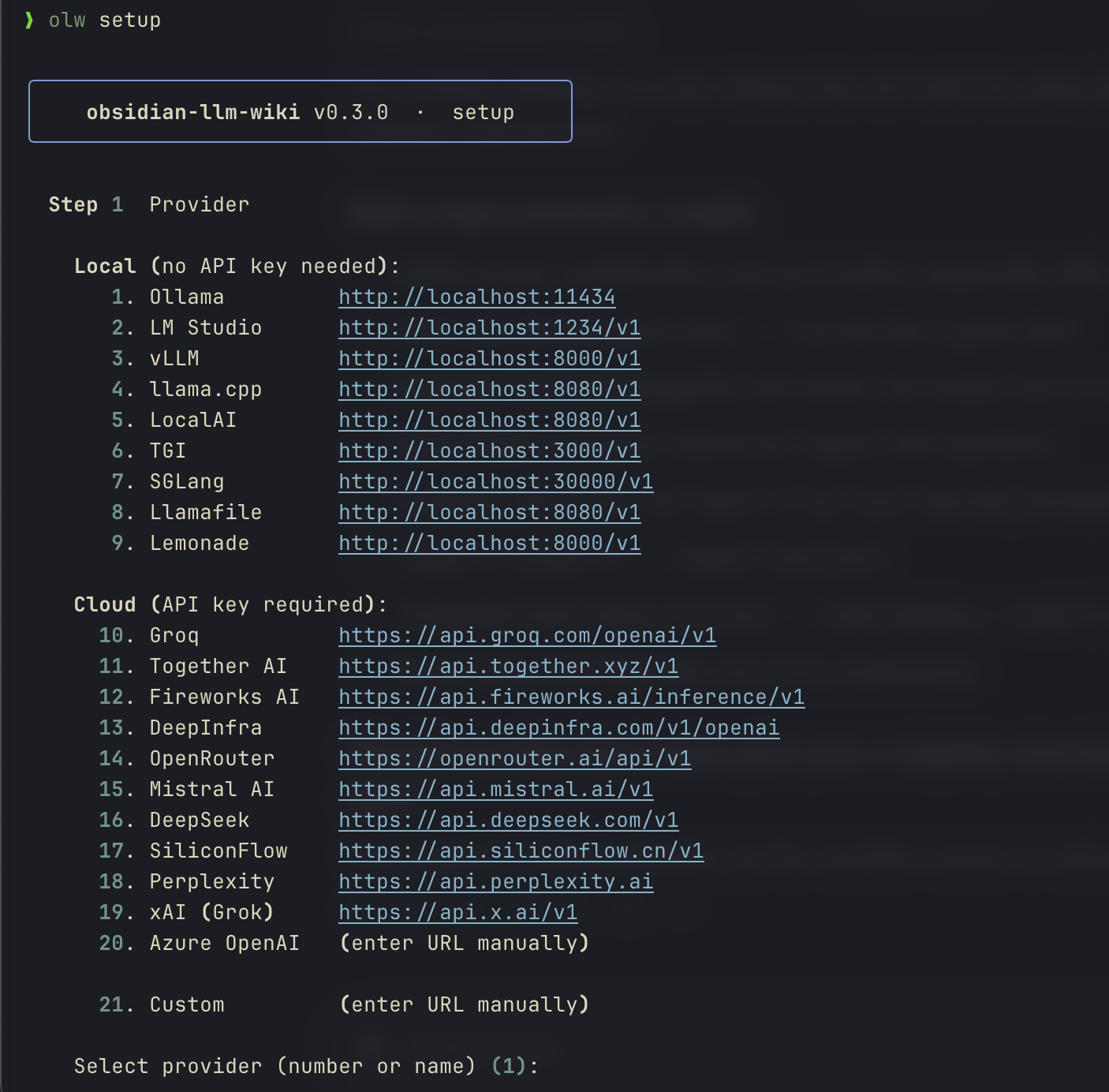
olw setup
An interactive wizard selects a provider, configures the URL and optional API key, picks fast and heavy models, and sets an optional default vault. Takes ~30 seconds.
╭──────────────────────────────────────────────────╮
│      obsidian-llm-wiki  ·  setup                 │
╰──────────────────────────────────────────────────╯

  Step 1  Provider

    Local (no API key needed):
       1. Ollama          http://localhost:11434  [default]
       2. LM Studio       http://localhost:1234/v1
       3. vLLM            http://localhost:8000/v1
       ...
    Cloud (API key required):
      10. Groq            https://api.groq.com/openai/v1
      11. Together AI     https://api.together.xyz/v1
      ...

    Select provider (number or name) [1]: _

  Step 2  URL
    Base URL [http://localhost:11434]: _
    ✓ connected

  Step 3  Fast model  (analysis & routing · 3–8B recommended)
    #  Model           Size
    1  gemma4:e4b      9.6 GB
    2  phi4-mini       2.5 GB
    Select (number or name) [1]: _
  ...
Settings are saved to ~/.config/olw/config.toml (Mac/Linux) or %APPDATA%\olw\config.toml (Windows). API keys are stored only in this user-private file, never in wiki.toml.
4. Set up your vault
olw init ~/my-wiki
This creates the folder structure and a wiki.toml pre-filled with your setup wizard choices.
5. Add some notes
Drop any .md files into ~/my-wiki/raw/. Web clips, book notes, meeting notes, anything.
~/my-wiki/raw/
  quantum-computing.md
  ml-fundamentals.md
  physics-lecture.md
6. Run the full pipeline
# One command: ingest + compile + lint + optional auto-approve
olw run

# Or step by step:
olw ingest --all
olw compile
olw review        # interactive draft review
If you set a default vault in olw setup, the --vault flag is optional. Otherwise use --vault ~/my-wiki or export OLW_VAULT=~/my-wiki.
Open ~/my-wiki as an Obsidian vault. The graph view shows your connected wiki.
7. Keep it running (optional)
olw watch
# Drop a file in raw/ → ingest + compile happen automatically (selective: only linked concepts)
How it works
The pipeline has three stages, each using the LLM for a different purpose:
raw/note.md
    │
    ▼ olw ingest  (or olw run)
    Fast LLM (3B–8B)
    • Reads note
    • Extracts concept names
    • Writes quality score + summary to state.db
    • Creates wiki/sources/Note.md (source summary page)
    │
    ▼ olw compile
    Heavy LLM (7B–14B)
    • For each concept: gathers all source notes that mention it
    • Injects rejection feedback from previous reviews into the prompt
    • Writes a wiki article with [[wikilinks]] to related concepts
    • Adds quality annotations if confidence is low or sources are sparse
    • Lands in wiki/.drafts/ for review
    │
    ▼ olw review  (or olw approve)
    • Interactive numbered menu — approve / reject / diff / edit
    • Rejection feedback stored and injected into next compile
    • On approve: annotations stripped, article published to wiki/
    • Updates wiki/index.md (navigation layer)
    • Git commits the change
No vector databases, no embeddings. wiki/index.md acts as the routing layer for olw query. This keeps the setup simple and works well up to ~100 source notes.
Multi-language support
olw detects the language of each raw note during ingest and stores it. At compile time, the article is written in that language — no configuration needed.
How it works:
- Ingest — the fast model detects the primary language and stores an ISO 639-1 code (
en,fr,de, …) per note in the state DB. - Compile — when all source notes for a concept share the same language, the heavy model is instructed to write the article in that language. If sources are mixed, it falls back to matching the source text.
- Config override — set
languageinwiki.tomlto force a specific output language for the whole vault, regardless of what the model detected.
[pipeline]
language = "fr"   # all articles will be written in French
Leave language unset (the default) to let auto-detection drive it per concept.
Example: a French note ingested alongside English notes produces a French article for French-only concepts and an English article for concepts sourced from English notes. Setting language = "en" forces everything to English.
Rejection feedback loop
The core v0.2 feature. When you reject a draft:
olw review
# Select draft → [r]eject → "The overview section is too vague, needs concrete examples"
The feedback is stored in the state database. On the next compile of that concept, the prompt includes:
PREVIOUS REJECTIONS — address these issues:
- The overview section is too vague, needs concrete examples
After 5 rejections of the same concept without an approval, the concept is auto-blocked and excluded from future compiles until you explicitly re-enable it:
olw unblock "Quantum Computing"
Draft annotations
Drafts with low confidence or sparse sources are annotated with HTML comments that are invisible in Obsidian's preview but visible in the editor:
<!-- olw-auto: low-confidence (0.32) — verify before publishing -->
<!-- olw-auto: single-source — cross-reference recommended -->

## Overview
...
Annotations are stripped automatically when you approve a draft. olw review surfaces them as a warning in the draft list.
Vault structure
my-wiki/
├── raw/                        ← YOUR NOTES (never modified by olw)
│   ├── quantum-computing.md
│   └── ml-fundamentals.md
├── wiki/
│   ├── Quantum Computing.md    ← concept articles (flat, one per concept)
│   ├── Machine Learning.md
│   ├── sources/                ← auto-generated source summaries
│   │   ├── Quantum Computing Fundamentals.md
│   │   └── ML Fundamentals.md
│   ├── queries/                ← saved Q&A answers (olw query --save)
│   ├── .drafts/                ← pending human review
│   ├── index.md                ← auto-generated navigation + routing layer
│   └── log.md                  ← append-only operation history
├── vault-schema.md             ← LLM context: conventions for this vault
├── wiki.toml                   ← configuration
└── .olw/
    ├── state.db                ← SQLite: notes, concepts, articles, rejections, stubs
    └── pipeline.lock           ← advisory lock (auto-released when the holding process exits)
raw/ is immutable — olw never writes to it. All metadata lives in state.db.
Configuration
wiki.toml (created by olw init):
[models]
fast = "gemma4:e4b"        # extraction, analysis, query routing
heavy = "qwen2.5:14b"     # article generation, Q&A answers
# Single-model: set heavy = fast

# ── Local Ollama (default) ────────────────────────────────────────────────────
[ollama]
url = "http://localhost:11434"   # supports LAN: http://192.168.1.x:11434
timeout = 600
fast_ctx = 16384                 # context window for fast model (tokens)
heavy_ctx = 32768                # context window for heavy model (tokens)

# ── Any other provider (replaces [ollama] when present) ──────────────────────
# [provider]
# name = "groq"                              # or lm_studio, vllm, together, azure, custom …
# url  = "https://api.groq.com/openai/v1"
# timeout = 120
# fast_ctx = 8192
# heavy_ctx = 32768
# azure_api_version = "2024-02-15-preview"  # Azure only

[pipeline]
auto_approve = false             # true = skip draft review
auto_commit = true               # git commit after each operation
auto_maintain = false            # true = run maintain checks after each compile
max_concepts_per_source = 8      # limit concepts extracted per note
watch_debounce = 3.0             # seconds after last file event before processing
ingest_parallel = false          # true = parallel chunk analysis (needs OLLAMA_NUM_PARALLEL>=4)
# language = "en"               # ISO 639-1 output language; autodetects from notes if unset
API keys are never stored in
wiki.toml. They are read at runtime from the provider-specific env var (e.g.GROQ_API_KEY), the genericOLW_API_KEYenv var, or theapi_keyfield in~/.config/olw/config.toml(written byolw setup).
Tuning context windows
heavy_ctx controls how much source material the heavy model reads when writing articles (source budget = heavy_ctx / 2 chars) and how long the generated article can be. Defaults target 16 GB VRAM. If you use a model with a large context window (e.g. gemma4:e4b supports 128K), increase it.
| VRAM | Recommended heavy_ctx |
Source budget | Notes |
|---|---|---|---|
| 8 GB | 8192 |
~4K chars | Minimum; short articles |
| 16 GB | 32768 |
~16K chars | Default |
| 32 GB+ | 65536 |
~32K chars | Rich multi-source articles |
fast_ctx controls ingest analysis. Notes longer than fast_ctx / 2 chars are automatically split into chunks and analyzed in sequence — all content is covered, no truncation.
| VRAM | Recommended fast_ctx |
Notes per chunk |
|---|---|---|
| 8 GB | 8192 |
~4K chars |
| 16 GB | 16384 |
~8K chars — Default |
| 32 GB+ | 32768 |
~16K chars |
Speeding up long-note ingest
For vaults with many long notes (>8K chars), enable parallel chunk analysis:
[pipeline]
ingest_parallel = true   # requires OLLAMA_NUM_PARALLEL>=4
Also set in your shell before starting Ollama:
OLLAMA_NUM_PARALLEL=4 ollama serve
This lets Ollama process multiple chunks simultaneously. On 16 GB VRAM with gemma4:e4b (9.6 GB), 4 parallel slots fit comfortably (~12.8 GB total). Wall time for a 25K-char note drops from ~39s to ~14s.
After editing wiki.toml, no reinstall is needed. Run olw compile --force to regenerate articles with the new context budget.
Commands
| Command | Description |
|---|---|
olw setup |
Interactive setup wizard: pick provider, models, vault |
olw init PATH |
Create vault structure and git repo |
olw init PATH --existing |
Adopt an existing Obsidian vault |
olw doctor |
Check provider connectivity, models, vault structure |
olw run |
Full pipeline: ingest → compile → lint → [approve] |
olw run --auto-approve |
Full pipeline, publish without review |
olw run --dry-run |
Report what would happen, make no changes |
olw ingest --all |
Analyze all raw notes |
olw ingest FILE |
Analyze one note |
olw compile |
Generate wiki articles → .drafts/ |
olw compile --retry-failed |
Retry previously failed notes |
olw review |
Interactive draft review (approve / reject / diff) |
olw approve --all |
Publish all drafts without review |
olw approve FILE |
Publish one draft |
olw reject FILE |
Discard a draft (prompts for feedback) |
olw reject FILE --feedback "..." |
Discard with feedback for next compile |
olw reject --all |
Discard all drafts (prompts once for shared feedback) |
olw reject --all --feedback "..." |
Discard all drafts with feedback |
olw unblock "Concept" |
Re-enable a concept blocked after 5 rejections |
olw maintain |
Health check + stubs + orphan and merge suggestions |
olw maintain --fix |
Repair broken alias links, create stubs, normalize alias wikilinks |
olw maintain --dry-run |
Report issues without making changes |
olw status |
Show pipeline state and pending drafts |
olw status --failed |
List failed notes with error messages |
olw query "question" |
Answer from your wiki |
olw query "..." --save |
Answer and save to wiki/queries/ |
olw lint |
Health check: orphans, broken links, stale articles |
olw lint --fix |
Auto-fix missing frontmatter fields |
olw watch |
File watcher — auto-pipeline on new notes |
olw watch --auto-approve |
Watch + auto-publish (no manual review) |
olw undo |
Revert last [olw] git commit |
olw clean |
Clear state DB + wiki/, keep raw/ notes |
All commands accept --vault PATH or the env var OLW_VAULT.
Providers
Run olw setup to pick a provider interactively. All providers are also configurable directly in wiki.toml.
| Provider | Type | Embeddings | Notes |
|---|---|---|---|
| Ollama | local | ✓ | default; full offline |
| LM Studio | local | ✓ | |
| vLLM | local | ✓ | |
| llama.cpp | local | — | |
| LocalAI | local | ✓ | |
| TGI | local | — | |
| SGLang | local | ✓ | |
| Llamafile | local | — | |
| Lemonade | local | — | |
| Groq | cloud | — | fast inference, free tier |
| Together AI | cloud | ✓ | |
| Fireworks AI | cloud | ✓ | |
| DeepInfra | cloud | ✓ | |
| OpenRouter | cloud | — | routes to many models |
| Mistral AI | cloud | ✓ | |
| DeepSeek | cloud | — | |
| SiliconFlow | cloud | ✓ | |
| Perplexity | cloud | — | |
| xAI (Grok) | cloud | — | |
| Azure OpenAI | cloud | ✓ | see azure_api_version |
| Custom | any | — | enter URL manually |
RAG (embeddings) requires a provider that supports /v1/embeddings. The default index-based query works with all providers.
Model recommendations
| Role | Ollama | Cloud |
|---|---|---|
| Fast (analysis + routing) | gemma4:e4b, llama3.2:3b |
llama-3.1-8b-instant (Groq), mistral-7b |
| Heavy (article writing) | qwen2.5:14b, llama3.1:8b |
llama-3.3-70b (Groq), mistral-large |
| Single model (everything) | llama3.1:8b, mistral:7b |
any 7B+ |
Any model with JSON format / response_format: json_object support works. The tool degrades gracefully with smaller models.
Obsidian tips
- Graph view — concept pages link to source pages and each other via
[[wikilinks]]; the graph shows how your knowledge connects - Dataview — query by
status: published,confidence: > 0.7,tags: [physics], etc. - Backlinks — every concept page shows which source pages mention it
- Web Clipper — save web articles directly to
raw/(see docs/web-clipper-setup.md)
Running the tests
All tests are offline — no Ollama required.
git clone https://github.com/kytmanov/obsidian-llm-wiki-local
cd obsidian-llm-wiki-local
uv sync --group dev
uv run pytest
For the full end-to-end smoke test (requires a running provider):
# Ollama (default)
bash scripts/smoke_test.sh

# LM Studio or any other OpenAI-compatible endpoint
PROVIDER=lm_studio bash scripts/smoke_test.sh
FAQ
Q: I ran olw compile but nothing appears in Obsidian.
Drafts land in wiki/.drafts/ — Obsidian hides dotfolders by default so they won't show in the graph yet. Run:
olw review        # interactive review
# or
olw approve --all
Articles move to wiki/ and become fully visible.
Q: Compile says "2 article(s) failed: Methodology, Sprints" — what do I do?
Failed concepts are retried automatically on the next run. Or force a retry:
olw compile --retry-failed
If the same concepts keep failing, the LLM is likely struggling with JSON output for those specific titles. Try increasing heavy_ctx in wiki.toml (see Tuning context windows).
Q: I see structured_output attempt N failed messages during compile — is something broken?
No. This is the built-in 3-tier retry system working as designed. The model occasionally echoes the JSON schema structure instead of flat output — the retry corrects it. Articles are still generated. A real failure surfaces as article(s) failed: ... in the summary line.
Q: olw ingest --all && olw compile gives "Missing option '--vault'".
Run olw setup first to configure a default vault, or pass it explicitly:
export OLW_VAULT=~/my-wiki
olw ingest --all && olw compile
Q: I changed models in olw setup but olw compile still uses the old model.
Re-run olw init on your vault — it syncs the model settings from your global config into wiki.toml:
olw init ~/my-wiki
Q: A concept keeps getting rejected — how do I stop it from recompiling?
After 5 rejections the concept is auto-blocked and excluded from future compiles. If it blocks earlier than you'd like:
olw unblock "Concept Name" # re-enable
Or manually block it:
# Mark as blocked so compile skips it
olw status   # shows blocked concepts
Q: Can I use a cloud provider like Groq or Together AI instead of Ollama?
Yes. Run olw setup and select the provider from the numbered list. Enter your API key when prompted — it is stored only in ~/.config/olw/config.toml. Alternatively set the provider-specific env var before each command:
export GROQ_API_KEY=gsk_...
olw run
The pipeline, vault structure, and all olw commands work identically regardless of provider.
Q: I changed providers in olw setup but wiki.toml still shows [ollama].
Re-run olw init on your vault to sync the global config into wiki.toml:
olw init ~/my-wiki
For existing vaults with a [ollama] section you can also add a [provider] block manually — it takes precedence over [ollama] when present.
Why not just use a chatbot?
Chatbots forget. Every conversation starts fresh. This tool builds a persistent artifact — a wiki that grows with every note you add, that you can open in Obsidian, search, query, and edit by hand.
The LLM is a compiler, not a conversation partner. You give it raw material; it produces structured knowledge. The output is plain markdown files you own forever.
License
MIT — see LICENSE.
Project details
Verified details
These details have been verified by PyPIProject links
GitHub Statistics
Maintainers
Release history Release notifications | RSS feed


Download files
Download the file for your platform. If you're not sure which to choose, learn more about installing packages.
Source Distribution
Built Distribution
Filter files by name, interpreter, ABI, and platform.
If you're not sure about the file name format, learn more about wheel file names.
Copy a direct link to the current filters
File details
Details for the file obsidian_llm_wiki-0.5.0.tar.gz.
File metadata
- Download URL: obsidian_llm_wiki-0.5.0.tar.gz
- Upload date:
- Size: 179.0 kB
- Tags: Source
- Uploaded using Trusted Publishing? Yes
- Uploaded via: twine/6.1.0 CPython/3.13.12
File hashes
| Algorithm | Hash digest | |
|---|---|---|
| SHA256 |
a1db74c389bb6c63afd143141e834702904d39f11ad683bb190650d5f46f4d5c
|
|
| MD5 |
50985fd80499dee7e19556e65ef7ff11
|
|
| BLAKE2b-256 |
3ed6ef2ef214f5c16addd503bbc6ee271b0692f88fbdf72cb924466a3dcb8f0e
|
Provenance
The following attestation bundles were made for obsidian_llm_wiki-0.5.0.tar.gz:
Publisher:
release.yml on kytmanov/obsidian-llm-wiki-local
-
Statement:
-
Statement type:
https://in-toto.io/Statement/v1 -
Predicate type:
https://docs.pypi.org/attestations/publish/v1 -
Subject name:
obsidian_llm_wiki-0.5.0.tar.gz -
Subject digest:
a1db74c389bb6c63afd143141e834702904d39f11ad683bb190650d5f46f4d5c - Sigstore transparency entry: 1340186718
- Sigstore integration time:
-
Permalink:
kytmanov/obsidian-llm-wiki-local@ed611f11b20a305513dfabd9f680fb13781dee82 -
Branch / Tag:
refs/tags/v0.5.0 - Owner: https://github.com/kytmanov
-
Access:
public
-
Token Issuer:
https://token.actions.githubusercontent.com -
Runner Environment:
github-hosted -
Publication workflow:
release.yml@ed611f11b20a305513dfabd9f680fb13781dee82 -
Trigger Event:
push
-
Statement type:
File details
Details for the file obsidian_llm_wiki-0.5.0-py3-none-any.whl.
File metadata
- Download URL: obsidian_llm_wiki-0.5.0-py3-none-any.whl
- Upload date:
- Size: 92.4 kB
- Tags: Python 3
- Uploaded using Trusted Publishing? Yes
- Uploaded via: twine/6.1.0 CPython/3.13.12
File hashes
| Algorithm | Hash digest | |
|---|---|---|
| SHA256 |
dec617bbf1872dd4bd9723ae7b5dd16a098da827908d4dc0ec541ffc894f45a8
|
|
| MD5 |
66d7f9443163c9403f650e8d584c79f3
|
|
| BLAKE2b-256 |
2e5f02c10fea798a064be20cce36044405af8807316fa86b940aa0c6ecfc3cd1
|
Provenance
The following attestation bundles were made for obsidian_llm_wiki-0.5.0-py3-none-any.whl:
Publisher:
release.yml on kytmanov/obsidian-llm-wiki-local
-
Statement:
-
Statement type:
https://in-toto.io/Statement/v1 -
Predicate type:
https://docs.pypi.org/attestations/publish/v1 -
Subject name:
obsidian_llm_wiki-0.5.0-py3-none-any.whl -
Subject digest:
dec617bbf1872dd4bd9723ae7b5dd16a098da827908d4dc0ec541ffc894f45a8 - Sigstore transparency entry: 1340186735
- Sigstore integration time:
-
Permalink:
kytmanov/obsidian-llm-wiki-local@ed611f11b20a305513dfabd9f680fb13781dee82 -
Branch / Tag:
refs/tags/v0.5.0 - Owner: https://github.com/kytmanov
-
Access:
public
-
Token Issuer:
https://token.actions.githubusercontent.com -
Runner Environment:
github-hosted -
Publication workflow:
release.yml@ed611f11b20a305513dfabd9f680fb13781dee82 -
Trigger Event:
push
-
Statement type:






