
The Open Data Governance Schema (ODGS) - A vendor-neutral standard for business definitions.

Project description
The Open Governance Manifesto
Data is an Asset. Your Definitions are a Liability.
We have spent the last decade solving the Storage Problem. Thanks to Apache Iceberg and Delta Lake, we can now store petabytes of data cheaply and reliably.
But we are still failing at the Meaning Problem.
Ask your Data Engineer for "Gross Churn" and you get one number. Ask your Tableau dashboard and you get another. Ask your Finance team and you get a third.
This is Metric Drift. And in the age of AI, Metric Drift is fatal. If you feed conflicting definitions to an LLM, you don't get "Business Intelligence"—you get confident hallucinations.
The Solution: Headless Data Governance
It is time to decouple the Definition (The What) from the Tool (The How).
Authentic Intelligence Labs introduces the Open Data Governance Schema (ODGS).
ODGS is a vendor-neutral, JSON-based protocol that acts as the API for your business logic.
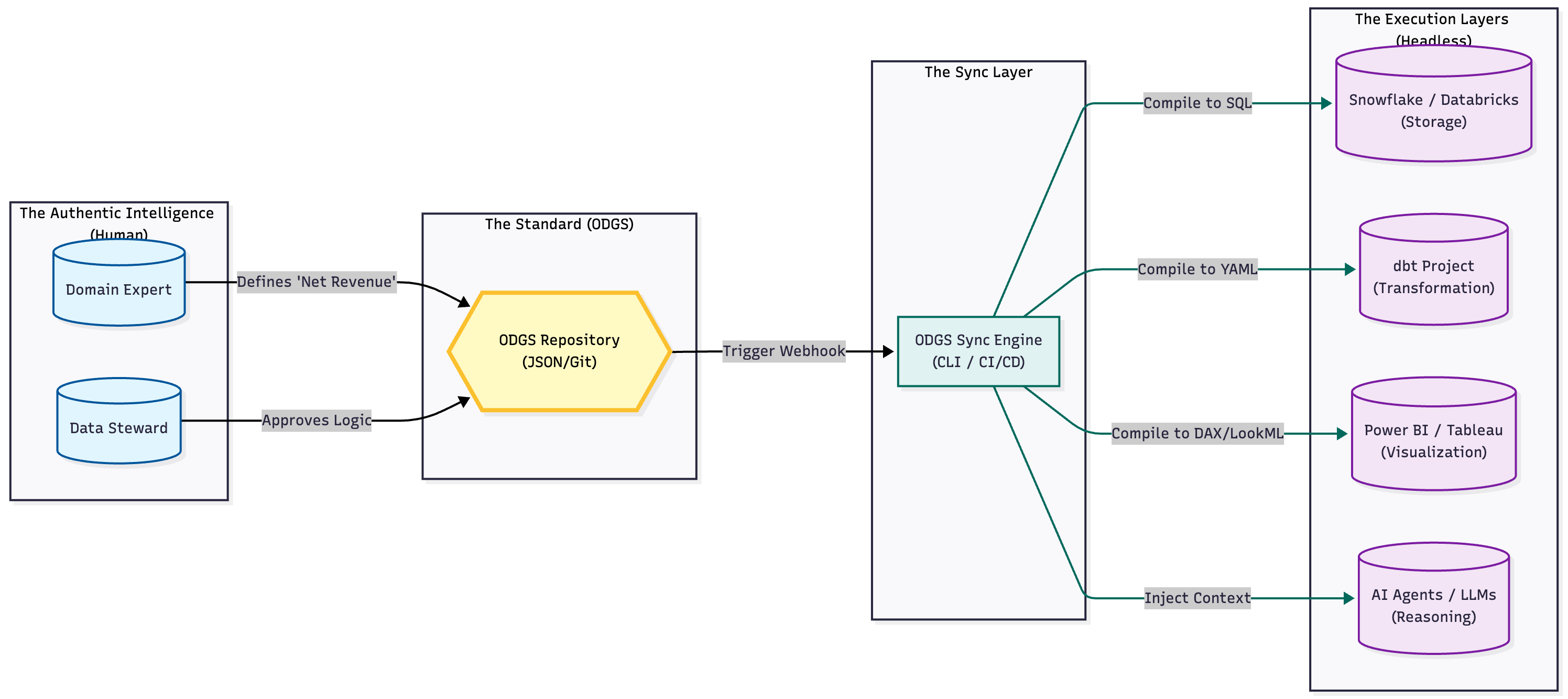
The Protocol: Write Once, Sync Everywhere
Instead of defining "Revenue" three times (once in dbt, once in Looker, once in Excel), you define it once in ODGS.
Our Sync Engine then compiles that definition into:
- SQL for your Data Warehouse (Snowflake/Databricks)
- LookML for Looker
- DAX for Power BI
- Semantic Context for your AI Agents
ODGS: The Open Data Governance Standard
The Protocol for "AI Safety" and "Algorithmic Accountability".
📢 The Problem: Semantic Hallucinations
When AI agents or LLMs query your database, they guess the meaning of columns. This leads to Semantic Hallucinations—where the AI confidently returns the "Net Profit" but calculated it wrong because it didn't know your specific accounting rules.
🛡️ The Solution: ODGS
ODGS is a machine-readable protocol (JSON Schema) that explicitly defines your business logic. It serves as the "Ground Truth" for both Humans, AI Agents, and Regulators (EU AI Act).
It's not just documentation; it compiles into:
- dbt Tests (for engineering reliability)
- Power BI/Tableau (for BI consistency)
- AI Context (so Copilots don't lie)
The Killer Feature: Metric Provenance
Generative AI is a "Reasoning Engine," not a "Knowledge Base." It is great at syntax, but terrible at facts. When an executive asks, "What was our Churn last month?", the AI hallucinates because it sees three different "Churn" columns in your warehouse.
ODGS provides Metric Provenance. It forces the AI to look up the human-codified definition first. It provides the Chain of Custody for your business logic, ensuring that every AI answer can be traced back to a specific, version-controlled definition in your Git repo.
We believe AI is only as good as the rules you give it.
- Artificial Intelligence guesses the answer based on probability.
- Authentic Intelligence knows the answer based on codified human expertise.
ODGS captures the Authentic Intelligence of your domain experts—the nuances, the exceptions, the business rules—and codifies them into a standard that AI can respect.
Join the Revolution
The Table Format War is over. The Semantic War has just begun.
Don't build another silo. Build on the Standard.
🏛️ The Open Data Governance Schema (ODGS)
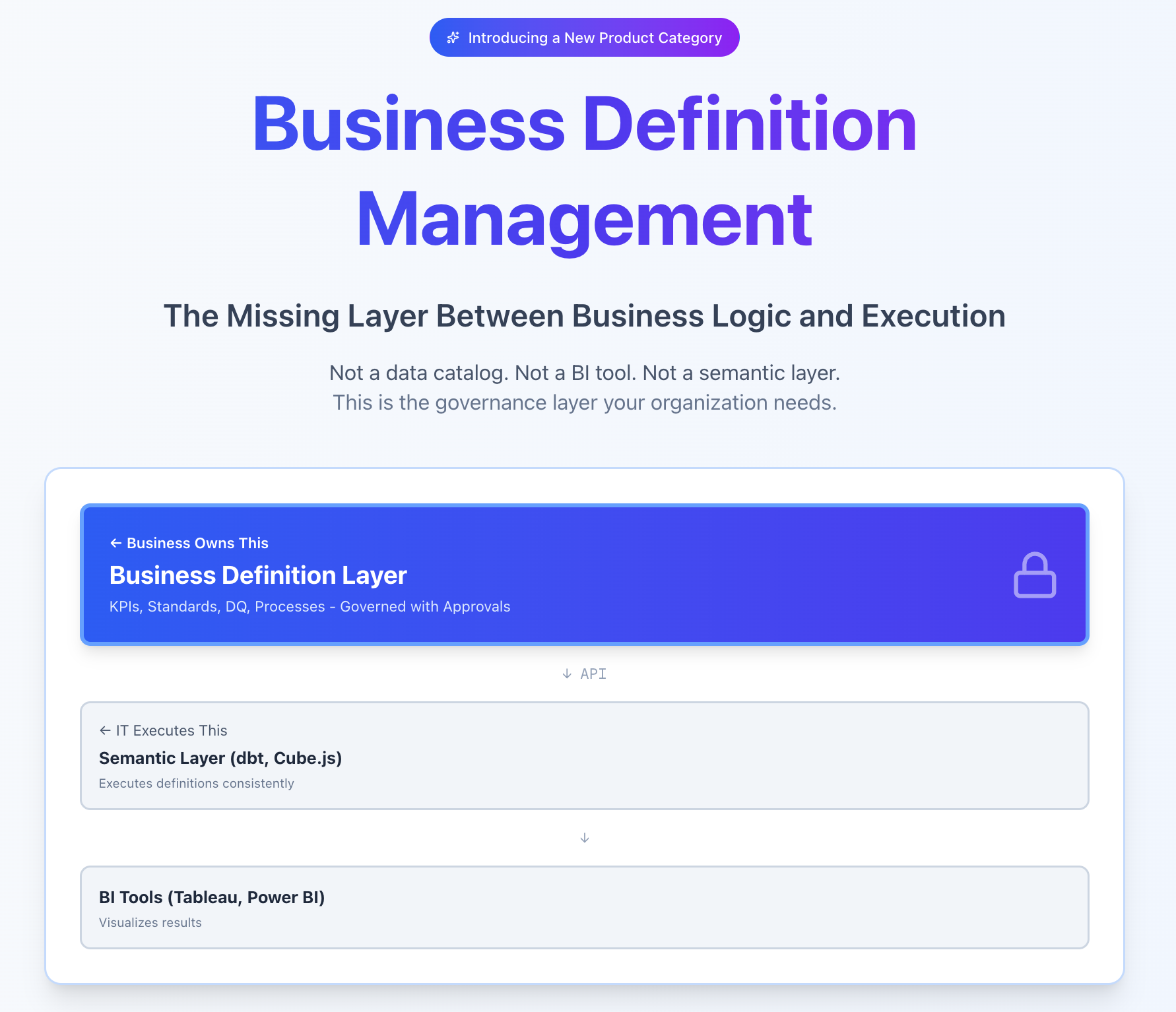
🧩 Why now, why this?

ODGS: Open Data Governance Schema
The Protocol for Algorithmic Accountability

ODGS is an open standard that decouples business logic from execution engines (like dbt, Power BI, or Tableau). It serves as the "Ground Truth" for Enterprise AI, ensuring that the context fed to LLMs is mathematically verifiable and consistent with business reality.
The Problem: "Semantic Hallucination." When an AI Agent calculates "Churn Rate", does it use the Marketing definition (Power BI) or the Finance definition (Snowflake)? If it guesses, it hallucinates.
The Solution: ODGS defines metrics once in a protocol-agnostic schema. It then compiles these definitions into the native languages of your tools (SQL, DAX, TMSL, YAML).
🛡️ AI Safety & Governance
ODGS is designed for Algorithmic Accountability. It provides:
- Provenance: Every metric has a unique ID and owner, traceable back to the source.
- Consistency: The AI, the Dashboard, and the Regulatory Report use the exact same logic.
- Auditability: Changes to logic are Git-versioned and mathematically verified before deployment.
🚀 The odgs CLI
ODGS comes with a developer-first CLI to manage your governance layer.
# 1. Validate your schema for AI Safety compliance
odgs validate

# 2. Build artifacts for all downstream tools
odgs build
graph TD
    subgraph PROBLEM ["❌ The Problem: Definition Drift"]
        A[CFO: 'Gross Margin' in Excel] -->|Disconnect| B[dbt: SQL Logic]
        A -->|Disconnect| C[Power BI: DAX Logic]
        B -.-|Mismatch| C
    end

    subgraph SOLUTION ["✅ The Solution: Open Governance Schema"]
        D[("JSON Schema (OGS)
        Single Source of Truth")]

        D -->|Auto-Sync| E[dbt / Snowflake]
        D -->|Auto-Sync| F[Power BI / Tableau]
        D -->|Auto-Sync| G[Data Catalog / Collibra]
    end

    style D fill:#f9f,stroke:#333,stroke-width:4px,color:black
    style PROBLEM fill:#ffcccc,stroke:#333,stroke-width:1px
    style SOLUTION fill:#ccffcc,stroke:#333,stroke-width:1px
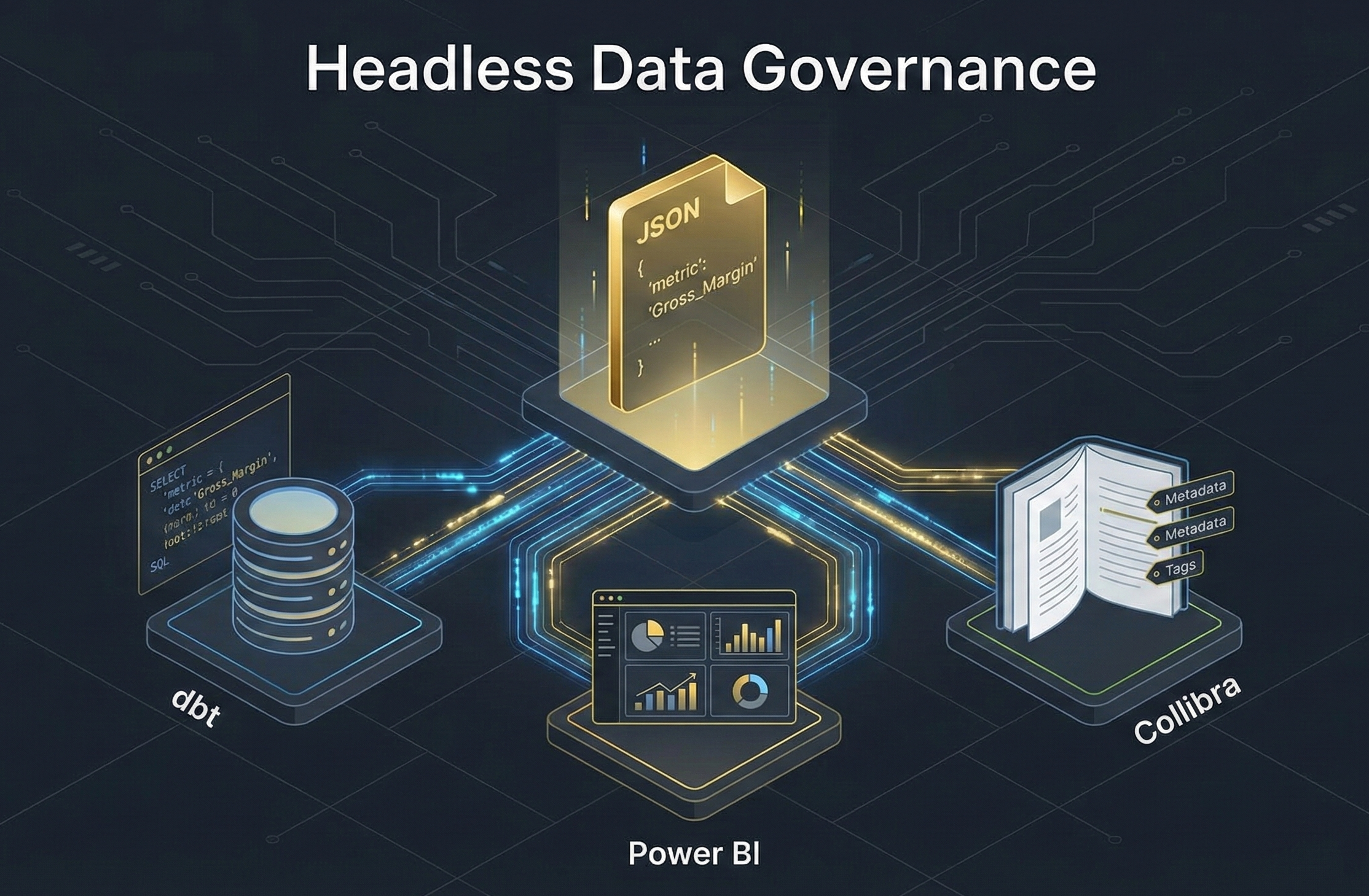
The Open Data Governance Schema (ODGS) is a vendor-neutral JSON protocol that acts as the "API" for your business definitions. By decoupling the Definition (The "What") from the Tool (The "How"), you achieve Headless Governance.
How it works
// example: standard_metrics.json
{
  "metric_id": "KPI_102",
  "name": "Gross_Margin",
  "domain": "Finance",
  "calculation_logic": {
    "abstract": "Revenue - COGS",
    "sql_standard": "SUM(gross_sales) - SUM(cost_of_goods)",
    "dax_pattern": "[Total Sales] - [Total Cost]"
  },
  "owner": "CFO_Office",
  "quality_threshold": "99.5%"
}
📂 The Protocol Structure
This repository contains the core schemas that define the "Alphabet" of Data Governance:
| File | Purpose |
|---|---|
standard_metrics.json |
The "Golden Record" for KPIs. Define logic, ownership, and sensitivity here. |
standard_dq_dimensions.json |
The 60 industry-standard dimensions of data quality (Accuracy, Timeliness, Completeness, etc.). |
standard_data_rules.json |
Technical validation rules (Regex patterns, null checks, referential integrity). |
root_cause_factors.json |
A standardized taxonomy for why data breaks (e.g., Process_Gap vs Integration_Failure). |
business_process_maps.json |
Maps how data entities flow through the business lifecycle. |
physical_data_map.json |
Maps abstract metrics to physical database tables/columns. |
ontology_graph.json |
Defines relationships between business entities. |
✅ Validation & CI/CD Integration
The repository includes a validator script that enforces the governance schema:
python3 scripts/validate_schema.py
Output:
🔍 Running Open Governance Schema Validator...
✅ Loaded 72 metrics.
✅ Loaded 50 data rules.
🎉 All Governance Checks Passed!
CI/CD Integration
Add this to your GitHub Actions workflow to enforce governance standards:
- name: Validate Governance Schema
  run: python3 scripts/validate_schema.py
This ensures that all metrics and rules have:
- Unique IDs
- Assigned owners
- Defined domains
- Clear calculation logic
📦 Installation
NPM (Node.js)
npm install odgs
Usage:
import { standardMetrics } from 'odgs';
// or
const { standardMetrics } = require('odgs');
PyPI (Python)
PyPI (Python)
pip install "odgs[all]"
Usage:
# Initialize a new project
odgs init my_governance_layer

# Add a new metric
cd my_governance_layer
odgs add metric

# Validate schema
odgs validate

# Build artifacts
odgs build
🛠 Usage & Implementation
🔌 BI Adapters
The repository includes built-in adapters to generate configuration files for major BI tools:
| Tool | Output Format | Script |
|---|---|---|
| dbt MetricFlow | semantic_models.yml |
adapters/dbt/generate_semantic_models.py |
| Power BI | measures.tmsl.json (TMSL) |
adapters/powerbi/generate_tmsl.py |
| Tableau | metrics.tds (XML) |
adapters/tableau/generate_tds.py |
Generating Adapters
Run the following commands to generate the configurations:
# Generate dbt MetricFlow YAML
python3 adapters/dbt/generate_semantic_models.py

# Generate Power BI TMSL
python3 adapters/powerbi/generate_tmsl.py

# Generate Tableau TDS
python3 adapters/tableau/generate_tds.py
The generated files will be located in the adapters/<tool>/ directories.
What is generated?
- Metrics: Calculation logic (SQL/DAX) for all 72 standard metrics.
- Reference Data: Static tables for DQ Dimensions, Root Causes, and Business Processes.
- Data Rules:
- dbt: Generic tests (
macros/odgs_tests.sql) derived from standard rules. - Power BI/Tableau: Reference tables to join against.
- dbt: Generic tests (
Option B: The Reference Implementation
If you prefer a managed "Headless Governance" layer that natively supports ODGS and handles the sync to Power BI/dbt automatically, feel free to see the art of possible with these end-state applications built with the same data:
These examples demonstrate the end outcome for the business user of what the Open Data Governance Schema can do.
Commercial Managed Service Partners
For commercial managed services, please visit:
📄 License
This project is licensed under the Apache License 2.0 - see the LICENSE file for details.
Copyright © 2025 Authentic Intelligence Labs
Contributing: We welcome Pull Requests to expand the dq_dimensions or refine the root_cause_factors taxonomy.
Release history Release notifications | RSS feed


Download files
Download the file for your platform. If you're not sure which to choose, learn more about installing packages.
Source Distribution
Built Distribution
Filter files by name, interpreter, ABI, and platform.
If you're not sure about the file name format, learn more about wheel file names.
Copy a direct link to the current filters
File details
Details for the file odgs-1.2.0.tar.gz.
File metadata
- Download URL: odgs-1.2.0.tar.gz
- Upload date:
- Size: 211.5 kB
- Tags: Source
- Uploaded using Trusted Publishing? No
- Uploaded via: twine/6.2.0 CPython/3.13.9
File hashes
| Algorithm | Hash digest | |
|---|---|---|
| SHA256 |
f0c78d183c0b07d22ab3fa4d9f67d38021affeb86e08dc4a9aad2cd3456af5cf
|
|
| MD5 |
ddee83338491e909fcbb840002fda5f5
|
|
| BLAKE2b-256 |
1c6ca34dfe00aa171f341027ffdc7332977517f5dce4d6740308e9f494b07022
|
File details
Details for the file odgs-1.2.0-py3-none-any.whl.
File metadata
- Download URL: odgs-1.2.0-py3-none-any.whl
- Upload date:
- Size: 96.0 kB
- Tags: Python 3
- Uploaded using Trusted Publishing? No
- Uploaded via: twine/6.2.0 CPython/3.13.9
File hashes
| Algorithm | Hash digest | |
|---|---|---|
| SHA256 |
08fd74b5d107ab073928a95ce27304a4a8e01ec930242a2cae8cdab93d2c25af
|
|
| MD5 |
4093e9bf9e2a861afc1308f0cc94a9a4
|
|
| BLAKE2b-256 |
9e6fb5927f4d3bab8bedce1579409b30a5db159fc3ce2084c736d8c6407da4c5
|






