
Remote CLI client for Ollama servers - Network-ready chat interface with history tracking and inference control

Project description
Ollama Remote Chat CLI


A network-ready command-line chat client for Ollama servers. Connect to local or remote Ollama instances from any machine on your network.
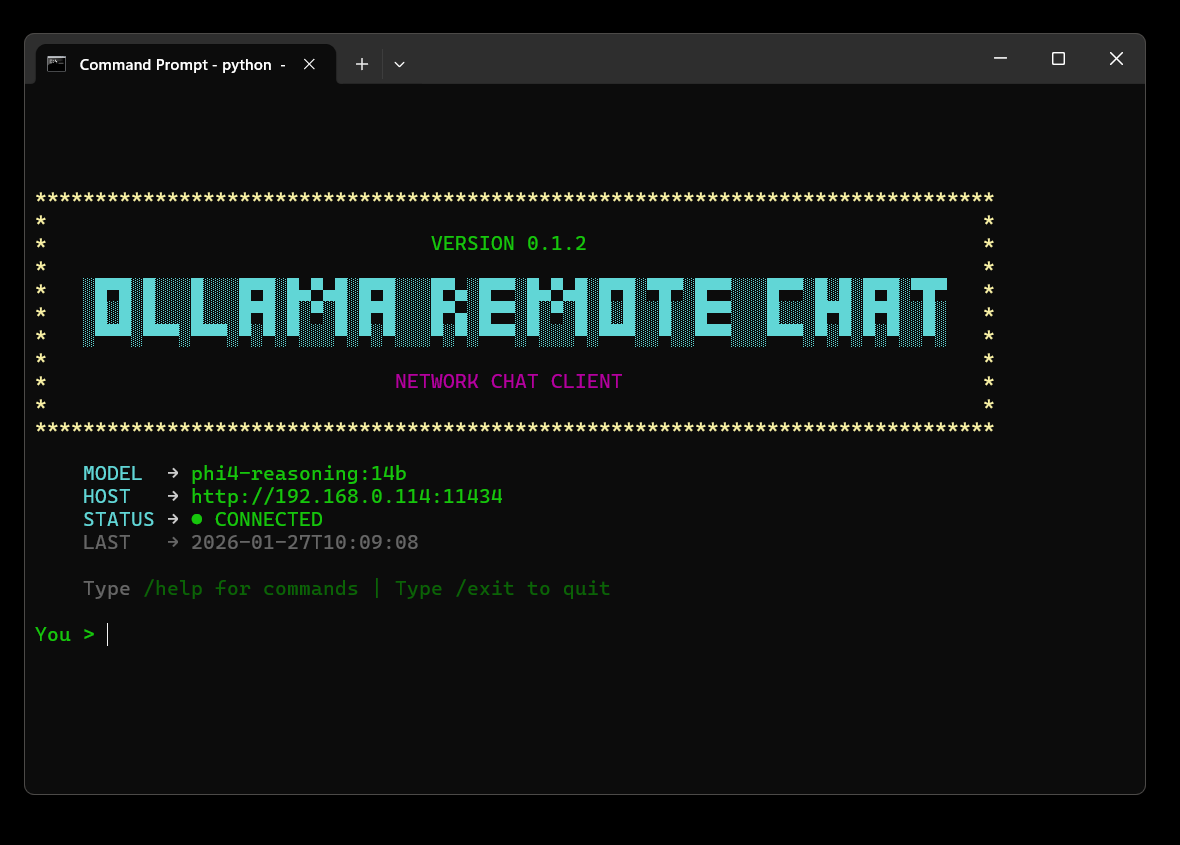
Quick Start
Installation
Install directly from PyPI:
pip install ollama-remote-chat-cli
Run the client:
orc
Or use the full command:
ollama-remote-chat-cli
First Run Setup
The first time you run orc, a setup wizard will guide you through:
- Configuring your Ollama server URL
- Selecting your preferred model
- Setting up your preferences
orc
# Follow the interactive setup wizard
Features
- 🌐 Network-ready - Connect to local or remote Ollama servers
- 🎨 Retro terminal UI - Clean, colorful command-line interface with dynamic spinner messages
- 🧹 Smart screen clearing -
/clearand/newpreserve header while clearing chat history - 🎨 Rich markdown rendering - Beautiful syntax highlighting and formatting
- 🧠 Thinking process support - See how reasoning models think (DeepSeek R1, QwQ, etc.)
- 📝 Chat history - Session management with search functionality
- ⚙️ Inference control - Configurable temperature, top_p, context window, and more
- 📊 Real-time metrics - Token usage, thinking metrics, and generation speed
- 🔄 Model management - Easy switching, pulling, and deletion of models
- 🔍 History search - Search through past conversations
- 💻 System monitoring - View running models and memory usage
- 🔒 Secure configuration - Environment-based settings with .env support
Requirements
- Python 3.7 or higher
- Ollama server (local or remote)
- Required packages:
requests,python-dotenv,wcwidth,rich
Connection Methods
Method 1: Local Connection (Default)
Ollama running on the same machine:
OLLAMA_HOST=http://localhost:11434
OLLAMA_MODEL=llama2
Setup:
- Install Ollama from ollama.ai
- Run:
ollama serve - Pull a model:
ollama pull llama2
Method 2: Hostname Connection (.local / mDNS)
Connect to another computer on your local network:
OLLAMA_HOST=http://my-computer.local:11434
OLLAMA_MODEL=llama3.3
Setup:
-
Find your server's hostname:
- Windows:
hostnamein CMD - Mac: System Preferences → Sharing → Computer Name
- Linux:
hostnamein terminal
- Windows:
-
Ensure mDNS/Bonjour is enabled:
- Windows: Install Bonjour Print Services
- Mac/Linux: Built-in support
-
Test:
ping my-computer.local -
Configure firewall to allow port 11434
Method 3: Static IP Address
For computers with fixed network IPs:
OLLAMA_HOST=http://192.168.1.100:11434
OLLAMA_MODEL=mistral
Setup:
-
Set static IP on your Ollama server
-
Find IP address:
- Windows:
ipconfig - Mac:
ifconfig en0 | grep inet - Linux:
ip addr show
- Windows:
-
Configure firewall to allow port 11434
Method 4: Docker
Ollama running in a Docker container:
OLLAMA_HOST=http://localhost:11434
OLLAMA_MODEL=llama2
Docker setup:
docker run -d -p 11434:11434 --name ollama ollama/ollama
docker exec -it ollama ollama pull llama2
Method 5: WSL (Windows Subsystem for Linux)
Accessing Windows Ollama host from WSL:
OLLAMA_HOST=http://host.docker.internal:11434
OLLAMA_MODEL=llama2
Or find Windows IP from WSL:
ip route | grep default | awk '{print $3}'
Available Commands
| Command | Description |
|---|---|
/help |
Show all available commands |
/multi |
Enter multi-line input mode |
/clear |
Clear conversation context |
/new |
Start a new chat session |
/exit |
Exit the chat |
| Model Management | |
/models |
List available models |
/switch |
Switch to a different model |
/pull |
Download a new model |
/delete |
Delete a model |
/create |
Create custom model from Modelfile |
/modelinfo |
Show detailed model information |
| Generation | |
/generate |
Generate raw completion without chat context |
| Configuration | |
/config |
Show current configuration |
/settings |
Configure inference settings |
/host |
Change Ollama host URL |
| History | |
/history |
View chat history |
/search |
Search chat history |
/showthinking |
View thinking from last AI response |
| System Monitoring | |
/version |
Show Ollama server version |
/ps |
List running models (memory usage) |
/ping |
Test connection latency to server |
Inference Settings
Fine-tune AI behavior with the /settings command:
Temperature (0.0-2.0) - Controls response creativity
- 0.1-0.3: Precise (coding, math, facts)
- 0.6-0.8: Balanced (general chat)
- 1.0-1.5: Creative (writing, brainstorming)
Top P (0.0-1.0) - Nucleus sampling threshold (default: 0.9)
Top K (1-100) - Limits token choices (default: 40)
Context Window (128-32768) - Conversation memory in tokens (default: 2048)
Max Output (1-4096) - Maximum response length (default: 512)
Repeat Penalty (0.0-2.0) - Reduces repetition (default: 1.1)
Advanced Features
Thinking Process Visualization
For reasoning models like DeepSeek R1, QwQ, and others that use chain-of-thought:
- Hidden by default: Thinking process is hidden during streaming for cleaner output
- View thinking: Use
/showthinkingto see the AI's reasoning after response - Live thinking: Enable in
/settingsto watch the model think in real-time - Saved in history: Thinking is automatically saved for later review
Settings control:
show_thinking_live- Display thinking as it happens (default: false)save_thinking- Save thinking to chat history (default: true)
Rich Markdown Rendering
AI responses are automatically formatted with:
- Syntax highlighting for code blocks
- Styled headers and emphasis (bold, italic)
- Formatted lists and blockquotes
- Colored output optimized for all terminals
Toggle in /settings:
use_markdown- Enable/disable Rich rendering (default: true)
System Monitoring
/ps command shows:
- Currently loaded models in memory
- VRAM usage per model
- Model expiration times
- Total memory consumption
Useful for:
- Monitoring resource usage
- Debugging slow responses
- Managing multiple models
Remote Access & Performance Metrics
Optimized for remote server usage with transparent diagnostics:
- Live timing: Spinner shows elapsed time during processing (e.g., "Thinking... 4.2s")
- TTFT tracking: Measures Time To First Token for responsiveness analysis
- Connection testing:
/pingcommand with color-coded latency status- 🟢 Excellent: <100ms (LAN/local)
- 🟡 Good: 100-300ms (fast remote)
- 🔴 Slow: >800ms (high latency)
- Detailed metrics: Two-line performance breakdown
- Line 1: Total time, first token time, generation speed
- Line 2: Context size, input/output tokens, thinking words
Perfect for Tailscale/VPN setups - Metrics help diagnose whether slowness is from network or model processing.
Example output:
Total: 6.3s | First token: 4.1s | Speed: 23.0 tok/s
Context: 2048 tokens | Input: 15 | Output: 118
Use Cases
Home Network Setup
- Powerful Desktop/Server: Runs Ollama with GPU acceleration
- Laptop/Weak PC: Runs
orcclient, connects remotely - Benefit: Use AI from any device without local GPU
Development Environment
- Server: Dedicated AI inference machine
- Workstation: Lightweight client for coding assistance
- Benefit: Consistent model across team
Multi-Device Access
- Gaming PC: Hosts Ollama when not gaming
- Any Device: Connect from laptop, tablet, or work PC
- Benefit: Centralized AI without duplicate models
Troubleshooting
"Could not connect to Ollama"
1. Verify Ollama is running:
curl http://localhost:11434
# Should return: "Ollama is running"
2. Check firewall:
- Windows: Allow port 11434 in Windows Firewall
- Mac: System Preferences → Security → Firewall
- Linux:
sudo ufw allow 11434
3. Test hostname resolution:
ping your-hostname.local
# If fails, use IP address instead
4. Check Ollama binding:
# Ensure Ollama is listening on all interfaces
OLLAMA_HOST=0.0.0.0 ollama serve
"Model not found"
# List available models on server
ollama list

# Pull a model
ollama pull llama2
"Module not found" or Import Errors
# Reinstall the package
pip install --upgrade --force-reinstall ollama-remote-chat-cli
Command not found: orc
Windows:
# Add Python Scripts to PATH
# Location: C:\Users\YourName\AppData\Local\Programs\Python\Python3XX\Scripts
Mac/Linux:
# Ensure pip install location is in PATH
export PATH="$HOME/.local/bin:$PATH"

# Add to ~/.bashrc or ~/.zshrc to make permanent
Configuration Files
Config location: ~/.ollama_chat_config.json
History location: ~/.ollama_chat_history.json
These are created automatically on first run.
Manual configuration:
Create a .env file in your home directory:
OLLAMA_HOST=http://localhost:11434
OLLAMA_MODEL=llama2
TEMPERATURE=0.8
TOP_P=0.9
Alternative Installation Methods
From Source (Development)
# Clone the repository
git clone https://github.com/Avaxerrr/ollama-remote-chat-cli.git
cd ollama-remote-chat-cli

# Install in editable mode
pip install -e .

# Run it
orc
Building Standalone Executable
# Using Nuitka build script
python nuitka_build.py

# Follow the interactive menu
# Creates portable .exe or binary
Updating
To get the latest version:
pip install --upgrade ollama-remote-chat-cli
Check your current version:
pip show ollama-remote-chat-cli
Or inside the app:
orc
# Then type: /version
Development
Running from source:
git clone https://github.com/Avaxerrr/ollama-remote-chat-cli.git
cd ollama-remote-chat-cli
pip install -e .
orc
Running tests:
# Install dev dependencies
pip install -e ".[dev]"

# Run tests (when available)
pytest
License
MIT License - see LICENSE file for details.
Copyright © 2026 Avaxerrr
Permission is hereby granted, free of charge, to use, modify, and distribute this software.
Links
- PyPI: https://pypi.org/project/ollama-remote-chat-cli/
- GitHub: https://github.com/Avaxerrr/ollama-remote-chat-cli
- Issues: https://github.com/Avaxerrr/ollama-remote-chat-cli/issues
- Changelog: CHANGELOG.md - View release history and version updates
- Ollama: https://ollama.ai
Acknowledgments
- Built for Ollama
- Inspired by modern CLI tools
- Community contributions welcome
Support
Having issues? Here's how to get help:
- Check the Troubleshooting section
- Search existing issues
- Open a new issue with:
- Your OS and Python version
- Error messages
- Steps to reproduce


Download files
Download the file for your platform. If you're not sure which to choose, learn more about installing packages.
Source Distribution
Built Distribution
Filter files by name, interpreter, ABI, and platform.
If you're not sure about the file name format, learn more about wheel file names.
Copy a direct link to the current filters
File details
Details for the file ollama_remote_chat_cli-0.1.2.tar.gz.
File metadata
- Download URL: ollama_remote_chat_cli-0.1.2.tar.gz
- Upload date:
- Size: 31.5 kB
- Tags: Source
- Uploaded using Trusted Publishing? No
- Uploaded via: twine/6.2.0 CPython/3.12.5
File hashes
| Algorithm | Hash digest | |
|---|---|---|
| SHA256 |
fff92e79cdd2dd203591c899422b549ffd0b014cc9a59861f25d6fef3794f496
|
|
| MD5 |
0034ad8b5172f7cdda171d32af79b0c2
|
|
| BLAKE2b-256 |
0c3ee36f74e83e2830388a07b050fb11a2463a0bfe0466442992cd5e5a61e481
|
File details
Details for the file ollama_remote_chat_cli-0.1.2-py3-none-any.whl.
File metadata
- Download URL: ollama_remote_chat_cli-0.1.2-py3-none-any.whl
- Upload date:
- Size: 27.8 kB
- Tags: Python 3
- Uploaded using Trusted Publishing? No
- Uploaded via: twine/6.2.0 CPython/3.12.5
File hashes
| Algorithm | Hash digest | |
|---|---|---|
| SHA256 |
03a5b86bbd827f73370dc556af8c670a6e807fdd2b2bfa33f7448a034583bbca
|
|
| MD5 |
142ea64dd06b5e8ee2857d6f0fd8b6cd
|
|
| BLAKE2b-256 |
022e69ac632688d56ffece52014e12af2be36047b1e42d41ccd2a51204b2b0bc
|






