
OGC Observations & Measurements REST API (compliant with OM-JSON OGC DP 15-100r1 and GeoJSON, used by WMO WHOS DAB) client. Part of WMO HydroSOS project

Project description
WHOS data retrieval functionality for HydroSOS
Purpose
To facilitate interoperable timeseries data retrieval from the WHOS (WMO Hydrological Observations System).
How to use
-
Install this module (see Installation)
-
Register into WHOS and save your access token
-
Explore WHOS portals and search engines to select the timeseries of interest
- https://community.wmo.int/en/whos-portals
- https://whos.geodab.eu/gs-service/om-api
- https://alerta.ina.gob.ar/wmlclient/wml/
- http://whos.geodab.eu/gs-service/search?view=whos-plata
-
Take note of the feature id (site) plus observedProperty, or the observationIdentifier
-
Use either a python script or notebook (see examples below) or the command line interface to get the data (see examples below) for a given time period
Installation
pip install om-api-client
Config file location
- Linux: $HOME/.om-api-client.yml
- Windows: %USERPROFILE%/.om-api-client.yml
- MacOS: $HOME/.om-api-client.yml
You can insert your access token and change other config parameters by editing the config file.
Output
Output format of data retrieval is either:
-
a JSON-serializable list of dicts:
[ { "date": "ISO format date string", "value": float }, ... ] -
or CSV:
date,value
string,float
...
Use
Python script / notebook
from om_api_client import OmApiClient, timeseriesMetadataToDataFrame, featuresToDataFrame, featuresToGeoJSON
import pandas
import plotly.express as px
import logging
from datetime import datetime
parameters
begin_date = "1990-01-01"
end_date = str(datetime.now())[0:10]
feature_id = "FAAC49BA633EFF325BE5D2BA81BE14574A268ABA"
observation_identifiers_csv = "data/ina_timeseries.csv"
observed_property = "Discharge"
aggregation_duration = "P1M"
Instantiate client
client = OmApiClient()
retrieve timeseries using site and variable ids
ts_metadata = client.getTimeseries(
    feature=feature_id,
    observedProperty=observed_property,
    aggregationDuration=aggregation_duration)
Inspect metadata
len(ts_metadata["member"])
Select observation identifier
observationIdentifier = ts_metadata["member"][0]["id"] # '18EB307E3D1C45D3A2842D710A41001AB5083041'
retrieve data
data = client.getData(
    begin_date,
    end_date,
    observationIdentifier = observationIdentifier)
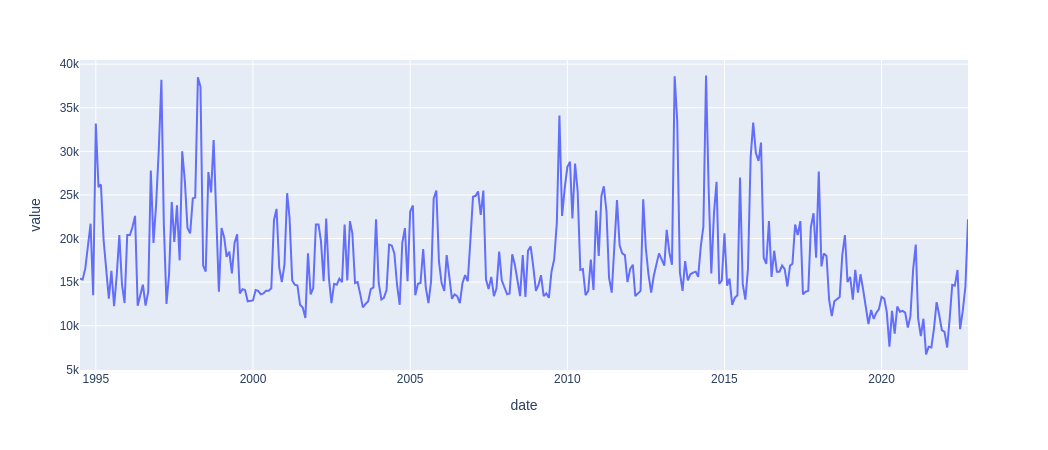
convert to dataframe and plot
df = pandas.DataFrame(data)
df["date"] = pandas.to_datetime(df["date"])
df = df.set_index("date")
px.line(df.reset_index(), x="date", y="value")
read observation identifiers from csv, retrieve data and plot together
from io import StringIO
csv_data = """stream,station_name,station_id,variable,observation_identifier
URUGUAY,Paso de los Libres,72,monthly discharge,8272678FE72DB91CD511E653099DB3219DEE615B
URUGUAY,Santo Tomé,68,monthly discharge,18A95E501B2C4EEC191BE2215D87DDF107AF8A42
URUGUAY,San Javier,65,monthly discharge,9DB2FD5D21BE8FFDF36B699E3CC607CD98FFFB03
PARANA,Paraná,29,monthly discharge,B569750A1B728AB62D03460068CF80CCCD011D13
PARANA,Santa Fe,30,monthly discharge,97A1C9210A637D94FB29B5BACB0500E0F353AB04
PARANA,Barranqueras,20,monthly discharge,24F40961A057CE7DC723EE86BBA3B39729F03CBC
"""
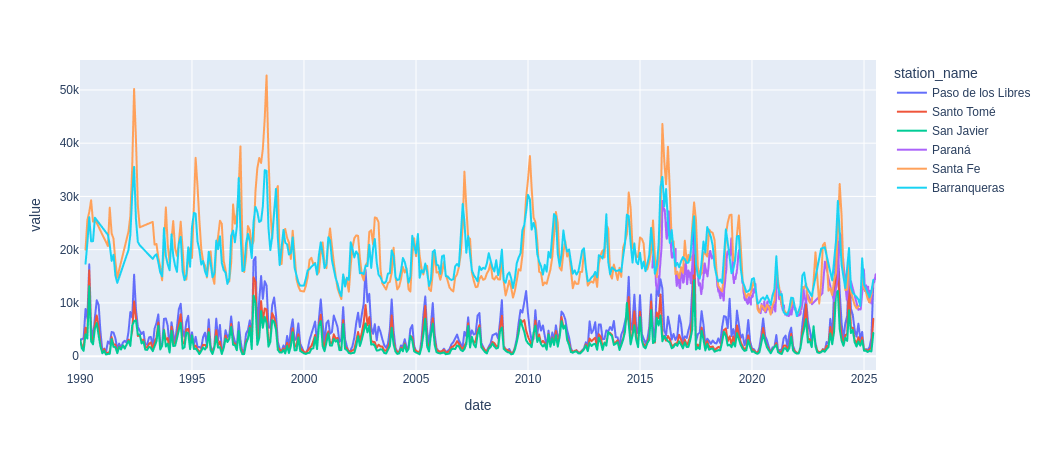
stations = pandas.read_csv(StringIO(csv_data))
df_list = []
for index, row in stations.iterrows():
    data = client.getData(
        begin_date,
        end_date,
        observationIdentifier = row["observation_identifier"])
    df_ = pandas.DataFrame(data)
    df_["station_name"] = row["station_name"]
    df_list.append(df_)
df = pandas.concat(df_list)
px.line(df, x = "date", y = "value", color = "station_name")
get metadata first page
ts_metadata = client.getTimeseries(
    observedProperty=observed_property,
    limit=50)
ts_metadata.keys() #  dict_keys(['id', 'member', 'completed', 'resumptionToken'])
len(ts_metadata["member"]) # 50
ts_metadata["completed"] # False
get metadata all pages
ts_metadata = client.getTimeseriesWithPagination(
    observedProperty=observed_property,
    limit=50)
len(ts_metadata["member"]) #  > 50
df_ts = timeseriesMetadataToDataFrame(ts_metadata)
df_ts.head(5)
| sourceId | observedProperty | beginDate | endDate | featureId | ObservationId | uom | interpolationType | aggregationDuration | |
|---|---|---|---|---|---|---|---|---|---|
| 0 | argentina-ina | Discharge, stream | 2020-08-06T03:00:00Z | 2020-08-31T03:00:00Z | 00D3297FBC6A70359AC9C78EC0A56AE2EBBD8B6C | 04CE047C0DF5A150C3FD9F7FD9B75F7E6098EFC9 | metros cúbicos por segundo | Continuous/Instantaneous | None |
| 1 | argentina-ina | Discharge, stream | 2020-08-01T03:00:00Z | 2020-08-01T03:00:00Z | 00D3297FBC6A70359AC9C78EC0A56AE2EBBD8B6C | 33DC6C9A6EC6777C8C1E57391C0539749DC40BE3 | metros cúbicos por segundo | Average in succeeding interval | P1M |
| 2 | argentina-ina | Discharge, stream | 2020-08-01T03:00:00Z | 2020-08-01T03:00:00Z | 00D3297FBC6A70359AC9C78EC0A56AE2EBBD8B6C | 363201EC2149C679D5A7A65C126916A13FABDD5D | metros cúbicos por segundo | Average in succeeding interval | P1M |
| 3 | argentina-ina | Discharge, stream | 2020-08-06T03:00:00Z | 2020-08-31T03:00:00Z | 00D3297FBC6A70359AC9C78EC0A56AE2EBBD8B6C | 68DA7DC5CB959B851B4461E8CA6A875790B8F919 | metros cúbicos por segundo | Average in succeeding interval | P1D |
| 4 | argentina-ina | Discharge, stream | 2020-08-01T03:00:00Z | 2020-08-01T03:00:00Z | 00D3297FBC6A70359AC9C78EC0A56AE2EBBD8B6C | D170EC5D1100F30D913E60AE223E44DDDCCC7078 | metros cúbicos por segundo | Average in succeeding interval | P1M |
5 rows × 9 columns
get features first page
features = client.getFeatures(
    observedProperty=observed_property,
    limit=50)
get features with pagination
features = client.getFeaturesWithPagination(
    observedProperty=observed_property,
    limit=50)
features["results"][0]
{
  "shape": {
    "coordinates": [-57.938011, -31.273969],
    "type": "Point"
  },
  "parameter":
    [
      {
        "name": "country",
        "value": "Argentina"
      },
      {
        "name": "source",
        "value": "Argentina, Instituto Nacional del Agua (INA)"
      },
      {
        "name": "sourceId",
        "value": "argentina-ina"
      },
      {
        "name": "identifier",
        "value": "argentina-ina:alturas_prefe:89"
      }
    ],
  "name": "Aporte Salto Grande",
  "id": "00D3297FBC6A70359AC9C78EC0A56AE2EBBD8B6C",
  "relatedParty": []}
df_features = featuresToDataFrame(features)
df_features.head(5)
| longitude | latitude | country | sourceId | identifier | name | id | author | |
|---|---|---|---|---|---|---|---|---|
| 0 | -57.938011 | -31.273969 | Argentina | argentina-ina | argentina-ina:alturas_prefe:89 | Aporte Salto Grande | 00D3297FBC6A70359AC9C78EC0A56AE2EBBD8B6C | None |
| 1 | -60.780556 | -31.491222 | Argentina | argentina-ina | argentina-ina:alturas_bdhi:103 | Recreo - Ruta Provincial nº 70 | 02E07E2F72A815E237B7896D79BC68193EF3A0A6 | None |
| 2 | -58.558333 | -28.995000 | Argentina | argentina-ina | argentina-ina:sat2:2832 | Corriente - Paso Lucero | 083988DC8C2E39D6E0C82B296A857F6A088B8028 | None |
| 3 | -57.633333 | -30.250000 | Argentina | argentina-ina | argentina-ina:alturas_prefe:74 | Monte Caseros | 0DF4C4284AA14E0A545C0F855B4F6FF558693CEE | None |
| 4 | -55.883333 | -27.366667 | Argentina | argentina-ina | argentina-ina:alturas_prefe:14 | Posadas | 23137FB463C0902450418E9E2F0D38C719419AA9 | None |
featuresToGeoJSON(features)
{
  "type": "FeatureCollection",
  "features": [
    {
      "geometry": {
        "coordinates": [-57.938011, -31.273969],
        "type": "Point"
      },
      "properties": {
        "longitude": -57.938011,
        "latitude": -31.273969,
        "country": "Argentina",
        "sourceId": "argentina-ina",
        "identifier": "argentina-ina:alturas_prefe:89",
        "name": "Aporte Salto Grande",
        "id": "00D3297FBC6A70359AC9C78EC0A56AE2EBBD8B6C",
        "author": null
      }
    },
    ...
  ]
}
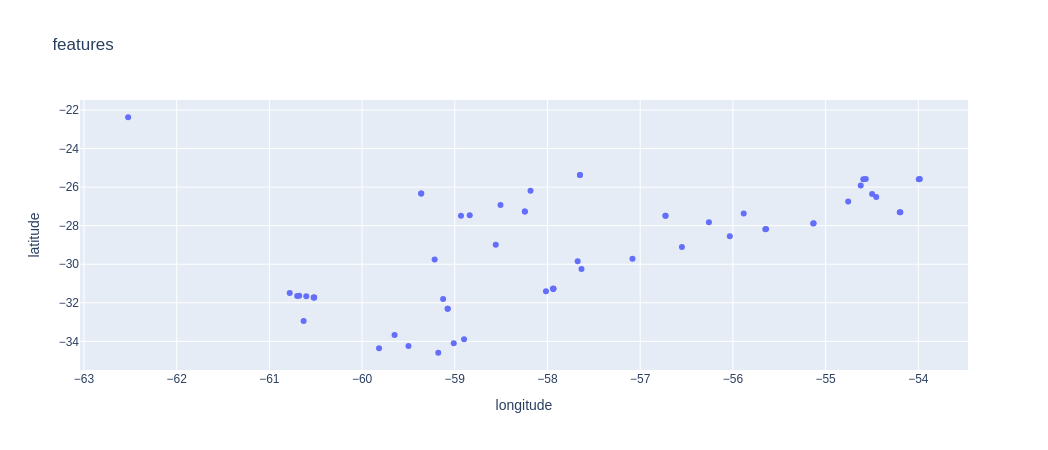
px.scatter(featuresToDataFrame(features), "longitude", "latitude", hover_name = "name", title = "features")
Command line interface
data
$ om-api-client data --help
Usage: om-api-client data [OPTIONS] BEGIN_POSITION END_POSITION

Options:
  -t, --token TEXT                WHOS access token
  -u, --url TEXT                  WHOS OM OGC timeseries API url
  -o, --output TEXT               Save result into this file (instead of print
                                  on stdout)
  -c, --csv                       Use CSV format for output (instead of JSON)
  -m, --monitoring_point TEXT     site identifier. It must be user together
                                  with --variable_name
  -v, --variable_name TEXT        variable identifier. It must be used
                                  together with --monitoring_point
  -s, --timeseries_identifier TEXT
                                  timeseries identifier. If set,
                                  --monitoring_point and --variable_name are
                                  ignored
  -a, --aggregation_duration TEXT
                                  aggregation duration ISO code. i.e. P1M,
                                  P1D, P6H
  --help                          Show this message and exit.
examples
# retrieve data using feature id + variable id + aggregation duration (-m + -v + -a)
# output json to stdout
om-api-client data -m FAAC49BA633EFF325BE5D2BA81BE14574A268ABA -v Discharge -a P1M 1990-01-01 2024-05-01
# output to json file
om-api-client data -m FAAC49BA633EFF325BE5D2BA81BE14574A268ABA -v Discharge -a P1M -o /tmp/data.json 1990-01-01 2024-05-01
# output csv to stdout
om-api-client data -m FAAC49BA633EFF325BE5D2BA81BE14574A268ABA -v Discharge -a P1M -c 1990-01-01 2024-05-01
# output to csv file
om-api-client data -m FAAC49BA633EFF325BE5D2BA81BE14574A268ABA -v Discharge -a P1M -o /tmp/data.csv -c 1990-01-01 2024-05-01
# retrieve using timeseries observation id (-s)
om-api-client data -s 18EB307E3D1C45D3A2842D710A41001AB5083041 1990-01-01 2024-05-01
metadata
$ om-api-client metadata --help
Usage: om-api-client metadata [OPTIONS]

Options:
  -t, --token TEXT                WHOS access token
  -u, --url TEXT                  WHOS OM OGC timeseries API url
  -o, --output TEXT               Save result into this file (instead of print
                                  on stdout)
  -m, --monitoring_point TEXT     site (feature) identifier. It must be user
                                  together with --variable_name
  -v, --variable_name TEXT        variable identifier (=observedProperty). It
                                  must be used together with
                                  --monitoring_point
  -s, --timeseries_identifier TEXT
                                  timeseries identifier. If set,
                                  --monitoring_point and --variable_name are
                                  ignored
  -l, --limit INTEGER             pagination page size
  -h, --has_data                  return only observations with data
  -W, --west FLOAT                west longitude of bounding box
  -S, --south FLOAT               south latitude of bounding box
  -E, --east FLOAT                east longitude of bounding box
  -N, --north FLOAT               north latitude of bounding box
  -O, --ontology TEXT             The ontology to be used to expand the
                                  observed property search term (or URI) with
                                  additional terms from the ontology that are
                                  synonyms and associated to narrower
                                  concepts. Two ontologies are available: whos
                                  or his-central
  -V, --view TEXT                 Identifier of the data subset interesting
                                  for the user
  -T, --time_interpolation TEXT   The interpolation used on the time axis (for
                                  example, MAX, MIN, TOTAL, AVERAGE, MAX_PREC,
                                  MAX_SUCC, CONTINUOUS, ...)
  -i, --intended_observation_spacing TEXT
                                  The expected duration between individual
                                  observations, expressed as ISO8601 duration
                                  (e.g., P1D)
  -a, --aggregation_duration TEXT
                                  Time aggregation that has occurred to the
                                  value in the timeseries, expressed as
                                  ISO8601 duration (e.g., P1D)
  -f, --format TEXT               Response format (e.g. JSON or CSV)
  --help                          Show this message and exit.
examples
# retrieve timeseries observations metadata with variable name filter (-v) and custom page size (-l)
om-api-client metadata -l 50 -v Discharge -o /tmp/whos_metadata.json
features (monitoring points)
$ om-api-client features --help
Usage: om-api-client features [OPTIONS]

Options:
  -t, --token TEXT                WHOS access token
  -u, --url TEXT                  WHOS OM OGC timeseries API url
  -o, --output TEXT               Save result into this file (instead of print
                                  on stdout)
  -m, --monitoring_point TEXT     site (feature) identifier. It must be user
                                  together with --variable_name
  -v, --variable_name TEXT        variable identifier (=observedProperty). It
                                  must be used together with
                                  --monitoring_point
  -s, --timeseries_identifier TEXT
                                  timeseries identifier. If set,
                                  --monitoring_point and --variable_name are
                                  ignored
  -l, --limit INTEGER             pagination page size
  -W, --west FLOAT                west longitude of bounding box
  -S, --south FLOAT               south latitude of bounding box
  -E, --east FLOAT                east longitude of bounding box
  -N, --north FLOAT               north latitude of bounding box
  -O, --ontology TEXT             The ontology to be used to expand the
                                  observed property search term (or URI) with
                                  additional terms from the ontology that are
                                  synonyms and associated to narrower
                                  concepts. Two ontologies are available: whos
                                  or his-central
  -V, --view TEXT                 Identifier of the data subset interesting
                                  for the user
  -T, --time_interpolation TEXT   The interpolation used on the time axis (for
                                  example, MAX, MIN, TOTAL, AVERAGE, MAX_PREC,
                                  MAX_SUCC, CONTINUOUS, ...)
  -i, --intended_observation_spacing TEXT
                                  The expected duration between individual
                                  observations, expressed as ISO8601 duration
                                  (e.g., P1D)
  -a, --aggregation_duration TEXT
                                  Time aggregation that has occurred to the
                                  value in the timeseries, expressed as
                                  ISO8601 duration (e.g., P1D)
  -F, --filter KEY=VALUE          Set additional filters as key=value. Valid
                                  keys: beginPosition, endPosition,
                                  spatialRelation, predefinedLayer, country,
                                  provider
  -f, --format TEXT               Response format (e.g. JSON (raw), GeoJSON or
                                  CSV)
  --help                          Show this message and exit.
examples
# retrieve features with variable name filter (-v) and custom page size (-l)
om-api-client features -l 50 -v Discharge -o /tmp/whos_features.json
# as csv
om-api-client features -l 50 -v Discharge -o /tmp/whos_features.csv -f csv
# as geojson
om-api-client features -l 50 -v Discharge -o /tmp/whos_features.geojson -f geojson
# with country filter (-F country=)
om-api-client features -l 50 -F country=ARG -o /tmp/whos_features.json
# with provider filter (-F provider=)
om-api-client features -l 50 -F provider=argentina-ina -o /tmp/whos_features.json
Credits
Programa de Sistemas de Información y Alerta Hidrológico de la Cuenca del Plata
Laboratorio de Hidrología
Instituto Nacional del Agua
Argentina
2025-07-15
Release history Release notifications | RSS feed


Download files
Download the file for your platform. If you're not sure which to choose, learn more about installing packages.
Source Distribution
Built Distribution
Filter files by name, interpreter, ABI, and platform.
If you're not sure about the file name format, learn more about wheel file names.
Copy a direct link to the current filters
File details
Details for the file om_api_client-0.0.0.dev2.tar.gz.
File metadata
- Download URL: om_api_client-0.0.0.dev2.tar.gz
- Upload date:
- Size: 342.8 kB
- Tags: Source
- Uploaded using Trusted Publishing? No
- Uploaded via: twine/6.1.0 CPython/3.12.3
File hashes
| Algorithm | Hash digest | |
|---|---|---|
| SHA256 |
c966e49fea83a184af0468062590aea7e415ebbd5d956b5ced13309c418fd131
|
|
| MD5 |
c320d8ac7fb9506b427ce509686ee9d1
|
|
| BLAKE2b-256 |
b166958f542f5707c5d7cb55df8089d00ad089d89d3341b09fba0d2cb1356d7d
|
File details
Details for the file om_api_client-0.0.0.dev2-py3-none-any.whl.
File metadata
- Download URL: om_api_client-0.0.0.dev2-py3-none-any.whl
- Upload date:
- Size: 12.8 kB
- Tags: Python 3
- Uploaded using Trusted Publishing? No
- Uploaded via: twine/6.1.0 CPython/3.12.3
File hashes
| Algorithm | Hash digest | |
|---|---|---|
| SHA256 |
d9a840c939301c2aa161393ae8bd2026c00396ac073d2da276f60f5f98fe743d
|
|
| MD5 |
a69651d321eac2e05aac52311ba4cb03
|
|
| BLAKE2b-256 |
a3f2f1da7e5d04b62e10a48e31c5fce7d6b2b8be0dd0f905d7fb6460bde7bf49
|






