
Modern Data Centric AI system for Large Language Models


Project description
DataFlow

















🎉 If you like our project, please give us a star ⭐ on GitHub for the latest update.
Beginner-friendly learning resources (continuously updated): [🎬 Video Tutorials] [📚 Written Tutorials]
简体中文 | English
📰 1. News
-
[2025-12-19] 🎉 Our DataFlow technical report is now available!
We welcome you to read and cite our work if you find it helpful.
👉 Read the full report on arXiv: https://arxiv.org/abs/2512.16676 -
[2025-11-20] Introducing New Data Agents for DataFlow! 🤖 You can try them out now and follow the tutorial on Bilibili for a quick start.
-
[2025-06-28] 🎉 We’re excited to announce that DataFlow, our Data-centric AI system, is now released! Stay tuned for future updates.
🔍 2. Overview
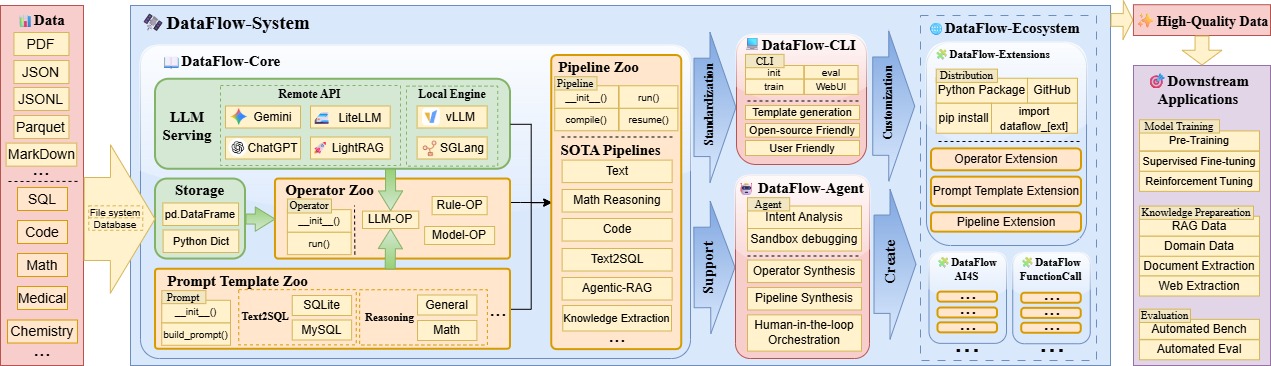
DataFlow is a data preparation and training system designed to parse, generate, process, and evaluate high-quality data from noisy sources (PDF, plain-text, low-quality QA), thereby improving the performance of large language models (LLMs) in specific domains through targeted training (Pre-training, Supervised Fine-tuning, RL training) or RAG using knowledge base cleaning. DataFlow has been empirically validated to improve domain-oriented LLMs' performance in fields such as healthcare, finance, and law.
Specifically, we are constructing diverse operators leveraging rule-based methods, deep learning models, LLMs, and LLM APIs. These operators are systematically integrated into distinct pipelines, collectively forming the comprehensive DataFlow system. Additionally, we develop an intelligent DataFlow-agent capable of dynamically assembling new pipelines by recombining existing operators on demand.
🛠️ 3. Operators Functionality
🔧 3.1 How Operators Work
DataFlow adopts a modular operator design philosophy, building flexible data processing pipelines by combining different types of operators. As the basic unit of data processing, an operator can receive structured data input (such as in json/jsonl/csv format) and, after intelligent processing, output high-quality data results. For a detailed guide on using operators, please refer to the Operator Documentation.

📊 3.2 Operator Classification System
In the DataFlow framework, operators are divided into three core categories based on their functional characteristics:
| Operator Type | Quantity | Main Function |
|---|---|---|
| Generic Operators | 80+ | Covers general functions for text evaluation, processing, and synthesis |
| Domain-Specific Operators | 40+ | Specialized processing for specific domains (e.g., medical, financial, legal) |
| Evaluation Operators | 20+ | Comprehensively evaluates data quality from 6 dimensions |
🛠️ 4. Pipelines Functionality
🔧 4.1 Ready-to-Use PipeLines
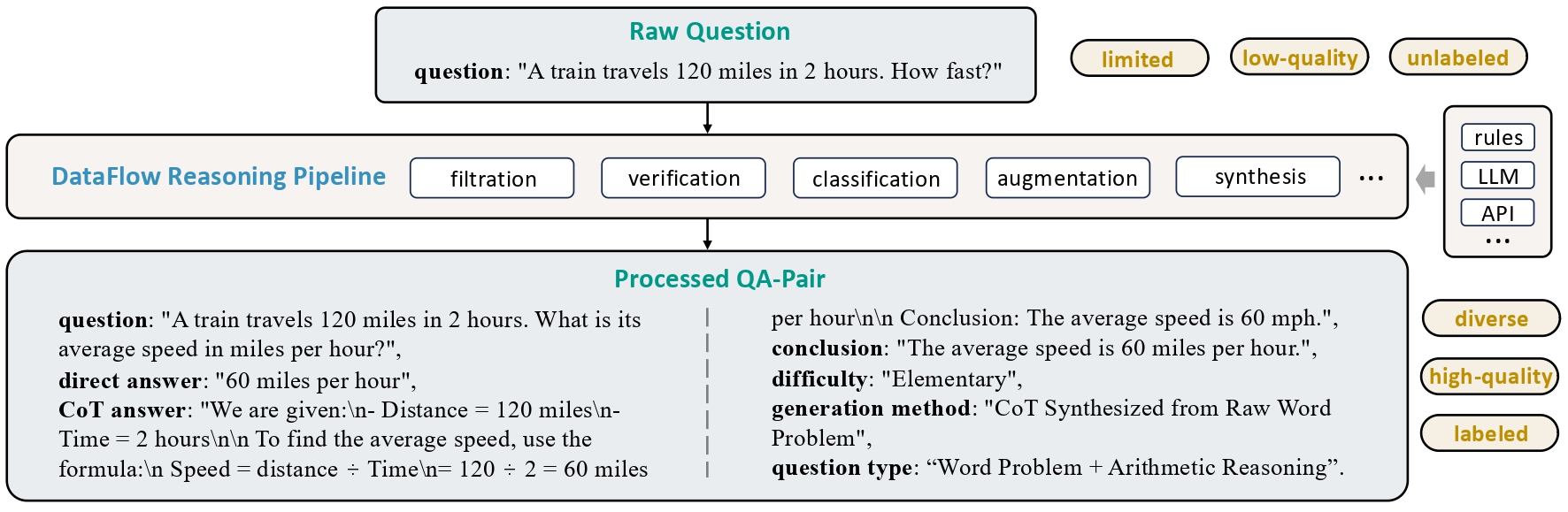
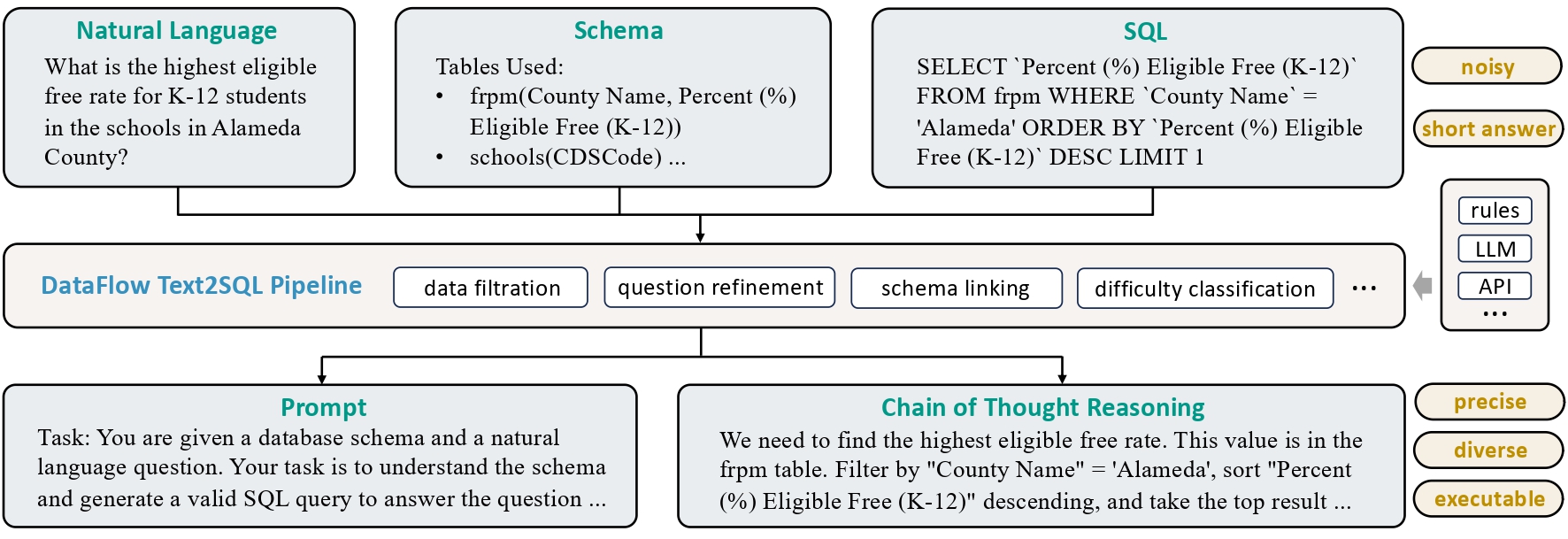
Current Pipelines in Dataflow are as follows:
- 📝 Text Pipeline: Mine question-answer pairs from large-scale plain-text data (mostly crawed from InterNet) for use in SFT and RL training.
- 🧠 Reasoning Pipeline: Enhances existing question–answer pairs with (1) extended chain-of-thought, (2) category classification, and (3) difficulty estimation.
- 🗃️ Text2SQL Pipeline: Translates natural language questions into SQL queries, supplemented with explanations, chain-of-thought reasoning, and contextual schema information.
- 📚 Knowlege Base Cleaning Pipeline: Extract and structure knowledge from unorganized sources like tables, PDFs, and Word documents into usable entries for downstream RAG or QA pair generation.
- 🤖 Agentic RAG Pipeline: Identify and extract QA pairs from existing QA datasets or knowledge bases that require external knowledge to answer, for use in downstream training of Agnetic RAG tasks.



⚙️ 4.2 Flexible Operator PipeLines
In this framework, operators are categorized into Fundamental Operators, Generic Operators, Domain-Specific Operators, and Evaluation Operators, etc., supporting data processing and evaluation functionalities. Please refer to the documentation for details.
🤖 4.3 Agent Guided Pipelines
-
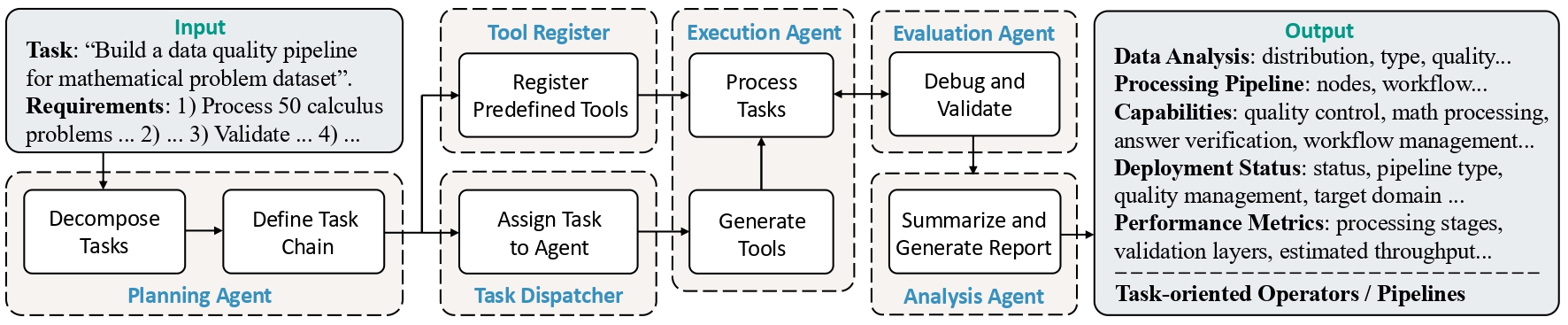
DataFlow Agent: An intelligent assistant that performs data analysis, writes custom
operators, and automatically orchestrates them intopipelinesbased on specific task objectives.
⚡ 5. Quick Start
🛠️ 5.1 Environment Setup and Installation
Please use the following commands for environment setup and installation👇
conda create -n dataflow python=3.10
conda activate dataflow

pip install open-dataflow
If you want to use your own GPU for local inference, please use:
pip install open-dataflow[vllm]
DataFlow supports Python>=3.10 environments
After installation, you can use the following command to check if dataflow has been installed correctly:
dataflow -v
If installed correctly, you should see:
open-dataflow codebase version: 1.0.0
        Checking for updates...
        Local version:  1.0.0
        PyPI newest version:  1.0.0
You are using the latest version: 1.0.0.
🐳 5.1.1 Docker Installation (Alternative)
We also provide a Dockerfile for easy deployment and a pre-built Docker image for immediate use.
Option 1: Use Pre-built Docker Image
You can directly pull and use our pre-built Docker image:
# Pull the pre-built image
docker pull molyheci/dataflow:cu124

# Run the container with GPU support
docker run --gpus all -it molyheci/dataflow:cu124

# Inside the container, verify installation
dataflow -v
Option 2: Build from Dockerfile
Alternatively, you can build the Docker image from the provided Dockerfile:
# Clone the repository (HTTPS)
git clone https://github.com/OpenDCAI/DataFlow.git
# Or use SSH
# git clone git@github.com:OpenDCAI/DataFlow.git

cd DataFlow

# Build the Docker image
docker build -t dataflow:custom .

# Run the container
docker run --gpus all -it dataflow:custom

# Inside the container, verify installation
dataflow -v
Note: The Docker image includes CUDA 12.4.1 support and comes with vLLM pre-installed for GPU acceleration. Make sure you have NVIDIA Container Toolkit installed to use GPU features.
📖 5.2 Reference Project Documentation
For detailed usage instructions and getting started guide, please visit our Documentation.
🧪 6. Experimental Results
For Detailed Experiments setting, please visit our DataFlow Technical Report.
6.1 Text Pipeline
6.1.1 Pre-training data filter pipeline
From the SlimPajama-627B corpus, we extract a 100B-token subset and apply multiple DataFlow text-pretraining filters. We train a Qwen2.5-0.5B model from scratch for 30B tokens using the Megatron-DeepSpeed framework, the results are as follows:
| Methods | ARC-C | ARC-E | MMLU | HellaSwag | WinoGrande | Gaokao-MathQA | Avg |
|---|---|---|---|---|---|---|---|
| Random-30B | 25.26 | 43.94 | 27.03 | 37.02 | 50.99 | 27.35 | 35.26 |
| Qurating-30B | 25.00 | 43.14 | 27.50 | 37.03 | 50.67 | 26.78 | 35.02 |
| FineWeb-Edu-30B | 26.45 | 45.41 | 27.41 | 38.06 | 50.43 | 25.64 | 35.57 |
| DataFlow-30B | 25.51 | 45.58 | 27.42 | 37.58 | 50.67 | 27.35 | 35.69 |
6.1.2 SFT data filter and synthesis pipeline
To study small-scale SFT data quality, we fine-tune the Qwen2.5-7B base model using LLaMA-Factory on WizardLM and Alpaca datasets.
For each dataset, we compared a randomly sampled set of 5K instances against a set of 5K instances filtered by DataFlow's SFT pipeline. Additionally, we synthesize a 15k-size dataset, DataFlow-SFT-15K, using DataFlow’s Condor Generator and Condor Refiner pipeline, followed by DataFlow’s SFT filtering pipeline (excluding the Instagram filter). Benchmarks include comprehensive Math, Code, and Knowledge evaluation suites.
Math Benchmarks
| Methods | math | gsm8k | aime24 | minerva | olympiad | Avg |
|---|---|---|---|---|---|---|
| Alpaca (random) | 54.9 | 77.2 | 13.3 | 14.0 | 27.0 | 37.3 |
| Alpaca (filtered) | 60.3 | 80.0 | 13.3 | 14.7 | 30.7 | 39.8 |
| WizardLM (random) | 61.1 | 84.2 | 6.7 | 18.0 | 29.3 | 39.9 |
| WizardLM (filtered) | 69.7 | 88.8 | 10.0 | 19.9 | 35.4 | 44.8 |
| DataFlow-SFT-15K (random) | 72.6 | 89.6 | 13.3 | 37.9 | 32.9 | 49.3 |
| DataFlow-SFT-15K (filtered) | 73.3 | 90.2 | 13.3 | 36.0 | 35.9 | 49.7 |
Code Benchmarks
| Methods | HumanEval | MBPP | Avg |
|---|---|---|---|
| Alpaca (random) | 71.3 | 75.9 | 73.6 |
| Alpaca (filtered) | 73.8 | 75.7 | 74.8 |
| WizardLM (random) | 75.6 | 82.0 | 78.8 |
| WizardLM (filtered) | 77.4 | 80.4 | 78.9 |
| DataFlow-SFT-15K (random) | 79.9 | 75.9 | 77.9 |
| DataFlow-SFT-15K (filtered) | 82.9 | 74.9 | 78.9 |
Knowledge Benchmarks
| Methods | MMLU | C-EVAL | Avg |
|---|---|---|---|
| Alpaca (random) | 71.8 | 80.0 | 75.9 |
| Alpaca (filtered) | 71.8 | 80.0 | 75.9 |
| WizardLM (random) | 71.8 | 79.2 | 75.5 |
| WizardLM (filtered) | 71.9 | 79.6 | 75.8 |
| DataFlow-SFT-15K (random) | 72.1 | 80.0 | 76.1 |
| DataFlow-SFT-15K (filtered) | 72.2 | 80.4 | 76.3 |
6.1.3 Conversation Synthesis Pipeline
We synthesize DataFlow-Chat-15K using DataFlow's conversation-generation pipeline and fine-tune Qwen2.5-7B-Base on it. Baselines include ShareGPT-15K, UltraChat-15K, and their full (non-truncated) versions. We evaluate on domain-specific tasks (TopDial, Light) and general benchmarks (MMLU, AlpacaEval, Arena-Hard).
Conversation Benchmarks
| Model | TopDial | Light | Avg |
|---|---|---|---|
| Qwen2.5-7B | 7.71 | 7.79 | 7.75 |
| + ShareGPT-15K | 7.75 | 6.72 | 7.24 |
| + UltraChat-15K | 7.72 | 6.83 | 7.28 |
| + DataFlow-Chat-15K | 7.98 | 8.10 | 8.04 |
General Benchmarks
| Model | MMLU | AlpacaEval | Arena-Hard | Avg |
|---|---|---|---|---|
| Qwen2.5-7B | 71.45 | 7.05 | 0.60 | 26.36 |
| + ShareGPT-15K | 73.09 | 3.70 | 1.30 | 26.03 |
| + UltraChat-15K | 72.97 | 3.97 | 0.80 | 25.91 |
| + DataFlow-Chat-15K | 73.41 | 10.11 | 1.10 | 28.21 |
6.2 Reasoning Pipeline
We adopt the NuminaMath dataset as a high-quality seed dataset. We compare three training sources: (1) a random 10K subset from Open-R1, (2) a random 10K subset from Synthetic-1, and (3) our 10K synthesized DataFlow-Reasoning-10K dataset constructed using DataFlow.
| Setting | Model | gsm8k | math | amc23 | olympiad | gaokao24_mix | minerva | AIME24@32 | AIME25@32 | Avg |
|---|---|---|---|---|---|---|---|---|---|---|
| Baseline | Qwen2.5-32B-Instruct | 95.8 | 73.5 | 70.0 | 38.5 | 42.9 | 26.5 | 16.8 | 11.6 | 46.95 |
| 1 Epoch | + SYNTHETIC-1-10k | 92.9 | 71.8 | 52.5 | 38.4 | 23.1 | 24.3 | 35.6 | 34.0 | 46.6 |
| 1 Epoch | + Open-R1-10k | 91.5 | 72.3 | 65.0 | 38.4 | 20.9 | 24.6 | 43.0 | 33.5 | 48.7 |
| 1 Epoch | + DataFlow-Reasoning-10K | 93.9 | 72.3 | 72.5 | 38.7 | 38.5 | 26.5 | 35.9 | 34.5 | 51.6 |
| 2 Epochs | + SYNTHETIC-1-10k | 94.5 | 78.4 | 75.0 | 45.0 | 24.2 | 28.3 | 48.4 | 37.9 | 54.0 |
| 2 Epochs | + Open-R1-10k | 93.9 | 77.2 | 80.0 | 44.1 | 20.9 | 25.4 | 51.0 | 40.7 | 54.2 |
| 2 Epochs | + DataFlow-Reasoning-10K | 94.4 | 76.6 | 75.0 | 45.2 | 42.9 | 25.7 | 45.4 | 40.0 | 55.7 |
6.3 Code PipeLine
We randomly sample 20k instances from the Ling-Coder-SFT corpus and process them through the DataFlow Code Pipeline. This yields three curated code instruction datasets of different scales, DataFlow-Code-1K, DataFlow-Code-5K, and DataFlow-Code-10K, each designed to provide high-quality, pipeline-refined supervision signals for code generation tasks.
We compare our synthesized datasets against Code-Alpaca-1k and Self-OSS-Instruct-SC2-Exec-Filter-1k.
Trained on Qwen2.5-7B-Instruct
| Training Data | BigCodeBench | LiveCodeBench (v6) | CruxEval (Input) | CruxEval (Output) | HumanEval+ | Avg |
|---|---|---|---|---|---|---|
| Qwen2.5-7B-Instruct | 35.3 | 23.4 | 44.8 | 43.9 | 72.6 | 44.0 |
| + Code Alpaca-1K | 33.3 | 18.7 | 45.6 | 46.4 | 66.5 | 42.1 |
| + Self-OSS | 31.9 | 21.4 | 46.9 | 45.9 | 70.1 | 43.2 |
| + DataFlow-Code-1K | 35.5 | 25.7 | 48.0 | 45.1 | 72.6 | 45.4 |
| + DataFlow-Code-5K | 36.2 | 26.4 | 48.6 | 45.0 | 73.2 | 45.9 |
| + DataFlow-Code-10K | 36.8 | 26.0 | 48.8 | 45.4 | 73.8 | 46.2 |
Trained on Qwen2.5-14B-Instruct
| Training Data | BigCodeBench | LiveCodeBench (v6) | CruxEval (Input) | CruxEval (Output) | HumanEval+ | Avg |
|---|---|---|---|---|---|---|
| Qwen2.5-14B-Instruct | 37.5 | 33.4 | 48.0 | 48.5 | 74.4 | 48.4 |
| + Code Alpaca-1K | 37.0 | 28.2 | 50.2 | 49.6 | 71.3 | 47.3 |
| + Self-OSS | 36.9 | 22.3 | 52.6 | 50.1 | 68.3 | 46.0 |
| + DataFlow-Code-1K | 41.4 | 33.7 | 51.0 | 50.9 | 77.3 | 50.9 |
| + DataFlow-Code-5K | 41.1 | 33.2 | 52.5 | 50.6 | 76.2 | 50.7 |
| + DataFlow-Code-10K | 41.9 | 33.2 | 52.9 | 51.0 | 76.2 | 51.0 |
📄 7. Publications
Our team has published the following papers that form core components of the DataFlow system:
| Paper Title | DataFlow Component | Venue | Year |
|---|---|---|---|
| MM-Verify: Enhancing Multimodal Reasoning with Chain-of-Thought Verification | Multimodal reasoning verification framework for data processing and evaluation | ACL | 2025 |
| Efficient Pretraining Data Selection for Language Models via Multi-Actor Collaboration | Multi-actor collaborative data selection mechanism for enhanced data filtering and processing | ACL | 2025 |
Contributing Institutions:


🏆 8. Awards & Achievements
We are honored to have received first-place awards in two major international AI competitions, recognizing the excellence and robustness of DataFlow and its reasoning capabilities:
| Competition | Track | Award | Organizer | Date |
|---|---|---|---|---|
| ICML 2025 Challenges on Automated Math Reasoning and Extensions | Track 2: Physics Reasoning with Diagrams and Expressions | 🥇 First Place Winner | ICML AI for Math Workshop & AWS Codabench | July 18, 2025 |
| 2025 Language and Intelligence Challenge (LIC) | Track 2: Beijing Academy of Artificial Intelligence | 🥇 First Prize | Beijing Academy of Artificial Intelligence (BAAI) & Baidu | August 10, 2025 |
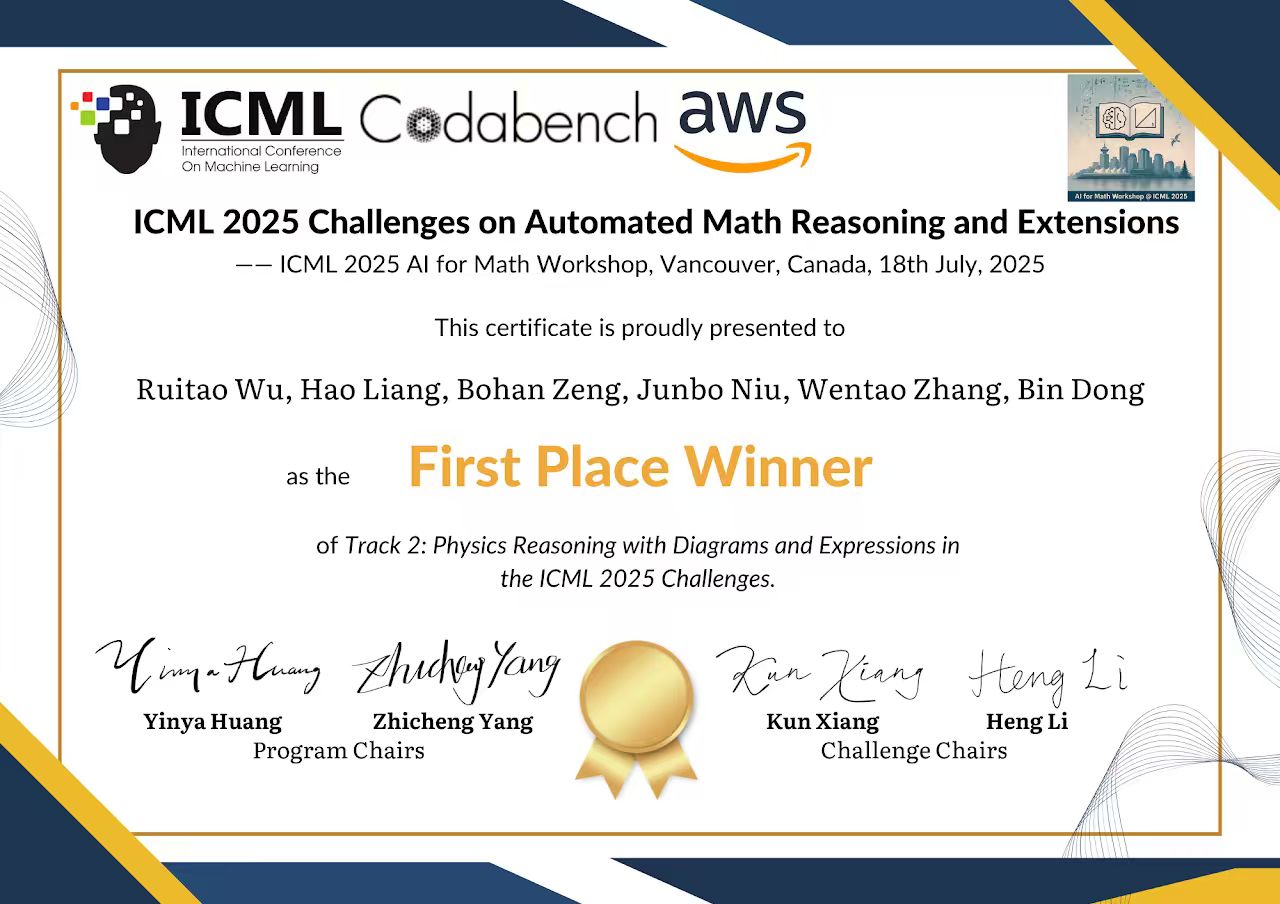 ICML 2025 Automated Math Reasoning Challenge — First Place Winner |
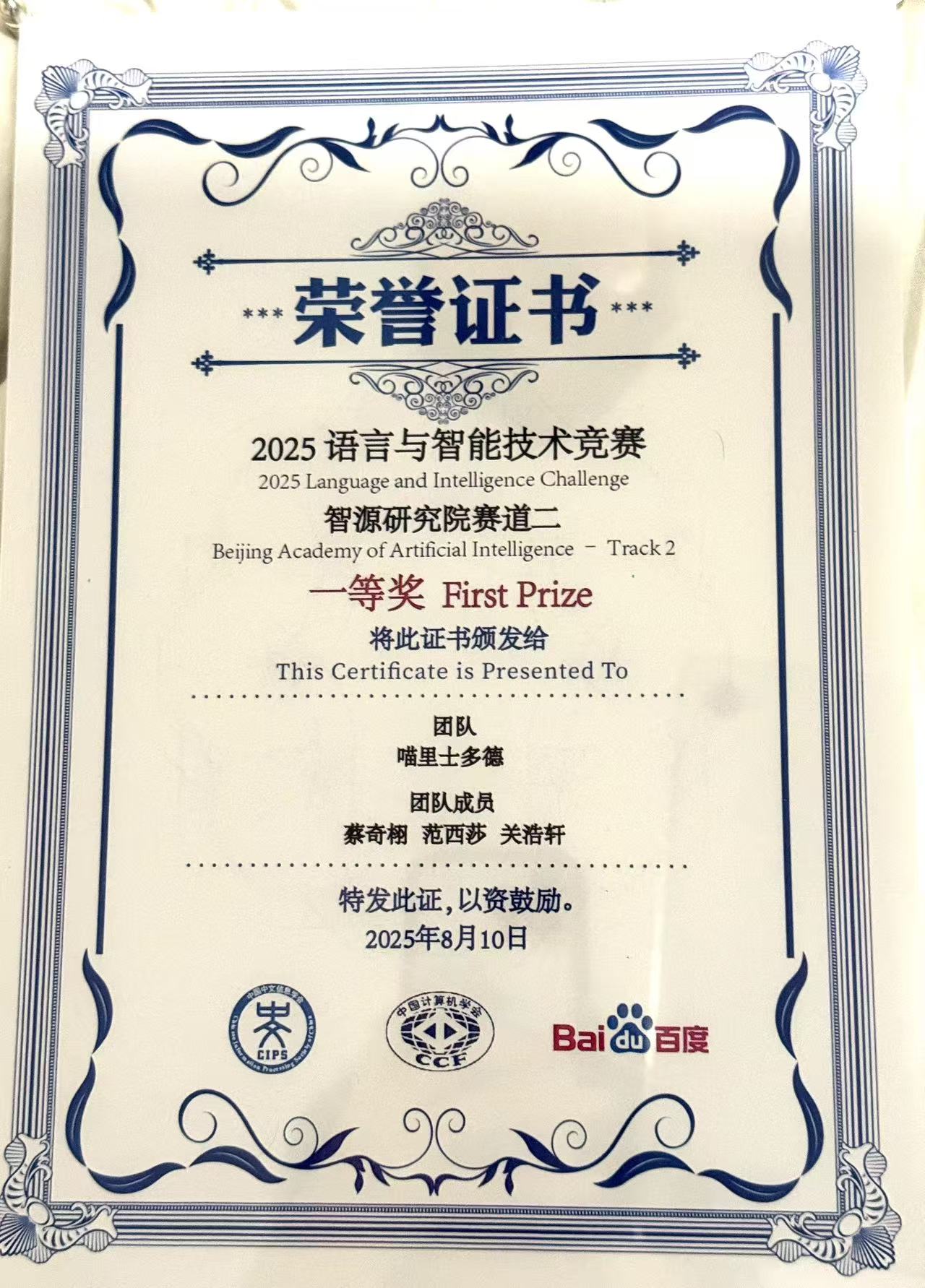 BAAI Language & Intelligence Challenge 2025 — First Prize |
💐 9. Acknowledgements
We sincerely thank MinerU for their outstanding work, whose powerful PDF/document text extraction capabilities provided essential support for our data loading process.
We also thank LLaMA-Factory for offering an efficient and user-friendly framework for large model fine-tuning, which greatly facilitated rapid iteration in our training and experimentation workflows.
Our gratitude extends to all contributors in the open-source community—their efforts collectively drive the development of DataFlow.
🤝 10. Community & Support
Join the DataFlow open-source community to ask questions, share ideas, and collaborate with other developers!
• 📮 GitHub Issues: Report bugs or suggest features
• 🔧 GitHub Pull Requests: Contribute code improvements
• 💬 Join our community groups to connect with us and other contributors!

📜 11. Citation
If you use DataFlow in your research, feel free to give us a cite.
@misc{liang2025dataflowllmdrivenframeworkunified,
      title={DataFlow: An LLM-Driven Framework for Unified Data Preparation and Workflow Automation in the Era of Data-Centric AI},
      author={Hao Liang and Xiaochen Ma and Zhou Liu and Zhen Hao Wong and Zhengyang Zhao and Zimo Meng and Runming He and Chengyu Shen and Qifeng Cai and Zhaoyang Han and Meiyi Qiang and Yalin Feng and Tianyi Bai and Zewei Pan and Ziyi Guo and Yizhen Jiang and Jingwen Deng and Qijie You and Peichao Lai and Tianyu Guo and Chi Hsu Tsai and Hengyi Feng and Rui Hu and Wenkai Yu and Junbo Niu and Bohan Zeng and Ruichuan An and Lu Ma and Jihao Huang and Yaowei Zheng and Conghui He and Linpeng Tang and Bin Cui and Weinan E and Wentao Zhang},
      year={2025},
      eprint={2512.16676},
      archivePrefix={arXiv},
      primaryClass={cs.LG},
      url={https://arxiv.org/abs/2512.16676},
}
📊 12. Statistics
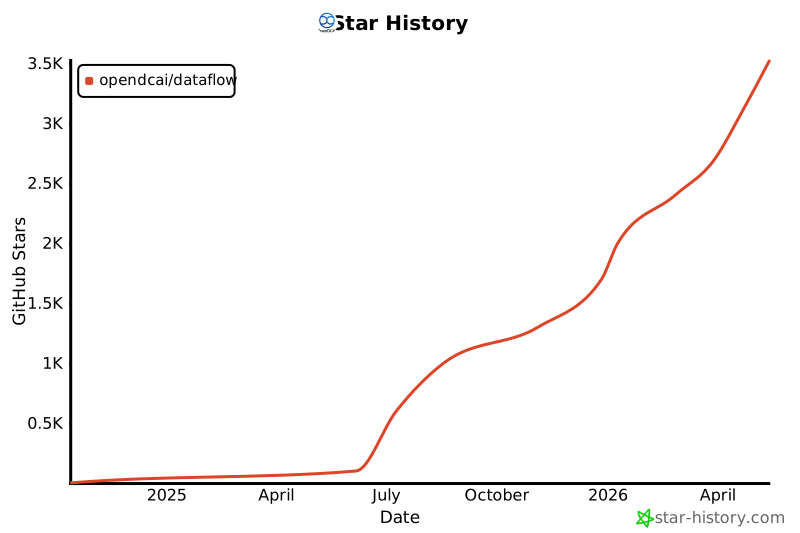
Release history Release notifications | RSS feed


Download files
Download the file for your platform. If you're not sure which to choose, learn more about installing packages.
Source Distribution
Built Distribution
Filter files by name, interpreter, ABI, and platform.
If you're not sure about the file name format, learn more about wheel file names.
Copy a direct link to the current filters
File details
Details for the file open_dataflow-1.0.8.tar.gz.
File metadata
- Download URL: open_dataflow-1.0.8.tar.gz
- Upload date:
- Size: 2.4 MB
- Tags: Source
- Uploaded using Trusted Publishing? Yes
- Uploaded via: twine/6.1.0 CPython/3.13.7
File hashes
| Algorithm | Hash digest | |
|---|---|---|
| SHA256 |
b1e711110bbb28a4bfb55877ea12041acf53badbdb1b0c2ee076304f99fd9a2c
|
|
| MD5 |
b7bbbf828c473a76f47d5f0bcf2b8563
|
|
| BLAKE2b-256 |
74fb7c72bedb54260bb7bf7fad2052241eb97e37ac421fe9e639f9beab9092be
|
Provenance
The following attestation bundles were made for open_dataflow-1.0.8.tar.gz:
Publisher:
python-publish.yml on OpenDCAI/DataFlow
-
Statement:
-
Statement type:
https://in-toto.io/Statement/v1 -
Predicate type:
https://docs.pypi.org/attestations/publish/v1 -
Subject name:
open_dataflow-1.0.8.tar.gz -
Subject digest:
b1e711110bbb28a4bfb55877ea12041acf53badbdb1b0c2ee076304f99fd9a2c - Sigstore transparency entry: 772087955
- Sigstore integration time:
-
Permalink:
OpenDCAI/DataFlow@df4f68991be4af4b25cfa2ad76ae76bcf68a48fb -
Branch / Tag:
refs/tags/v1.0.8 - Owner: https://github.com/OpenDCAI
-
Access:
public
-
Token Issuer:
https://token.actions.githubusercontent.com -
Runner Environment:
github-hosted -
Publication workflow:
python-publish.yml@df4f68991be4af4b25cfa2ad76ae76bcf68a48fb -
Trigger Event:
release
-
Statement type:
File details
Details for the file open_dataflow-1.0.8-py3-none-any.whl.
File metadata
- Download URL: open_dataflow-1.0.8-py3-none-any.whl
- Upload date:
- Size: 2.7 MB
- Tags: Python 3
- Uploaded using Trusted Publishing? Yes
- Uploaded via: twine/6.1.0 CPython/3.13.7
File hashes
| Algorithm | Hash digest | |
|---|---|---|
| SHA256 |
98ad989583ad15b3cd285c45292b30f070c75d1e66c8a59281affb4e27967118
|
|
| MD5 |
2859003f21add4baef666f508574f3e8
|
|
| BLAKE2b-256 |
151eaf8867936375a8608c9d11df2ea5c5627822fb80cb53192f25590c1dc805
|
Provenance
The following attestation bundles were made for open_dataflow-1.0.8-py3-none-any.whl:
Publisher:
python-publish.yml on OpenDCAI/DataFlow
-
Statement:
-
Statement type:
https://in-toto.io/Statement/v1 -
Predicate type:
https://docs.pypi.org/attestations/publish/v1 -
Subject name:
open_dataflow-1.0.8-py3-none-any.whl -
Subject digest:
98ad989583ad15b3cd285c45292b30f070c75d1e66c8a59281affb4e27967118 - Sigstore transparency entry: 772087965
- Sigstore integration time:
-
Permalink:
OpenDCAI/DataFlow@df4f68991be4af4b25cfa2ad76ae76bcf68a48fb -
Branch / Tag:
refs/tags/v1.0.8 - Owner: https://github.com/OpenDCAI
-
Access:
public
-
Token Issuer:
https://token.actions.githubusercontent.com -
Runner Environment:
github-hosted -
Publication workflow:
python-publish.yml@df4f68991be4af4b25cfa2ad76ae76bcf68a48fb -
Trigger Event:
release
-
Statement type:






