
OpenCDA-MARL





OpenCDA-MARL extends the OpenCDA cooperative driving automation framework (see SAE J3216) with multi-agent reinforcement learning for driving in complex and mixed traffic: learners, a verified training lifecycle on CARLA and SUMO, benchmark scenarios and the tools to watch and compare runs.
- Learners out of the box: MAPPO, MASAC, MATD3, DQN and tabular Q-learning, plus PCMAPPO and PCMASAC, which build on PCMA (without its Dirichlet preference planner) for multi-objective training, and the preference-conditioned PCMATD3.
- Two backends, one loop: CARLA 0.9.15 / 0.9.16 and SUMO (libsumo), plus CARLA–SUMO co-simulation. The same scenarios and learners run on both.
- Replaceable parts: the lifecycle is fixed, and every part an experiment might vary (algorithm, agent, planner, observation, reward, intent provider) is a plugin chosen by configuration.
- Standard interfaces: a PettingZoo
ParallelEnvport, so external RL stacks can drive the same scenarios. - Mixed autonomy: human-driven vehicles, rule-based AVs and learning agents in the same traffic.
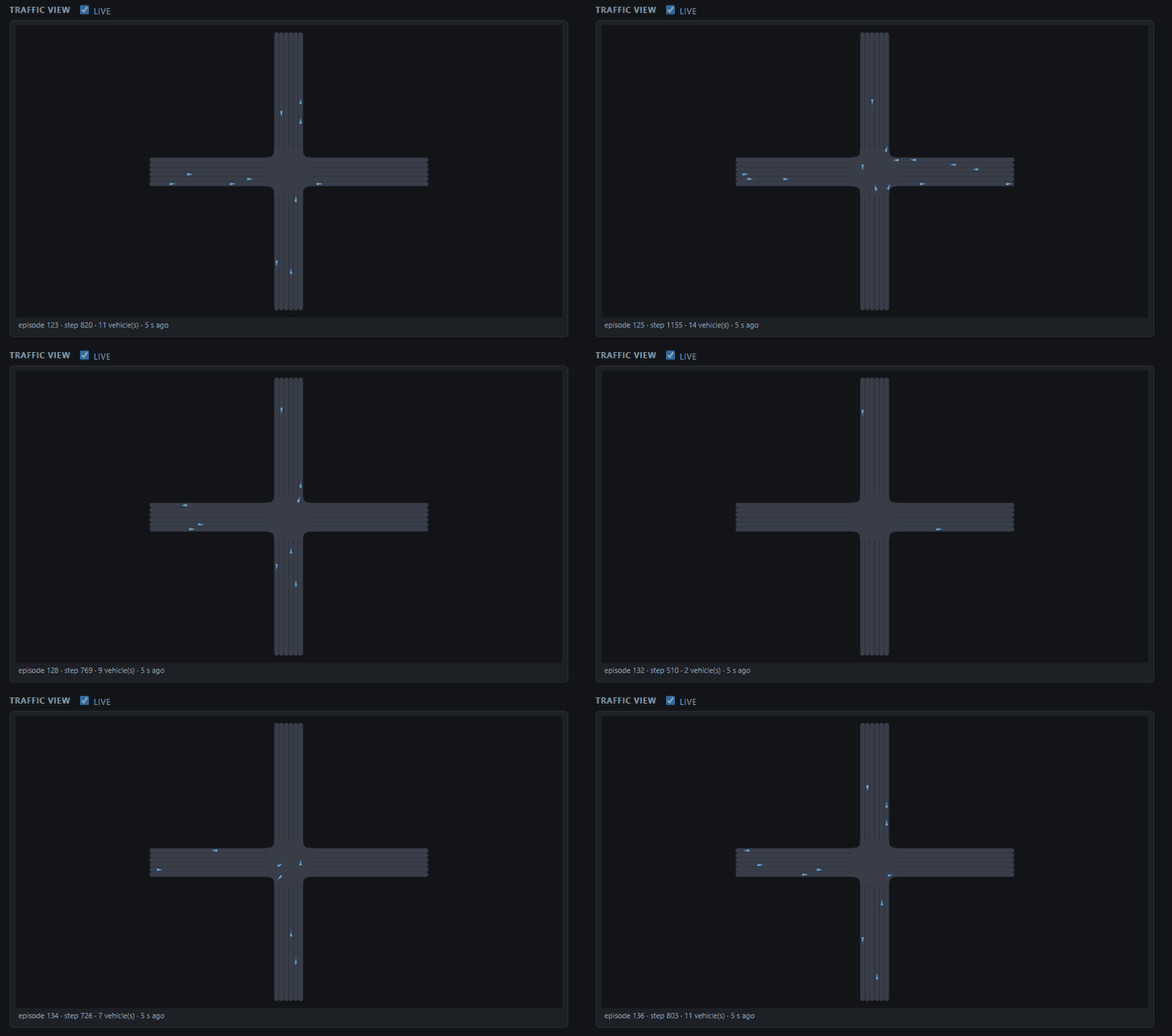
- Tools for experiments: a matrix launcher for parallel training cells across GPUs, and a web monitor with a live traffic view.
Quick start
For research on the SUMO benchmark (the library, the plugin system, the baselines; no simulator to install):
pip install opencda-marl
opencda-marl run -t sumo-marl/intersection/route_speed_only_pcmappo
That trains PCMAPPO on a signal-free intersection on SUMO, headless. The run starts a web monitor at
http://127.0.0.1:8765 with losses, episode summaries and a live traffic view. The wheel from PyPI is the public
build: it leaves out the vendored OpenCDA core, whose UCLA licence does not allow it to travel in a package. pip
installs the CPU build of PyTorch; for a GPU, install the matching CUDA build from pytorch.org
first. To build your own study on it, start from the
research template.
For CARLA, co-simulation and the OpenCDA scenarios, clone the repository (the clone brings the core):
git clone https://github.com/radar-lab/OpenCDA-MARL.git && cd OpenCDA-MARL
pixi install
pixi run python opencda.py -t sumo-marl/intersection/route_speed_only_pcmappo --marl
Installation covers CARLA, and Quick Start goes on from here.
Architecture
One sealed lifecycle, many replaceable joints. _kernel/ runs the episode loop and knows only the contracts in
api/; builtin/ registers the framework's own learners, agents and planners through the same plugin system an
external package uses, and a test keeps the kernel from importing them. See
Architecture for the joints, and
Add an Algorithm for the largest worked example.
What's New in OpenCDA-MARL
v2.2.0
- On PyPI:
pip install opencda-marlinstalls a public wheel without any UCLA-licensed path (the vendored OpenCDA core, the copied OpenCDA configs and the files with adapted OpenCDA code), licensedApache-2.0 AND MIT. The SUMO benchmark, the library, the plugins and the baselines run on it; CARLA needs agit clone(changelog).
v2.1.0
The first 2.x release (changelog, including its known issues).
- A library, not just a repo:
pixi run wheelbuilds a wheel with the lifecycle, the SUMO benchmark and the baseline learners, and anopencda-marl runCLI. Every algorithm arrives through theopencda_marl.pluginsentry point, so a research repository imports the library and registers its own components without touching it. - Verified lifecycle: one episode loop across both backends, CARLA world reloads that carry the full learner state, and resumable runs.
- SUMO backend: the same scenarios and learners without CARLA, orders of magnitude faster per step.
- Experiment infrastructure: the matrix launcher with parallel cells, per-slot CARLA servers, GPU spreading and
--resume, and opt-in throughput features. - Metrics store and monitor: a per-run SQLite store and a dependency-free web monitor that overlays runs, lists episode summaries and draws a live traffic view.
- Bundled baselines: the framework paper's DQN, MAPPO and SAC checkpoints and most of its TD3 ones ship with their profiles and the deterministic traffic recordings they were trained against.
Research template
Building a study on top of OpenCDA-MARL? The opencda-marl-research-template is the starting point: a research repository that installs this library and registers its own components through the plugin entry point, with a demo, a test and the framework pinned to a release. It is an initial version and is still being completed.
Documentation
- Users: Installation, Quick Start, CARLA Version Support, Run Experiments, PCMA Learners
- Developers: Add an Algorithm, Agent Workflow and Code Index (what coding agents and people read before changing code), OpenCDA Patch Ledger
The framework is mainly tested on our customized maps; we do not guarantee the same robustness on other maps. Contributions by people and by coding agents are welcome: see the Contributing Guide, file issues, and open pull requests with the PR template.
Citation
If you use OpenCDA-MARL in your research, please cite both the MARL extension and the original OpenCDA paper:
@ARTICLE{11396022,
  author={Guo, Lihao and Liu, Louis and Tang, Jiahao and Liu, Bo and Cao, Siyang},
  journal={IEEE Robotics and Automation Letters},
  title={OpenCDA-MARL: A Unified Benchmarking Framework for Cooperative Autonomous Intersection Management With Multi-Agent Reinforcement Learning},
  year={2026},
  volume={11},
  number={4},
  pages={4291-4298},
  keywords={Vehicle dynamics;Training;Robot sensing systems;Heuristic algorithms;Vehicle-to-everything;Benchmark testing;Real-time systems;Monitoring;Laser radar;Graphical user interfaces;Autonomous driving;benchmark testing;connected vehicles;cooperative systems;deep reinforcement learning;multi-agent systems;reinforcement learning;simulation},
  doi={10.1109/LRA.2026.3664656}
}


@misc{xu2021opencdaanopencooperativedriving,
      title={OpenCDA:An Open Cooperative Driving Automation Framework Integrated with Co-Simulation},
      author={Runsheng Xu and Yi Guo and Xu Han and Xin Xia and Hao Xiang and Jiaqi Ma},
      year={2021},
      eprint={2107.06260},
      archivePrefix={arXiv},
      primaryClass={cs.RO},
      url={https://arxiv.org/abs/2107.06260},
}
The preference-conditioned learners (PCMASAC / PCMAPPO / PCMATD3) build on Preference Coordinated Multi-agent Policy Optimization (PCMA), without its Dirichlet preference planner. If you use them, please also cite:
@misc{wang2026pcma,
  title={Learning Coordinated Preference for Multi-Objective Multi-Agent Reinforcement Learning},
  author={Pengxin Wang and Lihao Guo and Yi Xie and Bo Liu and Siyang Cao and Jingdi Chen},
  year={2026},
  eprint={2606.14693},
  archivePrefix={arXiv},
  primaryClass={cs.MA},
  url={https://arxiv.org/abs/2606.14693},
}
What the implementation does, layer by layer, is documented in PCMA Learners.
License
The code written for OpenCDA-MARL (the opencda_marl package, scripts, tests, configuration profiles and
documentation) is licensed under the Apache License 2.0; see also NOTICE.
The vendored OpenCDA core (opencda/, opencda.py and the files derived from it) remains under the UCLA Mobility
Lab's Academic Software License: academic and nonprofit research use only, and no further transfer of the software
or its derivatives; commercial users should contact the UCLA Mobility Lab as that licence says. A running
installation includes that core, so use of the complete system is limited by UCLA's licence to academic and
nonprofit research; this does not narrow what the Apache License allows for our own files. CARLA code and map
data and the other third-party material keep their own terms. THIRD_PARTY_NOTICES.md
lists each part, the paths it occupies and its terms, and reproduces UCLA's licence text.
Contributors
- OpenCDA-MARL (UA Radar Lab): Project Lead Lihao Guo; core team Louis Liu and Jiahao Tang; advisors Dr. Liu Bo and Dr. Siyang Cao.
- OpenCDA (UCLA Mobility Lab): Principal Investigator Dr. Jiaqi Ma (UCLA Samueli); Project Lead Runsheng Xu (github); core team Xu Han, Hao Xiang, Zhaoliang Zheng, Zonglin Meng and Dr. Xin Xia.
Acknowledgements
- UA Radar lab and the UCLA Mobility Lab
- UC Davis Professor Junshan Zhang's group for openScenario integration
- @GoodarzMehr for Docker support
- All contributors to the OpenCDA and OpenCDA-MARL projects
1 maintainer

Metadata
1 maintainer
Release files for opencda-marl 2.2.0
For a detailed explanation of source distributions (sdists) and built distributions (wheels), please see the package formats documentation.
Built distribution (wheel)
| File | Interpreter | ABI | Platform | Reset |
|---|---|---|---|---|
| opencda_marl-2.2.0-py3-none-any.whl | Python 3 | none | any | Details |
Release files / opencda_marl-2.2.0-py3-none-any.whl
| Download URL | opencda_marl-2.2.0-py3-none-any.whl |
|---|---|
| Size | 20.7 MB |
| Tags | Python 3 |
|
SHA-256 checksum How to use checksums |
4eeef0af7b4b128302602fde621feb351f9f863f5883a5c4b74e73efc9a1d573
|
|
BLAKE2b-256 checksum How to use checksums |
c5295e406c7c239ba51eeae1838ded0af84df90bb12d44f8409321465201dbbc
|
| Upload date | |
|
Uploaded using Trusted Publishing? What is trusted publishing? |
No |
| Uploaded via |
twine/6.2.0 CPython/3.12.13
|
Security for opencda-marl 2.2.0
Provenance
Provenance describes where a file came from. On PyPI, provenance is shared via attestations, which provide a verifiable record of the build or publishing details. View details, limitations and caveats.
No provenance found
None of the files in this release were uploaded with provenance metadata.
A note on package security
PyPI is a repository for distributing packages, not a service for auditing them. While third-party security researchers and our staff do their best to detect and remove malicious packages, PyPI cannot guarantee the quality, security or suitability of any given package.
To learn more about protecting yourself from malicious actors, visit our package security documentation.













