
Python-accessible, Julia-powered simulation tools for open quantum systems.
Verified details
These details have been verified by PyPIProject links
GitHub Statistics
Maintainers

Project description
OpenQuantumSim





QuTiP is excellent general-purpose quantum dynamics software. OpenQuantumSim is for researchers who want a Python interface while moving expensive open-system propagation into a Julia backend: Lindblad solvers, Monte Carlo wave-function trajectories, Dicke-space collective spins, restartable parameter sweeps, HDF5 outputs, phase-space tools, and state diagnostics in one package.
On the current Apple M1 benchmark snapshot, OpenQuantumSim is 1.3x-2.6x faster than QuTiP on deterministic Lindblad reference cases up to Hilbert dimension 80. For a qubit MCWF trajectory scaling smoke test, OpenQuantumSim is 5.0x-10.4x faster end-to-end than QuTiP, with 9.7x-19.7x faster Julia backend trajectory aggregation when using four Julia threads. The benchmark commands and environment are documented so these numbers can be reproduced and challenged.
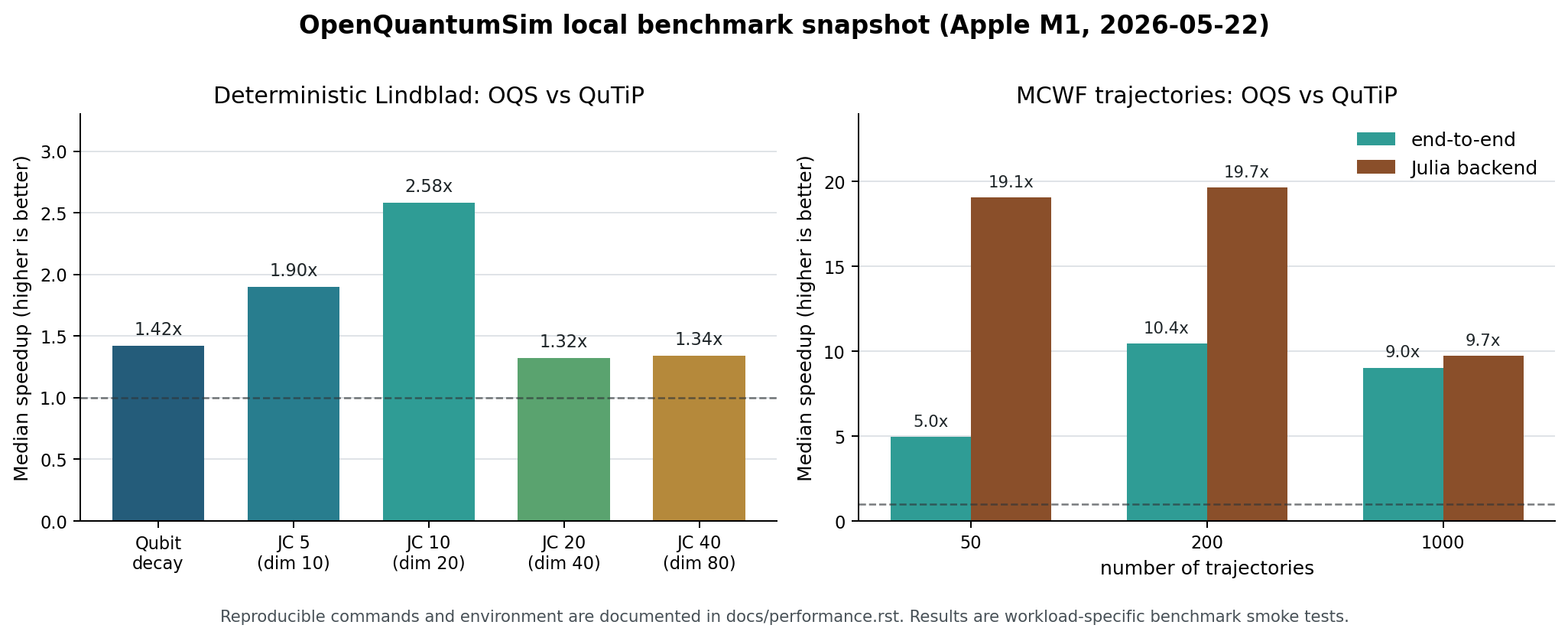
Documentation: https://mohammadjafariph.github.io/OpenQuantumSimulation/
The package is currently released as an alpha. The API is usable, tested, and
published on PyPI, but minor interface changes may still occur before a stable
0.1 release.
Installation
python -m pip install openquantumsim
OpenQuantumSim uses JuliaCall to load the packaged Julia backend. The first solver call on a new machine may spend a few minutes resolving and precompiling Julia packages.
For development from source:
git clone https://github.com/mohammadjafariph/OpenQuantumSimulation.git
cd OpenQuantumSimulation
python -m pip install -e ".[dev]"
python setup_julia.py
Features
- Hilbert-space helpers for finite Fock spaces, spin spaces, tensor-product systems, and symmetric Dicke manifolds.
- State and operator constructors for common open-system models.
- Lindblad master-equation propagation with dense and sparse backends.
- Monte Carlo wave-function trajectories with backend-side aggregation for selected diagnostics.
- Time-dependent Hamiltonians with callable or interpolated coefficients.
- Steady-state solves, two-time correlations, and parameter sweeps.
- State metrics including purity, entropy, fidelity, trace distance, populations, coherences, and Bloch-vector components.
- Wigner and Husimi-Q phase-space distributions for finite Fock spaces.
- HDF5 result persistence for solver outputs and sweep summaries.
- Validation scripts comparing analytic limits and QuTiP reference models.
Quick Example
The example below solves spontaneous emission for a two-level system and
compares the excited-state population with the analytic result
exp(-gamma * t).
import numpy as np
import openquantumsim as oqs

atom = oqs.SpinSpace(0.5, label="atom")
excited = oqs.basis(atom, "up")

gamma = 0.2
H = 0.0 * oqs.sigmaz(atom)
rho0 = oqs.ket2dm(excited)
collapse = np.sqrt(gamma) * oqs.sigmam(atom)
projector = oqs.Operator(oqs.ket2dm(excited), atom, "P_excited")
times = np.linspace(0.0, 0.2, 3)

result = oqs.mesolve(
    H,
    rho0,
    times,
    c_ops=[collapse],
    e_ops=[projector],
    options=oqs.Options(rtol=1e-8, atol=1e-10),
)

expected = np.exp(-gamma * times)
assert np.allclose(result.expect[0].real, expected, atol=2e-7)
print(result.expect[0].real)
More complete scripts are available under examples/gallery/, including
deterministic decay, a time-dependent driven qubit, Jaynes-Cummings dynamics,
Monte Carlo trajectories, phase-space plots, and restartable parameter sweeps.
Each one supports a quick smoke run:
python examples/gallery/qubit_decay.py --fast
python examples/gallery/phase_space.py --fast
Tutorial notebooks are available in the documentation, including qubit decay, Dicke synchronization, parameter sweeps, phase-space plots, and state metrics:
Time-Dependent Hamiltonians
Time-dependent systems can be written as
H(t) = H0 + sum_i f_i(t) H_i.
drive = oqs.InterpolatedCoefficient([0.0, 5.0], [0.0, 0.2])
H_t = oqs.time_dependent_hamiltonian(
    0.5 * oqs.sigmaz(atom),
    [(oqs.sigmax(atom), drive)],
)

result = oqs.mesolve(H_t, rho0, np.linspace(0.0, 5.0, 101), c_ops=[collapse])
Monte Carlo Trajectories
result = oqs.mcsolve(
    H,
    excited,
    times,
    c_ops=[collapse],
    e_ops=[projector],
    n_traj=1000,
    options=oqs.Options(seed=2026, max_step=0.01, progress=True),
)

population_mean = result.expect[0].real
population_stderr = result.expect_stderr[0].real
Long trajectory runs can checkpoint partial sums and resume from the same operators, seed, time grid, and solver options:
result = oqs.mcsolve(
    H,
    excited,
    times,
    c_ops=[collapse],
    e_ops=[projector],
    n_traj=20_000,
    options=oqs.Options(
        seed=2026,
        max_step=0.01,
        checkpoint_file="runs/mcsolve_checkpoint.h5",
        checkpoint_every=100,
    ),
)
State Diagnostics
State diagnostics can be evaluated during deterministic solves, single trajectories, and supported trajectory aggregations.
metrics = oqs.state_metrics(
    purity=True,
    fidelity_to=excited,
    population_indices=[0, 1],
)

trajectory = oqs.single_trajectory(
    H,
    excited,
    times,
    c_ops=[collapse],
    state_observables=metrics,
    options=oqs.Options(seed=2026, max_step=0.01),
)

purity = trajectory.state_observables["purity"].real
Parameter Sweeps
ParameterSweep expands a parameter grid, skips completed points on rerun,
writes a restartable manifest, and saves aggregate summaries.
sweep = oqs.ParameterSweep(
    base_system={"model": "qubit_decay"},
    params={"gamma": [0.05, 0.1, 0.2]},
)

run = sweep.run(run_one_point, output_dir="runs/gamma_sweep")
print(run.summary)
Phase-Space Utilities
Finite Fock-space states can be inspected with Wigner and Husimi-Q distributions.
space = oqs.FockSpace(30)
rho = oqs.ket2dm(oqs.coherent(space, 1.0 + 0.5j))
x, p = oqs.phase_space_grid(xlim=(-5.0, 5.0), points=201)

W = oqs.wigner(rho, x, p)
Q = oqs.q_function(rho, x, p)
ax = oqs.plot_wigner(rho, x, p)
Result Persistence
Solver results can be saved and loaded in HDF5 format.
result.save_hdf5("runs/qubit_decay.h5")
loaded = oqs.load_result("runs/qubit_decay.h5")
The schema stores time points, expectation series, optional saved states, state-observable series, Monte Carlo uncertainty estimates, entropy, and solver statistics.
Validation
The validation suite includes analytic qubit decay and a damped Jaynes-Cummings comparison against QuTiP.
python -m pip install -e ".[validation]"
python scripts/validate_jaynes_cummings_qutip.py
Performance comparison scripts are available under benchmarks/. Benchmark
results depend strongly on problem size, backend warmup, hardware, and thread
configuration; record those settings with any reported timings.
Documentation
Build the local documentation with:
python -m pip install -e ".[docs]"
sphinx-build -b html docs docs/_build/html
The documentation includes API pages, tutorials, validation examples, benchmark notes, and the HDF5 result schema.
Development
Run the Python test suite:
python -m pytest
Run the Julia backend tests:
julia --project=src/OpenQuantumSimJL -e 'using Pkg; Pkg.test()'
Repository layout:
openquantumsim/             Python frontend
src/OpenQuantumSimJL/       Julia backend package
tests/                      Python test suite
docs/                       Sphinx documentation
benchmarks/                 Benchmark scripts
scripts/                    Development and validation helpers
examples/                   Domain examples built on the public API
Project details
Verified details
These details have been verified by PyPIProject links
GitHub Statistics
Maintainers
Release history Release notifications | RSS feed


Download files
Download the file for your platform. If you're not sure which to choose, learn more about installing packages.
Source Distribution
Built Distribution
Filter files by name, interpreter, ABI, and platform.
If you're not sure about the file name format, learn more about wheel file names.
Copy a direct link to the current filters
File details
Details for the file openquantumsim-0.1.0a3.tar.gz.
File metadata
- Download URL: openquantumsim-0.1.0a3.tar.gz
- Upload date:
- Size: 84.4 kB
- Tags: Source
- Uploaded using Trusted Publishing? Yes
- Uploaded via: twine/6.1.0 CPython/3.13.12
File hashes
| Algorithm | Hash digest | |
|---|---|---|
| SHA256 |
d6b2bf48e6ccb7dff3361fb53c81633d3af0a5bc8726055fd8300a86911a4b67
|
|
| MD5 |
dfd200df97dd974373217fd454c77e29
|
|
| BLAKE2b-256 |
8503a1b908116544b7ba7bf47eb1f537d291a9a050494611a2b79092d6673ee5
|
Provenance
The following attestation bundles were made for openquantumsim-0.1.0a3.tar.gz:
Publisher:
release.yml on mohammadjafariph/OpenQuantumSimulation
-
Statement:
-
Statement type:
https://in-toto.io/Statement/v1 -
Predicate type:
https://docs.pypi.org/attestations/publish/v1 -
Subject name:
openquantumsim-0.1.0a3.tar.gz -
Subject digest:
d6b2bf48e6ccb7dff3361fb53c81633d3af0a5bc8726055fd8300a86911a4b67 - Sigstore transparency entry: 1609573682
- Sigstore integration time:
-
Permalink:
mohammadjafariph/OpenQuantumSimulation@79275e6064a93e80f684437aeefd8552580e5823 -
Branch / Tag:
refs/heads/main - Owner: https://github.com/mohammadjafariph
-
Access:
public
-
Token Issuer:
https://token.actions.githubusercontent.com -
Runner Environment:
github-hosted -
Publication workflow:
release.yml@79275e6064a93e80f684437aeefd8552580e5823 -
Trigger Event:
workflow_dispatch
-
Statement type:
File details
Details for the file openquantumsim-0.1.0a3-py3-none-any.whl.
File metadata
- Download URL: openquantumsim-0.1.0a3-py3-none-any.whl
- Upload date:
- Size: 77.8 kB
- Tags: Python 3
- Uploaded using Trusted Publishing? Yes
- Uploaded via: twine/6.1.0 CPython/3.13.12
File hashes
| Algorithm | Hash digest | |
|---|---|---|
| SHA256 |
460545d8f145a4a00ffd173068e15c5515d421a11548c7bc9c79029878a0a3c1
|
|
| MD5 |
b9010e96046801b4de8a86e52675e0c1
|
|
| BLAKE2b-256 |
b71eba6945a1a1ebc76850d5746a9233f362360ade1c9eaf5642cd0559a86618
|
Provenance
The following attestation bundles were made for openquantumsim-0.1.0a3-py3-none-any.whl:
Publisher:
release.yml on mohammadjafariph/OpenQuantumSimulation
-
Statement:
-
Statement type:
https://in-toto.io/Statement/v1 -
Predicate type:
https://docs.pypi.org/attestations/publish/v1 -
Subject name:
openquantumsim-0.1.0a3-py3-none-any.whl -
Subject digest:
460545d8f145a4a00ffd173068e15c5515d421a11548c7bc9c79029878a0a3c1 - Sigstore transparency entry: 1609573774
- Sigstore integration time:
-
Permalink:
mohammadjafariph/OpenQuantumSimulation@79275e6064a93e80f684437aeefd8552580e5823 -
Branch / Tag:
refs/heads/main - Owner: https://github.com/mohammadjafariph
-
Access:
public
-
Token Issuer:
https://token.actions.githubusercontent.com -
Runner Environment:
github-hosted -
Publication workflow:
release.yml@79275e6064a93e80f684437aeefd8552580e5823 -
Trigger Event:
workflow_dispatch
-
Statement type:






