

OpenRing
The open-source, self-hosted Vapi alternative for voice AI agents. Vapi-compatible API, no platform fee.
OpenRing runs AI phone agents, voice AI agents and AI receptionists that answer and place calls over Twilio, Telnyx, Plivo, Vonage or any SIP trunk, with your own provider keys or a free, 100% local stack (Whisper, Ollama, Kokoro).
Latest release 0.1.7 · README updated November 11, 2026






Quick start · How it works · Compare · API guide · Providers · Roadmap · Discussions
Hosted voice platforms charge a fee for every minute of every call, on top of what you already pay for speech-to-text, the model, the voice and the phone line. OpenRing does the same job on your own computer or server, with your own provider keys, and speaks the same JSON as Vapi.
- 💸 No platform fee, ever. You pay Deepgram, OpenAI, Twilio or whoever you pick, directly, at their price.
- 🔁 Vapi-compatible. Same assistant JSON, provider names, tool calls and webhooks: a Vapi client moves over by changing its base URL, and Import copies an account in one click.
- 🖥️ Yours. Keys, calls and transcripts stay on your machine. No telemetry.
- 🆓 Free to try. A free local voice (Kokoro) is built in, so your first test call costs nothing.
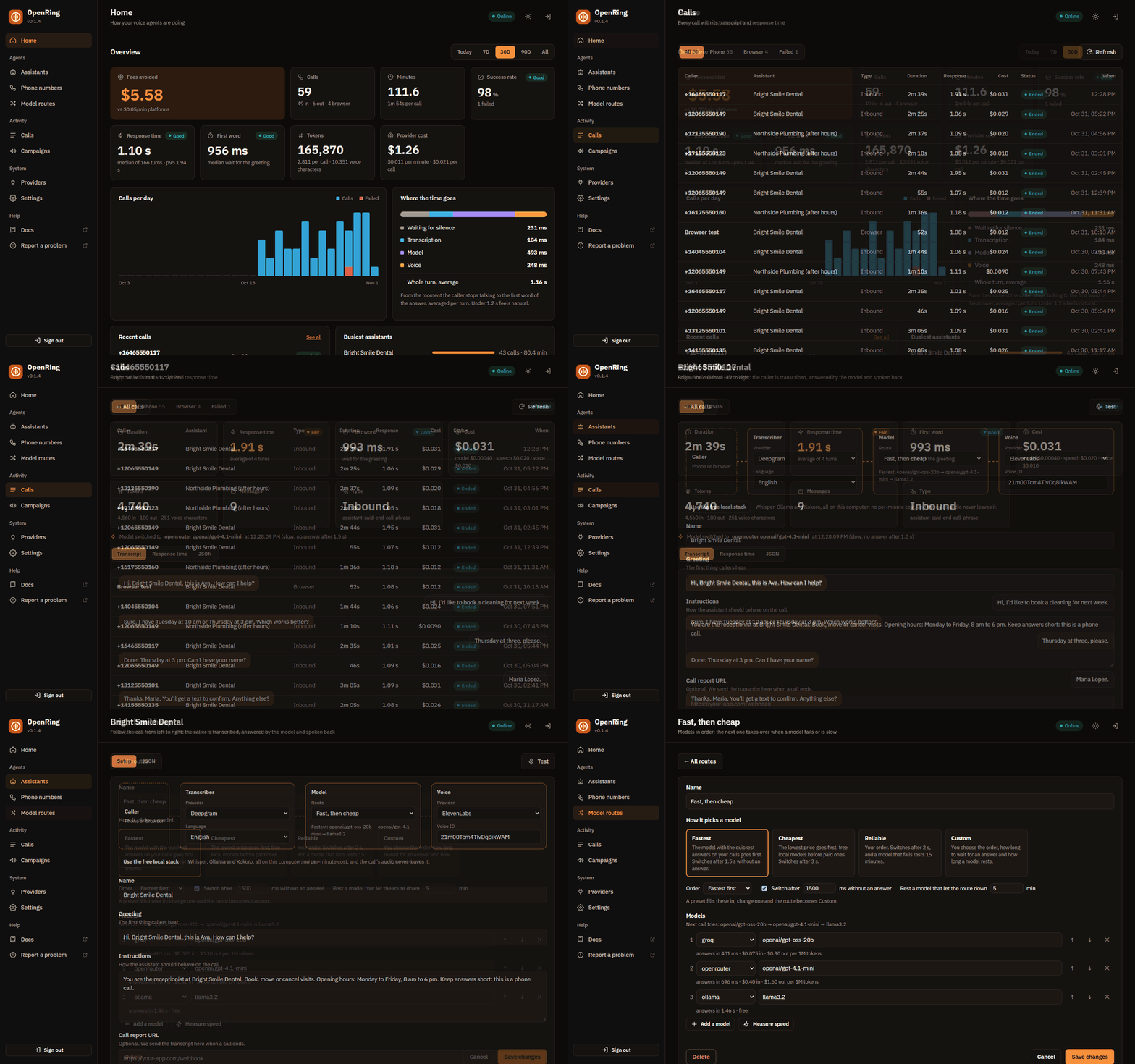
The dashboard, with sample data.
⚡ Quick start
You need Node.js 18 or later. Everything else, Python included, installs itself:
npx openring
The dashboard opens at http://localhost:8000. From there:
- Choose a password. The first visit asks for one (only from this computer).
- Connect providers on the Providers page: Deepgram for speech (new accounts get US$200 of credit) and a model, for example Groq's free tier or one-click sign-in with OpenRouter. Each key is checked with the provider before it's saved.
- Create an assistant on Assistants: a greeting, instructions, a model and a voice.
- Talk to it. Press Test and speak into your microphone. No phone number needed.
- Give it a number when you're ready: see Phone calls.
Settings live in ~/.openring/.env, created on the first run with a generated API key for apps that call
the API (it's under Settings). The free Kokoro voice downloads itself on the first start (about 120 MB).
🧭 How it works
flowchart LR
  caller["Caller<br/>phone or browser"] <-->|audio| line["Twilio or WebRTC"]
  line <--> openring
  subgraph openring["OpenRing, on your server"]
    direction LR
    stt["Speech-to-text<br/>Deepgram, Whisper, ..."] --> llm["Model<br/>OpenAI, Groq, Ollama, ..."] --> tts["Voice<br/>ElevenLabs, Kokoro, ..."]
  end
  llm <-->|"tools and webhooks, in Vapi's format"| app["Your app"]
Each call runs a Pipecat pipeline: the caller's speech becomes text, the model answers (and can call your tools), and the voice speaks the answer back. Every turn's latency is recorded, step by step, and shown in the dashboard.
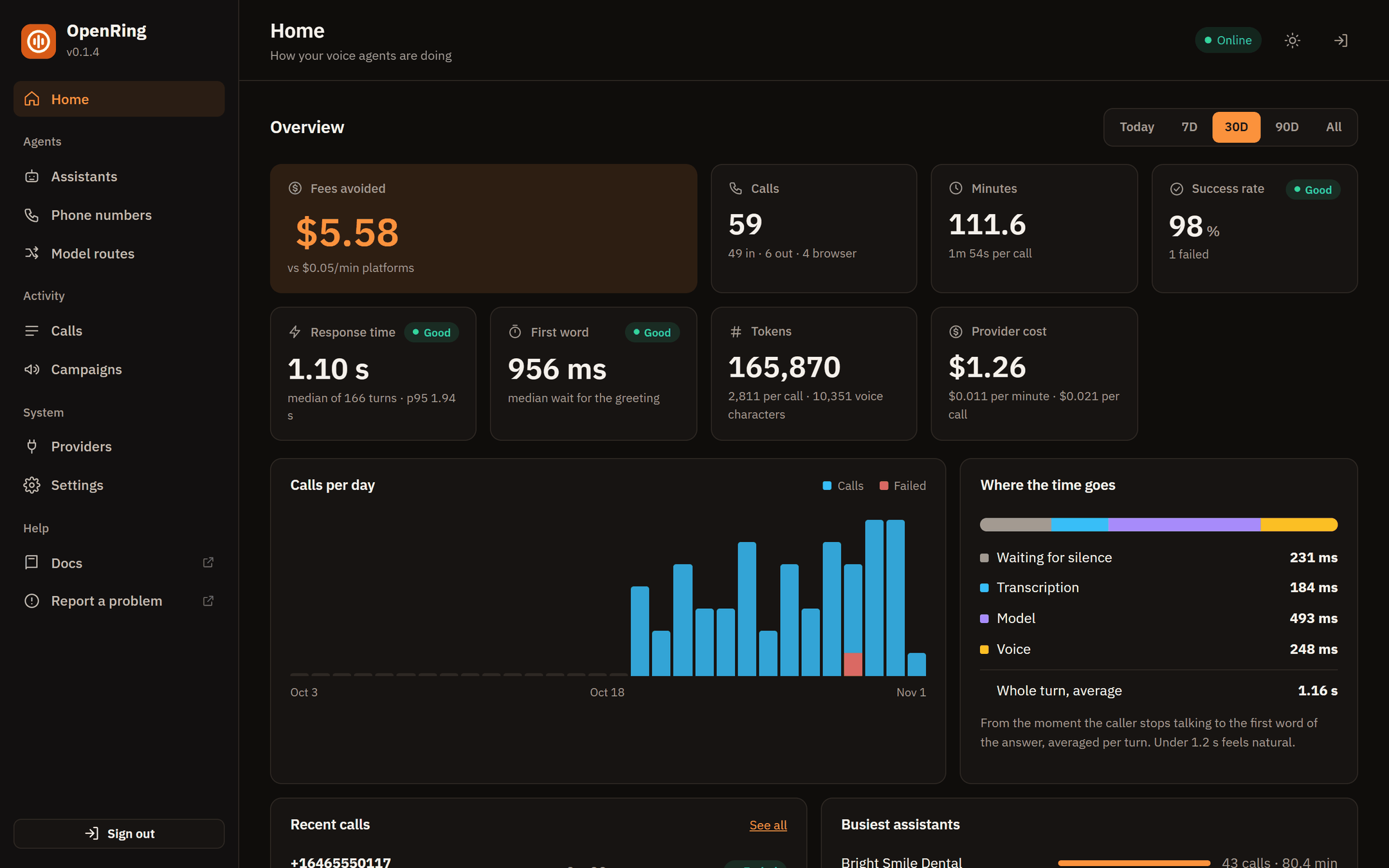 Overview. Calls, minutes, response time and what the providers charged. |
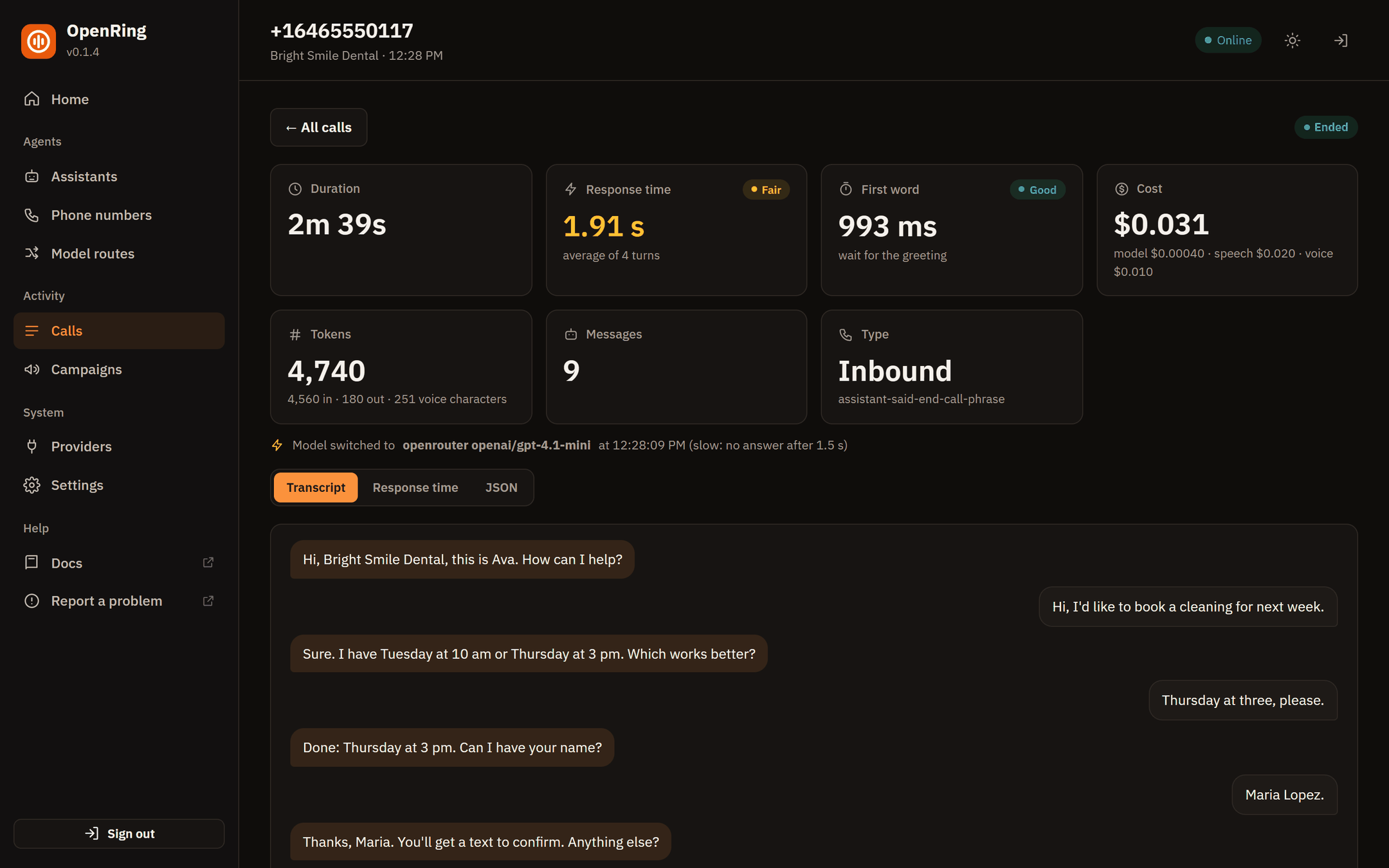 Every call. Transcript, latency per turn, cost per provider, and each provider switch with its reason. |
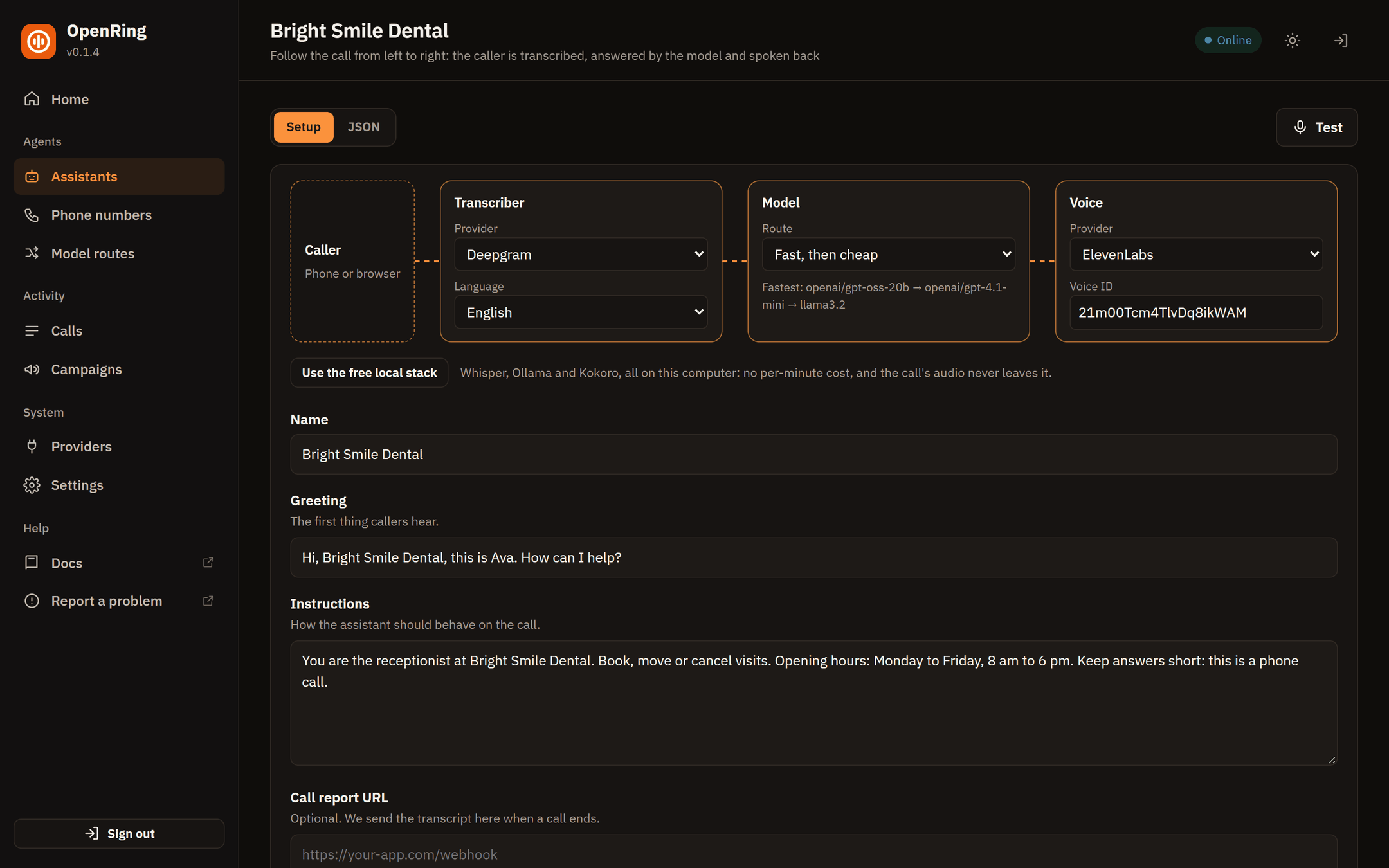 Assistants. Transcriber, model (or a route) and voice, in the order a call goes through them. |
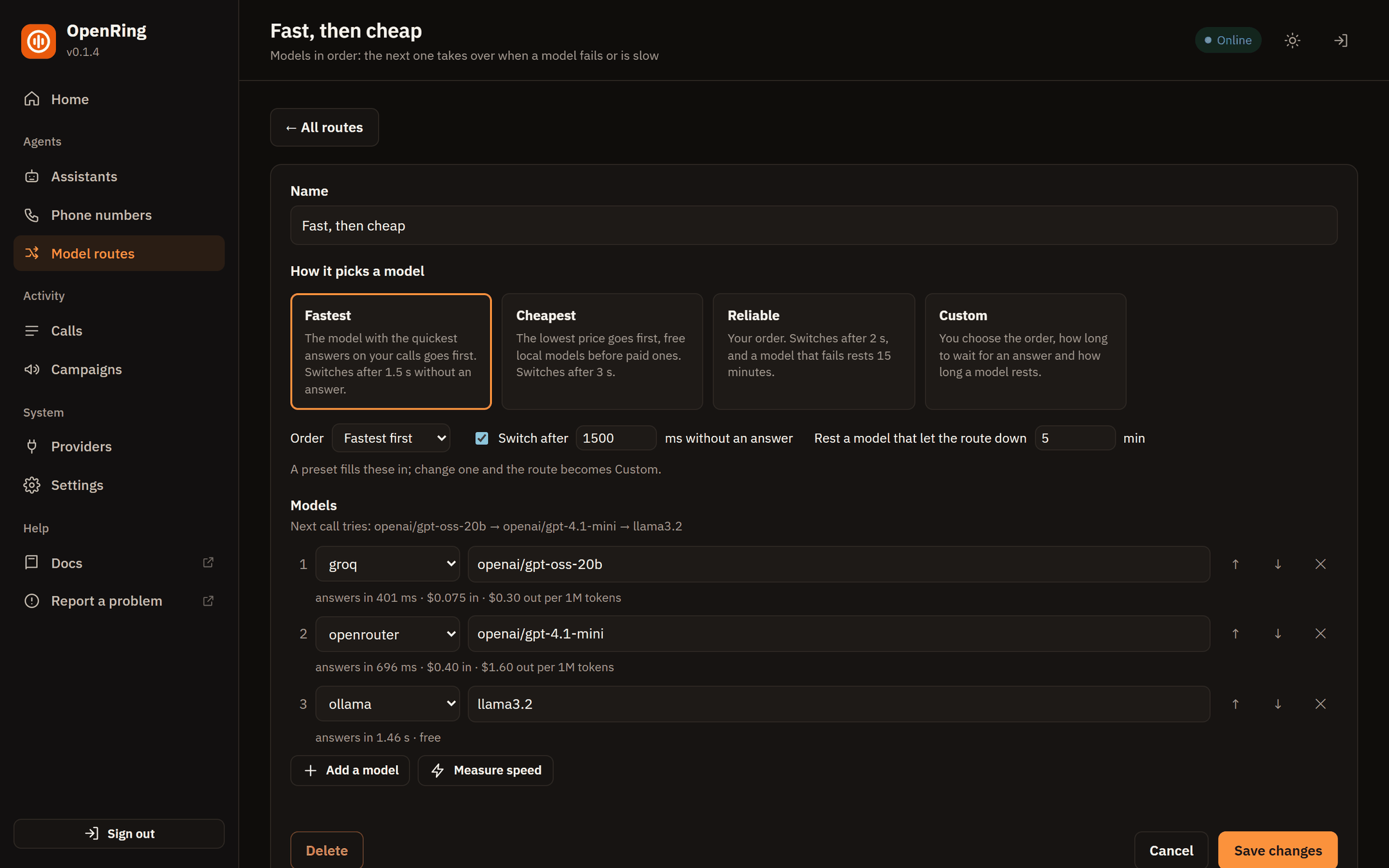 Model routes. Fastest, Cheapest, Reliable or Custom, with each model's measured speed and price. |
📊 How it compares
| OpenRing | Vapi | Retell | Dograh | |
|---|---|---|---|---|
| Source code | ✅ Open (MIT) | ❌ Closed | ❌ Closed | ✅ Open (BSD-2) |
| Platform fee | ✅ None | US$0.05/min | US$0.055/min | None self-hosted, US$0.01/min in its cloud |
| Run it on your server | ✅ npx openring, no Docker needed (Docker works too) |
❌ Their cloud | Their cloud; on-premise on Enterprise plans | ✅ With Docker |
| Calls and transcripts | ✅ On your server, no telemetry | Their cloud | Their cloud; on-premise on Enterprise plans | On your server when self-hosted; anonymous telemetry unless you turn it off |
| Vapi-compatible API | ✅ Change the base URL, import an account | (it's Vapi) | ❌ | ❌ |
| Free local stack | ✅ Whisper, Ollama, Kokoro | ❌ | ❌ | ✅ Open models you host |
| Calls at once | ✅ No limit of its own, your server decides, never billed per line | 4, then US$10 per line a month | 20, then US$8 per call a month | 10 by default when self-hosted, you can raise it; 10 in its cloud |
| Backup model | ✅ From any provider, when one fails or is slow | Same provider only, on OpenAI and Bedrock | ✅ Takes over when the main model fails or is slow | — |
| Phone lines | ✅ Twilio, Telnyx, Plivo, Vonage and any carrier by SIP trunk, all included free; incoming only on Genesys | ✅ Twilio, Vonage, Telnyx, SIP | ✅ Twilio, Telnyx, SIP | ✅ Twilio, Vonage, Telnyx, Plivo, Vobiz, Cloudonix, Asterisk |
| Campaigns | ✅ Every line that calls out, free, no per-call platform fee, with retries | ✅ | ✅ | ✅ With retries |
| Knowledge base (RAG) | ✅ Free, on your server, matching words; or your own search | ✅ Google Gemini, or your own server | ✅ | ✅ |
| Several assistants in one call | ✅ Squads, in Vapi's format | ✅ Squads | ✅ | ✅ |
— means we didn't find it in their public docs. On every platform you also pay for the model, the voice and the phone line, and for speech-to-text too, except that Retell's pricing page lists no separate charge for it. With OpenRing, the server, its uptime and any compliance work are yours; hosted platforms take on the first two and help with the third (for HIPAA, Vapi charges US$2,000 a month and Retell says there's no extra fee). Prices and features are from each company's public pages and docs on November 8, 2026 (prices rechecked that day); check them before you decide. OpenRing isn't affiliated with any of them.
🔁 Moving from Vapi
Copy every assistant, squad, tool and Twilio number of an account in one request, or press Import on the Assistants page. The key is used once and never stored; importing again updates what came in before.
curl -X POST http://localhost:8000/import \
  -H "Authorization: Bearer $OPENRING_API_KEY" -H "Content-Type: application/json" \
  -d '{"baseUrl": "https://api.vapi.ai", "apiKey": "YOUR_VAPI_PRIVATE_KEY"}'
The answer lists each assistant with anything that keeps it from taking calls here yet (for example a
provider OpenRing doesn't support yet). Documents keep their full JSON, so nothing is lost. Then point your
client's base URL at your server, and each imported Twilio number's voice webhook at
$PUBLIC_URL/twilio/voice.
📖 API guide
Every request takes Authorization: Bearer $OPENRING_API_KEY, and the JSON is Vapi's. The full guide is in
docs/api.md:
- Assistants, names the transcriber should get right and recording calls
- Phone calls, campaigns, Telnyx, Plivo, Vonage, Genesys Cloud and SIP trunks
- Tools, server messages, knowledge bases and squads
- Provider fallback, model routes and what a call costs
🆓 The free stack
| Layer | Free option |
|---|---|
| Speech-to-text | "provider": "whisper": runs on your computer, no key; or Deepgram's US$200 credit for new accounts |
| Model | "provider": "ollama" (local), "provider": "groq" (free tier) or "provider": "omniroute" (free local gateway to 150+ free providers) |
| Voice | "provider": "kokoro": runs on your CPU, no key |
| Phone line | A Twilio trial account, for testing |
100% local. Whisper, Ollama and Kokoro together cost nothing per minute, and the call's audio never leaves your computer. In the assistant editor, press Use the free local stack, or:
"transcriber": {"provider": "whisper", "model": "base", "language": "en"},
"model": {"provider": "ollama", "model": "llama3.2"},
"voice": {"provider": "kokoro", "voiceId": "af_heart"}
Install Ollama and run ollama pull llama3.2 first; the Providers page shows whether
it is running and which models it has. Whisper downloads its model once, when an assistant first uses it
(tiny 75 MB, base 145 MB, small 480 MB; also medium, large-v3 and large-v3-turbo, or any
faster-whisper repo on Hugging Face). It runs on an NVIDIA GPU when there is one, otherwise on the CPU: on a
2018 laptop a four-second sentence takes about 0.6 s with tiny and 1.2 s with base, about twice that with
"language": "multi", so pick the language when you know it. A local model on a laptop also answers slower
than a cloud one; a desktop GPU makes the whole stack quick.
🔌 Providers
Provider names are Vapi's, so an assistant JSON moves between the two unchanged. Connect each one from the
dashboard's Providers page, or put its key in ~/.openring/.env.
| Layer | provider values |
Key |
|---|---|---|
| Model | openai, anthropic, google (Gemini), groq, openrouter, deepseek / deep-seek, xai, cerebras, together-ai, deepinfra, perplexity-ai, mistral, fireworks |
OPENAI_API_KEY, ANTHROPIC_API_KEY, GOOGLE_API_KEY, GROQ_API_KEY, ... (the provider's name) |
| Model, local | ollama, omniroute, or custom-llm with model.url (any OpenAI-compatible endpoint) |
none (OMNIROUTE_API_KEY once OmniRoute's API key protection is on) |
| Speech-to-text | deepgram, assembly-ai, gladia, soniox, cartesia, 11labs |
DEEPGRAM_API_KEY, ASSEMBLYAI_API_KEY, GLADIA_API_KEY, SONIOX_API_KEY, CARTESIA_API_KEY, ELEVENLABS_API_KEY |
| Speech-to-text, local | whisper (free; model: tiny, base, small, medium, large-v3, large-v3-turbo) |
none |
| Voice | 11labs / elevenlabs, cartesia, deepgram (Aura), openai, rime-ai, neuphonic, smallest-ai, inworld |
the provider's key (RIME_API_KEY, NEUPHONIC_API_KEY, SMALLEST_API_KEY, INWORLD_API_KEY, ...) |
| Voice, local | kokoro (free, runs on CPU) |
none |
Callers in any language. With "language": "multi" (Follow the caller in the dashboard) the
transcriber detects the language, OpenRing tells the model to answer in it and to switch when the caller
switches, and an ElevenLabs or OpenAI voice reads whatever language it gets. Kokoro and Deepgram voices speak
one language each; the dashboard says so when you pick one. With a Deepgram key you already have a fast cloud
voice: {"provider": "deepgram", "voiceId": "thalia"}.
Requests to OpenRouter carry OpenRing's name, so OpenRouter can list it among the apps that use it;
OPENRING_ATTRIBUTION=false leaves that out.
🐳 Docker
cp .env.example .env          # fill in your keys and OPENRING_PASSWORD
docker compose up --build     # dashboard and API on http://localhost:8000
On a server, set PUBLIC_URL to its https address so Twilio can reach it. There is a ready image,
ghcr.io/elifalanrocha/openring, and a one-click Render
blueprint; docs/deploy.md covers those, Railway and a plain VPS.
❓ FAQ
Can I move my Vapi assistants to OpenRing? Yes. OpenRing reads the same assistant JSON, provider names, tools and webhooks. Point your client at your server's base URL, or press Import to copy an account's assistants, tools, squads and Twilio numbers.
Can I run a voice AI agent for free? Yes, on your own computer: Whisper for speech-to-text, a model through Ollama and the Kokoro voice cost nothing per minute. Only a phone line costs money; browser test calls don't.
Which phone providers work? Twilio, Telnyx, Plivo, Vonage, Genesys Cloud and SIP trunks. Only Twilio has taken real calls so far; the others are tested against simulated carriers, and each one's section says what's left to confirm. The comparison says what each one does today.
What does a call cost? What your providers charge, nothing more. Every call records its cost per provider at list prices, so the dashboard shows what you spent.
Do I need Docker or a GPU? No. npx openring installs everything, Python included. A GPU makes the local
stack faster; cloud providers need none.
🧱 Principles
OpenRing never charges per minute, keeps your keys and data on your machine, stays compatible with Vapi clients, runs with one command and says plainly what works and what doesn't. The whole list, and how we decide what to build, is in PRINCIPLES.md.
🤝 Contributing
git clone https://github.com/elifalanrocha/openring && cd openring
pip install -e ".[dev,kokoro,whisper]"
pytest                 # a few minutes, no paid services or internet needed
python -m openring
Small pull requests get merged fastest. Start with CONTRIBUTING.md and the good first issues; see CHANGELOG.md for what shipped.
Questions, ideas and "look what I built" go to Discussions; bugs go to issues. If you have a phone provider account, testing it on a real call helps more than anything.
💛 Support the project
OpenRing is free and has no platform fee, and it stays that way. If it saves you money, you can help keep it going on Patreon, or with Pix if you're in Brazil (random key):
0e0094ed-3545-4bff-991c-4b927633ac4a
Telling someone who runs a voice agency about it helps just as much.
🔒 Security
openring generates OPENRING_API_KEY on its first run; without a key, the API answers only the computer it
runs on, and example values such as change-me are refused and replaced. The dashboard has its own password: the first one can
only be chosen from the server's own computer (http://localhost) or with OPENRING_PASSWORD, so a stranger
who finds your tunnel URL cannot claim it first. Sessions are HttpOnly, SameSite=Strict cookies, and
repeated wrong passwords are slowed down. Forgot it? openring --reset-password. Incoming calls need
TWILIO_AUTH_TOKEN: every Twilio webhook is checked against its X-Twilio-Signature, and calls are refused
while the token is missing (VALIDATE_TWILIO_SIGNATURE=false turns the check off, for local tests only).
Each call accepts a single media stream, so a replayed or second connection is dropped. Found a
vulnerability? Please report it privately: see SECURITY.md.
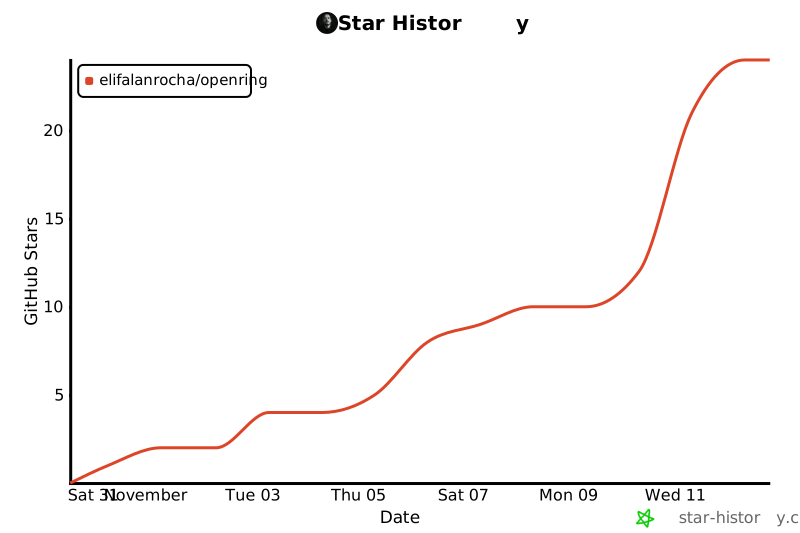
⭐ Star history
📄 License
MIT. Not affiliated with Vapi, Retell, Dograh or Twilio. OpenRing builds on Pipecat and other open-source projects, credited in THIRD_PARTY.md.
1 maintainer

Metadata
1 maintainer
Release files for openring 0.1.7
For a detailed explanation of source distributions (sdists) and built distributions (wheels), please see the package formats documentation.
Source distribution (sdist)
| File | Size | Uploaded | Provenance | Actions |
|---|---|---|---|---|
| openring-0.1.7.tar.gz | 492.8 kB | With provenance | Details for openring-0.1.7.tar.gz |
Built distribution (wheel)
| File | Interpreter | ABI | Platform | Actions Reset |
|---|---|---|---|---|
| openring-0.1.7-py3-none-any.whl | Python 3 | none | any | Details for openring-0.1.7-py3-none-any.whl |
Total release size: 836.1 kB
Release files / openring-0.1.7.tar.gz
| Download URL | openring-0.1.7.tar.gz |
|---|---|
| Size | 492.8 kB |
| Tags | Source |
|
SHA-256 checksum How to use checksums |
60ac80f48b1d54ebab5ccef8a584c63a922c475932289fe5ee3d5dc57a70ce62
|
|
BLAKE2b-256 checksum How to use checksums |
708f162036b10063b8856aa91a64da82ffe35173082a53b1f3980abd000d6c94
|
| Upload date | |
|
Uploaded using Trusted Publishing? What is trusted publishing? |
Yes |
| Uploaded via |
twine/7.0.0 CPython/3.13.16
|
Provenance
Provenance describes where a file came from. On PyPI, provenance is shared via attestations, which provide a verifiable record of the build or publishing details. View details, limitations and caveats.


PyPI Publish Attestation
PyPI verified that this artifact, at this checksum, originated from the publisher listed below.
Signed by GitHub Actions, verified by PyPI on Nov 12, 2026.
Transparency logRelease files / openring-0.1.7-py3-none-any.whl
| Download URL | openring-0.1.7-py3-none-any.whl |
|---|---|
| Size | 343.2 kB |
| Tags | Python 3 |
|
SHA-256 checksum How to use checksums |
3d5fc587b8efeb36a20619eba87220dbffe4f68229092abb3a5ef40f44073e6f
|
|
BLAKE2b-256 checksum How to use checksums |
014cc7c41614f534667aff75d63c6467c37121664743bc53ef36a1c2e1553416
|
| Upload date | |
|
Uploaded using Trusted Publishing? What is trusted publishing? |
Yes |
| Uploaded via |
twine/7.0.0 CPython/3.13.16
|
Provenance
Provenance describes where a file came from. On PyPI, provenance is shared via attestations, which provide a verifiable record of the build or publishing details. View details, limitations and caveats.
PyPI Publish Attestation
PyPI verified that this artifact, at this checksum, originated from the publisher listed below.
Signed by GitHub Actions, verified by PyPI on Nov 12, 2026.
Transparency logSecurity for openring 0.1.7
Provenance
Provenance describes where a file came from. On PyPI, provenance is shared via attestations, which provide a verifiable record of the build or publishing details. View details, limitations and caveats.
Full provenance
Both files in this release have been uploaded with provenance metadata.
Attestation for openring-0.1.7.tar.gz
PyPI Publish Attestation
PyPI verified that this artifact, at this checksum, originated from the publisher listed below.
Signed by GitHub Actions, verified by PyPI on Nov 12, 2026.
Transparency logA note on package security
PyPI is a repository for distributing packages, not a service for auditing them. While third-party security researchers and our staff do their best to detect and remove malicious packages, PyPI cannot guarantee the quality, security or suitability of any given package.
To learn more about protecting yourself from malicious actors, visit our package security documentation.














