
package-doctor




Tells you which Python dependencies to fix first: the ones being exploited, and the ones nobody is left to patch. Then stops your coding agent from adding another.
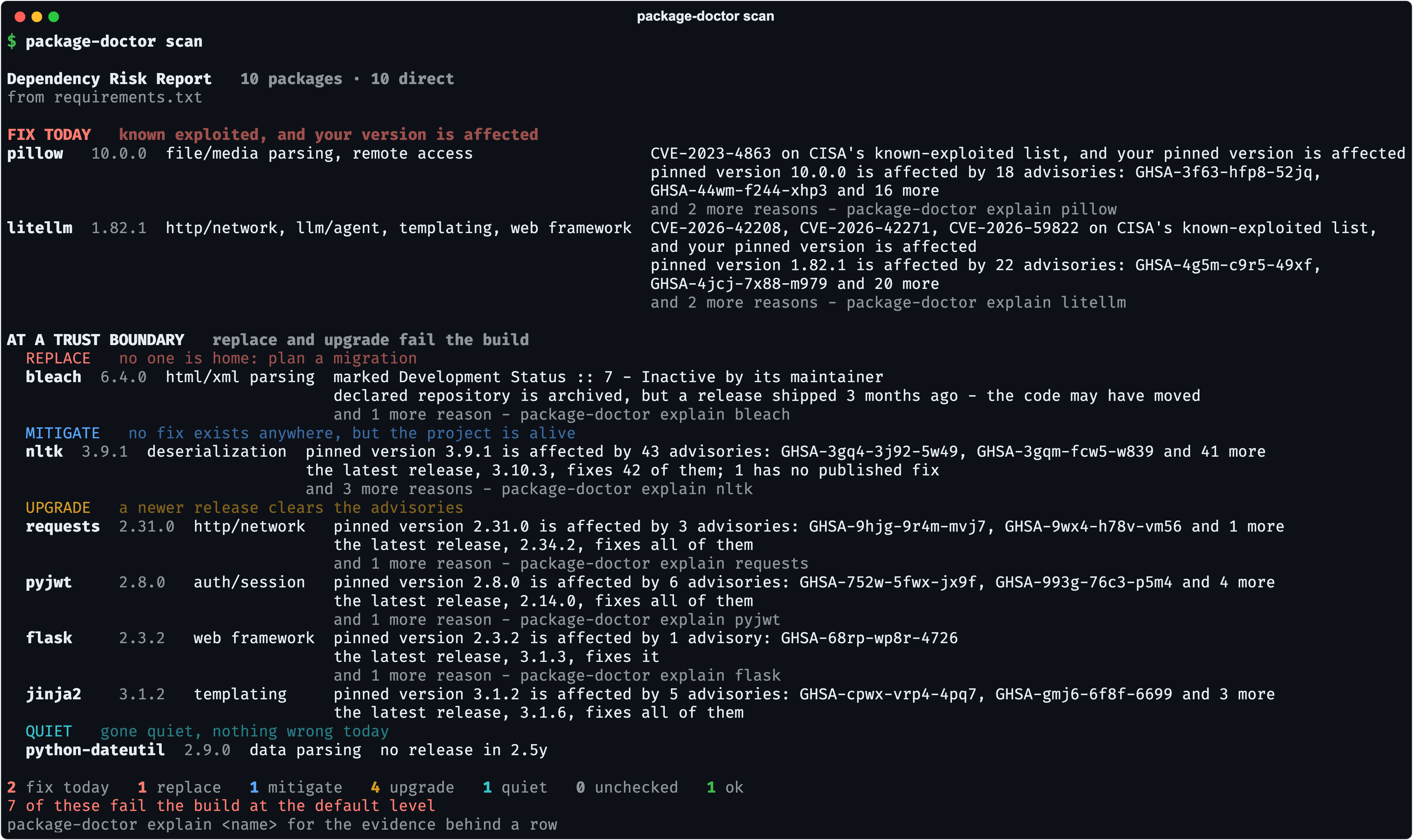
A demo project with deliberately old pins, scanned on 16 September 2026. Advisory and exploitation data change daily, so the same pins will not read the same later.
In late August 2026, Anthropic's coordinated disclosure programme reported 2,300 vulnerabilities across 392 open source projects. 421 had been patched upstream. Discovery is becoming automated; remediation still needs a human. So the question worth asking about a dependency is not "is it healthy?" It is:
If a vulnerability lands in this package tomorrow, am I exposed, and is anyone home to fix it?
What it does
- Two axes, not one. A package is escalated only when it sits at a trust
boundary - it parses, decodes or authenticates data an attacker can
influence - and there is proof nobody is left to ship a fix.
mockgoing quiet is not a finding; an archived auth library is. The boundary call comes from a human-reviewed map of about 1,500 packages, each with its reason. - Exploited first. Advisories that affect your pinned version are ranked by CISA's known-exploited list and FIRST EPSS, so hundreds of advisories become the handful worth reading today.
- Reachability. Each finding says whether, and where, your own code imports the package.
- A guardrail for coding agents. As a Claude Code, Codex or Gemini CLI hook it checks every install an agent proposes, and blocks invented names, packages published in the last 30 days, and vulnerable or abandoned libraries at a trust boundary - with the reason, so the agent picks something else.
Findings are grouped by what to do about them:
| Section | Means | Fails the build by default |
|---|---|---|
| exploited | a CVE on CISA's known-exploited list affects your version | yes |
| replace | proof nobody is home - archived or marked Inactive - or an unfixable advisory in a project that has gone quiet | at a boundary |
| upgrade | advisories affect your version, and a newer release is clear of them | at a boundary |
| mitigate | an advisory with no fix anywhere, in a project that is still active | no |
| quiet | gone quiet, nothing actually wrong | no |
| unchecked | not enough data to judge | no |
Install
pip install package-doctor
Quick start
package-doctor scan                            # everything your project depends on
package-doctor explain pillow                  # the evidence behind one row
package-doctor check requests pillow==10.0.0   # before adding a dependency
It reads uv.lock, poetry.lock, Pipfile.lock, pyproject.toml, Pipfile,
setup.cfg, setup.py and requirements*.txt. Without a lockfile it assumes
the newest release a fresh install would get, and marks that version ?.
In CI, one line scans the checkout, fails the job on what needs work at a trust boundary, and writes the report to the job summary:
- uses: binuka200/package-doctor@v1.0.0
It also runs as a pre-commit hook, writes SARIF for code scanning, and lets you accept a known risk on the record, with a reason and an expiry date.
As a Claude Code hook, add this to .claude/settings.json:
{
  "hooks": {
    "PreToolUse": [
      { "matcher": "Bash",
        "hooks": [{ "type": "command", "command": "package-doctor hook claude-code", "timeout": 60 }] }
    ],
    "PostToolUse": [
      { "matcher": "Bash|Edit|Write|MultiEdit",
        "hooks": [{ "type": "command", "command": "package-doctor hook claude-code", "timeout": 60 }] }
    ]
  }
}
PreToolUse checks what an install names before it runs. PostToolUse checks
what it pulled in with it, and names written straight into a dependency file.
For Gemini CLI and Codex, use package-doctor hook gemini or
package-doctor hook codex; the settings are in
the guardrail docs.
How accurate is it?
Measured on 100 open source repositories and 18,138 packages, on 23 September 2026:
- 8,260 of 8,261 pinned versions match OSV's own answer about which advisories affect them.
- 0 vulnerabilities that pip-audit found and package-doctor missed, over 1,663 found by both (on the first 60 repositories).
- 116,317 reported import sites checked against the source line: 116,283
match outright, and the other 34 are modules their distribution ships under
another name, such as
_pytest. - Every verdict's claim checked at its source: all 14 exploited CVEs are on CISA's list and no affected pin escaped; all 554 upgrade targets clear their advisories; 87 of 88 archived claims confirmed by GitHub.
- 2,550 advisories affecting pinned versions, of which 34 are on CISA's list or above a 10% exploit probability.
The exposure map carries real signal too: among entries decided from what a package does, the ones marked exposed have security advisories 8.6× as often as the ones reviewed and cleared. The method, and its limits, are in accuracy.
Use it alongside pip-audit, not instead of it
pip-audit is the PyPA tool and is better at what it does: telling you, on every
commit, which pinned versions have known CVEs. Most of what lands in
fix today, upgrade and mitigate here, it would also find.
What it does not do is tell you which of those to fix first, which of them your code actually imports, or which of your dependencies has nobody left to ship a patch at all. That is this tool's job, and it is a different cadence — a quarterly maintenance review rather than a per-commit gate.
Documentation
- Using package-doctor - commands, CI, the GitHub Action, SARIF, pre-commit, accepted risks, every option
- A guardrail for coding agents -
what
checkand the agent hooks block, warn on and allow, and why - How package-doctor decides - the two-axis model, exploit ranking, reachability, data sources
- The exposure map - what counts as a trust boundary, and how the map is grown and audited
- Accuracy - the full measurements, how to reproduce them, and what is still unmeasured
- Changelog
Contributing
The most useful contribution isn't code — it's arguing with
exposure.toml,
about 1,500 judgement calls about which packages sit where an attacker can
reach, each with a one-sentence reason. A verdict you think is wrong is worth
the same: post it in
Discussions
with the output of package-doctor explain. See
CONTRIBUTING.md
to get started.
A note on tone
Being listed here is not an accusation. Most unmaintained packages are the work of volunteers who gave what they could, and "no releases since 2021, repository archived" is a fact that helps a user without indicting anyone. Findings are worded that way on purpose. If you find output that reads as a judgement on a maintainer rather than a description of risk, that is a bug — please report it.
Background
The reasoning behind this tool is set out in Rethinking Dependency Maintenance in the Age of AI Vulnerability Research.
License
MIT
1 maintainer

Release files for package-doctor 1.0.5
For a detailed explanation of source distributions (sdists) and built distributions (wheels), please see the package formats documentation.
Source distribution (sdist)
| File | Size | Uploaded | |
|---|---|---|---|
| package_doctor-1.0.5.tar.gz | 306.5 kB | Details |
Built distribution (wheel)
| File | Interpreter | ABI | Platform | Reset |
|---|---|---|---|---|
| package_doctor-1.0.5-py3-none-any.whl | Python 3 | none | any | Details |
Total release size: 479.7 kB
Release files / package_doctor-1.0.5.tar.gz
| Download URL | package_doctor-1.0.5.tar.gz |
|---|---|
| Size | 306.5 kB |
| Tags | Source |
|
SHA-256 checksum How to use checksums |
5ee12270476ae4b6542b984f8e5ba0c48511c8ff46a6aaea1a9d2757c1307591
|
|
BLAKE2b-256 checksum How to use checksums |
b6c77300708dd588ffad2a86322b972bb9017e7b6314562acfba849889cb1514
|
| Upload date | |
|
Uploaded using Trusted Publishing? What is trusted publishing? |
Yes |
| Uploaded via |
twine/7.0.0 CPython/3.13.14
|
Provenance
Provenance describes where a file came from. On PyPI, provenance is shared via attestations, which provide a verifiable record of the build or publishing details. View details, limitations and caveats.


PyPI Publish Attestation
PyPI verified that this artifact, at this checksum, originated from the publisher listed below.
Signed by GitHub Actions, verified by PyPI on Sep 24, 2026.
Transparency logRelease files / package_doctor-1.0.5-py3-none-any.whl
| Download URL | package_doctor-1.0.5-py3-none-any.whl |
|---|---|
| Size | 173.1 kB |
| Tags | Python 3 |
|
SHA-256 checksum How to use checksums |
d473a5b086f6801d3311ce082007b7a2974971f8e4ac480a11d28b2e6840724d
|
|
BLAKE2b-256 checksum How to use checksums |
7c802e2ce8b2cd3ecc25cf6c92e713fc5f24d6d50bd16a11203dc729f4adf8bb
|
| Upload date | |
|
Uploaded using Trusted Publishing? What is trusted publishing? |
Yes |
| Uploaded via |
twine/7.0.0 CPython/3.13.14
|
Provenance
Provenance describes where a file came from. On PyPI, provenance is shared via attestations, which provide a verifiable record of the build or publishing details. View details, limitations and caveats.
PyPI Publish Attestation
PyPI verified that this artifact, at this checksum, originated from the publisher listed below.
Signed by GitHub Actions, verified by PyPI on Sep 24, 2026.
Transparency log













