
panoptes: monitor computational workflows in real time


Project description





Bioinformaticians and data scientists, rely on computational frameworks (e.g. snakemake, nextflow, CWL, WDL) to process, analyze and integrate data of various types. Such frameworks allow scientists to combine software and custom tools of different origin in a unified way, which lets them reproduce the results of others, or reuse the same pipeline on different datasets. One of the fundamental issues is that the majority of the users execute multiple pipelines at the same time, or execute a multistep pipeline for a big number of datasets, or both, making it hard to track the execution of the individual steps or monitor which of the processed datasets are complete. panoptes is a tool that monitors the execution of such workflows.
panoptes is a service that can be used by:
- Data scientists, bioinformaticians, etc. that want to have a general overview of the progress of their pipelines and the status of their jobs
- Administrations that want to monitor their servers
- Web developers that want to integrate the service in bigger web applications
Note: panoptes currently supports workflows written in snakemake.
Snakemake 9 users: the legacy
--wms-monitorflag was removed upstream. Monitoring is now delivered via a logger plugin — see Snakemake 9 support below.
Installation
Requirements:
- Python>=3.11
- virtualenv
- sqlite3
Local
pypi
Create virtual environment
python3 -m venv venv
Activate virtual environment
source venv/bin/activate
Install via pypi
pip install panoptes-ui
conda
Create conda environment
conda create --name panoptes -c conda-forge -c bioconda panoptes-ui
Activate conda environment
conda activate panoptes
Source code
Clone repo
git clone https://github.com/panoptes-organization/panoptes.git
Enter repo
cd panoptes
Create virtual environment
python3 -m venv venv
Activate virtual environment
source venv/bin/activate
Install all requirements
pip install .
Run the server
By default the server binds to 0.0.0.0:5000 — i.e. it listens on all network interfaces (open http://127.0.0.1:5000 in your browser) — and generates the sqlite database .panoptes.db.
Because 0.0.0.0 means every interface, the server is reachable from other machines on your network (and, on Linux, on any 127.x.x.x loopback address — the whole 127.0.0.0/8 block is loopback by standard). If you only need local access, restrict it with:
panoptes --ip 127.0.0.1
The running version is shown in the web UI under About (and is available programmatically as panoptes.__version__).
Environment variables:
| Variable | Default | Description |
|---|---|---|
PANOPTES_DB_URL |
sqlite:///.panoptes.db |
Database URL — any SQLAlchemy-supported database; see Using PostgreSQL. |
PANOPTES_STALE_HOURS |
48 |
Hours without any event before a Running workflow is marked Stale (e.g. its snakemake process was killed and never reported back). Set to 0 to disable. A Stale workflow flips back to Running if events resume, and can be deleted directly. |
Using PostgreSQL (or another SQLAlchemy-supported database)
SQLite is the zero-setup default, but panoptes talks to its database purely
through SQLAlchemy, so PANOPTES_DB_URL can point at a PostgreSQL server
instead:
pip install 'panoptes-ui[postgres]'   # pulls the psycopg2 driver
export PANOPTES_DB_URL='postgresql+psycopg2://user:password@dbhost:5432/panoptes'
panoptes
When to prefer PostgreSQL over the default SQLite file:
- Containers — state lives outside the container, so restarts and redeployments keep the history without volume mounts.
- HPC / network filesystems — SQLite relies on file locking that is unreliable on NFS; if the panoptes working directory is on network storage, use PostgreSQL.
- Several gunicorn workers or panoptes instances — PostgreSQL handles concurrent writers natively instead of serializing on a file lock.
The full test suite runs against a real PostgreSQL in CI, so this stays supported. Other SQLAlchemy-supported databases (e.g. MySQL/MariaDB) are expected to work the same way but are not exercised by CI.
Installing via conda or using the biocontainer instead of pip? The bioconda
package (and therefore the container image) ships the psycopg2 driver from
recipe version 1.6.0 onward, so PANOPTES_DB_URL can point at PostgreSQL out
of the box — which pairs naturally with running the container against an
external database instead of mounting volumes for SQLite.
Using the development server
panoptes
Using a WSGI server
Install all necessary packages (see above), plus a WSGI server (e.g. gunicorn or waitress), and run the server:
gunicorn --access-logfile logs/access.log --error-logfile logs/error.log --timeout 120 --bind :5000 panoptes.app:app
Containers
Docker
Requirements:
- docker
Pull the image that is automatically built from bioconda. Replace <tag> with a release from the list of available tags: https://quay.io/repository/biocontainers/panoptes-ui?tab=tags
docker pull quay.io/biocontainers/panoptes-ui:<tag>
Then run the container with:
docker run -p 5000:5000 -it <image-id> panoptes
Note: In this case the database is stored within the docker image, so every time you restart the server the database will be empty. You would need to mount the volumes to make the database persistent.
Docker compose
Requirements:
- docker
- docker-compose
Build
docker-compose build
Run
docker-compose up -d
Server should run on: http://127.0.0.1:8000
Stop
docker-compose down
Singularity
You can also deploy the server with singularity. To do so pull the image with singularity. Replace <tag> with a release from the list of available tags: https://quay.io/repository/biocontainers/panoptes-ui?tab=tags
singularity pull docker://quay.io/biocontainers/panoptes-ui:<tag>
And then we can start the server by running:
singularity exec panoptes-ui:<tag>
Run an example workflow
A small reference pipeline (samtools sort/index → htseq-count → merge across
four samples) that already wires up --logger panoptes lives at
snakemake_example_workflow.
Follow the instructions there to exercise this server end-to-end.
Snakemake 9 support
Starting with Snakemake 9, the --wms-monitor flag that older panoptes versions
relied on has been removed. Monitoring is instead delivered through
logger plugins.
To stream events from a Snakemake 9 workflow to panoptes, install the companion logger plugin with either pip or conda:
pip install snakemake-logger-plugin-panoptes
# or
conda install -c conda-forge -c bioconda snakemake-logger-plugin-panoptes
Then pass --logger panoptes to Snakemake:
snakemake \
    --cores 1 \
    --logger panoptes \
    --logger-panoptes-address http://127.0.0.1:5000
Re-runs under a stable id
By default every invocation registers a new workflow in panoptes. If you want re-runs of the same pipeline to show up as the same workflow — e.g. a run fails halfway, you fix the problem and resume — give it a stable id:
snakemake \
    --cores 1 \
    --logger panoptes \
    --logger-panoptes-address http://127.0.0.1:5000 \
    --logger-panoptes-workflow-id my-pipeline
When a run starts with an id panoptes already knows, the existing workflow entry is reset and reused instead of a second entry being created, so the dashboard tracks the latest state of that pipeline under one entry.
Restart protection: the entry is only reset when the previous run is in a
finished state (Done, Error, Cancelled, Stale, …). A run interrupted
with Ctrl+C or failed mid-way ends up as Error, so the normal
fail-fix-restart cycle just works. But if the previous run still shows
Running — either it is genuinely alive, or its process was killed hard
(kill -9) and never got to report — panoptes will not wipe its history:
the new run is tracked under a fresh entry with a random suffix (e.g.
my-pipeline-1a2b3c4d) instead. To restart under the original id in that
case, first cancel the stuck entry (the ban button in the UI, or
POST /api/workflow/<id>/cancel) and then re-run — mirroring the
cancel-before-delete rule.
The plugin lives in its own repository:
panoptes-organization/snakemake-logger-plugin-panoptes.
It registers a workflow with panoptes via GET /create_workflow on the first
event and then translates Snakemake's LogEvent records (JOB_INFO,
JOB_STARTED, JOB_FINISHED, JOB_ERROR, SHELLCMD, PROGRESS, ERROR,
RUN_INFO) into the JSON payloads that panoptes' /update_workflow_status
endpoint already understands. When a run ends without error, the plugin also
emits a workflow_success event so panoptes can mark the workflow Done even
when Snakemake never reported done == total — e.g. with --until, where the
reported total is the whole DAG but only a subset actually runs.
Workflows orchestrated by Snakemake < 9 continue to work unchanged via the
legacy --wms-monitor http://<host>:<port> flag.
Using panoptes via the Snakemake Python API
If you drive Snakemake programmatically instead of via the CLI, enable the
panoptes logger by passing the plugin's settings in
OutputSettings.log_handler_settings — the API equivalent of
--logger panoptes --logger-panoptes-address ...:
from pathlib import Path

from snakemake.api import SnakemakeApi
from snakemake.settings.types import OutputSettings, ResourceSettings
from snakemake_logger_plugin_panoptes import LogHandlerSettings

panoptes_settings = LogHandlerSettings(
    address="http://127.0.0.1:5000",  # where the panoptes server runs
    workflow_id="my-workflow",        # optional: stable id, so re-runs reuse
                                      # the same workflow entry in panoptes
)

with SnakemakeApi(
    OutputSettings(
        log_handler_settings={"panoptes": panoptes_settings},
    )
) as snakemake_api:
    workflow_api = snakemake_api.workflow(
        resource_settings=ResourceSettings(cores=2),
        snakefile=Path("Snakefile"),
    )
    dag_api = workflow_api.dag()
    dag_api.execute_workflow()
Requires snakemake>=9 and snakemake-logger-plugin-panoptes (see above) in
the same environment. Everything else (workflow registration, per-job events,
end-of-run success reporting) behaves exactly as with the CLI flags.
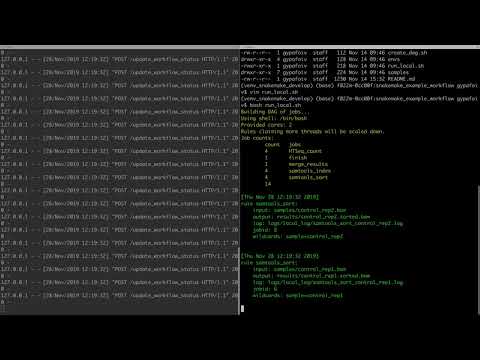
panoptes in action
Workflow statuses
| Status | Meaning |
|---|---|
Running |
The workflow is registered and events are arriving. |
Done |
All jobs finished (done == total), or the plugin reported end-of-run success (e.g. --until runs). |
Error |
A job or the workflow reported an error. |
Cancelled |
Explicitly cancelled via POST /api/workflow/<id>/cancel. |
Stale |
No events for more than PANOPTES_STALE_HOURS (default 48h) — the snakemake process was probably killed. Reverts to Running if events resume. |
No Execution |
Snakemake reported there was nothing to be done. |
The web pages poll the JSON API every few seconds and refresh automatically when the data changes, so a dashboard left open tracks running workflows without manual reloads. A workflow page also shows a per-rule progress breakdown below the overall progress bar, so a run with hundreds of jobs but few rules stays legible at a glance.
panoptes API
Panoptes provides the following API endpoints:
| Endpoint | Method | Description |
|---|---|---|
/api/service-info |
GET |
Server status |
/api/workflows |
GET |
Get all workflows |
/api/workflow/<workflow-id> |
GET |
Get workflow status |
/api/workflow/<workflow-id>/jobs |
GET |
Get all jobs of a workflow |
/api/workflow/<workflow-id>/job/<job-id> |
GET |
Get job status |
/api/workflow/<workflow-id> |
PUT |
Rename a workflow Expects a dictionary with new name (e.g. {'name': 'my new workflow name'}) |
/api/workflow/<workflow-id>/cancel |
POST |
Cancel a workflow (sets its status to Cancelled). Use this to move a workflow that is stuck as Running (e.g. a dry run, or a process killed with kill -9) into a deletable state. |
/api/workflow/<workflow-id> |
DELETE |
Delete a workflow. A workflow that is still Running is protected and returns 403; cancel it first via the endpoint above. |
/api/workflows/all |
DELETE |
Clean up database (deletes all workflows, including running ones) |
To communicate with panoptes the following endpoints are used by snakemake:
| Endpoint | Method | Description |
|---|---|---|
/api/service-info |
GET |
Server status (same as above) |
/create_workflow |
GET |
Get a unique id/name str(uuid.uuid4()) for each workflow |
/update_workflow_status |
POST |
Panoptes receives a dictionary from snakemake that contains: - A log message dictionary (JSON-encoded) - The current timestamp - The unique id/name of the workflow. (e.g. {'msg': json.dumps(message), 'timestamp': time.asctime(), 'id': id}) |
Contribute
Please see the Contributing instructions.
CI server
Changes on master (and pull requests against it) trigger a GitHub Actions build that runs the test suite and a live end-to-end run of the example workflow.
Contact
In case the issues section is not enough for you, you can also contact us via discord
Release history Release notifications | RSS feed


Download files
Download the file for your platform. If you're not sure which to choose, learn more about installing packages.
Source Distribution
Built Distribution
Filter files by name, interpreter, ABI, and platform.
If you're not sure about the file name format, learn more about wheel file names.
Copy a direct link to the current filters
File details
Details for the file panoptes_ui-1.6.0.tar.gz.
File metadata
- Download URL: panoptes_ui-1.6.0.tar.gz
- Upload date:
- Size: 1.4 MB
- Tags: Source
- Uploaded using Trusted Publishing? No
- Uploaded via: twine/6.2.0 CPython/3.9.25
File hashes
| Algorithm | Hash digest | |
|---|---|---|
| SHA256 |
16f8a3138353e9dc350a69d2e4bac79dd8ba05ec506092cefc55b6eb3454fc61
|
|
| MD5 |
87c7ede441991ca3c263a0a0bdb82dab
|
|
| BLAKE2b-256 |
cf74b7b8d7c84731aaceb6ca29595b2954cd00cee67ef507e02b6f39b73637af
|
File details
Details for the file panoptes_ui-1.6.0-py3-none-any.whl.
File metadata
- Download URL: panoptes_ui-1.6.0-py3-none-any.whl
- Upload date:
- Size: 1.4 MB
- Tags: Python 3
- Uploaded using Trusted Publishing? No
- Uploaded via: twine/6.2.0 CPython/3.9.25
File hashes
| Algorithm | Hash digest | |
|---|---|---|
| SHA256 |
d4a9a6ebf824730316efad48451cfbc6f73227d23da56d8621dcf5b26e4e42ac
|
|
| MD5 |
c4b3a38c0f49d8c49bbff4e52245995f
|
|
| BLAKE2b-256 |
125a27796421ff982cbdb3ae49c4ecf5ac6468fa397f0fdb78b95696a7b58738
|






