
A lightweight Python library for dynamic parameter management and runtime configuration.

Project description
Paramify
Paramify is a lightweight Python library designed to simplify dynamic parameter management. It allows developers to define, validate, and manage parameters dynamically using a JSON or YAML schema, with optional support for command-line integration and a web-based parameter configuration.
Key Features
- Dynamic Parameter Management: Easily define and manage parameters using a simple JSON schema.
- Command-Line Integration: Automatically generate CLI arguments using
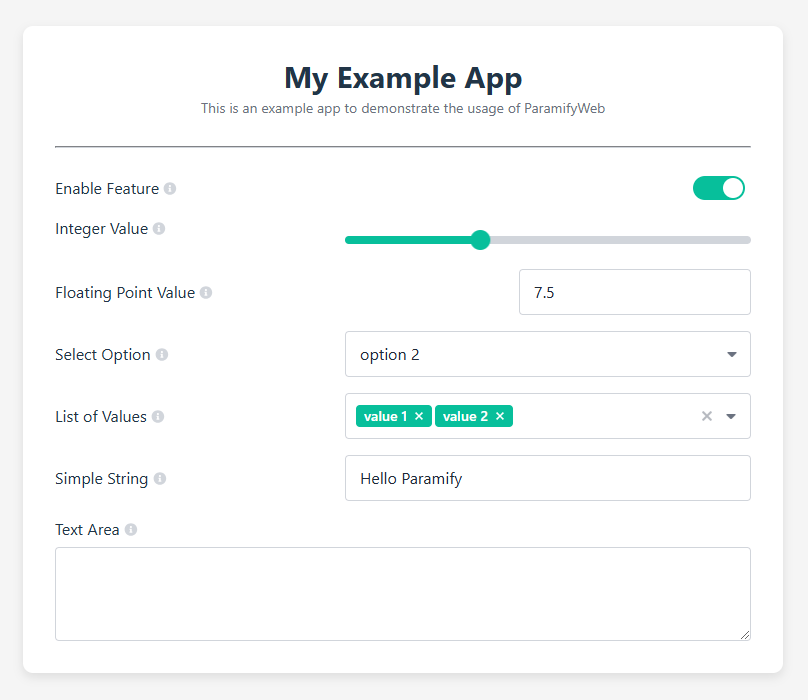
argparserbased on your configuration, allowing runtime overrides without separate definitions. - Web Interface: Expose parameters through a user-friendly Flask-based UI for runtime configuration.
- Validation: Automatically validate parameters with the help of Pydantic.
- Custom Callbacks: Define optional callbacks to handle updates to specific parameters.
- JSON/YAML Integration: Load and manage parameters directly from JSON or YAML files for flexible configurations.
- Scope-Based Control: Specify a parameter's scope as
"runtime","cli"and"all" - Extensible: Developers can extend the base class to add custom behaviors.
Here is an example of the Paramify web interface:
Installation
To install Paramify, use the following command:
pip install paramify
Quick Start
1. Programmatic Parameter Management
Below is an example of using Paramify for managing parameters dynamically:
from logger import Logger
from paramify.paramify import Paramify

# Define optional callback functions
class MyApp(Paramify):
    def on_param1_set(self, value):
        Logger.info(f"param1 was updated to {value}")

    def on_param2_set(self, value):
        Logger.info(f"param2 was updated to {value}")


if __name__ == '__main__':
    params = {
        "parameters": [
            {"name": "param1", "type": "bool", "label": "Enable Feature", "default": True},
            {"name": "param2", "type": "int", "label": "Integer Value", "default": 4},
        ]
    }

    app = MyApp(params)

    # Access default or loaded values
    Logger.info(app.parameters.param1)
    Logger.info(app.parameters.param2)

    # Update values and trigger callbacks
    app.set_param1(False)
    app.set_param2(23)

    # View current parameters
    Logger.info(app.get_parameters())
This example demonstrates how to define parameters, set values programmatically, and trigger custom callbacks.
2. Web-Based Parameter Management
Below is an example of using ParamifyWeb to expose parameters through a web interface:
import json
from logger import Logger
from paramify.paramify_web import ParamifyWeb

# Define optional callback functions
class MyApp(ParamifyWeb):
    def on_param1_set(self, value):
        Logger.info(f"Boolean parameter was updated to {value}")

    def on_param2_set(self, value):
        Logger.info(f"Integer parameter was updated to {value}")

    def on_param3_set(self, value):
        Logger.info(f"Float parameter was updated to {value}")

    def on_param4_set(self, value):
        Logger.info(f"Selectable parameter was updated to {value}")

    def on_param5_set(self, value):
        Logger.info(f"List parameter was updated to {value}")

    def on_param6_set(self, value):
        Logger.info(f"Simple string was updated to {value}")

    def on_param7_set(self, value):
        Logger.info(f"Text area value was updated to {value}")


if __name__ == '__main__':
    # Initialize the app with parameters from a YAML file
    app = MyApp('config.yaml')

    # Prevent the script from exiting immediately
    input("Press Enter to continue...")
This example demonstrates how to load parameters from a YAML file and expose them via a web interface. Callback functions are triggered when parameters are updated.
YAML Configuration Example
Here is an example of a JSON configuration file:
name: "My Example App"
description: "This is an example app to demonstrate the usage of Paramify"
parameters:
  - name: "param1"
    type: "bool"
    label: "Enable Feature"
    description: "A boolean parameter to enable or disable a feature."
    default: true
    scope: "all" # cli, runtime, all

  - name: "param2"
    type: "int"
    label: "Integer Value"
    description: "An integer parameter for numeric configuration."
    default: 4
    ui:
      element: "slider"
      min: 1
      max: 10

  - name: "param3"
    type: "str"
    label: "Select Option"
    description: "A parameter to select from predefined options."
    default: "option 2"
    ui:
      element: "select"
      items:
        - "option 1"
        - "option 2"
        - "option 3"
JSON Configuration Example
Here is an example of a JSON configuration file:
{
    "name": "My Example App",
    "description": "This is an example app to demonstrate the usage of Paramify",
    "parameters": [
        {
            "name": "param1",
            "type": "bool",
            "label": "Enable Feature",
            "description": "A boolean parameter to enable or disable a feature.",
            "default": true
        },
        {
            "name": "param2",
            "type": "int",
            "label": "Integer Value",
            "description": "An integer parameter for numeric configuration.",
            "default": 4,
            "ui": {"element": "slider", "min": 1, "max": 10}
        },
        {
            "name": "param3",
            "type": "str",
            "label": "Select Option",
            "description": "A parameter to select from predefined options.",
            "default": "option 2",
            "ui": {"element": "select", "items": ["option 1", "option 2", "option 3"]}
        }
    ]
}
Command-Line Integration
Paramify automatically generates CLI arguments based on your parameter schema, eliminating the need for separate argument definitions. Parameters defined with scope: "cli" or scope: "all" (it is the default) are included in the command-line interface, allowing users to override default values directly from the terminal.
Here is an example of the generated CLI for a simple application using Paramify:
usage: simple_params_web.py [-h] [--param1] [--param2 PARAM2] [--param3 PARAM3]

This is an example app to demonstrate the usage of Paramify

options:
  -h, --help            show this help message and exit
  --param1              A boolean parameter to enable or disable a feature.
  --param2 PARAM2       An integer parameter for numeric configuration.
  --param3 PARAM3       A parameter to select from predefined options.
Features Overview
- Ease of Use: Simple, human-readable JSON schema for parameter definitions.
- Web UI: Manage and modify parameters in real-time through a web interface.
- Custom Logic: Implement application-specific callbacks for parameters.
- JSON/YAML Support: Load configurations from external JSON or YAML files for flexibility.
Contributing
Contributions are welcome! Feel free to open issues or submit pull requests to improve this library.
License
This project is licensed under the MIT License. See the LICENSE file for details.


Download files
Download the file for your platform. If you're not sure which to choose, learn more about installing packages.
Source Distributions
Built Distribution
Filter files by name, interpreter, ABI, and platform.
If you're not sure about the file name format, learn more about wheel file names.
Copy a direct link to the current filters
File details
Details for the file paramify-0.1.1-py3-none-any.whl.
File metadata
- Download URL: paramify-0.1.1-py3-none-any.whl
- Upload date:
- Size: 403.5 kB
- Tags: Python 3
- Uploaded using Trusted Publishing? No
- Uploaded via: twine/6.0.1 CPython/3.12.3
File hashes
| Algorithm | Hash digest | |
|---|---|---|
| SHA256 |
df113310e83b567973fe9abd01c39cc7b3b0cd07710e7a2ceb0b67e04f50acb4
|
|
| MD5 |
07654c50127647e618a7f7e5c5a397bb
|
|
| BLAKE2b-256 |
20980e08721992d3cd5376bf8f52cf34584c4442724a1f4291c2ffee62496525
|






