
PDFDesk
Your reading desk for research papers.
Library, PDF reader, highlights, notes, and a complete log of your reading, all in one window, all on your machine.





pip install pdfdesk && pdfdesk
Why PDFDesk
You read dozens of papers a month. A file manager tells you where a PDF lives. An annotation tool tells you what you marked. Neither tells you how you read it: when you opened it, how far you got, how long you actually spent, and what you concluded at the end of each sitting.
PDFDesk keeps that record for you. Every paper moves through a reading lifecycle, every sitting becomes a session, and every highlight and note links back to the page it came from. Months later you can see what you read and why it mattered.
Read with highlights that mean something
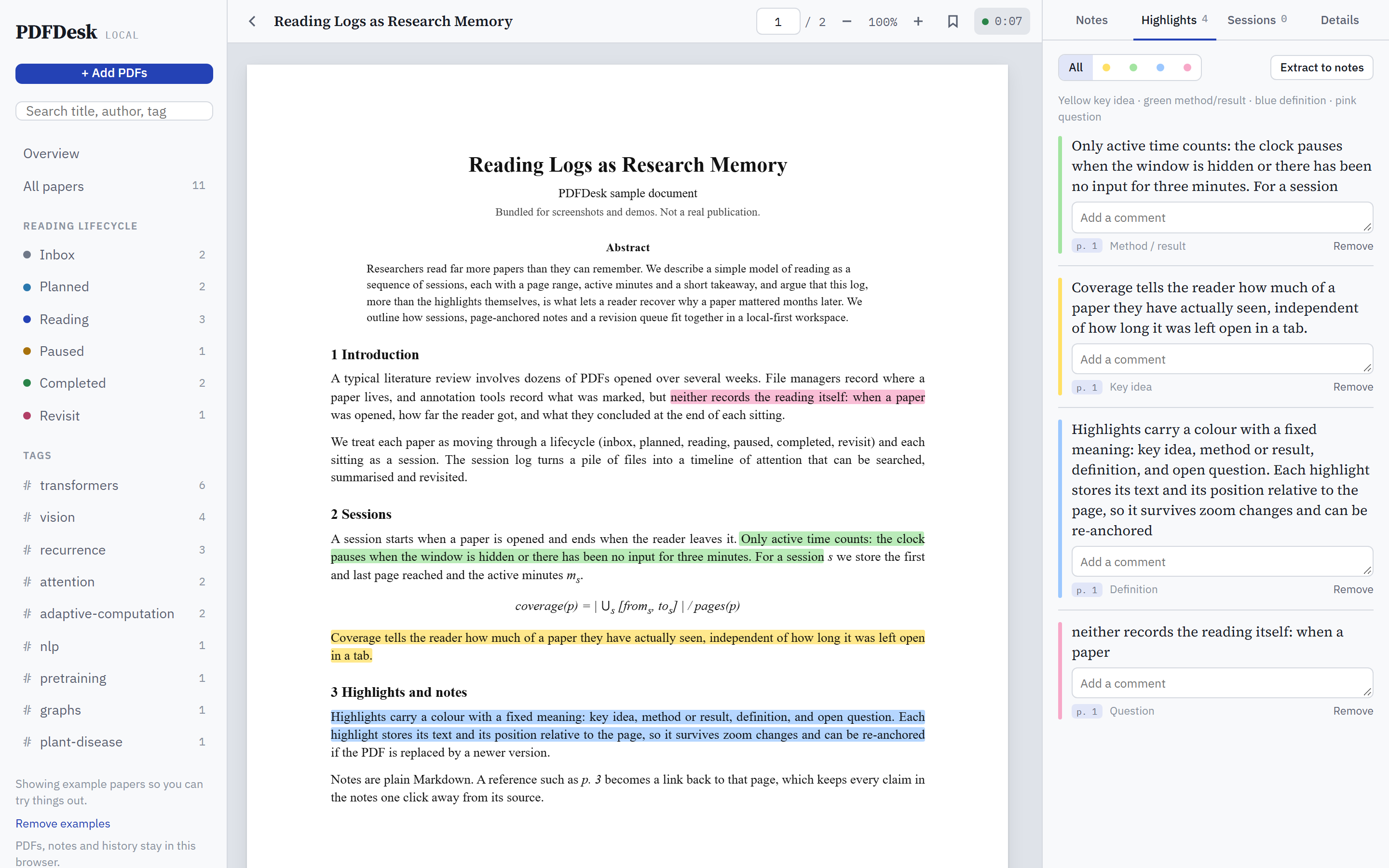
Select text on any page and pick a colour. Each colour has one job, so a page of highlights reads at a glance:
| Colour | Meaning | |
|---|---|---|
| 🟨 | Yellow | Key idea |
| 🟩 | Green | Method or result |
| 🟦 | Blue | Definition |
| 🟥 | Pink | Question or doubt |
- Add a comment to any highlight, and filter the panel by colour.
- Click a highlight in the panel to jump straight to it in the PDF.
- Highlights store the selected text as well as their position, so they stay put when you zoom.
- Extract to notes pulls every highlight into your notes, each with its page reference.
Notes that point back to the page
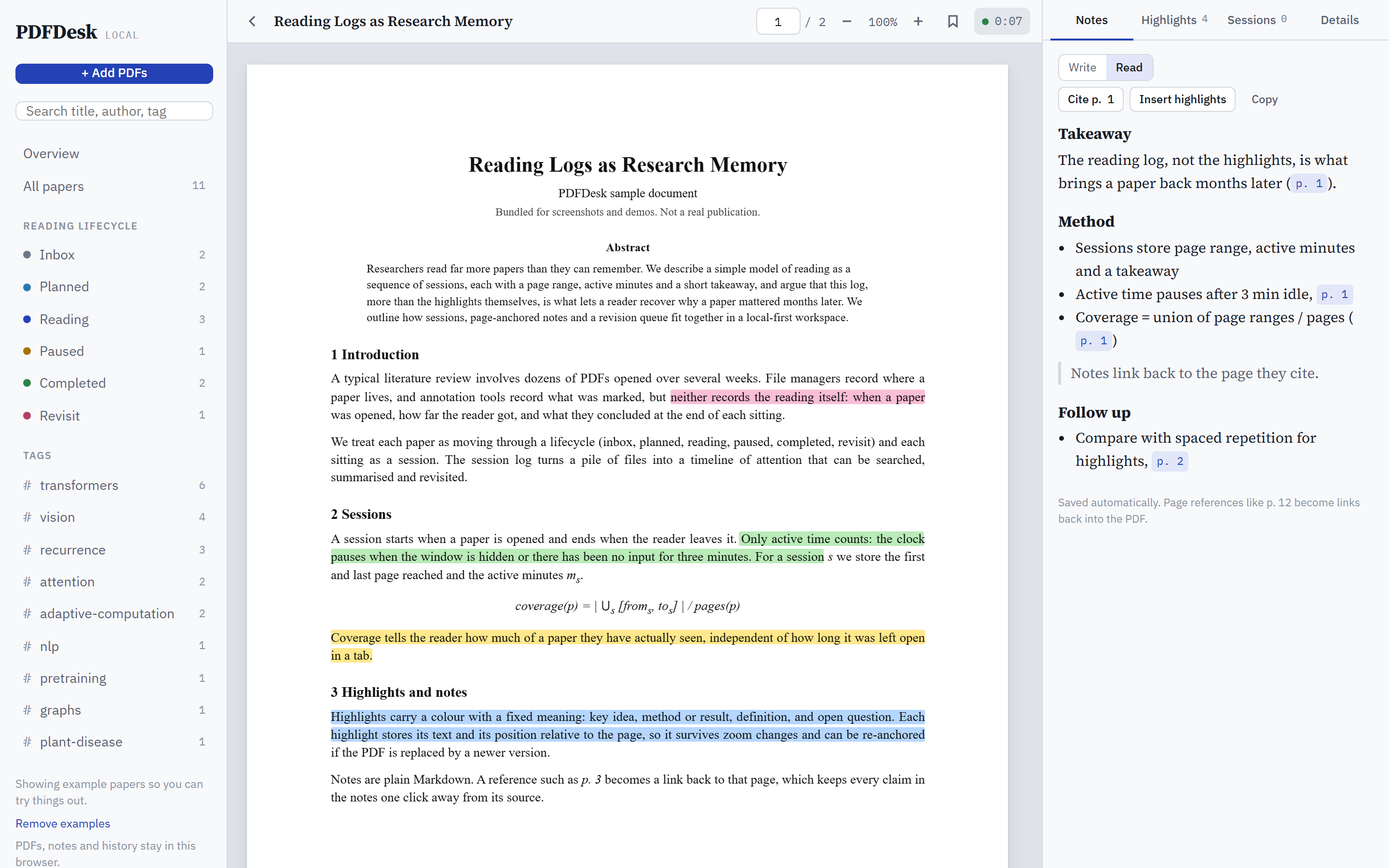
- Write in Markdown: headings, bullets, quotes.
- Type
p. 12anywhere and it becomes a link to page 12. - Cite p. N drops in a reference to the page you're on.
- Insert highlights adds your highlights to the notes, each with its page.
- Copy exports the notes as Markdown, ready for your paper, wiki or Obsidian vault.
- Notes save automatically as you type.
A library that follows your reading
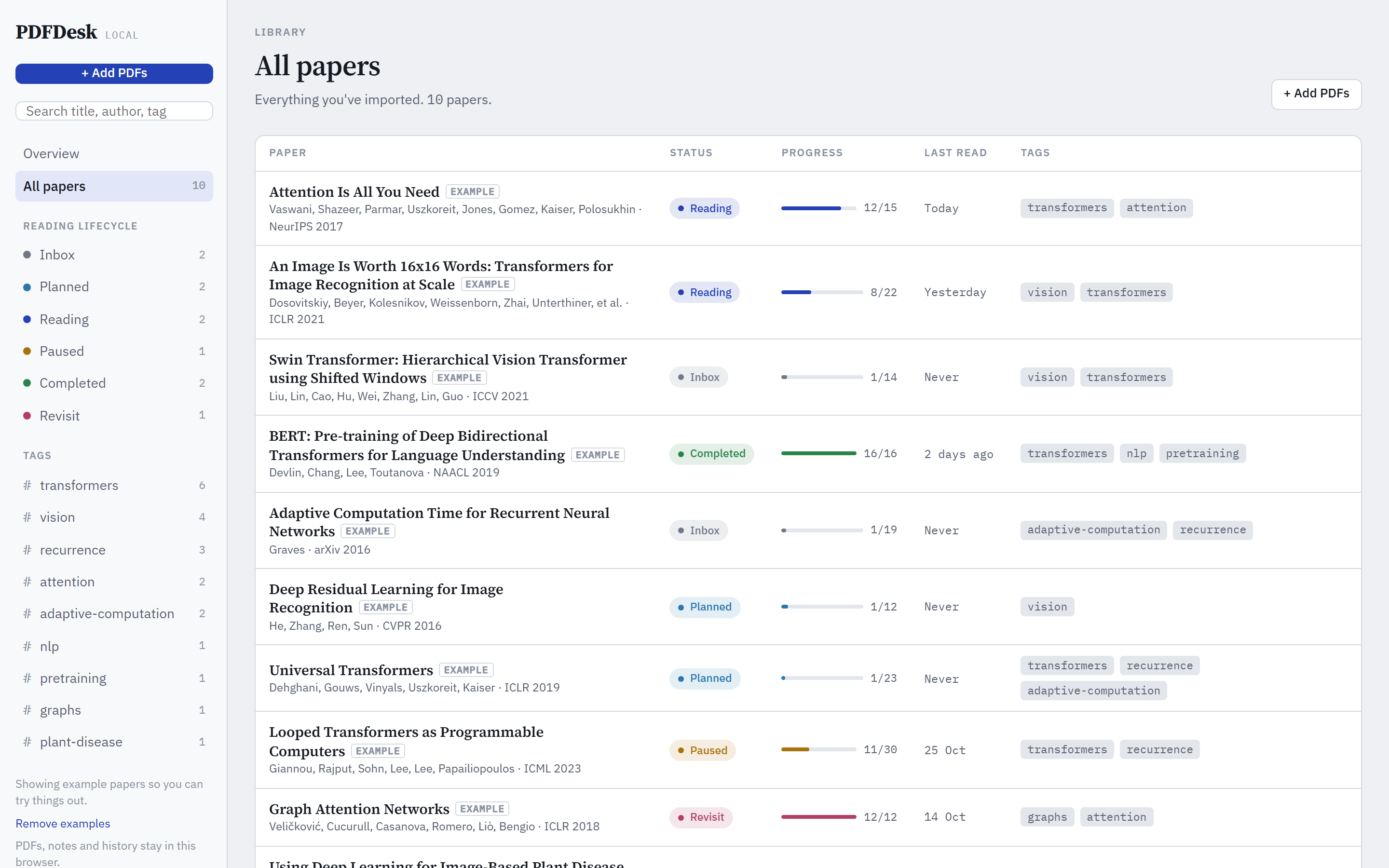
Every paper has a place in the reading lifecycle:
Inbox → Planned → Reading → Paused → Completed → Revisit
- Opening a paper moves it to Reading. When you reach the last page, PDFDesk asks whether it's Completed or worth a Revisit.
- Import by button or drag and drop. Title, authors and page count come from the PDF itself.
- Search by title, author or tag from anywhere.
- Tags in the sidebar, with counts, for one-click filtering.
- See each paper's status, progress bar, pages read and when you last opened it.
- Set a target page and date ("finish section 3 by Friday") and it shows up in Up next.
Every session, recorded
PDFDesk logs each sitting with a paper on its own:
- Active time only. The clock pauses when the tab is hidden or you've been idle for 3 minutes, so your stats count reading, not open tabs.
- Pages covered: the first and last page you reached.
- A takeaway: an optional line on what you got out of the session.
- Resume where you left off: every paper reopens at your last page.
- Bookmarks for pages you'll come back to.
Your reading, at a glance
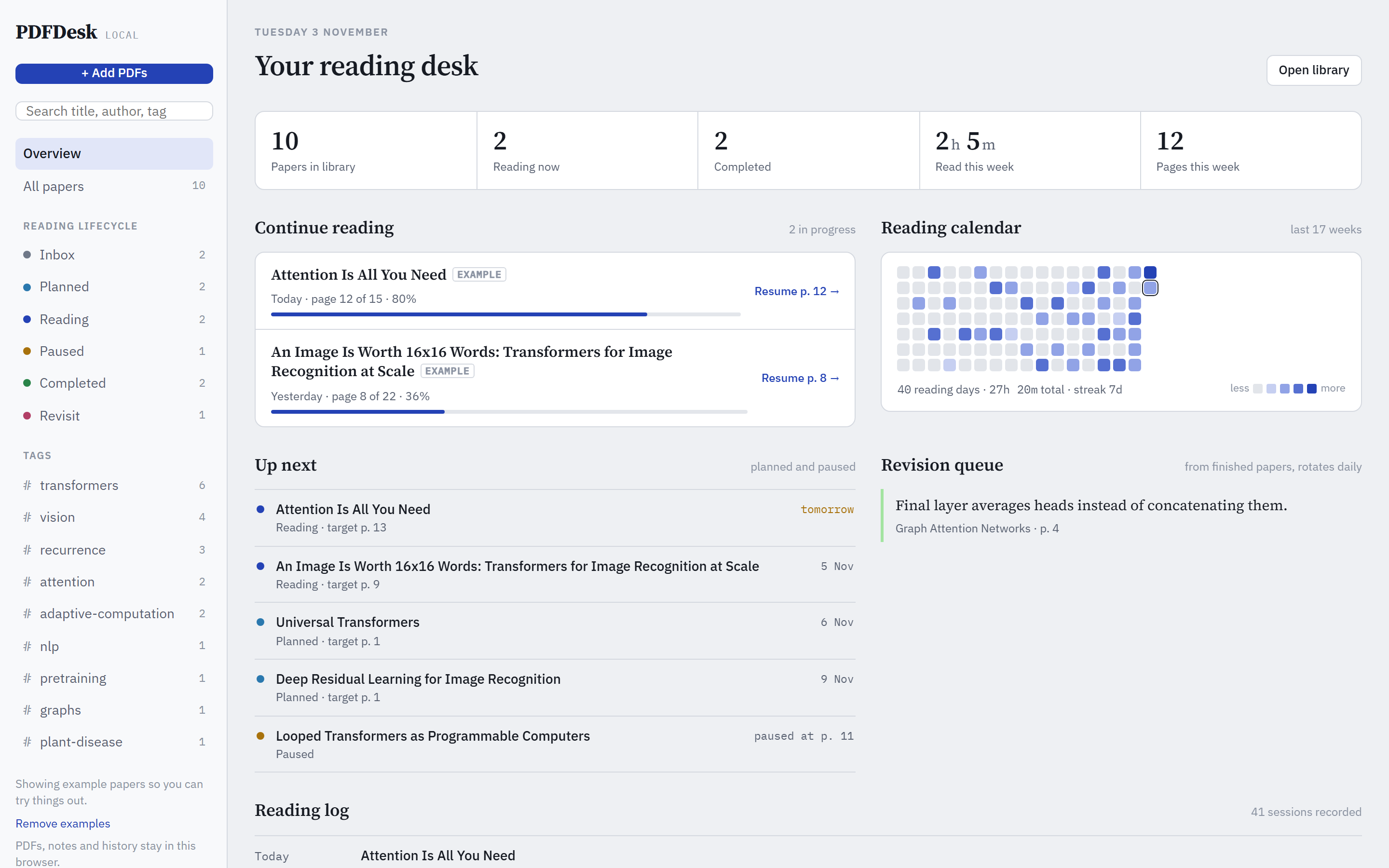
The overview turns your sessions into a picture of your reading:
- Stats: papers in your library, reading now, completed, time and pages this week.
- Continue reading: papers in progress, with a progress bar and a one-click resume.
- Reading calendar: a 17-week heatmap of your reading days, with your current streak and total hours.
- Up next: planned and paused papers, sorted by target date.
- Revision queue: highlights from finished papers come back each day, so ideas don't fade.
- Reading log: every session, newest first.
Easy on the eyes, day and night
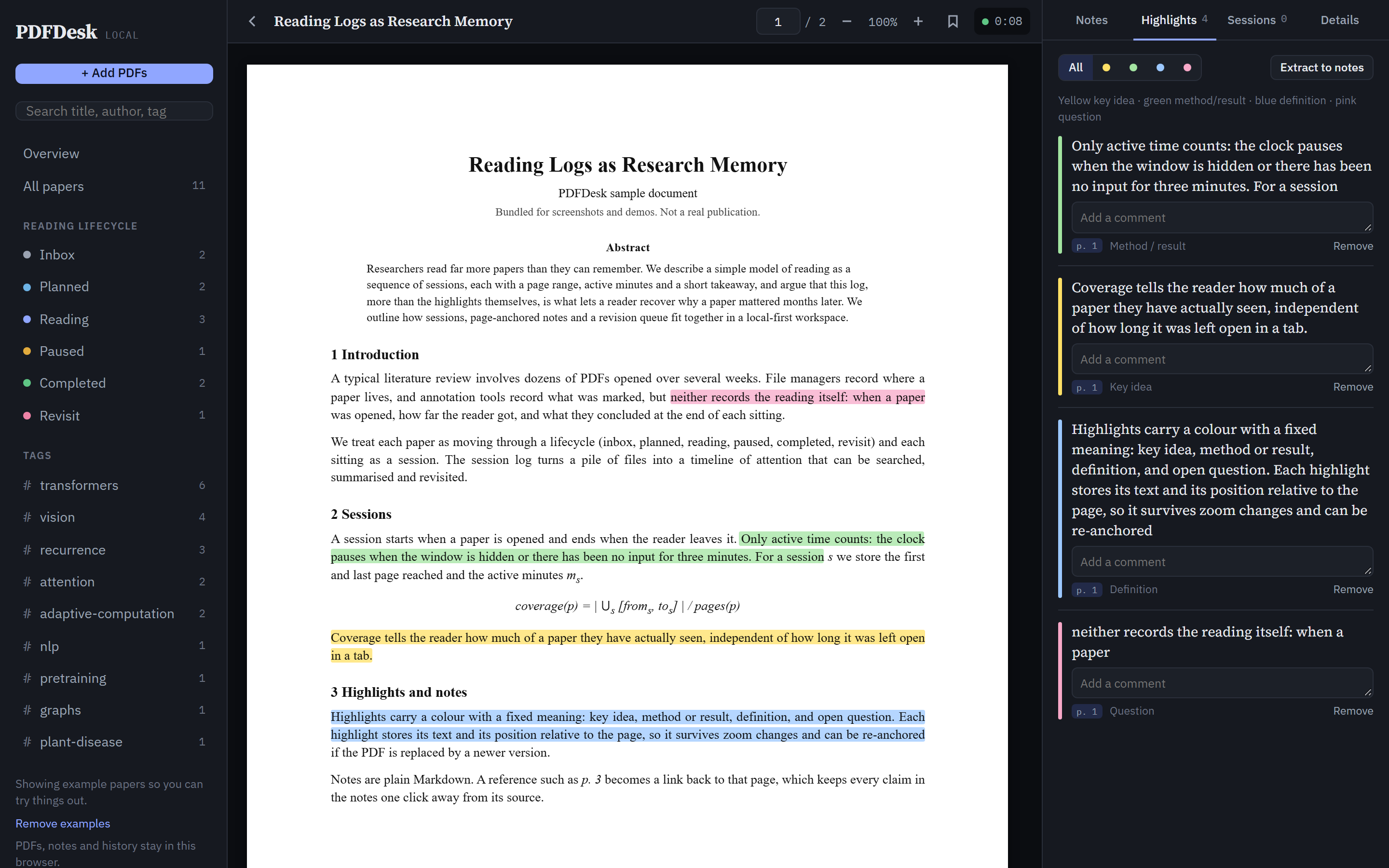
Dark mode follows your system setting. Typography is set for long reading sessions: Source Serif 4 for titles and notes, IBM Plex Sans for the interface, IBM Plex Mono for numbers and page references.
Keyboard shortcuts
| Key | Action |
|---|---|
j or → |
Next page |
k or ← |
Previous page |
b |
Bookmark this page |
Enter in the page box |
Jump to page |
Esc |
Close the highlight menu |
Private by design
- 🔒 Local-first. Your PDFs, notes and history stay on your computer. No account, no cloud, no tracking.
- ✈️ Works offline. The PDF engine and fonts ship inside the package. Nothing loads from the internet.
- 🪶 Lightweight. One small package with zero Python dependencies. If you have Python 3.9+, you can run it.
Get started
pip install pdfdesk
pdfdesk
PDFDesk opens in your browser at http://localhost:5173. A few example papers are loaded so you can explore. Remove them from the sidebar when you're ready, then drop in your own PDFs.
pdfdesk --no-browser      # start without opening a browser window
pdfdesk --port 8080       # use another port
pdfdesk --version
Upgrade any time with pip install -U pdfdesk.
Good to know: in this version your library is stored in the browser you open PDFDesk in, for the address
localhost:5173. Keep using the same browser and the default port and your library will be there every time. Uninstalling the package doesn't delete it.
What's coming
PDFDesk is at 0.1, an early release. Next up:
- Export and import your whole library, PDFs included.
- arXiv and DOI import: paste an id and the title, authors, year and venue fill themselves in.
- Full-text search across notes and highlights.
- PDF outline in the sidebar, from the paper's table of contents.
- PDFDesk 1.0 as a native desktop app (Tauri + SQLite), installed the same way, with
pip install -U pdfdesk. - Later: links between papers, spaced revision, weekly reading reports, Zotero import.
The full plan is in docs/roadmap.md.
Contributing
Bug reports and ideas are welcome in Issues. To work on the code, start with DEVELOPMENT.md.
License
MIT. Bundled third-party code keeps its own licence: PDF.js (Apache-2.0) and the Source Serif 4, IBM Plex Sans and IBM Plex Mono fonts (SIL Open Font License 1.1).
Built for people who read papers for a living.
1 maintainer

Metadata
1 maintainer
Release files for pdfdesk 0.1.0
For a detailed explanation of source distributions (sdists) and built distributions (wheels), please see the package formats documentation.
Source distribution (sdist)
| File | Size | Uploaded | Provenance | Actions |
|---|---|---|---|---|
| pdfdesk-0.1.0.tar.gz | 1.4 MB | Without provenance | Details for pdfdesk-0.1.0.tar.gz |
Built distribution (wheel)
| File | Interpreter | ABI | Platform | Actions Reset |
|---|---|---|---|---|
| pdfdesk-0.1.0-py3-none-any.whl | Python 3 | none | any | Details for pdfdesk-0.1.0-py3-none-any.whl |
Total release size: 2.8 MB
Release files / pdfdesk-0.1.0.tar.gz
| Download URL | pdfdesk-0.1.0.tar.gz |
|---|---|
| Size | 1.4 MB |
| Tags | Source |
|
SHA-256 checksum How to use checksums |
452bc30bf1e1ae537b43d157530789880e85e9d1c78f13b084adfa04193e414b
|
|
BLAKE2b-256 checksum How to use checksums |
ff3748a013ef67315c9d8293769a59e9dafba962c4d774891bb1ac628d857f9e
|
| Upload date | |
|
Uploaded using Trusted Publishing? What is trusted publishing? |
No |
| Uploaded via |
twine/7.0.0 CPython/3.14.5
|
Release files / pdfdesk-0.1.0-py3-none-any.whl
| Download URL | pdfdesk-0.1.0-py3-none-any.whl |
|---|---|
| Size | 1.4 MB |
| Tags | Python 3 |
|
SHA-256 checksum How to use checksums |
c7421d3920889c2903a64dba5e6439adffa1f44426623ce3a6e6d80e13c4342e
|
|
BLAKE2b-256 checksum How to use checksums |
de643cf85867cfe3d7b5e54eba21da21c7101595d192967797cbaf3aad2de9c4
|
| Upload date | |
|
Uploaded using Trusted Publishing? What is trusted publishing? |
No |
| Uploaded via |
twine/7.0.0 CPython/3.14.5
|
Security for pdfdesk 0.1.0
Provenance
Provenance describes where a file came from. On PyPI, provenance is shared via attestations, which provide a verifiable record of the build or publishing details. View details, limitations and caveats.
No provenance found
None of the files in this release were uploaded with provenance metadata.
A note on package security
PyPI is a repository for distributing packages, not a service for auditing them. While third-party security researchers and our staff do their best to detect and remove malicious packages, PyPI cannot guarantee the quality, security or suitability of any given package.
To learn more about protecting yourself from malicious actors, visit our package security documentation.














