
A purpose-built PDF link analysis and reporting tool with GUI and CLI.
Verified details
These details have been verified by PyPIProject links
GitHub Statistics
Maintainers

Project description
pdflinkcheck
A purpose-built tool for comprehensive analysis of hyperlinks and GoTo links within PDF documents. Users may leverage either the PyMuPDF or the pypdf library. Use the CLI or the GUI.
📥 Access and Installation
The recommended way to use pdflinkcheck is to either install the CLI with pipx or to download the appropriate latest binary for your system from Releases.
🚀 Release Artifact Files (EXE, PYZ, ELF)
For the most user-typical experience, download the single-file binary matching your OS.
| File Type | Primary Use Case | Recommended Launch Method |
|---|---|---|
| Executable (.exe, .elf) | GUI | Double-click the file. |
| PYZ (Python Zip App) | CLI or GUI | Run using your system's python command: python pdflinkcheck-VERSION.pyz --help |
Installation via pipx
For an isolated environment where you can access pdflinkcheck from any terminal:
# Ensure you have pipx installed first (if not, run: pip install pipx)
pipx install pdflinkcheck[full]

# On Termux
pipx install pdflinkcheck
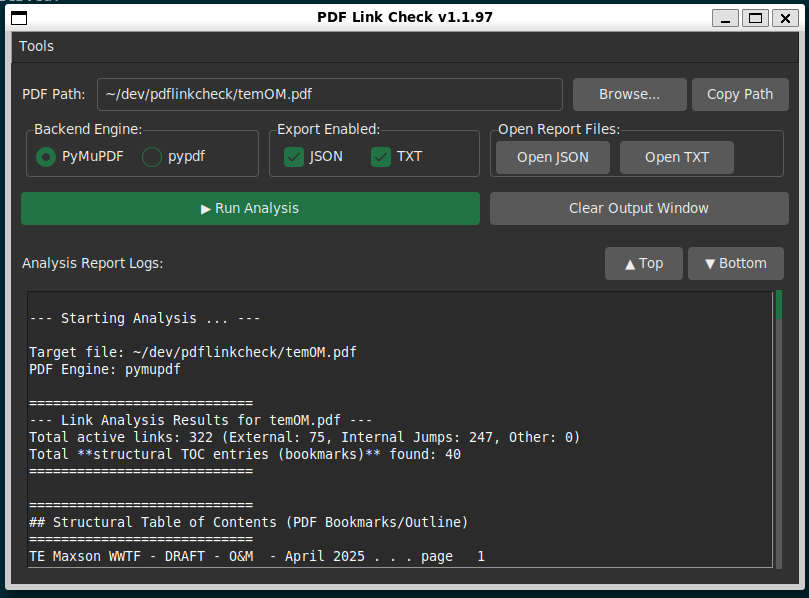
💻 Graphical User Interface (GUI)
The tool can be run as simple cross-platform graphical interface (Tkinter).
Launching the GUI
Ways to launch the GUI interface:
- Implicit Launch: Run the tool or file with no arguments, subcommands, or flags. (Note: PyInstaller builds use the --windowed (or -noconsole) flag, except for on Termux.)
- Explicit Command: Use the dedicated GUI subcommand (
pdflinkcheck gui).
🚀 CLI Usage
The core functionality is accessed via the analyze command.
pdflinkcheck --help:
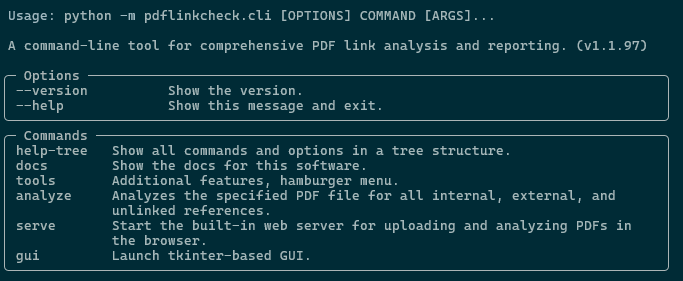
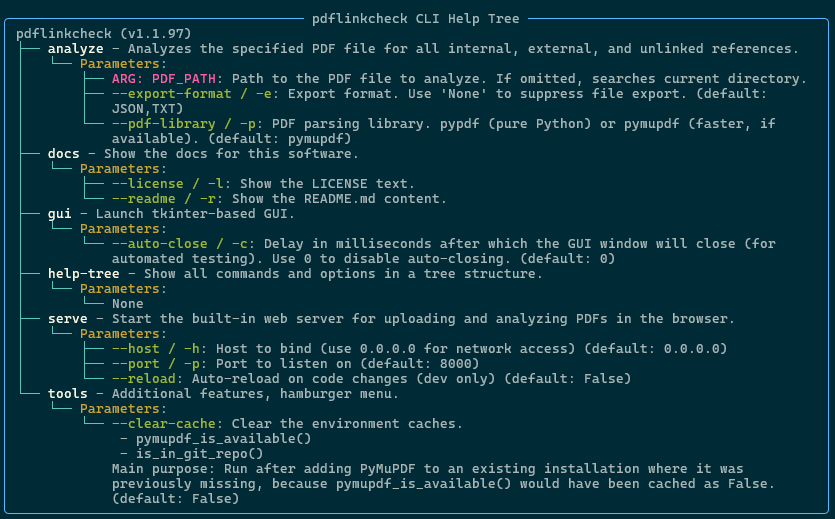
See the Help Tree by unlocking the help-tree CLI command, using the DEV_TYPER_HELP_TREE env var.
DEV_TYPER_HELP_TREE=1 pdflinkcheck help-tree` # bash
$env:DEV_TYPER_HELP_TREE = "1"; pdflinkcheck help-tree` # PowerShell
Available Commands
| Command | Description |
|---|---|
pdflinkcheck analyze |
Analyzes a PDF file for links and validates their reasonableness. |
pdflinkcheck gui |
Explicitly launch the Graphical User Interface. |
pdflinkcheck docs |
Access documentation, including the README and AGPLv3+ license. |
pdflinkcheck serve |
Serve a basic local web app which uses only the Python standard library. |
pdflinkcheck tools |
Access additional tools, like --clear-cache. |
analyze Command Options
| Option | Description | Default |
|---|---|---|
<PDF_PATH> |
Required. The path to the PDF file to analyze. | N/A |
--pdf-library / -p |
Select engine: pymupdf or pypdf. |
pypdf |
--export-format / -e |
Export to JSON, TXT, or None to suppress file output. |
JSON |
gui Command Options
| Option | Description | Default |
|---|---|---|
--auto-close INTEGER |
(For testing/automation only). Delay in milliseconds after which the GUI window will automatically close. | 0 (Disabled) |
Example Runs
# Analyze a document, show all links, and save the report as JSON and TXT
pdflinkcheck analyze "TE Maxson WWTF O&M Manual.pdf" --export-format JSON,TXT

# Show the GUI for only a moment, like in a build check
pdflinkcheck gui --auto-close 3000

# Show both the LICENSE and README.md docs
pdflinkcheck docs --license --readme
📦 Library Access (Advanced)
For developers importing pdflinkcheck into other Python projects, the core analysis functions are exposed directly in the root namespace. The various analysis_pdf_* functions each use a different library to extract the target PDF's internal TOC, external links, and metadata.
| Function | Library | Description |
|---|---|---|
run_report() |
pdflinkcheck | (Primary function) Performs the full analysis, prints to console, and handles file export. |
analyze_pdf_pdfium() |
pypdfium2 | Fast, ~10 mb, Permissively licensed |
analyze_pdf_pymupdf() |
PyMuPDF | Fast, ~30 mb, AGPL3+ licensed |
analyze_pdf_pypdf() |
pypdf library | Slow, ~2 mb, Permissively licensed |
Exanple:
from pdflinkcheck import ( run_report,
                          analyze_pdf_pymupdf,
                          analyze_pdf_pypdf,
                          analyze_pdf_pdfium,
                          )

file = "document1.pdf"
report_data = run_report(file)
links_pymupdf = extract_links_pymupdf(file)
links_pypdf = extract_links_pypdf(file)
✨ Features
- Active Link Extraction: Identifies and categorizes all programmed links (External URIs, Internal GoTo/Destinations, Remote Jumps).
- Anchor Text Retrieval: Extracts the visible text corresponding to each link's bounding box.
- Structural TOC: Extracts the PDF's internal Table of Contents (bookmarks/outline).
🥚 Optional REPL‑Friendly GUI Access (Easter Egg)
For users who prefer exploring tools interactively—especially those coming from MATLAB or other REPL‑first environments—pdflinkcheck includes an optional Easter egg that exposes the GUI launcher directly in the library namespace.
This feature is disabled by default and has no effect on normal imports.
Enabling the Easter Egg
Set the environment variable before importing the library:
import os
os.environ["PDFLINKCHECK_GUI_EASTEREGG"] = "true"

import pdflinkcheck
pdflinkcheck.start_gui()
Accepted values include: true, 1, yes, on (case‑insensitive).
Purpose
This opt‑in behavior is designed to make the library feel welcoming to beginners who are experimenting in a Python REPL for the first time. When enabled, the start_gui() function becomes available at the top level:
pdflinkcheck.start_gui()
If the PDFLINKCHECK_GUI_EASTEREGG environment variable is not set—or if GUI support is unavailable—pdflinkcheck behaves as a normal library with no GUI functions exposed.
Another Easter Egg
DEV_TYPER_HELP_TREE=1 pdflinkcheck help-tree
This help-tree feature has not yet been submitted for inclusion into Typer.
⚠️ Compatibility Notes
Termux Compatibility as a Key Goal
A key goal of City-of-Memphis-Wastewater is to release all software as Termux-compatible.
Termux compatibility is important in the modern age, because Android devices are common among technicians, field engineers, and maintenace staff. Android is the most common operating system in the Global South. We aim to produce stable software that can do the most possible good.
Now pdflinkcheck can run on Termux by using the pypdf engine and the pdfium engine.
Benefits:
pypdf-only artifacts, to reduce size to about 6% compared to artifacts that includePyMuPDF.- Web-stack GUI as an alternative to the Tkinter GUI, which can be run locally on Termux or as a web app.
PDF Library Selection
At long last, PyMuPDF is an optional dependency. All testing comparing pypdf and PyMuPDF has shown identical validation performance. However PyMuPDF is much faster. The benfit of pypdf is small size of packages and cross-platform compatibility. We have recently added a PDFium option, which circumvents the AGPL3+.
Expecte that all binaries and artifacts contain PyMuPDF, unlss they are built on Android. The GUI and CLI interfaces both allow selection of the library; if PyMuPDF is selected but is not available, the user will be warned.
To install the complete version use one of these options:
pip install "pdflinkcheck[mupdf]"
pipx install "pdflinkcheck[pdfium]"
uv tool install "pdflinkcheck[pdfium]"
uv add "pdflinkcheck[pdfium]"
Document Compatibility:
Not all PDF files can be processed successfully. This tool is designed primarily for digitally generated (vector-based) PDFs.
Processing may fail or yield incomplete results for:
- Scanned PDFs (images of text) that lack an accessible text layer.
- Encrypted or Password-Protected documents.
- Malformed or non-standard PDF files.
Run from Source (Developers)
git clone http://github.com/city-of-memphis-wastewater/pdflinkcheck.git
cd pdflinkcheck

# To include the PyMuPDF dependency in the installation:
uv sync --extras full

# On Termux, to not include PyMuPDF:
uv sync

# To include developer depedecies:
uv sync --all-extras --group dev

# Run the CLI
uv run python src/pdflinkcheck/cli.py --help

# Run a basic webapp and Termux-facing browser-based interface
uv run  python -m pdflinkcheck.stdlib_server
📜 License Implications (AGPLv3+)
The AGPL3-or-later is required for binaries of pdflinkcheck which include PyMuPDF, which is licensed under the AGPL3.
The source code itself for pdflinkcheck is licensed under the MIT.
The AGPL3-or-later license has significant implications for distribution and network use, particularly for organizations:
- Source Code Provision: If you distribute this tool (modified or unmodified) to anyone, you must provide the full source code under the same license.
- Network Interaction (Affero Clause): If you modify this tool and make the modified version available to users over a computer network (e.g., as a web service or backend), you must also offer the source code to those network users.
Before deploying or modifying this tool for organizational use, especially for internal web services or distribution, please ensure compliance with the AGPLv3+ terms.
Because the AGPLv3 is a strong copyleft license, any version of pdflinkcheck that includes AGPL‑licensed components (such as PyMuPDF) must be distributed as a whole under AGPLv3+. This means that for those versions, anyone who distributes the application — or makes a modified version available over a network — must also provide the complete corresponding source code under the same terms.
The source code of pdflinkcheck itself remains licensed under the MIT License; only the distributed binary becomes AGPL‑licensed when PyMuPDF is included.
Links:
- Source code: https://github.com/City-of-Memphis-Wastewater/pdflinkcheck/
- PyMuPDF source code: https://github.com/pymupdf/PyMuPDF/
- pypdfium2 source code: https://github.com/pypdfium2-team/pypdfium2
- pypdf source code: https://github.com/py-pdf/pypdf/
- AGPLv3 text (FSF): https://www.gnu.org/licenses/agpl-3.0.html
- MIT License text: https://opensource.org/license/mit
Copyright © 2025 George Clayton Bennett
Project details
Verified details
These details have been verified by PyPIProject links
GitHub Statistics
Maintainers
Release history Release notifications | RSS feed


Download files
Download the file for your platform. If you're not sure which to choose, learn more about installing packages.
Source Distribution
Built Distribution
Filter files by name, interpreter, ABI, and platform.
If you're not sure about the file name format, learn more about wheel file names.
Copy a direct link to the current filters
File details
Details for the file pdflinkcheck-1.2.30.tar.gz.
File metadata
- Download URL: pdflinkcheck-1.2.30.tar.gz
- Upload date:
- Size: 399.9 kB
- Tags: Source
- Uploaded using Trusted Publishing? Yes
- Uploaded via: twine/6.1.0 CPython/3.13.7
File hashes
| Algorithm | Hash digest | |
|---|---|---|
| SHA256 |
6659c1a627849856fe6e1781858d89f85a3807f51963643e5b6e64c7754c0b49
|
|
| MD5 |
6def12762292ba99d620a039941a0b0f
|
|
| BLAKE2b-256 |
11514aab3db6e2da0c3938d7e713f2b3b3a6dd6ef8242d3f7fd0ff491ec2a492
|
Provenance
The following attestation bundles were made for pdflinkcheck-1.2.30.tar.gz:
Publisher:
publish.yml on City-of-Memphis-Wastewater/pdflinkcheck
-
Statement:
-
Statement type:
https://in-toto.io/Statement/v1 -
Predicate type:
https://docs.pypi.org/attestations/publish/v1 -
Subject name:
pdflinkcheck-1.2.30.tar.gz -
Subject digest:
6659c1a627849856fe6e1781858d89f85a3807f51963643e5b6e64c7754c0b49 - Sigstore transparency entry: 815084360
- Sigstore integration time:
-
Permalink:
City-of-Memphis-Wastewater/pdflinkcheck@13f85ca6c23f455c552f60349769a23f313d6c45 -
Branch / Tag:
refs/tags/v1.2.30 - Owner: https://github.com/City-of-Memphis-Wastewater
-
Access:
public
-
Token Issuer:
https://token.actions.githubusercontent.com -
Runner Environment:
github-hosted -
Publication workflow:
publish.yml@13f85ca6c23f455c552f60349769a23f313d6c45 -
Trigger Event:
release
-
Statement type:
File details
Details for the file pdflinkcheck-1.2.30-py3-none-any.whl.
File metadata
- Download URL: pdflinkcheck-1.2.30-py3-none-any.whl
- Upload date:
- Size: 448.5 kB
- Tags: Python 3
- Uploaded using Trusted Publishing? Yes
- Uploaded via: twine/6.1.0 CPython/3.13.7
File hashes
| Algorithm | Hash digest | |
|---|---|---|
| SHA256 |
dffd932103514ed5da5ece70dda501bba448298f2896513cb149ca93e83e414e
|
|
| MD5 |
2417d7e1ef61d10116b159d79dd502b8
|
|
| BLAKE2b-256 |
b888a05e8ddb6195501baf31bae90e0463d2bed945d47f326b95267e74b54407
|
Provenance
The following attestation bundles were made for pdflinkcheck-1.2.30-py3-none-any.whl:
Publisher:
publish.yml on City-of-Memphis-Wastewater/pdflinkcheck
-
Statement:
-
Statement type:
https://in-toto.io/Statement/v1 -
Predicate type:
https://docs.pypi.org/attestations/publish/v1 -
Subject name:
pdflinkcheck-1.2.30-py3-none-any.whl -
Subject digest:
dffd932103514ed5da5ece70dda501bba448298f2896513cb149ca93e83e414e - Sigstore transparency entry: 815084369
- Sigstore integration time:
-
Permalink:
City-of-Memphis-Wastewater/pdflinkcheck@13f85ca6c23f455c552f60349769a23f313d6c45 -
Branch / Tag:
refs/tags/v1.2.30 - Owner: https://github.com/City-of-Memphis-Wastewater
-
Access:
public
-
Token Issuer:
https://token.actions.githubusercontent.com -
Runner Environment:
github-hosted -
Publication workflow:
publish.yml@13f85ca6c23f455c552f60349769a23f313d6c45 -
Trigger Event:
release
-
Statement type:






