
A Python package to benchmark query performance on PostgreSQL Database.

Project description
pgbenchmark


Python package to benchmark query performance on a PostgreSQL database. It allows you to measure the execution time of queries over multiple runs, providing detailed metrics about each run's performance.
Installation
pip install pgbenchmark
Example
For ParallelBenchmark, scroll down....
import psycopg2
from pgbenchmark import Benchmark

conn = psycopg2.connect(
    dbname="postgres",
    user="postgres",
    password="  << Your Password >> ",
    host="localhost",
    port="5432"
)

benchmark = Benchmark(db_connection=conn, number_of_runs=1000)
benchmark.set_sql("SELECT 1;")

for result in benchmark:
    # {'run': X, 'sent_at': <DATETIME WITH MS>, 'duration': '0.000064'}
    pass

""" View Summary """
print(benchmark.get_execution_results())

# {'runs': 1000,
#      'min_time': '0.000576',
#      'max_time': '0.014741',
#      'avg_time': '0.0007',
#      'median_time': '0.000642',
#      'percentiles': {'p25': '0.000612',
#                      'p50': '0.000642',
#                      'p75': '0.000696',
#                      'p99': '0.001331'}
#      }
You can also pass SQL file, instead of query string
benchmark.set_sql("./test.sql")
Interactive | No-Code Mode
Simply run in your terminal:
pgbenchmark
You'll see the ouput
[ http://127.0.0.1:8000 ] Click to open pgbenchmark Interface
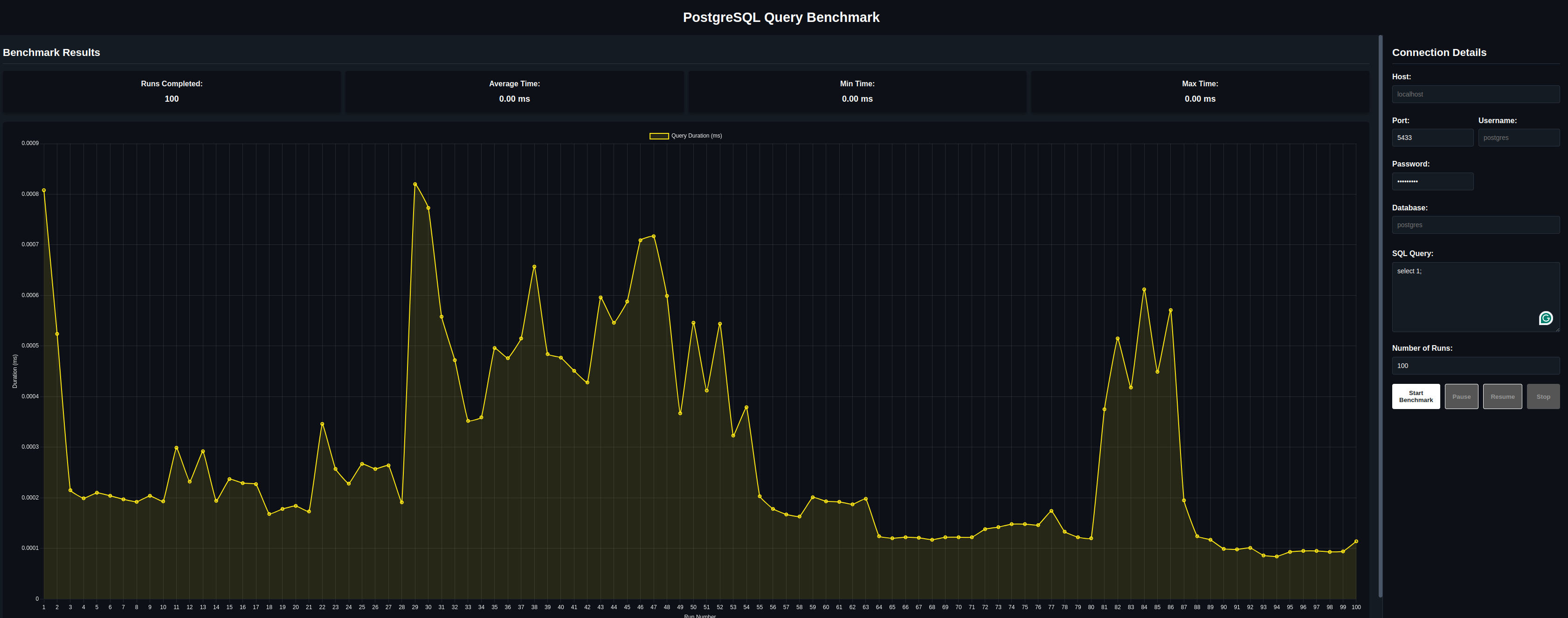
Configuration on the right, rest is very intuitive.
Pause and Resume buttons are not working for now :(
More Exmaples
Standard 'Benchmark' class allow all kinds of connections
- Providing Nothing at all. Benchmark will use standard default factory values
from pgbenchmark import Benchmark

benchmark = Benchmark(number_of_runs=1000)
benchmark.set_sql("SELECT 1;")

for iteration in benchmark:
    pass
- Providing Connection Details as Dict.
from pgbenchmark import Benchmark

params = {
    "dbname": "postgres",
    "host": "localhost",
    "port": "5432",
    "user": "postgres",
    "password": "postgres",
}

benchmark = Benchmark(db_connection=params, number_of_runs=1000)
benchmark.set_sql("SELECT 1;")

for iteration in benchmark:
    pass
- Psycopg2 connection object directly
from pgbenchmark import Benchmark

params = {
    "dbname": "postgres",
    "host": "localhost",
    "port": "5432",
    "user": "postgres",
    "password": "postgres",
}

benchmark = Benchmark(db_connection=params, number_of_runs=1000)
benchmark.set_sql("SELECT 1;")

for iteration in benchmark:
    pass
Example with Parallel execution
⚠️ Please be careful. If you are running on Linux, pgbenchmark will load your cores on 100% !!!⚠️
from pgbenchmark import ParallelBenchmark  # <<-------- NEW IMPORT

conn_params = {
    "dbname": "postgres",
    "user": "postgres",
    "password": "",
    "host": "localhost",
    "port": "5432"
}

n_procs = 20  # Number of Processes (Cores basically)
n_runs_per_proc = 1_000

parallel_bench_pg = ParallelBenchmark(
    num_processes=n_procs,
    number_of_runs=n_runs_per_proc,
    db_connection_info=conn_params
)

parallel_bench_pg.set_sql("SELECT * from information_schema.tables;")  # Same as before

""" Unfortunately, as of now, you can't get execution results on the fly. """

parallel_bench_pg.run()  # RUN THE BENCHMARK

results_pg = parallel_bench_pg.get_execution_results()
print(results_pg)
Example with Template Engine
From version 0.1.0 pgbenchmark supports simple Template Engine for queries.
import random
import string

from pgbenchmark import ParallelBenchmark

conn_params = {
    "dbname": "postgres",
    "user": "postgres",
    "password": "",
    "host": "localhost",
    "port": "5432"
}

n_procs = 20
n_runs_per_proc = 10


# Generator Function for Random Product Price
def generate_random_price():
    return round(random.randint(10, 1000), 2)


# Generator Function for Random Product Name (String)
def generate_random_string(length=10):
    characters = string.ascii_letters + string.digits
    return ''.join(random.choice(characters) for _ in range(length))


parallel_bench_pg = ParallelBenchmark(
    num_processes=n_procs,
    number_of_runs=n_runs_per_proc,
    db_connection_info=conn_params
)

# Define the SQL Query Template
query = """
            INSERT INTO products (name, price, stock_quantity) VALUES ('{{product_name}}', {{price_value}}, 10);
        """

# ===============================
# Note that similar to Jinja2, you have to define template variables within Query
#   {{product_name}}
#   {{price_value}}
# ===============================

parallel_bench_pg.set_sql(query)

# Set formatters
parallel_bench_pg.set_sql_formatter(for_placeholder="price_value", generator=generate_random_price)
parallel_bench_pg.set_sql_formatter(for_placeholder="product_name", generator=generate_random_string)

# Run Benchmark
if __name__ == '__main__':
    # Run the Parallel Benchmark
    parallel_bench_pg.run()

    results_pg = parallel_bench_pg.get_execution_results()

    throughput = results_pg["throughput_runs_per_sec"]
    avg_time = results_pg["avg_time"]

    print("\n=============================================================================")
    print("                           Benchmark Results                             ")
    print("=============================================================================")
    print(f"Throughput (runs/sec): {throughput}")
    print(f"Average Execution Time (sec): {avg_time}")
Release history Release notifications | RSS feed


Download files
Download the file for your platform. If you're not sure which to choose, learn more about installing packages.
Source Distribution
pgbenchmark-0.1.7.tar.gz
(127.2 kB
view details)
Built Distribution
Filter files by name, interpreter, ABI, and platform.
If you're not sure about the file name format, learn more about wheel file names.
Copy a direct link to the current filters
pgbenchmark-0.1.7-py3-none-any.whl
(191.5 kB
view details)
File details
Details for the file pgbenchmark-0.1.7.tar.gz.
File metadata
- Download URL: pgbenchmark-0.1.7.tar.gz
- Upload date:
- Size: 127.2 kB
- Tags: Source
- Uploaded using Trusted Publishing? No
- Uploaded via: twine/6.1.0 CPython/3.10.12
File hashes
| Algorithm | Hash digest | |
|---|---|---|
| SHA256 |
725a3caaa072f39c8caec288670e801aaa1ab68ff62cacb1b9fe6ad15aada3f8
|
|
| MD5 |
dc7004e9bbd666641d78a737f974ae68
|
|
| BLAKE2b-256 |
0870fb3d24e19f6b36449b3e547cfa7a7949f5eb32c634c6d9ead61254121da9
|
File details
Details for the file pgbenchmark-0.1.7-py3-none-any.whl.
File metadata
- Download URL: pgbenchmark-0.1.7-py3-none-any.whl
- Upload date:
- Size: 191.5 kB
- Tags: Python 3
- Uploaded using Trusted Publishing? No
- Uploaded via: twine/6.1.0 CPython/3.10.12
File hashes
| Algorithm | Hash digest | |
|---|---|---|
| SHA256 |
177a3dddc6702f24a9278b82a82903de0d390b86cfc2b3777b31055d55fbabb0
|
|
| MD5 |
a268920b3bd3db454fbc9fb946acd332
|
|
| BLAKE2b-256 |
ef60324df7811aada56ae08c1c51e730da6bd777f3b68d5b005132ec82306dcf
|






