
PhaseSweep
PhaseSweep runs phase-chained hyperparameter sweeps from one ordinary YAML file. That file contains your trainer configuration, the metric, and the search plan. PhaseSweep materializes the configured trainer input for every trial, decides what to try next, persists each phase winner, and carries selected values forward as fixed inputs to later phases.
This is useful when a full joint sweep is too expensive or hard to interpret. For example, choose architecture depth, then tune learning rate, then regularization. The configuration guide explains the inheritance model and its tradeoffs.
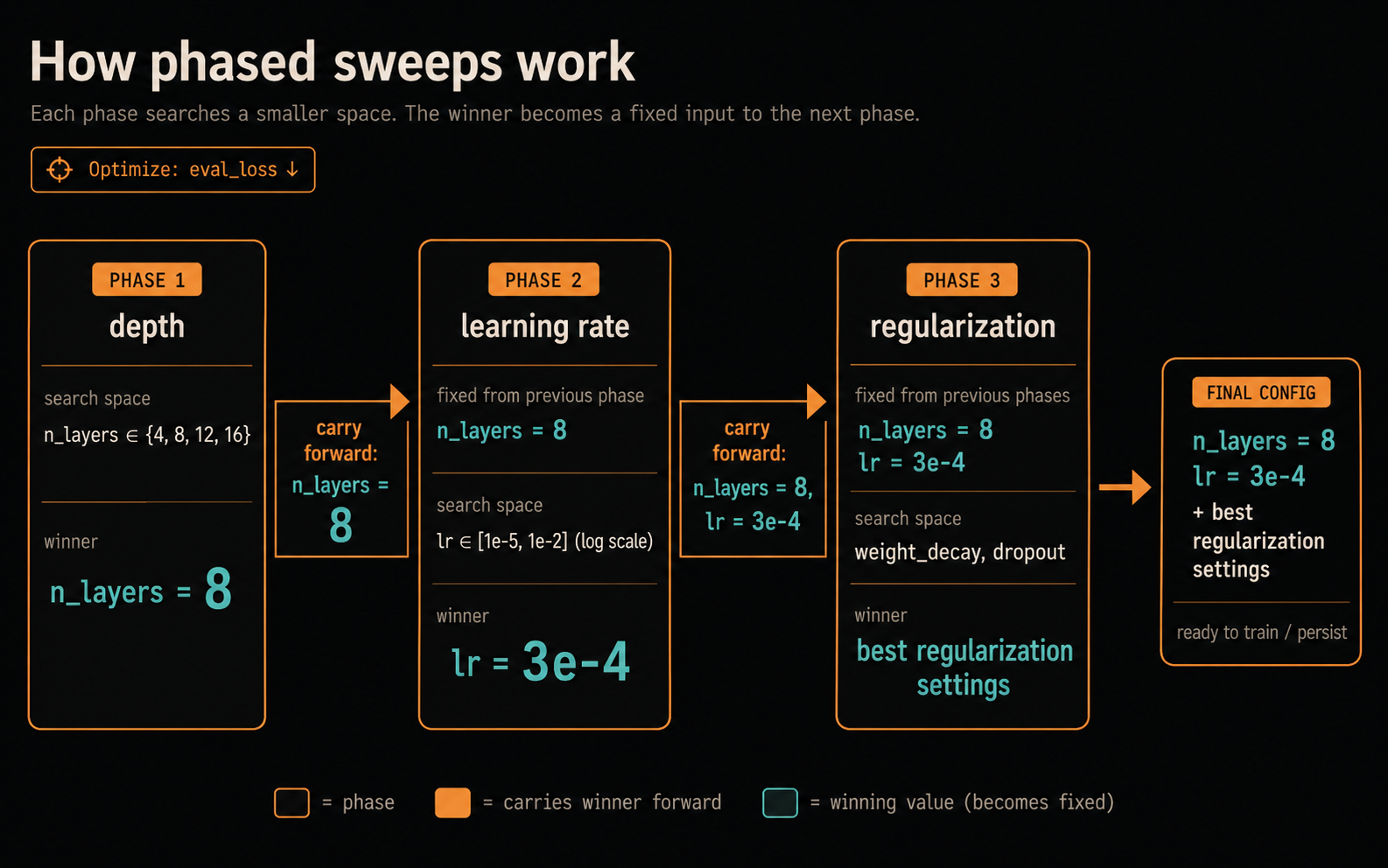
How it works
The starter generated by phasesweep init searches depth before learning rate (abridged; the full file also sets storage, the working directory, and the metric extractor):
experiment: phasesweep_starter

# The trainer receives one complete generated YAML per trial.
trial_command: "python -m phasesweep.examples.fake_train --config {config_path}"

trainer_config:
  model:
    n_layers: 8
    dropout: 0.1
  optimizer:
    lr: 0.0003
    weight_decay: 0.05

metric:
  name: eval_loss
  goal: minimize

phases:
  - name: depth
    n_trials: 2
    sampler: { type: grid }
    search_space:
      model.n_layers: { type: categorical, choices: [6, 8] }

  - name: learning_rate
    inherits: [depth] # the winning model.n_layers is fixed here
    n_trials: 2
    sampler: { type: grid }
    search_space:
      optimizer.lr: { type: categorical, choices: [0.0001, 0.0003] }
The packaged fake trainer uses the optional report_objective(...) envelope helper. Your own trainer can report through W&B, MLflow, ordinary JSON, or logs.
Install and try it
Requirements: Python 3.11+ and a POSIX host for real runs. GPUs are optional.
pip install phasesweep
phasesweep --version

mkdir phasesweep-demo && cd phasesweep-demo
phasesweep init                       # writes the starter experiment.yaml
phasesweep validate experiment.yaml   # checks it without launching anything
phasesweep run experiment.yaml        # four tiny trials, a few seconds
phasesweep init never overwrites an existing file; use -o PATH for another destination.
The run log shows the phase chaining directly (abridged):
[depth/trial_0] python -m phasesweep.examples.fake_train --config .../trainer_config.yaml
[depth/trial_1] python -m phasesweep.examples.fake_train --config .../trainer_config.yaml
phase=depth WINNER trial=0 metric=0.3 params={'model.n_layers': 8}
[learning_rate/trial_0] python -m phasesweep.examples.fake_train --config .../trainer_config.yaml
[learning_rate/trial_1] python -m phasesweep.examples.fake_train --config .../trainer_config.yaml
phase=learning_rate WINNER trial=0 metric=0.3 params={'optimizer.lr': 0.0003}
The depth winner's model.n_layers: 8 is injected into every learning_rate trial's complete YAML. Winners persist in the working directory, so you can inspect them any time (abridged):
phasesweep show-winners experiment.yaml
phase: learning_rate
metric:
  eval_loss: 0.3
  goal: minimize
trial_number: 0
params:
  optimizer.lr: 0.0003
effective_overrides:
  model.n_layers: 8
  optimizer.lr: 0.0003
# ... completion state, fingerprints, objective provenance, and confound
# verdicts on the ranked population follow
Use your own trainer
Choose the input interface your trainer already accepts:
| Input | Command placeholder |
|---|---|
Complete base-plus-overrides YAML (yaml_file, default) |
--config {config_path} |
Command-line flags (argparse) |
{overrides} produces --key=value |
Native Hydra overrides (hydra) |
{overrides} produces key=value |
Nested overrides-only JSON (json_file) |
--overrides {overrides_path} |
For ordinary JSON output, pass an output path under {trial_dir} to your trainer and select it with extractor: {type: json, path: result.json, key: eval.loss}. For W&B, use extractor: {type: wandb, entity: YOUR_ENTITY, project: YOUR_PROJECT, metric_key: eval/loss}, have the trainer honor the supplied W&B identity, and install the extra:
pip install "phasesweep[wandb]"
For native MLflow metrics, install phasesweep[mlflow], configure an existing experiment in the mlflow block, and use extractor: {type: mlflow, metric_key: eval/loss, select: last}. See the MLflow guide for both run ownership modes, a complete CPU example, Databricks setup, and retrying result uploads.
Connect an agent
The optional MCP server connects an AI agent to experiments you have approved without exposing config or storage paths, trainer commands, environment values, or raw logs. Sampled winner values follow the catalog's visible_params policy. Follow the MCP setup to install the extra, review the catalog authority boundary, configure a client-owned connection, and verify the result.
Reference
- Configuration guide: Experiment YAML, search spaces, inheritance, gates, and objective extractors.
- Configuration reference: per-key types, defaults, valid values, interactions, and lifecycle warnings.
- Minimal starting configuration: one local toy-trainer attempt; validate or run it from the checkout root.
- Runtime behavior: filesystem layout, locks, GPU leases, process supervision, fingerprints, and resume.
- MCP setup: installed-package agent onboarding and client-owned setup.
- MCP operator reference: catalog fields, tools, authorization, run state, and recovery.
- Toy experiment and MCP catalog: a checkout-local CLI example backed by the packaged fake trainer, plus an MCP catalog whose detached-run state and experiment outputs use absolute scratch paths under
/tmp. - Tiny Decoder Enwik8 example: real-trainer integration.
- Durability invariants: the ordering rules the ledger, publication, and recovery paths must hold, and the test that owns each one.
- Development: source checkout, contributor setup, and quality gates.

License
MIT. See LICENSE.
1 maintainer

Metadata
1 maintainer
Release files for phasesweep 0.3.7
For a detailed explanation of source distributions (sdists) and built distributions (wheels), please see the package formats documentation.
Source distribution (sdist)
| File | Size | Uploaded | |
|---|---|---|---|
| phasesweep-0.3.7.tar.gz | 2.4 MB | Details |
Built distribution (wheel)
| File | Interpreter | ABI | Platform | Reset |
|---|---|---|---|---|
| phasesweep-0.3.7-py3-none-any.whl | Python 3 | none | any | Details |
Total release size: 2.8 MB
Release files / phasesweep-0.3.7.tar.gz
| Download URL | phasesweep-0.3.7.tar.gz |
|---|---|
| Size | 2.4 MB |
| Tags | Source |
|
SHA-256 checksum How to use checksums |
8a22483c4743b1e65cadb73ec40a5ca083e092d0f115d393f278c2dc727a1052
|
|
BLAKE2b-256 checksum How to use checksums |
a09aab4ec907e04e26c8ec5f7093c4b32093de2351dd9caa2a4b140330d1f264
|
| Upload date | |
|
Uploaded using Trusted Publishing? What is trusted publishing? |
Yes |
| Uploaded via |
twine/6.1.0 CPython/3.13.13
|
Provenance
Provenance describes where a file came from. On PyPI, provenance is shared via attestations, which provide a verifiable record of the build or publishing details. View details, limitations and caveats.


PyPI Publish Attestation
PyPI verified that this artifact, at this checksum, originated from the publisher listed below.
Signed by GitHub Actions, verified by PyPI on Oct 12, 2026.
Transparency logRelease files / phasesweep-0.3.7-py3-none-any.whl
| Download URL | phasesweep-0.3.7-py3-none-any.whl |
|---|---|
| Size | 475.9 kB |
| Tags | Python 3 |
|
SHA-256 checksum How to use checksums |
ecbadb85057db00f3ea8fbfe959d835e9c127da85162613fc9cc930d45450c2a
|
|
BLAKE2b-256 checksum How to use checksums |
0e03d2e30d04d32d3d99ea40ed7dde5e2be8981021414b5acde0652e36338aa5
|
| Upload date | |
|
Uploaded using Trusted Publishing? What is trusted publishing? |
Yes |
| Uploaded via |
twine/6.1.0 CPython/3.13.13
|
Provenance
Provenance describes where a file came from. On PyPI, provenance is shared via attestations, which provide a verifiable record of the build or publishing details. View details, limitations and caveats.
PyPI Publish Attestation
PyPI verified that this artifact, at this checksum, originated from the publisher listed below.
Signed by GitHub Actions, verified by PyPI on Oct 12, 2026.
Transparency log













