
A True Random Number Generator using raw camera sensor data.

Project description
photorand

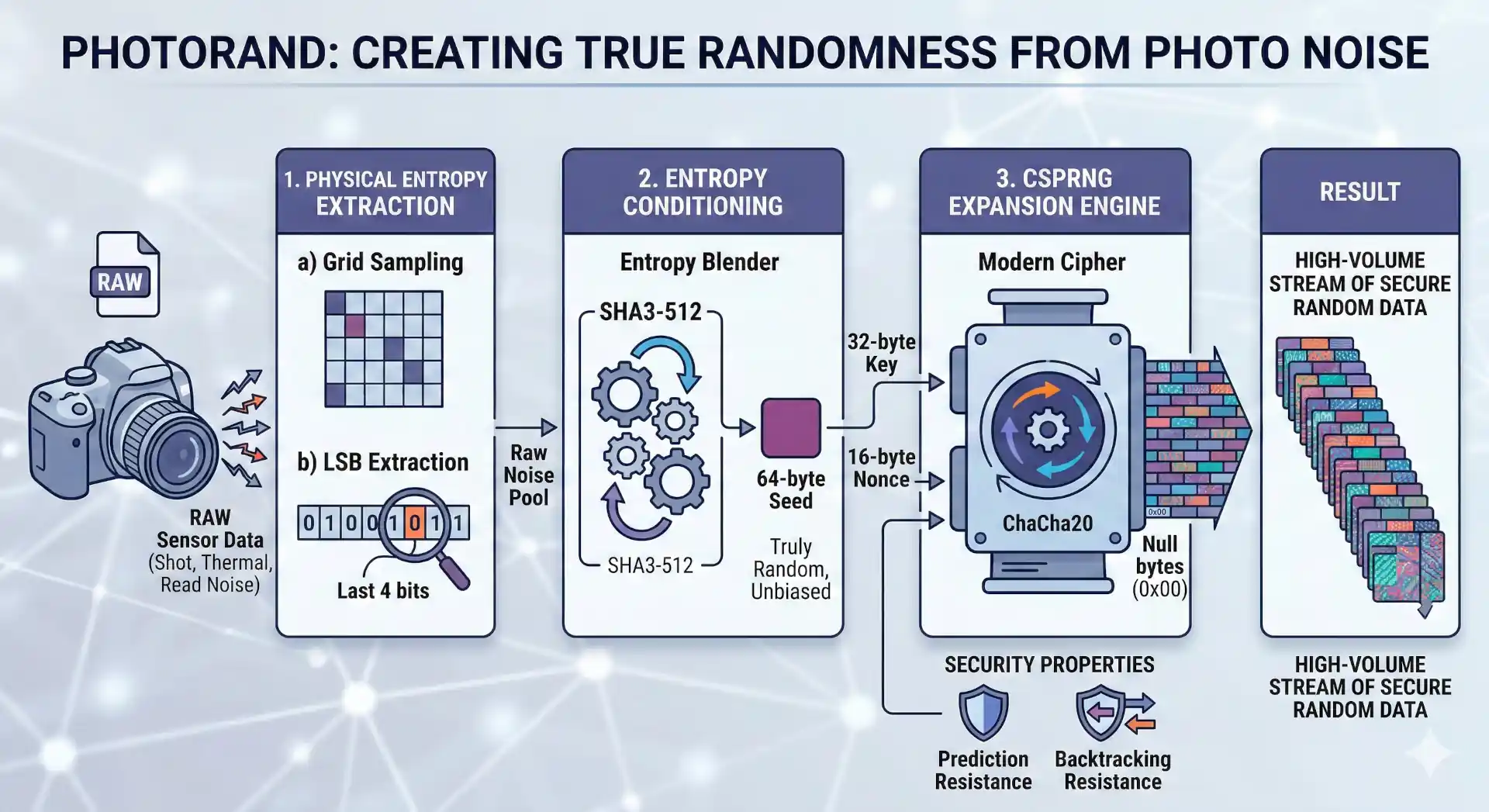
A True Random Number Generator (TRNG) using raw camera sensor data to extract physical entropy.
Project Structure
src/photorand/- Main package source code.low_level/- Modular primitives (ingest, sample, hash, csprng).high_level/- Clean OO abstractions (PhotoRandSeed,PhotoRandEngine).cli/- Command-line interface logic.
docs/- Technical and scientific documentation detailing the entropy extraction and entropy expansion mechanisms.tests/- Comprehensive test suite organized by architectural layer.examples/- Code samples, useful scripts
Installation
This project is available on PyPI:
pip install photorand
From Source (Development)
This project uses pyproject.toml for managing dependencies.
-
Create and activate a virtual environment (recommended):
python -m venv .venv
source .venv/bin/activate  # On Windows, use `.venv\Scripts\activate`
-
Install the project in editable mode:
pip install -e .
# or this one for also installing the dev tools
pip install -e ".[dev]"
Note: you can use photorand from the cli using python -m photorand instead of just photorand
1. High-Level Classes (Recommended)
The high-level classes provide a stateful and convenient interface for both TRNG and CSPRNG operations.
PhotoRandSeed (TRNG)
Encapsulates the process of extracting entropy from a RAW image. It is perfect for generating one-off secure seeds, keys, or dice rolls directly from physical noise.
from photorand import PhotoRandSeed

# 1. Extract entropy from a RAW image
seed = PhotoRandSeed("path/to/image.raw")

# 2. Access as bytes, hex, or large integer
print(seed.to_hex_string())
print(seed.to_int())

# 3. Roll a D100 using physical entropy (Rejection Sampling)
luck = seed.to_int_range(1, 100)

# 4. Get a float in range
prob = seed.to_float_range(0.5, 1.5)
PhotoRandEngine (CSPRNG)
An infinite stream generator powered by ChaCha20, seeded by a PhotoRandSeed. It handles salting (Time + PID) automatically to ensure that even consecutive runs with the same image produce unique streams.
from photorand import PhotoRandEngine

# 1. Initialize from image or existing Seed object
engine = PhotoRandEngine("path/to/image.raw")

# 2. Pull arbitrary amounts of secure data
key = engine.next_bytes(32)
pin = engine.next_string(length=6, charset='numeric')
dice = engine.next_int_range(1, 20)
float_luck = engine.next_float_range(10.5, 20.5)
coin_flip = engine.next_bool()
probability = engine.next_float()

# 3. Batch generation
multiple_passwords = engine.generate_batch(engine.next_string, count=5, length=16)
CLI (Command Line Interface)
The package includes a powerful CLI to use these classes directly from your terminal.
# Extract 64-byte photorand seed (hex)
photorand extract hex --from path/to/raw_image.ARW

# Roll a D20
photorand extract int-range --from path/to/raw_image.ARW --min 1 --max 20

# Extract a float in range (e.g. -1.0 to 1.0)
photorand extract float-range --from path/to/raw_image.ARW --min -1.0 --max 1.0

# Generate 5 random 16-char alphanumeric passwords
photorand generate string --from path/to/raw_image.ARW -n 5 -l 16 --charset alpha

# Extract a floating point number between 0 and 1
photorand extract float --from path/to/raw_image.ARW

# Generate 10 boolean values
photorand generate bool --from path/to/raw_image.ARW -n 10

# Generate 5 floats in a specific range
photorand generate float-range --from path/to/raw_image.ARW --min 0.5 --max 1.5 -n 5
For more details, run: photorand --help
2. Low-Level Modular Functions
For maximum control or research, you can use the modular primitives directly.
from photorand.low_level import ingest_raw_image
from photorand.low_level import sample_entropy_grid
from photorand.low_level import hash_entropy_pool

# 1. Ingest raw sensor data
raw_data = ingest_raw_image("path/to/image.raw")

# 2. Extract raw LSB bits
entropy_pool = sample_entropy_grid(raw_data)

# 3. Condition entropy into uniform bytes
seed_bytes = hash_entropy_pool(entropy_pool)
Alternatively, use the functional pipeline. It accepts custom functions for each part of the algorithm (ingest_fn, sample_fn and hash_fn) although we already provide the values as default parameters:
from photorand.low_level import generate_true_random_number
seed = generate_true_random_number("path/to/image.raw") # returns bytes
Development
Running the Tests
python -m pytest -v --log-cli-level=INFO
# or just this one to skip logs
pytest
Formatting
ruff check --fix src tests examples
Resources
- Blog Post: Physical Entropy with PhotoRand
- PyPI Package: photorand on PyPI
Release history Release notifications | RSS feed


Download files
Download the file for your platform. If you're not sure which to choose, learn more about installing packages.
Source Distribution
Built Distribution
Filter files by name, interpreter, ABI, and platform.
If you're not sure about the file name format, learn more about wheel file names.
Copy a direct link to the current filters
File details
Details for the file photorand-1.1.0.tar.gz.
File metadata
- Download URL: photorand-1.1.0.tar.gz
- Upload date:
- Size: 24.1 kB
- Tags: Source
- Uploaded using Trusted Publishing? No
- Uploaded via: twine/6.2.0 CPython/3.14.2
File hashes
| Algorithm | Hash digest | |
|---|---|---|
| SHA256 |
2493027efa1416003ca4151f4f865be2281307a12aa3cd8a419c6c649d5aeb20
|
|
| MD5 |
f4c7cc266300a937970ffdcce3eec9b7
|
|
| BLAKE2b-256 |
442ad42cd472e8e57da16fd454d689dcbf1d11fdf1b9f167822e474b15b36312
|
File details
Details for the file photorand-1.1.0-py3-none-any.whl.
File metadata
- Download URL: photorand-1.1.0-py3-none-any.whl
- Upload date:
- Size: 17.5 kB
- Tags: Python 3
- Uploaded using Trusted Publishing? No
- Uploaded via: twine/6.2.0 CPython/3.14.2
File hashes
| Algorithm | Hash digest | |
|---|---|---|
| SHA256 |
28eb138443a4e6aaba70e9895cb19e7b5955a8c5a9a08ef6af1a05fc0c57fffa
|
|
| MD5 |
75c620e25793f7fecac6e55ab155e2cd
|
|
| BLAKE2b-256 |
4efae932e66f99df4b137e516bf052c2c363d10878b05ff43978a6274acf804f
|






