
pi-oplsda: pi-OPLS-DA



pi-oplsda bridges the rigorous algorithmic foundation of the R package ropls with the modern Python data science ecosystem. It provides native Pandas support, parallel permutation testing, scikit-learn style estimator methods, ropls-compatible statistical reporting, and publication-ready visualizations in one lightweight package.
Core Capabilities
- ropls-compatible computation: Reproduces ropls-style OPLS-DA summaries, including cumulative $R^2X$, $R^2Y$, $Q^2$, RMSEE, VIP scores, predictive scores/loadings, and orthogonal scores.
- Automatic orthogonal component selection: Set
n_ortho="auto"to select the number of orthogonal components with ropls-style rules. - Two compatibility modes: Use
compatibility="ropls"for R comparison and visualization consistency, orcompatibility="sklearn"for fold-local preprocessing and modern Python ML conventions. - Scikit-learn style API:
fit,predict,decision_function,transform,fit_transform, andscoreare available onOPLSDA. - Pandas native:
pandas.DataFrameinputs preserve sample IDs and feature names in exported result tables. - Multi-core acceleration: Permutation tests are parallelized with
jobliband reported withtqdm. - Publication-ready graphics:
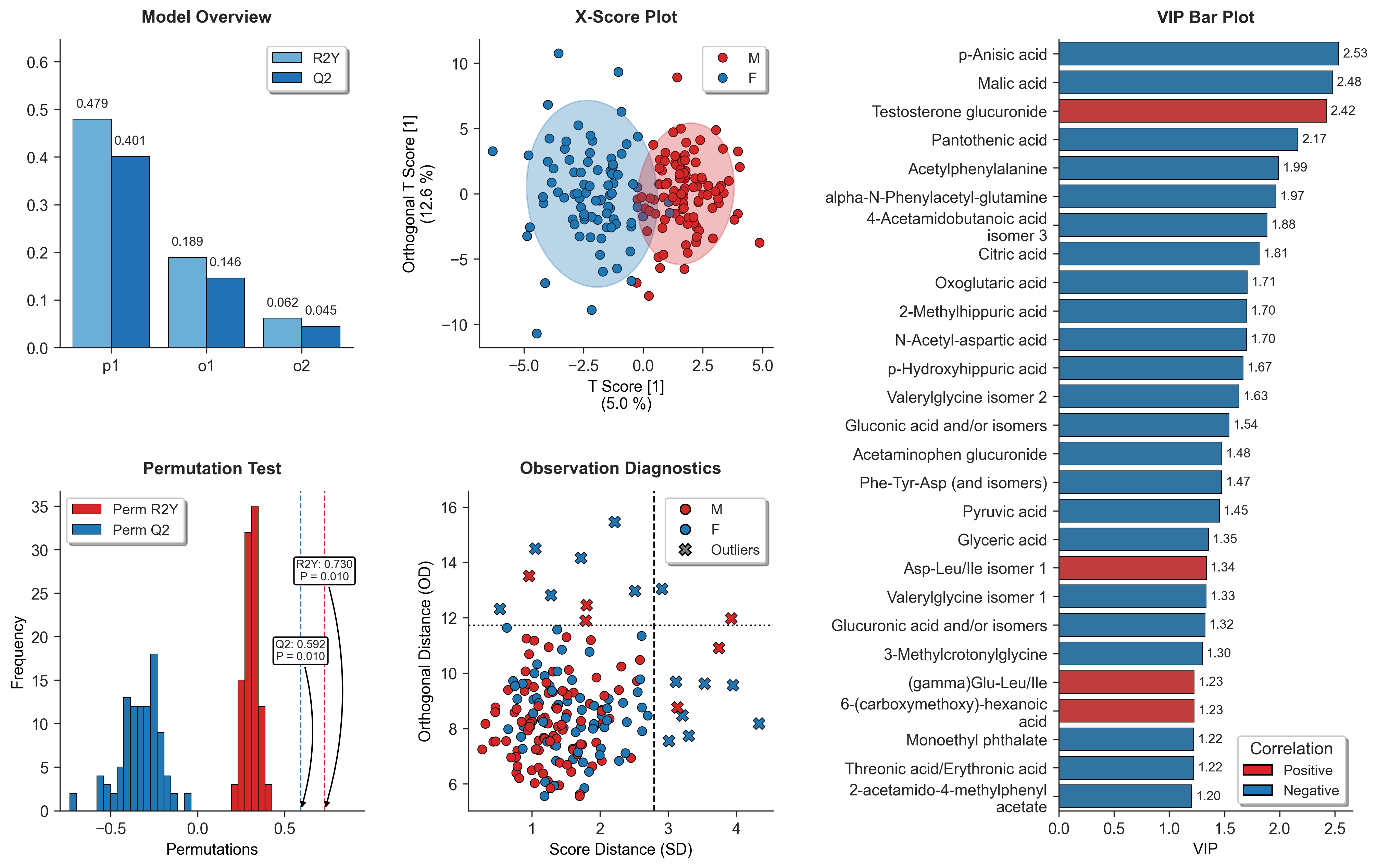
OPLSDA_Visualizergenerates diagnostic plots for model summary, scores, outliers, permutation tests, VIP rankings, and S-plot style feature statistics. - Structured export: Model metadata, component summaries, sample scores, and feature statistics are available as DataFrames.
Note: Due to the nature of latent-variable models, scores and loadings may be flipped in sign between platforms. This is mathematically equivalent and does not affect interpretation.
Installation
Install from PyPI:
pip install pi-oplsda
Install from GitHub:
pip install git+https://github.com/KaikunXu/pi-oplsda.git
Install from source for development:
git clone https://github.com/KaikunXu/pi-oplsda.git
cd pi-oplsda
pip install -e ".[dev]"
For benchmark/testing against R ropls, install the Python-side optional dependencies:
pip install -e ".[test]"
The R package ropls should be installed in your regular R installation. It is not bundled with this Python package.
Quickstart & Tutorials
Interactive examples are provided in the examples directory:
- Quickstart Tutorial: ropls-compatible workflow with automatic orthogonal component selection.
- R-ropls Equivalence Benchmark: numerical comparison between Python and R implementations.
- Terminal Tutorial: a script-oriented workflow.
Minimal ropls-compatible usage:
from piopls import OPLSDA, load_sacurine

X, y, feature_names, sample_names = load_sacurine()

model = OPLSDA(
    n_ortho="auto",
    max_ortho=10,
    cv_folds=7,
    compatibility="ropls",
    random_state=42,
)

model.fit_pipeline(X, y, run_permutations=False)

print(model.n_ortho_)
print(model.get_model_info_df())
print(model.get_summary_df())
For a scikit-learn style workflow, use the default compatibility="sklearn" or set it explicitly:
model = OPLSDA(n_ortho=1, compatibility="sklearn", random_state=42)
model.fit(X, y)

y_pred = model.predict(X)
y_score = model.decision_function(X)
accuracy = model.score(X, y)
Visualization
Running OPLSDA_Visualizer generates a suite of diagnostic subplots:
- Model Overview: Step-wise and cumulative model quality metrics.
- X-Score Plot: Sample clustering in predictive and orthogonal latent spaces with confidence ellipses.
- Observation Diagnostics: Score distance and orthogonal distance / DModX for outlier inspection.
- Permutation Test: Original $R^2Y$ and $Q^2$ against permuted null distributions.
- VIP Bar Plot: Top features contributing to group separation.
- S-Plot: Feature covariance and correlation diagnostics for binary models.
from piopls import OPLSDA_Visualizer

vis = OPLSDA_Visualizer(
    model=model,
    y=y,
    feature_names=feature_names,
    sample_names=sample_names,
    vip_threshold=1.0,
    top_n_vip=20,
)

vis.plot_all()
Mathematical Equivalence & Benchmarking
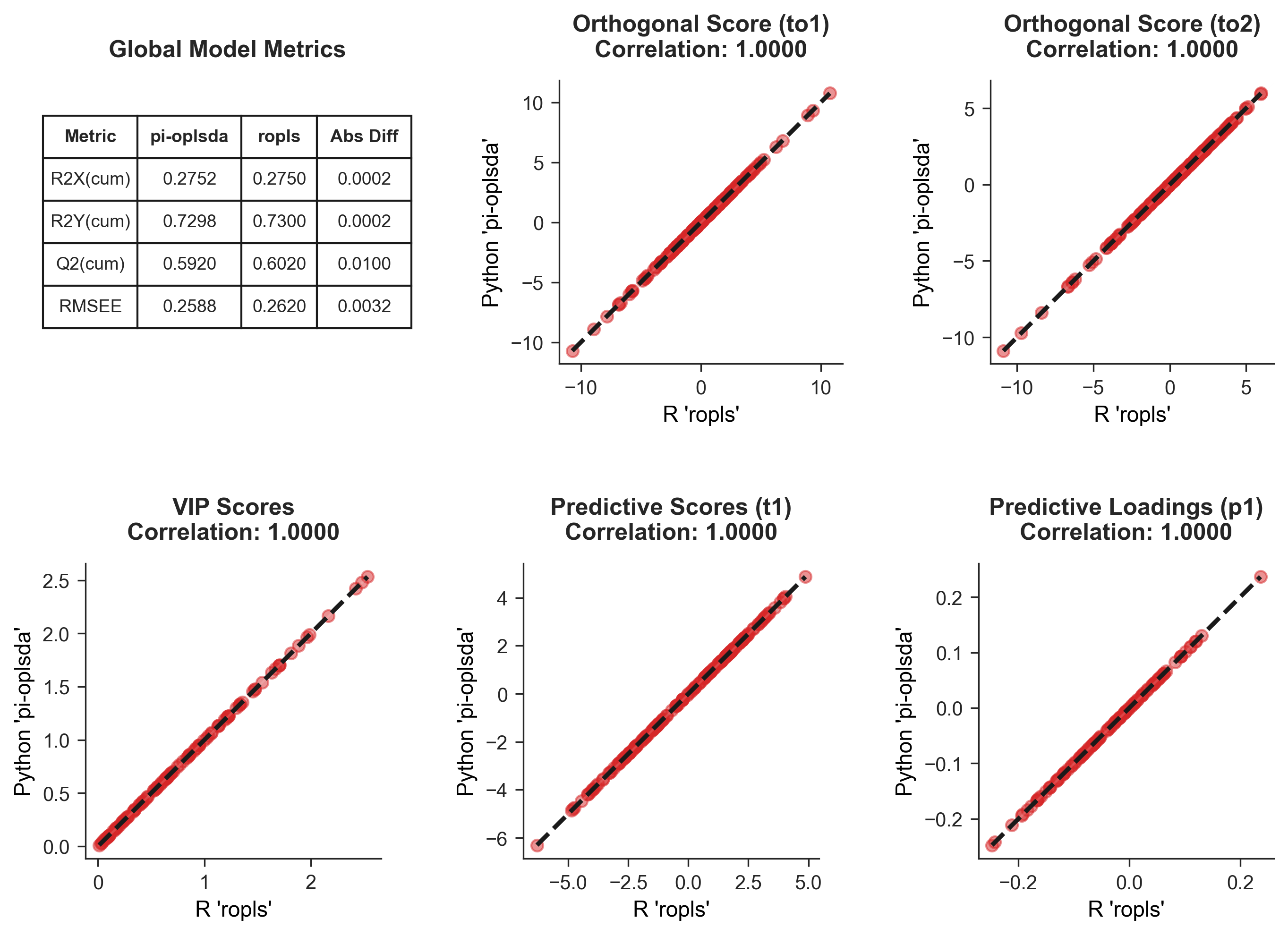
pi-oplsda is validated against the R/Bioconductor package ropls to ensure scientific consistency. The benchmark uses the Sacurine human urine metabolomics dataset with 183 samples and 109 metabolites.
The current benchmark aligns the two implementations as follows:
- Python:
OPLSDA(n_ortho="auto", compatibility="ropls") - R:
ropls::opls(..., predI = 1, orthoI = NA, crossvalI = 7)
Both implementations select two orthogonal components on the Sacurine dataset.
| Metric | Description | Comparison |
|---|---|---|
| Global Quality | Cumulative $R^2X$, $R^2Y$, and $Q^2$ | Approximately equal |
| Error Assessment | Root Mean Square Error of Estimation (RMSEE) | Approximately equal |
| Latent Space | Predictive scores, predictive loadings, and orthogonal scores | Pearson's r ~= 1 |
| Variable Importance | Variable Importance in Projection (VIP) scores | Pearson's r ~= 1 |
The benchmark figure summarizes global metrics and five vector-level comparisons: predictive scores (t1), predictive loadings (p1), VIP scores, and two orthogonal score vectors (to1, to2).
Testing
Run the test suite with:
pytest tests
The R benchmark test uses rpy2 and skips cleanly when a standalone R installation or the R package ropls is unavailable. On Windows, the benchmark setup expects a regular R installation such as D:/R/R-4.5.2.
Changelog
Release notes are maintained separately in CHANGELOG.md.
Acknowledgements
The algorithmic foundation of pi-oplsda is inspired by the excellent R package ropls.
Contributing
Contributions, issues, and feature requests are welcome. Feel free to check the issues page.
License
This project is licensed under the MIT License.
1 maintainer

Metadata
1 maintainer
Release files for pi-oplsda 1.1.0
For a detailed explanation of source distributions (sdists) and built distributions (wheels), please see the package formats documentation.
Source distribution (sdist)
| File | Size | Uploaded | |
|---|---|---|---|
| pi_oplsda-1.1.0.tar.gz | 135.1 kB | Details |
Built distribution (wheel)
| File | Interpreter | ABI | Platform | Reset |
|---|---|---|---|---|
| pi_oplsda-1.1.0-py3-none-any.whl | Python 3 | none | any | Details |
Total release size: 266.1 kB
Release files / pi_oplsda-1.1.0.tar.gz
| Download URL | pi_oplsda-1.1.0.tar.gz |
|---|---|
| Size | 135.1 kB |
| Tags | Source |
|
SHA-256 checksum How to use checksums |
84af69300c9e8a92e88fca82c4e7b7879f40d63e263ffab91335338a8beb2e9f
|
|
BLAKE2b-256 checksum How to use checksums |
a1371ca211ab3b473ebe4e8330778ff00cd9fc4e6a0d7acabc3b81c2c7c13f32
|
| Upload date | |
|
Uploaded using Trusted Publishing? What is trusted publishing? |
Yes |
| Uploaded via |
twine/6.1.0 CPython/3.13.12
|
Provenance
Provenance describes where a file came from. On PyPI, provenance is shared via attestations, which provide a verifiable record of the build or publishing details. View details, limitations and caveats.


PyPI Publish Attestation
PyPI verified that this artifact, at this checksum, originated from the publisher listed below.
Signed by GitHub Actions, verified by PyPI on Jul 2, 2026.
Transparency logRelease files / pi_oplsda-1.1.0-py3-none-any.whl
| Download URL | pi_oplsda-1.1.0-py3-none-any.whl |
|---|---|
| Size | 130.9 kB |
| Tags | Python 3 |
|
SHA-256 checksum How to use checksums |
40d374cc93c333b7305206a165119a034b7147459e858fc2d1e456b8f280acc3
|
|
BLAKE2b-256 checksum How to use checksums |
74fd67599b40a46903865e123a4a55d7bf53084e45c4b614c9091278c14ae694
|
| Upload date | |
|
Uploaded using Trusted Publishing? What is trusted publishing? |
Yes |
| Uploaded via |
twine/6.1.0 CPython/3.13.12
|
Provenance
Provenance describes where a file came from. On PyPI, provenance is shared via attestations, which provide a verifiable record of the build or publishing details. View details, limitations and caveats.
PyPI Publish Attestation
PyPI verified that this artifact, at this checksum, originated from the publisher listed below.
Signed by GitHub Actions, verified by PyPI on Jul 2, 2026.
Transparency log













