

PIEC — Python Integrated Experimental Control




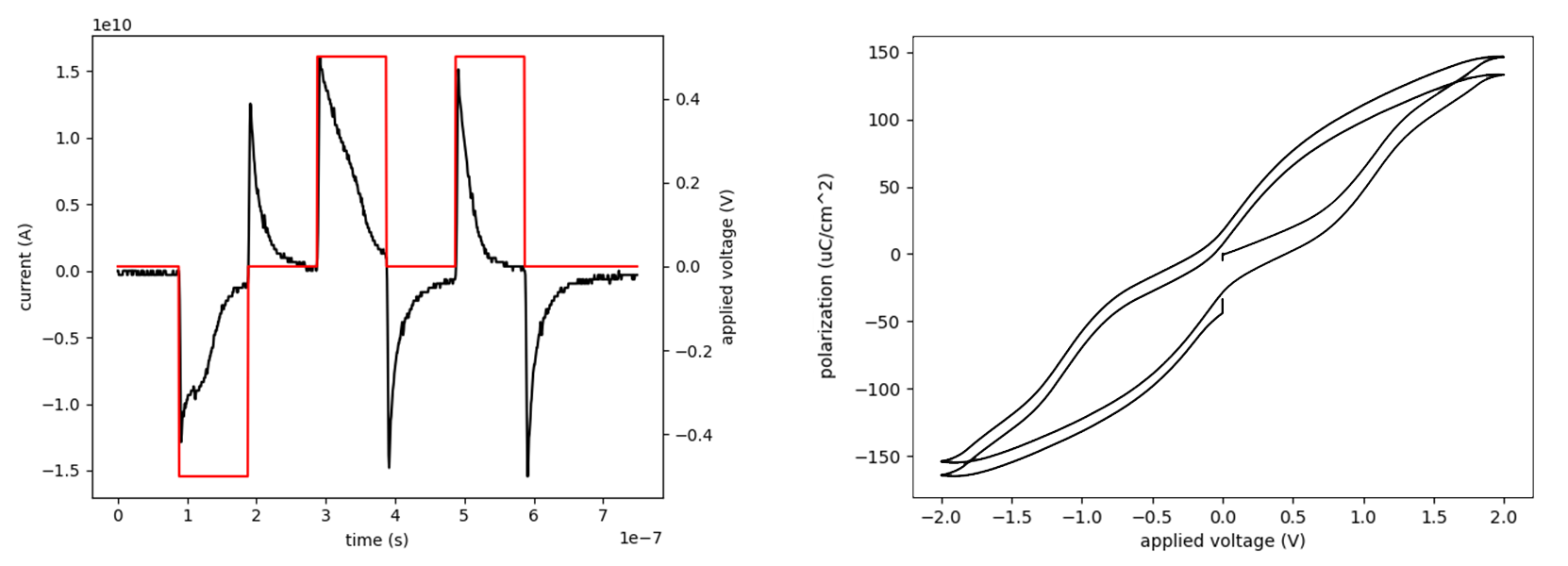
PIEC is an open-source Python library that provides infrastructure for laboratory experiment design and operation through a standardized, hierarchical, object-oriented framework. Originally developed at Brown University as a fork of the ferroelectric testing-focused EKPY Python suite, PIEC is designed to be extended to any experimental domain that requires programmable instrument control.
Installation
PIEC requires Python 3.9 or higher:
pip install piec
Quickstart GUI (No Coding Required)
Run the desktop quickstart app to generate and capture waveforms with an interactive graphical interface:
python Measurements/Quickstart/quick_start_local_GUI.py
- Works out of the box in Virtual simulation mode (no hardware required).
- Connect physical instruments with dropdown selection or Autodetect.
- Configure sine, square, or ramp waveforms and view live scope captures.
- Optionally save captured traces directly to CSV.
Prefer running in your browser? Launch the interactive notebook on Binder.
Quickstart in Python
Run a complete ferroelectric hysteresis measurement using virtual instruments:
from piec.drivers.awg.k_81150a import Keysight81150a
from piec.drivers.oscilloscope.k_dsox3024a import KeysightDSOX3024a
from piec.measurement.discrete_waveform import HysteresisLoop

# Connect in virtual simulation mode
awg = Keysight81150a("VIRTUAL")
osc = KeysightDSOX3024a("VIRTUAL")

# Configure, capture, analyze, and display plots
experiment = HysteresisLoop(awg, osc, save_dir=".", show_plots=True)
experiment.run_experiment()
To run on hardware, pass your instrument's VISA address instead of "VIRTUAL", or use autodetection:
from piec.drivers.autodetect import autodetect

awg   = autodetect('awg')
scope = autodetect('scope')
For complete driver documentation and advanced measurement workflows, see the User Guide.
Supported Instruments
| Category | Models |
|---|---|
| Arbitrary Waveform Generator | Keysight 81150A, Agilent 33220A, Agilent 33500, Siglent SDG2000X |
| Oscilloscope | Keysight DSOX3024A, Agilent DSOX5000, Rigol DS1000Z, Tektronix TDS2000, Tektronix TDS6604, LeCroy SDA6020 |
| Source Meter | Keithley 2400 |
| Lock-in Amplifier | Stanford Research SR830 |
| Digital Multimeter | Agilent 34410A, Keithley 2000, Keithley 193A |
| Pulser | Berkeley Nucleonics BNC 765 |
| DAQ | MCC USB-231, MCC USB-1208HS |
| DC Calibrator | EDC 522 |
| Stepper Motor | Arduino Stepper (custom serial) |
Contributing
New drivers can be added by implementing a driver subclass alongside its Virtual Instrument, following the Driver Development Guide. New experiment types require implementing a Measurement subclass without modifying existing code.
For general guidelines, see the Contributing Guide.
Support
Issues, bug reports, and feature requests: Issue Tracker
Maintainer: Geo Fratian — geo_fratian@brown.edu
Citation
Please cite this software following the CITATION.cff.
Fratian, G., Qualls, A., Phan, J., Pankaj, R., & Caretta, L. (2026).
PIEC: A Python library for Integrated Experimental Control [Software].
https://github.com/TransluSci/piec
1 maintainer

Metadata
1 maintainer
Release files for piec 1.0.4
For a detailed explanation of source distributions (sdists) and built distributions (wheels), please see the package formats documentation.
Source distribution (sdist)
| File | Size | Uploaded | Provenance | Actions |
|---|---|---|---|---|
| piec-1.0.4.tar.gz | 158.2 kB | Without provenance | Details for piec-1.0.4.tar.gz |
Built distribution (wheel)
| File | Interpreter | ABI | Platform | Actions Reset |
|---|---|---|---|---|
| piec-1.0.4-py3-none-any.whl | Python 3 | none | any | Details for piec-1.0.4-py3-none-any.whl |
Total release size: 341.0 kB
Release files / piec-1.0.4.tar.gz
| Download URL | piec-1.0.4.tar.gz |
|---|---|
| Size | 158.2 kB |
| Tags | Source |
|
SHA-256 checksum How to use checksums |
6285695c3b07bfedb6b63adf96820089ac6a582c845761126e4deb5f7eff46d7
|
|
BLAKE2b-256 checksum How to use checksums |
c155ef8e46ab1e4ad3859c1707e70bd3684c5ccd6ed4e193de90633d14f3e0a8
|
| Upload date | |
|
Uploaded using Trusted Publishing? What is trusted publishing? |
No |
| Uploaded via |
twine/6.1.0 CPython/3.13.2
|
Release files / piec-1.0.4-py3-none-any.whl
| Download URL | piec-1.0.4-py3-none-any.whl |
|---|---|
| Size | 182.8 kB |
| Tags | Python 3 |
|
SHA-256 checksum How to use checksums |
c92fb656516fe527278d147dafcb49cf9e553ba2a3e9ea9d99fc39ec04e5fbb3
|
|
BLAKE2b-256 checksum How to use checksums |
cd355f96e1186bec59cb8aa6687502b3e6e26ae774277730b01b2df253b92045
|
| Upload date | |
|
Uploaded using Trusted Publishing? What is trusted publishing? |
No |
| Uploaded via |
twine/6.1.0 CPython/3.13.2
|
Security for piec 1.0.4
Provenance
Provenance describes where a file came from. On PyPI, provenance is shared via attestations, which provide a verifiable record of the build or publishing details. View details, limitations and caveats.
No provenance found
None of the files in this release were uploaded with provenance metadata.
A note on package security
PyPI is a repository for distributing packages, not a service for auditing them. While third-party security researchers and our staff do their best to detect and remove malicious packages, PyPI cannot guarantee the quality, security or suitability of any given package.
To learn more about protecting yourself from malicious actors, visit our package security documentation.














