

PILOT: Policy-Informed Learned Optimization for Adaptive Deep Network Training





Project Page | Paper | PyPI
PILOT is an online adaptive optimizer that adjusts its update behavior during training. Instead of applying a fixed update rule from the first step to the last, PILOT reads a gradient-direction agreement signal and reshapes the update through a lightweight learned policy — no offline search, no meta-training, no second-order estimation.
Installation
pip install pilot-optimizer
Or install from source
git clone https://github.com/SattamAltwaim/PILOT.git
cd PILOT
pip install -e .
Usage
from pilot import PILOT

optimizer = PILOT(
    model.parameters(),
    lr=1e-3,
    betas=(0.9, 0.999),
    weight_decay=1e-4,
    gamma=0.95,        # smoothing for agreement signal
    eta_phi=0.01,      # policy learning rate
    degree=2           # polynomial degree
)

for batch in dataloader:
    loss = criterion(model(x), y)
    optimizer.zero_grad()
    loss.backward()
    optimizer.step()
Key Results
CNN Architecture
| Dataset | Optimizer | Accuracy (%) ↑ | Val Loss ↓ | Loss Var. ↓ |
|---|---|---|---|---|
| FashionMNIST | Adam | 93.28 | 0.1957 | 0.0033 |
| FashionMNIST | AdamW | 93.22 | 0.1944 | 0.0034 |
| FashionMNIST | Lion | 92.91 | 0.2091 | 0.0041 |
| FashionMNIST | AdaBelief | 93.66 | 0.1822 | 0.0046 |
| FashionMNIST | PILOT (Ours) | 94.13 | 0.1719 | 0.0045 |
| CIFAR-10 | Adam | 79.91 | 0.5794 | 0.0103 |
| CIFAR-10 | Lion | 80.87 | 0.5487 | 0.0105 |
| CIFAR-10 | PILOT (Ours) | 81.94 | 0.5302 | 0.0073 |
ResNet-18 Architecture
| Dataset | Optimizer | Accuracy (%) ↑ | Val Loss ↓ | Loss Var. ↓ |
|---|---|---|---|---|
| FashionMNIST | AdaBelief | 95.33 | 0.1711 | 0.0056 |
| FashionMNIST | PILOT (Ours) | 95.71 | 0.2690 | 0.0030 |
| CIFAR-10 | Adam | 93.18 | 0.2140 | 0.0073 |
| CIFAR-10 | AdamW | 92.90 | 0.2514 | 0.0066 |
| CIFAR-10 | PILOT (Ours) | 93.42 | 0.2496 | 0.0001 |
Full results with all baselines in the paper.
Training Curves
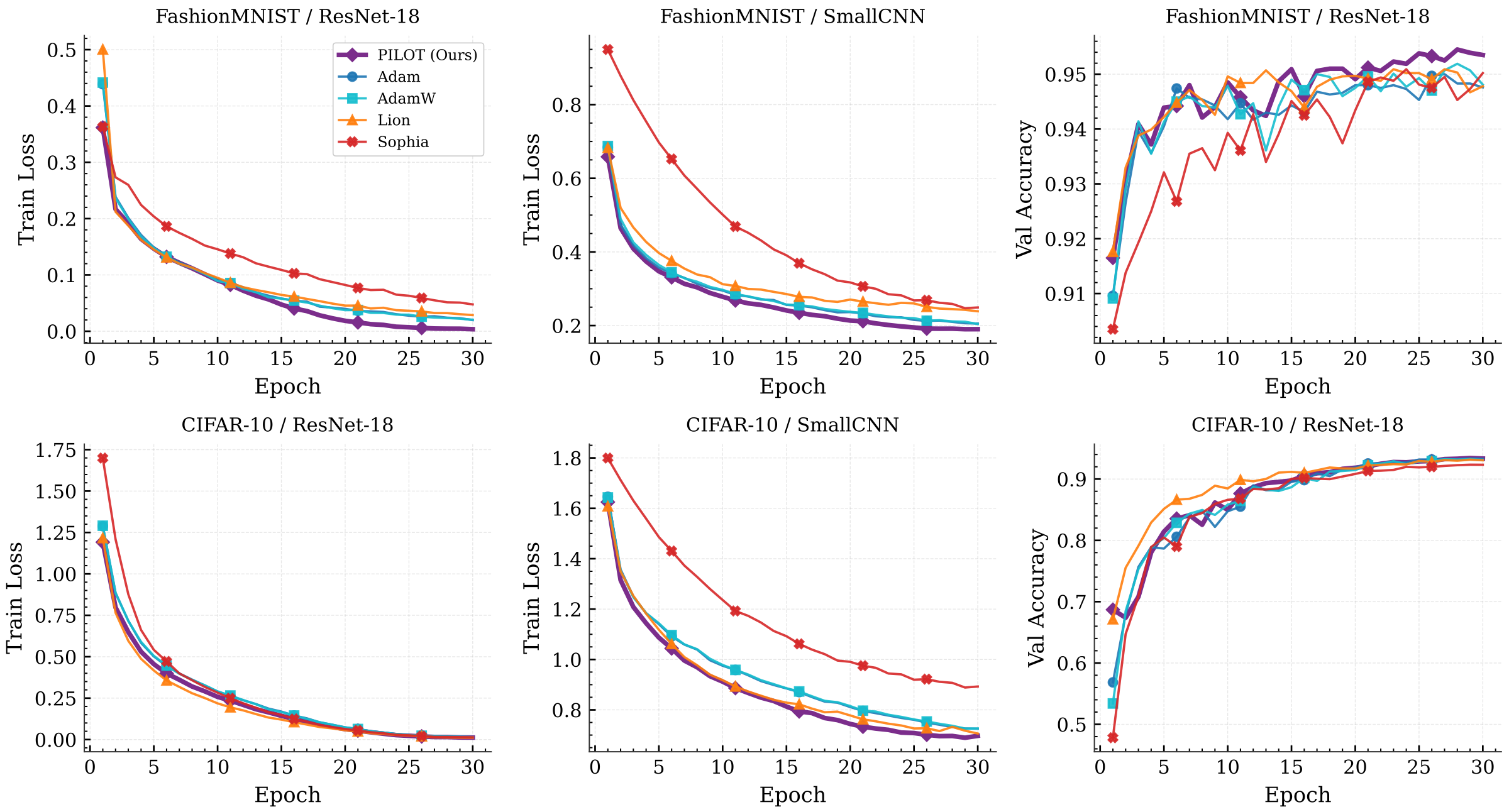
Training loss (left, middle) and validation accuracy (right) across FashionMNIST (top) and CIFAR-10 (bottom) over 30 epochs.
Loss Landscape
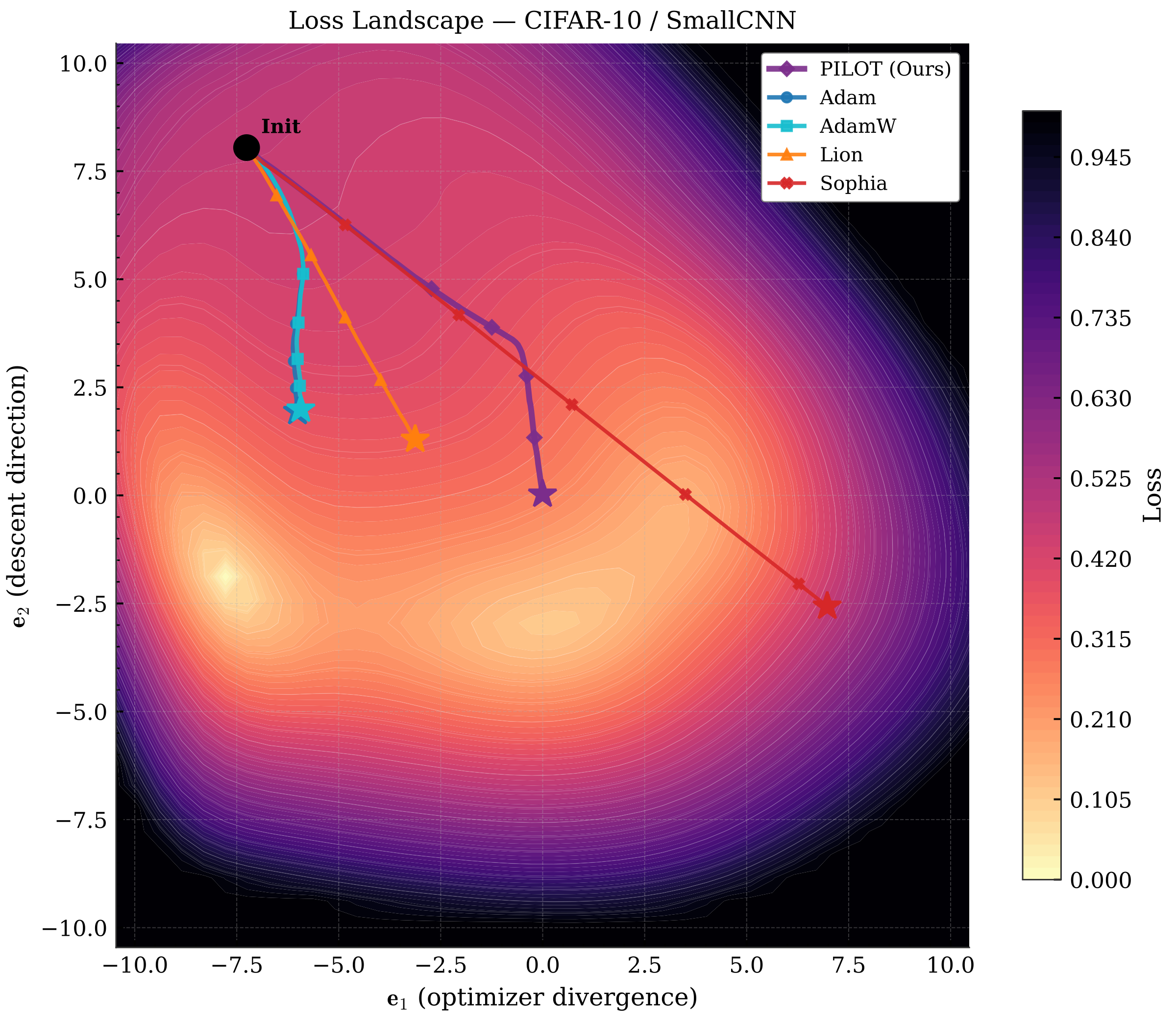
PILOT follows a distinct trajectory through the loss surface and converges to a lower-loss region compared to Adam, AdamW, Lion, and Sophia.
Method
PILOT monitors gradient-direction agreement (cosine similarity between successive gradients, smoothed into a running signal) and feeds it through a learned polynomial to produce three control knobs:
- Momentum reliance — trust the accumulated trend vs. react to the current gradient
- Variance normalization — how aggressively to apply adaptive scaling
- Sign compression — use full gradient magnitudes vs. compress toward ±1
Only 3(d+1) learnable coefficients (9 for degree 2). Initialized so PILOT starts as Adam and learns to deviate. The policy is updated each step via analytic meta-gradients at negligible cost. See the paper for the full derivation.
Hyperparameters
| Parameter | Description | Default / Range |
|---|---|---|
lr |
Learning rate | 1e-3 |
betas |
Moment coefficients | (0.9, 0.999) |
weight_decay |
Decoupled weight decay | 0.01 |
gamma |
Agreement signal smoothing | 0.85–0.99 |
eta_phi |
Policy learning rate | 5e-4–5e-2 |
degree |
Polynomial degree | 1–4 |
Tuned configurations from the paper
| Dataset | Architecture | γ | η_φ | Degree |
|---|---|---|---|---|
| CIFAR-10 | SmallCNN | 0.882 | 0.00312 | 1 |
| CIFAR-10 | ResNet-18 | 0.950 | 0.00500 | 2 |
| FashionMNIST | SmallCNN | 0.950 | 0.01000 | 2 |
| FashionMNIST | ResNet-18 | 0.957 | 0.00273 | 3 |
Selected via Bayesian optimization (TPE + ASHA early stopping, 30–40 trials).
Experiment Setup
30 epochs · cross-entropy loss · cosine annealing LR · batch size 128 · AMP · 3-epoch linear warmup for ResNet-18. Benchmarked on NVIDIA V100 GPUs. See the paper for full details.
Citation
@misc{altuuaim2026pilotpolicyinformedlearnedoptimization,
      title={PILOT: Policy-Informed Learned Optimization for Adaptive Deep Network Training},
      author={Sattam Altuuaim and Lama Ayash and Muhammad Mubashar and Naeemullah Khan},
      year={2026},
      eprint={2605.24570},
      archivePrefix={arXiv},
      primaryClass={cs.LG},
      url={https://arxiv.org/abs/2605.24570},
}
License
1 maintainer

Metadata
1 maintainer
Release files for pilot-optimizer 0.1.0.post3
For a detailed explanation of source distributions (sdists) and built distributions (wheels), please see the package formats documentation.
Source distribution (sdist)
| File | Size | Uploaded | Provenance | Actions |
|---|---|---|---|---|
| pilot_optimizer-0.1.0.post3.tar.gz | 16.0 kB | Without provenance | Details for pilot_optimizer-0.1.0.post3.tar.gz |
Built distribution (wheel)
| File | Interpreter | ABI | Platform | Actions Reset |
|---|---|---|---|---|
| pilot_optimizer-0.1.0.post3-py3-none-any.whl | Python 3 | none | any | Details for pilot_optimizer-0.1.0.post3-py3-none-any.whl |
Total release size: 26.9 kB
Release files / pilot_optimizer-0.1.0.post3.tar.gz
| Download URL | pilot_optimizer-0.1.0.post3.tar.gz |
|---|---|
| Size | 16.0 kB |
| Tags | Source |
|
SHA-256 checksum How to use checksums |
bd9c6a8bcd1b08f490445d14e7f8aed0cb18a126f8c174eac299a7919150ac1d
|
|
BLAKE2b-256 checksum How to use checksums |
70a5ff0d3020b8e3716482cc1bb12e1576d29f4b840f8292382c10fc57cfdcc5
|
| Upload date | |
|
Uploaded using Trusted Publishing? What is trusted publishing? |
No |
| Uploaded via |
twine/6.2.0 CPython/3.13.9
|
Release files / pilot_optimizer-0.1.0.post3-py3-none-any.whl
| Download URL | pilot_optimizer-0.1.0.post3-py3-none-any.whl |
|---|---|
| Size | 10.9 kB |
| Tags | Python 3 |
|
SHA-256 checksum How to use checksums |
c43647d3a0aa15382119ffacbe0da5d4f85b43ca5c3c72ff0efabebeb7f409b1
|
|
BLAKE2b-256 checksum How to use checksums |
0a491545058669e7080fe7c51be5f132fd49fe24ea3a5c47a33d49fef79e6dc2
|
| Upload date | |
|
Uploaded using Trusted Publishing? What is trusted publishing? |
No |
| Uploaded via |
twine/6.2.0 CPython/3.13.9
|
Security for pilot-optimizer 0.1.0.post3
Provenance
Provenance describes where a file came from. On PyPI, provenance is shared via attestations, which provide a verifiable record of the build or publishing details. View details, limitations and caveats.
No provenance found
None of the files in this release were uploaded with provenance metadata.
A note on package security
PyPI is a repository for distributing packages, not a service for auditing them. While third-party security researchers and our staff do their best to detect and remove malicious packages, PyPI cannot guarantee the quality, security or suitability of any given package.
To learn more about protecting yourself from malicious actors, visit our package security documentation.














