
Security scanner for CI/CD pipelines, IaC, and cloud: GitHub Actions, GitLab CI, Terraform, Kubernetes, and more, scored against the OWASP CI/CD Top 10.
Verified details
These details have been verified by PyPIProject links
GitHub Statistics
Maintainers

Project description

Pipeline-Check









Find security risks in your CI/CD pipelines before attackers do.
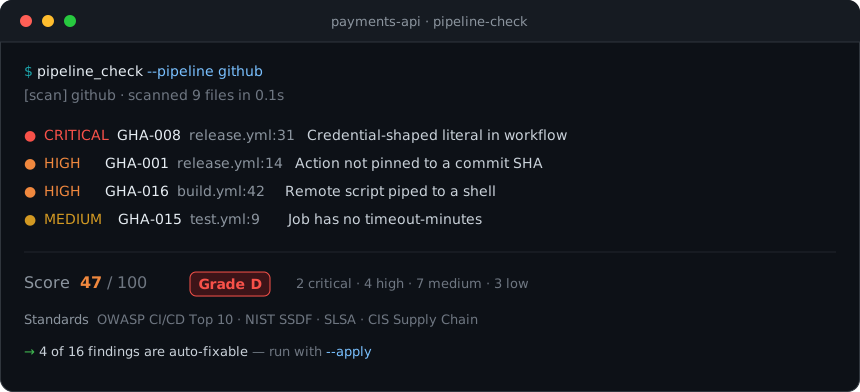
Full documentation: https://dmartinochoa.github.io/pipeline-check/
Pipeline-Check is a security scanner for GitHub Actions, GitLab CI, Jenkins, CircleCI, Azure DevOps, Bitbucket Pipelines, Buildkite, Drone, Tekton, Argo Workflows, and Google Cloud Build, plus Terraform, CloudFormation, Kubernetes, Helm, Dockerfile, OCI image manifests, and live AWS, Azure, and GCP accounts. It maps every finding to the OWASP Top 10 CI/CD Security Risks, SLSA, NIST SSDF, PCI DSS, SOC 2, the CIS GitHub Benchmark, and twelve other frameworks, and scores each scan A through D so you can gate merges on the result.
1180+ checks across 35 providers, mapped to 18 compliance standards, with 111 autofixers, plus 53 attack chains correlating findings into MITRE ATT&CK-mapped kill chains. A dataflow taint engine catches multi-step and cross-job propagation that single-rule scanners miss.
Quick start | Usage guide | Providers | How it works | CI integration | Compliance | vs. Checkov / KICS / Semgrep | Docs
🚀 Quick start
pip install pipeline-check          # Python >= 3.11
                                    # `pipeline-check` and `pipeline_check` both work

pipeline_check                      # auto-detects every provider in cwd
pipeline_check init                 # scan + baseline + tuned config (smart init)
pipeline_check --policy pr-gate     # PR gate: block on new HIGH+ findings
pipeline_check explain GHA-001      # full per-check reference (severity, fix, controls)
pipeline_check -p github -o json    # short flags work too
pipeline_check --pipeline aws       # force the live-AWS scan
pipeline_check --man recipes        # copy-paste recipes for the common workflows
🔐 Want to verify the wheel was built by this repo in CI before installing it? Every tagged release ships SLSA Build L3 provenance and PEP 740 attestations. See Verifying a release.
Or run from the published container image (no Python install needed):
# Docker Hub
docker run --rm -v "$PWD:/scan" dmartinochoa/pipeline-check

# GHCR (same image, different registry)
docker run --rm -v "$PWD:/scan" ghcr.io/dmartinochoa/pipeline-check
The image is multi-arch (linux/amd64 + linux/arm64), ships with
SLSA build provenance and an SBOM attached to the manifest, and is
tagged per release (:1.0.4), per commit (:sha-<short>), and
:latest on master. /scan is the image working directory, so
mounting your repo there lets auto-detect Just Work.
Run pipeline_check with no flags in any supported repo. It walks
the working directory for every supported provider's canonical file
(.github/workflows/, .gitlab-ci.yml, Jenkinsfile,
cloudbuild.yaml, Chart.yaml, template.yml, Dockerfile, …).
One match runs a single-provider scan; two or more matches
automatically switch to multi-provider mode (equivalent to
--pipelines X,Y,Z) so cross-provider attack chains (XPC-NNN)
fire. When nothing matches, the CLI exits with a usage error; pass
--pipeline aws explicitly to scan a live AWS account.
No API tokens required. CI configs are parsed from disk; AWS uses the
standard boto3 credential chain. The GitHub Actions provider can
optionally follow remote reusable-workflow refs over HTTPS via
--resolve-remote (off by default; see docs/providers/github.md
for the full opt-in surface).
PR review comments
Pipe findings into pull-request review comments on the changed lines via the bundled composite action:
on: pull_request
permissions:
  contents: read
  pull-requests: write
jobs:
  scan:
    runs-on: ubuntu-latest
    steps:
      - uses: actions/checkout@v4
      - uses: dmartinochoa/pipeline-check/.github/actions/pipeline-check-pr@v1
        with:
          severity-threshold: MEDIUM
Each finding lands as a review comment on its precise line (when the
rule emits a Location); everything else goes into a single PR-level
summary comment. See .github/actions/pipeline-check-pr/README.md
for inputs, idempotency, and fork-PR fallback behavior.
🧩 Supported providers
| Provider | Input | Auto-detect | Checks |
|---|---|---|---|
| AWS | Live account via boto3 | --region |
71 checks · CodeBuild, CodePipeline, CodeDeploy, ECR, IAM, PBAC, S3, CloudTrail, CloudWatch Logs, Secrets Manager, CodeArtifact, CodeCommit, Lambda, KMS, SSM, EventBridge, Signer |
| Azure (live) | Live account via Azure SDK | --subscription-id |
50 checks · ACR, Key Vault, App Service, Monitor, Network, SQL, Storage, VM, Entra ID |
| GCP (live) | Live account via Google Cloud SDK | --gcp-project |
50 checks · Artifact Registry, Compute Engine, IAM, KMS, Logging, Network, Cloud Run, Cloud Storage, Cloud SQL |
| Terraform | terraform show -json plan or raw *.tf source |
--tf-plan / --tf-source |
AWS-parity shift-left checks, pre-provisioning |
| CloudFormation | YAML or JSON template | --cfn-template |
~63 AWS-parity shift-left checks; resolves !Ref / !Sub / !GetAtt intrinsics (unresolved values treated as strict) |
| Pulumi | Pulumi.yaml + stack config + project source |
--pulumi-path |
14 checks · PULUMI-001..014 · plaintext secrets, wildcard IAM, public resources, insecure state backend, unpinned plugins, deploy-time exec (Python / TypeScript / Go / C#, no Pulumi CLI needed) |
| GitHub Actions | .github/workflows/*.yml |
--gha-path |
114 checks · GHA-001..073, GHA-086..123 + TAINT-001..003/009 · SHA pinning, script injection, OIDC trusted-publishing abuse, agentic-CLI / IaC-apply RCE, prompt injection, trust_remote_code model loads, unpinned model refs, unsafe pickle deserialization, unreviewed AI-generated changes, compromised-action and npm-worm IOCs, $GITHUB_ENV poisoning. Full reference → |
| Gitea / Forgejo Actions | .gitea/ or .forgejo/workflows/*.yml |
--gitea-path |
Reuses the full GitHub Actions rule pack; GitHub-only reputation rules pass silently without --resolve-remote metadata |
| GitHub Actions run forensics | Live Actions REST API | --pipeline runs |
3 checks · RUN-001..003 · audits run history for what actually executed (fork-originated runs, privileged-trigger runs that fired, secrets leaked in run logs via --audit-runs-logs) vs. what the static config could do |
| GitLab CI | .gitlab-ci.yml |
--gitlab-path |
51 checks · GL-001..049 + TAINT-004/008 · CI_JOB_TOKEN cross-project scope, DinD TLS bypass, debug-trace secret leaks, MR-pipeline IaC apply + prod deploy, disabled native scanners, trust_remote_code + unpinned + pickle model loads, agentic-CLI prompt injection + autoland, mutable include: component: |
| Bitbucket Pipelines | bitbucket-pipelines.yml |
--bitbucket-path |
35 checks · BB-001..035 · PR-pipeline IaC apply + prod deploy, trust_remote_code model loads |
| Azure DevOps | azure-pipelines.yml |
--azure-path |
34 checks · ADO-001..034 · incl. IaC apply on a PR-validated pipeline, trust_remote_code model loads |
| Jenkins | Jenkinsfile (Declarative / Scripted) |
--jenkinsfile-path |
36 checks · JF-001..036 |
| CircleCI | .circleci/config.yml |
--circleci-path |
33 checks · CC-001..033 · incl. Go-module-verification bypass |
| Google Cloud Build | cloudbuild.yaml |
--cloudbuild-path |
27 checks · GCB-001..027 |
| Buildkite | .buildkite/pipeline.yml |
--buildkite-path |
17 checks · BK-001..016 + TAINT-005 |
| Drone CI | .drone.yml / .drone.yaml |
--drone-path |
17 checks · DR-001..017 · image / plugin pinning, privileged steps, ${DRONE_*} injection, fork-PR exposure, pipe-to-shell, dangerous shell idioms, sensitive host-path mounts |
| Tekton | Task / Pipeline / *Run YAML |
--tekton-path |
17 checks · TKN-001..016 + TAINT-006 |
| Argo Workflows | Workflow / WorkflowTemplate YAML |
--argo-path |
18 checks · ARGO-001..017 + TAINT-007 · over-privileged / default service account, untrusted-parameter manifest injection |
| Argo CD | Application / AppProject YAML + argocd-* ConfigMaps |
--argocd-path |
19 checks · ARGOCD-001..019 · sourceRepo / destination wildcards, RBAC wildcards, mutable source refs, web terminal, drift-detection bypass. Reference → |
| Dockerfile | Dockerfile / Containerfile |
--dockerfile-path |
31 checks · DF-001..031 · image digest pinning, lifecycle scripts, TLS / loader-hijack env, unpinned COPY --from |
| Modelfile | Modelfile · HF config.json |
--modelfile-path |
5 checks · MODEL-001..005 · unpinned base model, third-party-hub (hf.co) source, local weights blob, remote LoRA adapter, model config custom code (auto_map) |
| Kubernetes | Manifest YAML (Deployment, Pod, …) |
--k8s-path |
44 checks · K8S-001..044 · image digest pinning, securityContext, hostPath / host-namespace, RBAC blast radius, admission-webhook fail-open |
| Helm | Chart directory (Chart.yaml) or .tgz |
--helm-path |
Renders via helm template, runs the 44 K8S-* rules on the result, plus 17 chart-supply-chain checks (HELM-001..017) read off Chart.yaml / Chart.lock / values.yaml: digest gaps, floating dependency versions, non-HTTPS repos, compromised-chart registry, values.yaml secrets, chart SSTI. Requires Helm 3 on PATH |
| Developer environment | .vscode/ · .devcontainer/ · .claude/settings.json · .mcp.json |
--devenv-path |
8 checks · DEV-001..008 · config that auto-executes on repo open (folder-open tasks, devcontainer lifecycle, committed Claude Code hooks, remote fetch-and-execute, executable-path / env hijack, committed MCP command servers, committed credentials) |
| OCI image manifest | docker buildx imagetools inspect --raw <ref> JSON |
--oci-manifest |
16 checks · OCI-001..009 + ATTEST-001..007 · provenance annotations, SLSA / SBOM attestations, base-image attribution, weak-digest and foreign-layer detection |
| SCM (GitHub / GitLab / Bitbucket) | Platform REST API | --scm-platform / --scm-repo |
55 checks · SCM-001..055 · branch protection, rulesets, Actions governance, environment protection, deploy keys, webhooks, code/secret scanning (GitHub full pack; GitLab + Bitbucket get a universal subset plus a small platform pack). Full reference → |
| Package registries (npm · PyPI) | npm: package.json / lockfile / .npmrc. PyPI: requirements*.txt / pyproject.toml / lockfiles |
--npm-path / --pypi-path |
npm: 20 checks (NPM-001..020) · PyPI: 20 checks (PYPI-001..021) · version pinning, lockfile integrity / hashes, install-time scripts, dependency-confusion, curated compromised-package registry, plus provenance / untrusted-ref / OpenSSF-Scorecard signals behind --resolve-remote. Full reference → |
| ↳ Maven | pom.xml / settings.xml |
--maven-path |
18 checks · MVN-001..018 · floating versions / -SNAPSHOT, HTTP repos, weak checksum policy, plaintext credentials, build-time plugin RCE, compromised-package registry. Reference → |
| ↳ NuGet | *.csproj / NuGet.config / lockfiles / dotnet-tools.json |
--nuget-path |
19 checks · NUGET-001..019 · floating versions, HTTP feeds, lockfile reproducibility, dependency-confusion, plaintext feed credentials, signature-validation enforcement, build-time MSBuild exec. Reference → |
| ↳ Composer | composer.json / composer.lock / auth.json |
--composer-path |
14 checks · COMPOSER-001..014 · floating constraints, HTTP repos, curl-pipe-shell hooks, allow-plugins wildcard, credential leaks, compromised-package registry |
| ↳ Cargo | Cargo.toml / Cargo.lock |
--cargo-path |
14 checks · CARGO-001..014 · floating versions, mutable git refs, alternate registries, build.rs compile-time exec, compromised-crate registry |
| ↳ Go modules | go.mod / go.sum |
--gomod-path |
12 checks · GOMOD-001..012 · go.sum integrity, replace-directive hijack, insecure module hosts, executable tool directives, compromised-module registry |
| ↳ RubyGems | Gemfile / Gemfile.lock / .bundle/config |
--rubygems-path |
13 checks · GEM-001..013 · floating constraints, HTTP sources, mutable git refs, dependency confusion, credential leaks, compromised-gem registry |
Each CI provider checks for: dependency pinning, script injection, credential
leaks, deploy approval gates, artifact signing, SBOM generation, Docker
security, package integrity, timeout enforcement, vulnerability scanning, TLS
verification, and more. The Kubernetes provider focuses on workload posture
(image digest pinning, securityContext, hostPath / host-namespace exposure,
RBAC blast radius, Secret hygiene). The Helm provider renders charts via
helm template and runs the Kubernetes rule pack on the result, plus
seventeen chart-supply-chain rules (HELM-001--017: legacy apiVersion: v1,
missing Chart.lock digests, non-HTTPS dependency / home / sources URLs,
non-pinned dependency versions, missing maintainers / description /
appVersion, missing kubeVersion range, stale Chart.lock > 90 days)
read straight off the on-disk chart files. See docs/providers/
for the full per-check reference.
⚙️ How it works
                 +-----------+
  Config files   |  Scanner  |   1180+ checks across 35 providers
  or live APIs ---->         +---> Findings (check_id, severity, resource)
                 +-----------+
                       |
                 +-----------+
                 |  Scorer   |   Severity-weighted: CRITICAL=20, HIGH=10, MED=5, LOW=2
                 |           +---> Score 0-100, Grade A/B/C/D
                 +-----------+
                       |
                 +-----------+
                 |   Gate    |   --fail-on, --min-grade, --max-failures, --baseline
                 |           +---> Exit 0 (pass) or 1 (fail)
                 +-----------+
                       |
                 +-----------+
                 | Reporter  |   Terminal, JSON, HTML, SARIF 2.1.0
                 +-----------+
Every finding is annotated with compliance controls from all enabled standards, so a single scan satisfies multiple audit frameworks.
⭐ Key features
| Feature | Description |
|---|---|
| Autofix | --fix emits unified-diff patches; --fix --apply writes in place. 111 fixers cover script injection, secrets, timeouts, pinning, Docker flags, TLS, Kubernetes securityContext, Cloud Build options, Helm chart-supply-chain TODOs, and more. |
| CI gate | --fail-on HIGH, --min-grade B, --max-failures 5, --fail-on-check GHA-002. Any condition trips exit 1. |
| Baselines | --baseline prior.json or --baseline-from-git origin/main:report.json. Only gate on new findings. |
| Diff-mode | --diff-base origin/main scans only files changed by the branch. |
| PR diff | --pr-diff origin/main re-scans both sides and emits a Markdown PR-comment summarizing which findings the branch introduced, resolved, or preserved. Multiset fingerprint on (check_id, resource) so line shifts on unchanged code don't surface as new. Combine with --fail-on HIGH to gate the PR on introduced findings only. See docs/pr_diff.md. |
| Suppressions | .pipelinecheckignore (flat or YAML with expires: dates). |
| Custom secrets | --secret-pattern '^acme_[a-f0-9]{32}$' extends the credential scanner. |
| Glob selection | --checks 'GHA-*' or --checks '*-008' to scope checks. |
| Incident-driven filter | --only-known-attacked narrows the run to rules whose detection shape is anchored to a documented real-world incident, CVE, or vendor disclosure (225 rules today). Useful for burning down the incident-driven worklist on a fresh repo without the full pack noise. Composes with --checks as intersection. |
| Standard audit | --standard-report nist_ssdf prints the control-to-check matrix and coverage gaps. |
| Custom rule DSL | --custom-rules PATH loads YAML-defined rules that run alongside the built-in catalog. Supports GHA, GitLab, Bitbucket, Azure, CircleCI, Cloud Build, Kubernetes, and Helm. Rule shape: for_each: jsonpath + assert: predicate (eq / regex / exists / len_gt / all_of / not / …). Findings flow through the same scoring, gating, and SARIF as built-ins. See docs/writing_a_custom_rule.md. |
| Component inventory | --inventory emits the list of resources / workflows / templates the scanner discovered, with per-type metadata (encryption, runtime, tags, lifecycle policies). Filter with --inventory-type 'AWS::IAM::*'; skip checks entirely with --inventory-only. Feeds asset-register dashboards and drift detectors. |
| STRIDE threat model | --output threatmodel emits a self-contained Markdown threat-model document populated from the scan + inventory: assets, trust boundaries, findings grouped by STRIDE category, implemented controls, top-25 risk register. Mapping is derived from each rule's existing OWASP / CWE tags so re-policing is one table swap. Shaped for SOC 2 / PCI / NIST SSDF evidence packages. |
| MCP server | pipeline_check --serve runs as a Model Context Protocol server on stdio so AI clients (Claude Desktop, Claude Code, Cursor, Continue, Zed) can drive scans and introspect the rule catalog directly. 11 tools advertised: scan / inventory / explain_check / list_chains / threat_model / scan_pr_diff / etc. The mcp SDK is an optional [mcp] extra so the default install stays slim. See docs/mcp.md. |
| Editor diagnostics (LSP) | python -m pipeline_check.lsp is the Language Server backing the Pipeline-Check VS Code extension (source · VS Code Marketplace · Open VSX). Same rule registry the CLI uses, surfaced inline as you edit .github/workflows/, .gitlab-ci.yml, azure-pipelines.yml, bitbucket-pipelines.yml, .circleci/, cloudbuild.yaml, .buildkite/, .drone.yml, Jenkinsfile, and Dockerfile. Each diagnostic carries the rule ID, severity, the dynamic recommendation, and a codeDescription link straight to the per-rule docs page. pygls is an optional [lsp] extra so the default install stays slim. |
| Multi-scanner SARIF ingest | --ingest <file>.sarif (repeatable) absorbs findings from Trivy / Checkov / Snyk / KICS / CodeQL / any conformant scanner. External rules become INGEST-<tool>-<rule-id> Finding rows; the chain engine RE-EVALUATES over the union, so cross-tool chains (e.g. XPC-009 — ingested CVE finding + DF-001 mutable runtime image) fire on compositions no individual scanner would surface. Caps: 25 MiB / 5,000 results per file. |
| Vulnerable-by-design benchmark | Two complementary regression gates. bench/cases/ is a synthetic set (one minimal fixture per attack pattern, gated at 100% recall in CI). bench/goats/ is the real-world phase: pinned clones of cicd-goat (GHA + 7 Jenkinsfiles), cfngoat, and kubernetes-goat, scanned via the same CLI a user runs, with hand-curated expected.txt locking 68 check IDs across four goats — each tied to a documented challenge or CIS benchmark control. The bench workflow runs nightly on master and on every PR that touches the rule pack; uploads a goat-bench-report artifact and posts a sticky PR comment. python bench/goat_runner.py --markdown reproduces locally. See docs/goat_bench.md. |
📤 Output formats
pipeline_check --output terminal            # rich table to stdout (default)
pipeline_check --output json                # machine-readable JSON
pipeline_check --output html --output-file report.html       # self-contained HTML
pipeline_check --output sarif --output-file scan.sarif       # SARIF 2.1.0 for GitHub/GitLab
pipeline_check --output junit --output-file junit.xml        # JUnit XML for test-runner UIs
pipeline_check --output codequality --output-file cq.json    # GitLab Code Quality (inline MR annotations)
pipeline_check --output cyclonedx --output-file sbom.cdx.json # CycloneDX 1.6 build-dependency SBOM
pipeline_check --output spdx --output-file sbom.spdx.json    # SPDX 2.3 build-dependency SBOM
pipeline_check --output markdown            # PR-comment shape (GFM)
pipeline_check --output threatmodel --output-file threats.md # STRIDE threat model
pipeline_check --output both                # terminal on stderr + JSON on stdout
🔁 CI integration
GitHub Actions
The marketplace action wraps install, scan, gate, and SARIF upload in one step. Findings show up in the GitHub Security tab.
permissions:
  contents: read
  security-events: write   # required by upload-sarif

jobs:
  scan:
    runs-on: ubuntu-latest
    steps:
      - uses: actions/checkout@v4
      - uses: dmartinochoa/pipeline-check@v1
        with:
          pipeline: auto       # or: github, gitlab, terraform, k8s, ...
          fail-on: HIGH
Inputs (all optional): pipeline, path, fail-on, min-grade,
max-failures, severity-threshold, baseline, baseline-from-git,
diff-base, standard, output, output-file, upload-sarif,
pipeline-check-version, python-version, resolve-remote,
extra-args. Outputs: exit-code, findings-count, failed-count,
score, grade, sarif-file. See action.yml for the
full surface.
For PR review comments on the changed lines, see the companion
pipeline-check-pr action.
For a single delta-shaped PR comment ("this branch added 3 HIGH
findings, resolved 1, preserved 12"), use
--pr-diff.
For finer control, the manual three-step form still works:
- run: pip install pipeline-check
- run: pipeline_check --pipeline github --output sarif --output-file pipeline-check.sarif --fail-on HIGH
- if: always()
  uses: github/codeql-action/upload-sarif@v3
  with:
    sarif_file: pipeline-check.sarif
GitLab CI
security-scan:
  script:
    - pip install pipeline-check
    - pipeline_check --pipeline gitlab --fail-on HIGH --output json > report.json
  artifacts:
    reports:
      sast: report.json
Any CI system
# Gate on grade
pipeline_check --pipeline github --min-grade B

# Gate on new findings only (baseline diff)
pipeline_check --pipeline github --fail-on HIGH \
  --baseline-from-git origin/main:baseline.json
Exit codes: 0 = pass, 1 = gate failed, 2 = scanner error, 3 = config error.
Pre-commit
pipeline_check ships hook definitions for the pre-commit
framework. Each hook is scoped to one provider so a Dockerfile change
doesn't run the GitHub Actions scanner. Enable just the hooks for the
providers your repo ships through:
# .pre-commit-config.yaml
repos:
  - repo: https://github.com/dmartinochoa/pipeline-check
    rev: v1.12.0   # pin to a release tag
    hooks:
      - id: pipeline-check-github
      - id: pipeline-check-dockerfile
All hooks default to --fail-on HIGH. Override with args: for a softer
gate (e.g. args: [--fail-on, CRITICAL]).
🛠️ Configuration
Every CLI flag can be set in pyproject.toml, .pipeline-check.yml, or
environment variables. Precedence: CLI > env > file > defaults.
# pyproject.toml
[tool.pipeline_check]
pipeline = "github"
severity_threshold = "MEDIUM"

[tool.pipeline_check.gate]
fail_on = "HIGH"
baseline = "artifacts/baseline.json"
ignore_file = ".pipelinecheckignore"
Full reference: docs/config.md.
📋 Compliance standards
Each finding is tagged with controls from all enabled frameworks. One scan covers multiple audits.
| Standard | Version | Coverage |
|---|---|---|
| OWASP Top 10 CI/CD Security Risks | 2022 | 10/10 risks |
| SLSA Build Track | 1.0 | 6/7 levels (413 check mappings) |
| NIST SSDF (SP 800-218) | v1.1 | CI/CD subset |
| NIST SP 800-53 | Rev. 5 | CI/CD subset |
| NIST SP 800-190 | 2017 | Container CI/CD subset |
| NIST CSF 2.0 | 2.0 | CI/CD subset |
| CIS Software Supply Chain | 1.0 | CI/CD subset |
| CIS AWS Foundations | 3.0.0 | CI/CD subset |
| CIS Azure Foundations | 2.1.0 | Cloud posture subset |
| CIS GCP Foundations | 3.0.0 | Cloud posture subset |
| CIS Kubernetes Benchmark | 1.10 | Section 5 (Policies) |
| CIS GitHub Benchmark | 1.1.0 | Sections 1.1, 1.4, 1.5 |
| PCI DSS v4.0 | 4.0 | CI/CD subset |
| SOC 2 Trust Services Criteria | 2017 (rev. 2022) | CC6/CC7/CC8 subset |
| NSA/CISA ESF Supply Chain | 2022 | CI/CD subset |
| OpenSSF Scorecard | v5 | CI/CD subset |
| Microsoft S2C2F | 2024-05 | CI/CD subset |
| OSC&R | 2024 | 61/86 techniques |
# Explore a standard's control-to-check matrix
pipeline_check --standard-report slsa

# Restrict a scan to specific standards
pipeline_check --standard owasp_cicd_top_10 --standard nist_ssdf
Standards are pure data. Adding SOC 2 or an internal policy is one Python module. See docs/standards/.
💻 CLI reference
| Flag | Default | Description |
|---|---|---|
--pipeline / -p |
auto |
auto (detect from cwd), aws, azure_cloud, gcp, terraform, cloudformation, pulumi, github, gitea, gitlab, bitbucket, azure, jenkins, circleci, cloudbuild, buildkite, drone, tekton, argo, argocd, dockerfile, modelfile, kubernetes, helm, oci, scm, npm, pypi, maven, nuget, composer, cargo, gomod, rubygems, devenv, runs |
--pipelines |
Comma-separated multi-provider list (e.g. --pipelines github,oci). Mutually exclusive with --pipeline. Activates cross-provider attack chains (XPC-NNN) by evaluating the chain engine over the union of every sub-scan's findings. |
|
--output / -o |
terminal |
terminal, json, html, sarif, junit, markdown, threatmodel, cyclonedx, spdx, codequality, both |
--output-file / -O |
Required with html; optional with sarif / junit / markdown / threatmodel / cyclonedx / spdx / codequality |
|
--fail-on / -f |
Fail if any finding >= severity (CRITICAL, HIGH, MEDIUM, LOW) |
|
--min-grade |
Fail if grade worse than A/B/C/D |
|
--max-failures |
Fail if > N effective findings | |
--fail-on-check |
Fail if named check fails (repeat for multiple) | |
--baseline |
Prior JSON report; existing findings don't gate | |
--baseline-from-git |
REF:PATH. Resolves baseline via git show |
|
--write-baseline |
Write the current scan's failing findings to PATH as JSON. Pair with --baseline PATH on subsequent runs to gate only on new issues. |
|
--policy |
Load a named scan profile from ./policies/<NAME>.yml (or ./.pipeline-check/policies/<NAME>.yml), or one of the built-in packs (pr-gate, release-gate, slsa-l3, pci-dss, supply-chain-strict) shipped with the tool. Bundles a rule filter, standards filter, gate thresholds, and per-rule severity overrides into one profile. A local policy of the same name shadows the built-in; CLI flags and config keep overriding policy values. |
|
--list-policies |
List every discoverable policy (local files plus built-in packs) and exit. | |
--ignore-file |
.pipelinecheckignore |
Suppressions (flat or YAML with expires:) |
--diff-base |
Only scan files changed vs this git ref | |
--fix |
Emit unified-diff patches to stdout | |
--apply |
With --fix, write patches in place |
|
--list-fixers |
List every check ID with a fixer (ID SEVERITY TIER TITLE) and exit |
|
--safety |
all |
Filter --list-fixers by tier: safe, unsafe, or all |
--checks / -c |
all | Check ID(s) or globs (GHA-*, *-008) |
--severity-threshold |
INFO |
Minimum severity to display |
--secret-pattern |
Extra regex for credential scanning (repeat) | |
--custom-rules |
YAML rule file or directory of rule files; loaded alongside the built-in catalog (repeatable) | |
--standard |
all | Standard(s) to annotate findings with |
--standard-report |
Print control-to-check matrix and exit | |
--inventory |
Emit scanned-component inventory alongside findings | |
--inventory-type |
Glob pattern to scope inventory by type (repeatable, implies --inventory) |
|
--inventory-only |
Skip checks; emit inventory only (implies --inventory) |
|
--ingest |
SARIF 2.1.0 file from another scanner (Trivy, Checkov, Snyk, KICS, CodeQL, …). External rules become INGEST-<tool>-<rule-id> findings; chain engine re-evaluates over the union. Repeatable. |
|
--scm-platform |
SCM platform for --pipeline scm: github (full 55-rule pack), gitlab, or bitbucket (each gets the 7-rule universal subset plus a small platform pack) |
|
--scm-repo |
Repository to scan: owner/name (GitHub), group/subgroup/project (GitLab — nested subgroups OK), or workspace/repo_slug (Bitbucket Cloud) |
|
--scm-fixture-dir |
Read SCM API responses from JSON files under DIR instead of hitting the network. Useful for offline tests / CI runs without a token. | |
--gh-token |
$GITHUB_TOKEN |
Token for the GHA reusable-workflow resolver and the SCM provider's REST API calls |
--resolve-remote |
Follow remote uses: refs (reusable workflows + composite actions) over HTTPS. Off by default; opt in to take on the network surface. |
|
--config |
auto | Config file path (TOML or YAML) |
--config-check |
Validate config, exit non-zero on unknown keys | |
--man [TOPIC] |
Extended docs (gate, autofix, diff, secrets, standards, config, output, inventory, lambda, recipes, explain) |
|
--region / -r |
us-east-1 |
AWS region |
--profile |
AWS CLI named profile | |
--verbose / -v |
Debug output to stderr | |
--quiet / -q |
Suppress all output; exit code only | |
--no-group |
Render every finding on its own row. By default the terminal table collapses repeated (check_id, resource) failures into one row plus a +N similar summary line. JSON / SARIF / JUnit outputs always carry every finding regardless. |
|
--inline-explain |
Surface each finding's exploit_example (when present), no --explain CHECK_ID round-trip. Honored by terminal, SARIF (rule help), JUnit, markdown, and codequality; JSON / HTML always include it. |
|
--version |
Print version |
Provider-specific path flags (--gha-path, --gitlab-path, --bitbucket-path, --cfn-template,
--azure-path, --jenkinsfile-path, --circleci-path, --tf-plan, --tf-source,
--cloudbuild-path, --buildkite-path, --drone-path, --tekton-path, --argo-path,
--dockerfile-path, --k8s-path, --helm-path, --oci-manifest) are
auto-detected from the working directory when omitted. The Helm provider also
takes --helm-values FILE and --helm-set KEY=VALUE (both repeatable),
forwarded to helm template. The SCM provider is API-only and takes
--scm-platform github --scm-repo owner/name (plus --gh-token or
$GITHUB_TOKEN); no on-disk path flag.
Subcommands:
pipeline_check initruns one scan against the auto-detected pipeline, writes.pipeline-check-baseline.jsoncapturing current failing findings, and emits.pipeline-check.ymlwith a recommendedgate.fail_onand a baseline pointer so future CI runs only block on new regressions. Prints a "top 5 to fix" summary to stderr. Pass--no-scanfor the legacy commented-out scaffold,--path PATHto redirect the output, or--forceto overwrite an existing file.pipeline_check fix-prscans, applies the autofixers of the chosen--safetytier (safedefault /unsafe/all), commits the changed files to a fresh branch, pushes, and opens the request:gh pr createon GitHub, a GitLab MR viamerge_request.*push options (no token needed), or a pushed branch plus manual instructions on other hosts.--dry-runpreviews the patch and planned git actions without touching the repo;--no-pushstops at the local commit;--allow-dirtyproceeds on a dirty tree while staging only the autofix edits. Closes the gap between "patch on disk" and "PR in your inbox".pipeline_check explain CHECK_IDprints the full per-check reference (severity, recommendation, controls, autofix availability, related rules, attack chains). Equivalent topipeline_check --explain CHECK_ID; the subcommand form is more discoverable and is what the smart-init top-5 summary and the gate-failure trailer point users at. Exit code0on a known ID,3on an unknown ID with a "did you mean" list.pipeline_check history --dir DIRrenders a self-contained HTML dashboard (trend graphs + a top-N firing-rules burn-down) from a directory of past--output jsonsnapshots. No server, no JS.pipeline_check fleet --repos repos.yml(or--from-org ORG) shallow-clones and scans many repositories, writing per-repo findings plus a fleet-wide digest (fleet.json/fleet.md) and a self-containedfleet.htmlposture graph (repos as grade-colored nodes, cross-repoCXPC-NNNchains as severity-colored edges; no JS, no CDN), re-evaluating those cross-repo chains over the union.pipeline_check fp-statsprints rule-to-false-positive-vote totals from the local--annotate-fpannotation file so rule authors can see which checks accumulate the most FP reports.pipeline_check verify-artifact REFruns the supply-chain verifiers on your PATH (cosign,slsa-verifier,gh attestation) against an OCI image or release file and reports whether its signature / SLSA provenance validates against an expected source repo and signing identity. Turns the static "you should sign" findings into a runtime pass/fail gate. Exit0verified,1verification failed,3no installed verifier matched the policy.
🏛️ Architecture
pipeline_check/
├── cli.py                     # Click CLI
├── lambda_handler.py          # AWS Lambda entry point
└── core/
    ├── scanner.py             # Provider-agnostic orchestrator
    ├── scorer.py              # Severity-weighted scoring (A/B/C/D)
    ├── gate.py                # CI gate (pass/fail thresholds + baselines)
    ├── autofix/               # 111 fixers (text-based, comment-preserving)
    ├── reporter.py            # Terminal + JSON
    ├── html_reporter.py       # Self-contained HTML
    ├── sarif_reporter.py      # SARIF 2.1.0
    ├── config.py              # TOML/YAML/env config loader
    ├── providers/             # One module per provider (register + go)
    ├── standards/data/        # One module per compliance standard
    └── checks/
        ├── base.py            # Finding, Severity, shared detection patterns
        ├── aws/rules/         # 71 rule-based checks (CB, CP, CD, ECR, IAM, PBAC, S3, CT, CWL, SM, CA, CCM, LMB, KMS, SSM, EB, SIGN, CW)
        ├── azure_cloud/rules/ # 50 rule-based checks (ACR, Key Vault, App Service, Monitor, Network, SQL, Storage, VM, Entra ID)
        ├── gcp/rules/         # 50 rule-based checks (Artifact Registry, Compute Engine, IAM, KMS, Logging, Network, Cloud Run, Cloud Storage, Cloud SQL)
        ├── terraform/         # AWS-parity checks against plan JSON or HCL source
        ├── cloudformation/    # AWS-parity checks against CFN templates (YAML/JSON)
        ├── pulumi/rules/      # PULUMI-001 .. PULUMI-014 — Pulumi.yaml + stack config + project source IaC static analysis (plaintext secrets, wildcard IAM, public resources, unpinned plugins, deploy-time exec)
        ├── github/rules/      # GHA-001 .. GHA-073, GHA-086..123 + TAINT-001..003, TAINT-009
        ├── runs/rules/        # RUN-001 .. RUN-003 — GitHub Actions run-history forensics via the live Actions REST API (fork-originated runs, privileged-trigger runs that fired, secrets leaked in run logs)
        ├── gitlab/rules/      # GL-001 .. GL-049 + TAINT-004 / TAINT-008
        ├── bitbucket/rules/   # BB-001 .. BB-035
        ├── azure/rules/       # ADO-001 .. ADO-034
        ├── jenkins/rules/     # JF-001 .. JF-036
        ├── circleci/rules/    # CC-001 .. CC-033
        ├── cloudbuild/rules/  # GCB-001 .. GCB-027
        ├── buildkite/rules/   # BK-001 .. BK-016 + TAINT-005
        ├── drone/rules/       # DR-001 .. DR-017
        ├── tekton/rules/      # TKN-001 .. TKN-016 + TAINT-006
        ├── argo/rules/        # ARGO-001 .. ARGO-017 + TAINT-007
        ├── argocd/rules/      # ARGOCD-001 .. ARGOCD-019
        ├── oci/rules/         # OCI-001 .. OCI-009 + ATTEST-001..007
        ├── dockerfile/rules/  # DF-001 .. DF-031
        ├── modelfile/rules/   # MODEL-001 .. MODEL-005
        ├── kubernetes/rules/  # K8S-001 .. K8S-044
        ├── helm/rules/        # HELM-001 .. HELM-017 + renders charts so the K8S rule pack also applies
        ├── scm/rules/         # SCM-001 .. SCM-055 — repo governance via the platform REST API (GitHub SCM-001..049 full pack: Actions governance + environment protection + deploy-keys + webhook security + outside-collaborator audit + private-repo fork policy + ruleset enforcement / always-bypass / PR-review / status-checks / force-push / deletion / signed-commits / stale-review dismissal / linear-history / required-workflows / code-scanning-gate / deployment-env-gate / merge-queue + auto-merge audit + tag-ruleset signing + admin-bypass-on-signing + default-scanning query-suite / paused / language-coverage; GitLab platform pack SCM-050..053: push-rule prevent_secrets / committer-check, MR discussions-resolved, MR author self-approval; Bitbucket platform pack SCM-054..055: private-repo fork policy, default-branch write-side restriction kinds; GitLab + Bitbucket universal subset SCM-001/002/006/007/008/009/017)
        ├── npm/rules/         # NPM-001 .. NPM-020 — package.json + package-lock.json + .npmrc supply-chain hygiene + curated compromised-package registry + files-field secret-leak detector + broad-files-field publish-blast-radius detector + cooldown gate + OSV advisory lookup + single-publisher / provenance / untrusted-ref / OpenSSF-Scorecard / new-publisher-takeover behavioral signals + overrides/resolutions source-redirect + .npmrc registry-repoint
        ├── pypi/rules/        # PYPI-001 .. PYPI-021 — requirements.txt + pyproject.toml supply-chain hygiene + curated compromised-package registry + cooldown gate + OSV advisory lookup + index-URL credentials + --trusted-host + build-system requires pinning + dynamic-dep deferral + custom-source HTTP + direct-artifact-URL / repointed-index / find-links / no-binary + PEP 740 provenance gap + provenance non-release ref + low upstream OpenSSF Scorecard
        ├── maven/rules/       # MVN-001 .. MVN-018 — pom.xml + settings.xml supply-chain hygiene + curated compromised-package registry (Log4Shell / Spring4Shell / Text4Shell) + cooldown gate + OSV advisory lookup + settings.xml plaintext server credentials + repo URL embedded credentials + build plugin / extension floating versions + Maven Wrapper distributionSha256Sum verification + lifecycle-bound command-running plugin (build-time RCE) + gradle allowInsecureProtocol + settings.xml private-key plaintext passphrase + distributionManagement release repo accepting SNAPSHOTs
        ├── nuget/rules/       # NUGET-001 .. NUGET-019 — *.csproj + NuGet.config + dotnet-tools.json supply-chain hygiene + curated compromised-package registry + cooldown gate + OSV advisory lookup + cleartext-feed-credential detector + packageSourceMapping wildcard detector + signatureValidationMode enforcement + tool-manifest version pinning + source-URL-credentials detector + Central-Package-Management VersionOverride enforcement
        ├── composer/rules/    # COMPOSER-001 .. COMPOSER-014 — composer.json + composer.lock + auth.json supply-chain hygiene + curated compromised-package registry + floating require constraint + HTTP repository + repo URL credentials + minimum-stability dev / alpha / beta floor + scripts curl-pipe-shell hook + config.allow-plugins wildcard + auth.json sibling credential leak + config.secure-http downgrade
        ├── rubygems/rules/    # GEM-001 .. GEM-013 — Gemfile + Gemfile.lock + .bundle/config supply-chain hygiene + curated compromised-gem registry (rest-client 2019 / strong_password 2019) + floating gem constraint + HTTP source + source URL credentials + git/github source mutable ref + multiple top-level sources (dep-confusion) + path: source in production + .bundle/config credential leak + dynamic Gemfile detection + Bundler plugin install-time exec + per-gem :source override + insecure git transport (git:// / http://)
        ├── cargo/rules/       # CARGO-001 .. CARGO-014 — Cargo.toml / Cargo.lock supply-chain hygiene + curated compromised-crate registry
        ├── gomod/rules/       # GOMOD-001 .. GOMOD-012 — go.mod / go.sum supply-chain hygiene + curated compromised-module registry
        └── custom/            # YAML rule loader + predicate engine
Adding a new check is a one-file change. Adding a new provider is three files. See docs/providers/ for the full pattern.
🐍 Python API
Embed pipeline-check in your own tooling without subprocess + JSON
parsing. The top-level surface is small and stable across minor
releases:
from pipeline_check import Scanner, Severity, score

scanner = Scanner(pipeline="github", gha_path=".github/workflows")
findings = scanner.run()

critical = [
    f for f in findings
    if not f.passed and f.severity is Severity.CRITICAL
]
result = score(findings)
print(f"score={result['score']} grade={result['grade']}")
Public surface: Scanner, Finding, Severity, Confidence,
ControlRef, score, ScoreResult, Chain, ChainRule,
evaluate_chains, list_chain_rules, available_providers(),
available_standards(), load_custom_rules(), LoadedCustomRules,
CustomRuleError, __version__. Anything reached through
pipeline_check.core.* is internal and may move between releases.
☁️ Lambda deployment
Pipeline-Check can run as an AWS Lambda for scheduled scans.
Run pipeline_check --man lambda for packaging, IAM permissions, event
payload shapes, and SNS alerting.
🔌 Extending
New check: Drop a module in checks/<provider>/rules/ exporting RULE
and check(). The orchestrator auto-discovers it.
New provider: Subclass BaseProvider, register in providers/__init__.py.
Available via --pipeline <name> immediately.
New standard: Add a Python module under standards/data/ with a
STANDARD object. The CLI and reporters pick it up automatically.
See docs/providers/README.md for the full contract.
🔐 Verifying a release
Every tagged release publishes two attestations.
PyPI PEP 740 attestations are produced at publish time and
visible on the project's PyPI page (pypi.org/project/pipeline-check/).
pip install and recent uv versions pick these up automatically;
no extra tooling needed. This is the recommended surface for most
users.
SLSA Build L3 provenance is generated by the
slsa-framework/slsa-github-generator reusable workflow running in
GitHub's isolated builder, signed via Sigstore using a short-lived
OIDC token. Starting with v1.0.4 the provenance file
(pipeline-check.intoto.jsonl) is uploaded as a workflow run
artifact rather than attached to the GitHub release (the repo runs
with immutable releases on, which the SLSA generator's release-asset
upload step can't co-exist with). Use this path when you need the
stronger build-time guarantee that the wheel came from this repo at
the tagged commit, in CI, by this project's workflow.
# 1. Install slsa-verifier (one-off).
go install github.com/slsa-framework/slsa-verifier/v2/cli/slsa-verifier@v2.7.0

# 2. Find the release.yml workflow run that built the version you want.
TAG=v1.12.0
RUN_ID=$(gh run list \
  --repo dmartinochoa/pipeline-check \
  --workflow release.yml \
  --status success \
  --json databaseId,headBranch,event,headSha \
  --jq "first(.[] | select(.headBranch == \"$TAG\" or .event == \"workflow_dispatch\")).databaseId")

# 3. Download the wheel and the matching provenance file.
gh run download "$RUN_ID" \
  --repo dmartinochoa/pipeline-check \
  --name dist \
  --name pipeline-check.intoto.jsonl

# 4. Verify. slsa-verifier checks the attestation's Sigstore
#    signature, the source repo, and the source tag against the
#    builder's claims.
slsa-verifier verify-artifact dist/pipeline_check-*.whl \
  --provenance-path pipeline-check.intoto.jsonl \
  --source-uri github.com/dmartinochoa/pipeline-check \
  --source-tag "$TAG"

# 5. Once verification passes, install the verified wheel directly.
pip install dist/pipeline_check-*.whl
A passing verification means: the wheel was built by this project's
own release.yml workflow, at the tagged commit, in GitHub's
isolated SLSA builder, and the bytes you have on disk match the
ones the builder signed. Skip this step and you trust PyPI, the
network, and every cache in between.
🤝 Contributing
PRs welcome. See CONTRIBUTING.md for dev setup, the test / lint / mypy commands CI runs, the rule-addition workflow, and the commit / PR conventions. Project-wide conventions (American English, generated docs, release process) live in CLAUDE.md. Security issues: follow SECURITY.md, not the public issue tracker.
📜 License
MIT. See LICENSE.
Project details
Verified details
These details have been verified by PyPIProject links
GitHub Statistics
Maintainers
Release history Release notifications | RSS feed


Download files
Download the file for your platform. If you're not sure which to choose, learn more about installing packages.
Source Distribution
Built Distribution
Filter files by name, interpreter, ABI, and platform.
If you're not sure about the file name format, learn more about wheel file names.
Copy a direct link to the current filters
File details
Details for the file pipeline_check-1.13.0.tar.gz.
File metadata
- Download URL: pipeline_check-1.13.0.tar.gz
- Upload date:
- Size: 2.9 MB
- Tags: Source
- Uploaded using Trusted Publishing? Yes
- Uploaded via: twine/6.1.0 CPython/3.13.13
File hashes
| Algorithm | Hash digest | |
|---|---|---|
| SHA256 |
9180a5b743de7264c3dcbf8b0c32690645a7620532a2fbb480fb685f76c2fde2
|
|
| MD5 |
8b9846b67a6a2294e4a8045d80a0b66b
|
|
| BLAKE2b-256 |
62db87815fc036f565b01ebd527854489b593ca7055d37c564e8e9bb1129215b
|
Provenance
The following attestation bundles were made for pipeline_check-1.13.0.tar.gz:
Publisher:
release.yml on dmartinochoa/pipeline-check
-
Statement:
-
Statement type:
https://in-toto.io/Statement/v1 -
Predicate type:
https://docs.pypi.org/attestations/publish/v1 -
Subject name:
pipeline_check-1.13.0.tar.gz -
Subject digest:
9180a5b743de7264c3dcbf8b0c32690645a7620532a2fbb480fb685f76c2fde2 - Sigstore transparency entry: 1767446840
- Sigstore integration time:
-
Permalink:
dmartinochoa/pipeline-check@fec2ba7582e060fc80130611e680dd39980d21a5 -
Branch / Tag:
refs/tags/v1.13.0 - Owner: https://github.com/dmartinochoa
-
Access:
public
-
Token Issuer:
https://token.actions.githubusercontent.com -
Runner Environment:
github-hosted -
Publication workflow:
release.yml@fec2ba7582e060fc80130611e680dd39980d21a5 -
Trigger Event:
push
-
Statement type:
File details
Details for the file pipeline_check-1.13.0-py3-none-any.whl.
File metadata
- Download URL: pipeline_check-1.13.0-py3-none-any.whl
- Upload date:
- Size: 3.4 MB
- Tags: Python 3
- Uploaded using Trusted Publishing? Yes
- Uploaded via: twine/6.1.0 CPython/3.13.13
File hashes
| Algorithm | Hash digest | |
|---|---|---|
| SHA256 |
64b7062f3aa55f0b59949ae5f173f1321ffdf5652da4a9821255eb65675134f6
|
|
| MD5 |
3bef90ddafba3e2c1f8aaa6a442a9b52
|
|
| BLAKE2b-256 |
d2d09a09dc2cdeec2509471f0894303d38b3299668c977bc78335c5cd975214d
|
Provenance
The following attestation bundles were made for pipeline_check-1.13.0-py3-none-any.whl:
Publisher:
release.yml on dmartinochoa/pipeline-check
-
Statement:
-
Statement type:
https://in-toto.io/Statement/v1 -
Predicate type:
https://docs.pypi.org/attestations/publish/v1 -
Subject name:
pipeline_check-1.13.0-py3-none-any.whl -
Subject digest:
64b7062f3aa55f0b59949ae5f173f1321ffdf5652da4a9821255eb65675134f6 - Sigstore transparency entry: 1767447182
- Sigstore integration time:
-
Permalink:
dmartinochoa/pipeline-check@fec2ba7582e060fc80130611e680dd39980d21a5 -
Branch / Tag:
refs/tags/v1.13.0 - Owner: https://github.com/dmartinochoa
-
Access:
public
-
Token Issuer:
https://token.actions.githubusercontent.com -
Runner Environment:
github-hosted -
Publication workflow:
release.yml@fec2ba7582e060fc80130611e680dd39980d21a5 -
Trigger Event:
push
-
Statement type:






