
Plate9 — The Ninth Ember
Version 1.0.0 · A first-person card game of memory, wagers, and patient decisions.
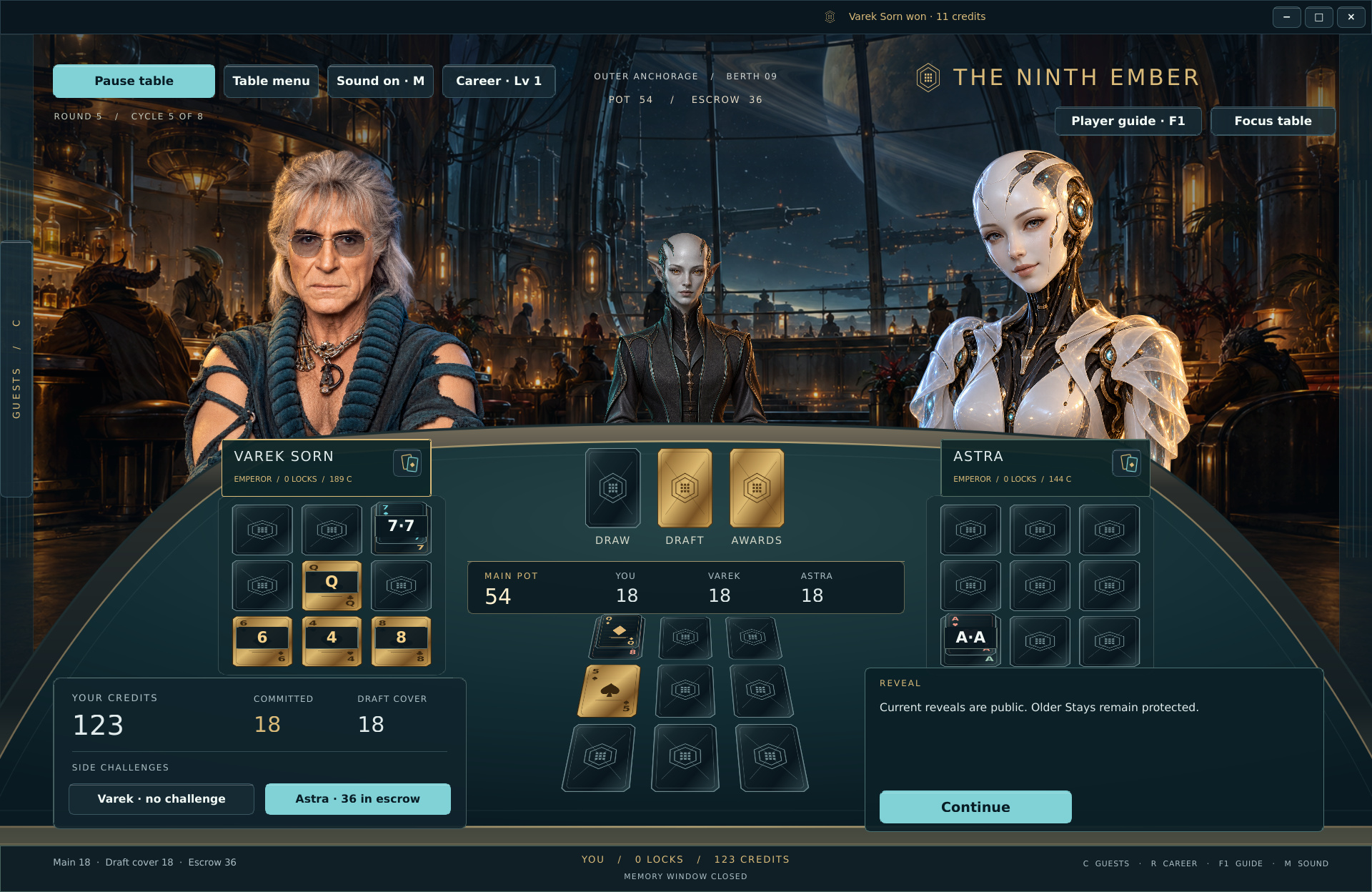
Take your seat at The Ninth Ember, a club overlooking the traffic of a galactic spaceport. Across the table sit two travelers with different habits, different strengths, and nine cards of their own. A neutral dealer keeps the game moving. What you remember, what you reveal, and what you are willing to risk shape every round.
Plate9 combines a concealed 3 × 3 card board with betting, persistent gold plates, and carefully timed reveals. Win the pot, develop your board, and work toward the ninth lock that gives the game its name.
Plate9 includes an advanced version of Ting Reasoner (0.10.0a21), bundled directly with the game. NumPy and Numba are required for its numerical runtime and are installed automatically during a standard pip installation. No separate Ting download is needed.
A place to settle in
The table is built for a seated, first-person view: character portraits across the felt, clear credit panels, purpose-built card artwork, and a full-screen guest gallery. Slow lighting, gentle portrait motion, card animations, ambient sound, and restrained effects give the room its pace.
Inspect either opponent's public board through the small cards icon in their nameplate. The expanded row makes exposed cards easier to read while keeping concealed cards covered. A short win-or-tie summary beside the title crest carries the last result into the next hand.
Use the table menu to adjust sound, reduce motion, or focus the view on the table. Once the memory window closes, ordinary decisions have no turn timer. There is time to think.
Your first round
A standard table has three players: you and two computer opponents. Each seat begins with 200 credits, and each round starts with a one-credit ante.
- Remember your board. Study and arrange your nine ordinary cards during the opening 30-second memory window. When it closes, their positions stay fixed and their faces are concealed.
- Place your incoming card. Privately inspect the new card, choose a playable slot, and commit it face down over the card already there. You cannot peek at it again after committing.
- Decide the price. Check, raise, call, or fold as the legal choices allow. Accepted side challenges add a separate wager on whether another player's committed play will match.
- Reveal or Stay. Reveal your current play, or choose a legal Stay over an open gold plate. The dealer resolves eligible hands, challenges, and any special showdown.
- Build your position. Credits settle, ordinary rank matches become gold plates, and qualifying gold-plate victories can earn locks. Then the action marker moves and the next round begins.
Matches use rank, not suit. A pair beats a high card; within either category, the higher rank wins. A triple is possible during a draft showdown and outranks a pair. Equal highest eligible hands split the pot.
An ordinary match can improve your board even when you lose the pot. If you remember a seven beneath your incoming seven, that revealed pair becomes a face-up gold plate even if another player wins with Kings.
Gold plates, Stays, and the ninth lock
Gold changes what you can plan. An open gold plate is visible, and a legal Stay preserves a regular card over it face down. Held cards remain protected until the rules allow them to reveal. Keeping a strong possibility concealed also occupies a slot you might need later.
A tie takeover lets a qualifying higher gold pair challenge two opponents' tied pairs. When all three current plays legally Stay, a draft showdown introduces a separate dealer comparison card and the possibility of a triple. Draft losses can require an additional payment reserved before the showdown.
After every eight completed rounds, the Trip renews the cycle. When locked counts qualify, it offers an additional memory challenge. Eligible gold plates can also be exchanged for ordinary cards, giving you another way to reshape your position.
There are two board milestones:
- Catch: all nine slots have become gold plates.
- Plate9: all nine gold plates are locked. Final obligations settle, the achievement is recorded, and a fresh game begins.
The illustrated in-game guide explains the exact Stay, challenge, lock, draft, and Trip conditions with worked card examples.
Choose your company
All 32 guests are available from the start. Open the left guest rail, choose a seat, and explore two rows of portraits by dragging, scrolling, or using the gallery controls. Each profile includes a biography, a playing style, and horizontal bars for Logic, Recall, Patience, and Pressure.
| Class | Guests | Character of play |
|---|---|---|
| Guard | 10 | Approachable opponents with varied recall, caution, and appetite for risk. |
| Veteran | 10 | More experienced play, stronger observation, and persistent pressure. |
| Super | 8 | Careful prices, deliberate uncertainty, and disciplined counterplay. |
| Emperor | 4 | The deepest probability sampling and most consistent logical play. |
Meet Varek Sorn, the unlisted sovereign behind lightly smoked glasses; Gus Perrin, an unusually patient courier with a cigar; and Astra, the white-and-black android whose courtesy accompanies formidable reasoning. Astra's profile carries the credit Co-Creator of Staqtapp-TDS MC.
Opponent choices respond to remembered cards, public actions, available credits, and uncertainty. Their profile bars describe configured tendencies. Every opponent uses the same legal information limits: concealed opposing cards and future deck order stay hidden.
You can change guests during a table. The arriving guest inherits the seat's cards and funded obligations; choose its existing free credits or a fresh 200-credit stack at the next hand boundary. A changed-lineup table keeps normal play rewards but does not change your skill rating or award Astra's Respect.
Build a club record
Your local career records XP, career levels, skill rating, badges, and club chips. Milestones include your first gold plate, successful Trip recall, qualifying locks, Catch, Plate9, and a completed-table victory over Astra.
Club chips unlock card finishes such as Aurora Teal, Obsidian Pearl, and Imperial Violet. They belong to your career wallet and do not fund table wagers. Career rewards bank when a table reaches its natural ending; unfinished progress remains pending when you save.
Closing the game saves the table, committed wagers, and retained opponent observations. Return to the same position and resume when ready.
Learn from your seat
Press F1 for the illustrated HTML player guide, included with the game and available offline. Its card examples explain the round sequence and the unusual situations that make Plate9 rewarding to learn.
| Control | Action |
|---|---|
| C | Open the guest gallery. |
| R | Open your career record. |
| F1 | Open the illustrated player guide. |
| Ctrl + Space | Pause or resume the table. |
| M | Toggle sound. |
| F8 | Open the table menu. |
| F | Switch between room and table focus. |
Opening the guide or guest gallery pauses play. Resume explicitly when you return. During memory study, pausing covers your cards and preserves the remaining viewing time.
Install and play
Use 64-bit Python 3.11, 3.12, or 3.13. The desktop application uses PySide6, NumPy, and Numba; a normal installation installs its declared dependencies.
On Windows, install and launch with the same Python:
py -m pip install --upgrade plate9
py -m plate9
For an offline wheel installation where the required libraries are already installed:
py -m pip install --no-index --force-reinstall --no-deps .\plate9-1.0.0-py3-none-any.whl
py -m plate9
To check the installed libraries, bundled files, numerical execution, and opponent workers:
py -m plate9 --check
Ting Reasoner is included. Each guest has a dedicated Ting rule program, supported by Plate9's memory and probability models. Two independent opponent worker processes keep decision work separate from the interface. Play runs locally, with no account, API key, or separate Ting download required.
1 maintainer

Metadata
1 maintainer
Release files for plate9 1.0.0
For a detailed explanation of source distributions (sdists) and built distributions (wheels), please see the package formats documentation.
Source distribution (sdist)
| File | Size | Uploaded | Provenance | Actions |
|---|---|---|---|---|
| plate9-1.0.0.tar.gz | 99.7 MB | Without provenance | Details for plate9-1.0.0.tar.gz |
Built distribution (wheel)
| File | Interpreter | ABI | Platform | Actions Reset |
|---|---|---|---|---|
| plate9-1.0.0-py3-none-any.whl | Python 3 | none | any | Details for plate9-1.0.0-py3-none-any.whl |
Total release size: 199.6 MB
Release files / plate9-1.0.0.tar.gz
| Download URL | plate9-1.0.0.tar.gz |
|---|---|
| Size | 99.7 MB |
| Tags | Source |
|
SHA-256 checksum How to use checksums |
a89025585b7aa26292bdf4c8224ef2f8ba2954805fbad689610698e84aa0304a
|
|
BLAKE2b-256 checksum How to use checksums |
6df79047440d402fb3a44046ec778ef4651d094e73315f6d2f3ee049baf5cd3e
|
| Upload date | |
|
Uploaded using Trusted Publishing? What is trusted publishing? |
No |
| Uploaded via |
twine/0.0.0 importlib_metadata/4.0.1 pkginfo/1.12.1.2 requests/2.25.1 requests-toolbelt/0.9.1 tqdm/4.61.1 CPython/3.9.16
|
Release files / plate9-1.0.0-py3-none-any.whl
| Download URL | plate9-1.0.0-py3-none-any.whl |
|---|---|
| Size | 99.9 MB |
| Tags | Python 3 |
|
SHA-256 checksum How to use checksums |
8fac9164c81e52459fb8042ffcdc510909c5aa3c1d87a90b13f069119929c96b
|
|
BLAKE2b-256 checksum How to use checksums |
07be5dbe0529f525d2a5980a9b5712165f9aa2dea59dcb79fefbf61eb6d0d7ab
|
| Upload date | |
|
Uploaded using Trusted Publishing? What is trusted publishing? |
No |
| Uploaded via |
twine/0.0.0 importlib_metadata/4.0.1 pkginfo/1.12.1.2 requests/2.25.1 requests-toolbelt/0.9.1 tqdm/4.61.1 CPython/3.9.16
|
Security for plate9 1.0.0
Provenance
Provenance describes where a file came from. On PyPI, provenance is shared via attestations, which provide a verifiable record of the build or publishing details. View details, limitations and caveats.
No provenance found
None of the files in this release were uploaded with provenance metadata.
A note on package security
PyPI is a repository for distributing packages, not a service for auditing them. While third-party security researchers and our staff do their best to detect and remove malicious packages, PyPI cannot guarantee the quality, security or suitability of any given package.
To learn more about protecting yourself from malicious actors, visit our package security documentation.














