
Plate9 — The Ninth Ember
Version 1.2.1 · A first-person card game of memory, wagers, and lasting progress.
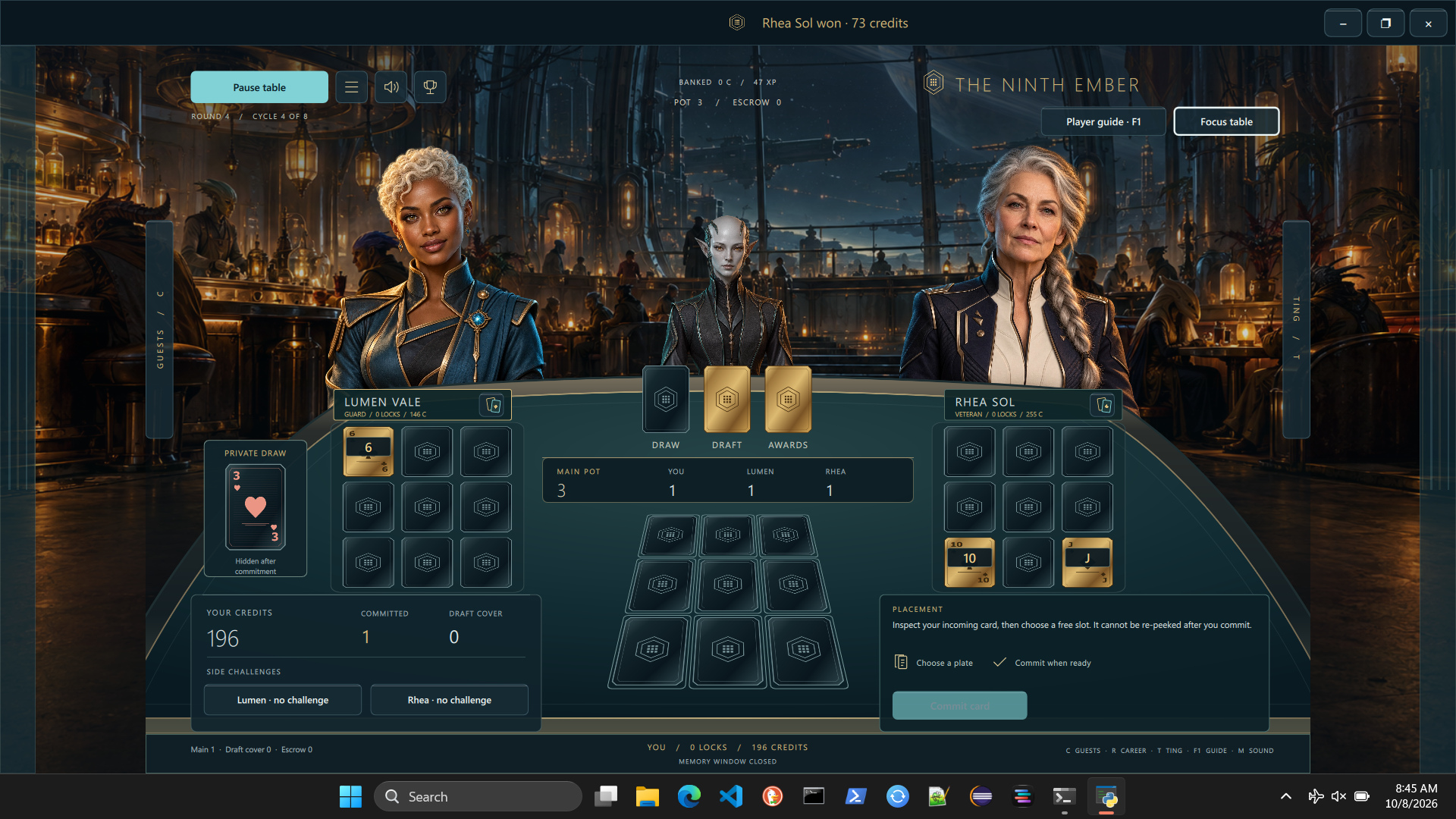
Take your seat at The Ninth Ember, a club overlooking a galactic spaceport. Two travelers sit across the table, each with a distinct playing style and nine cards to remember. A neutral dealer oversees the action. Every round asks you to balance what you know, what you suspect, and what you are willing to risk.
Plate9 brings together a concealed 3 × 3 board, rank matching, betting, and persistent gold plates. A winning hand can earn credits; a well-developed board can lead to Catch 9 and, ultimately, Plate9. Beyond the table, your career continues through banked credits, experience, collectible time crystals, and new opponents to discover.
Memory, wagers, and gold plates
A standard table has three seats: you and two computer opponents. Each seat begins with 200 credits, and each round opens with a one-credit ante.
- Study your board. Use the opening 30-second memory window to inspect and arrange your nine ordinary cards. Their positions remain fixed when the window closes and their faces are concealed.
- Commit a card. Inspect your incoming card privately, choose an eligible slot, and place it face down. Once committed, it cannot be peeked at again.
- Set the stakes. Check, raise, call, or fold as the legal choices allow. Side challenges offer separate wagers on whether another player's committed play will match.
- Reveal or Stay. Reveal your play or use a legal Stay over an open gold plate. The dealer resolves the eligible hands and funded challenges.
- Develop your board. Revealed ordinary rank matches create gold plates. Qualifying gold victories can earn locks, bringing you closer to Plate9.
Matches use rank, not suit. A pair beats a high card; higher ranks win within a category. Draft showdowns can produce triples, which outrank pairs. Equal highest eligible hands split the pot. An ordinary match can still improve your board when another player wins the pot.
Gold plates add a lasting layer of strategy. A Stay protects a regular card face down over an eligible open gold plate, preserving a possibility while occupying that slot. A qualifying tie takeover or draft showdown can earn a lock. Ordinary gold-pair wins do not automatically lock a plate.
- Catch 9: turn all nine board slots into gold plates. Earned progress banks immediately; continue toward Plate9 or settle the table and begin again with a confirmed buy-in.
- Plate9: lock all nine gold plates. The table settles its remaining obligations, records the achievement, and banks the result.
The illustrated player guide explains the exact conditions for Stays, locks, challenges, draft payments, and Trip matches with worked card examples.
Fresh opportunities every eight rounds
After eight completed rounds, the Trip marks the transition to another cycle. When the lock conditions qualify, it provides an additional memory challenge. Eligible open gold plates can also be exchanged for ordinary cards.
A fresh 30-second memory window then lets you replace an eligible ordinary card. Click its face-down slot, review the confirmation, and accept to see the replacement for the time remaining. Each eligible slot can be refreshed once. Declining reveals nothing, the timer is not extended, and protected Stays remain covered.
These replacement cards come from an independent 52-card deck. The primary deck retains its role: 27 opening board cards, 24 normal play cards, and one conditional Trip card. At the next cycle boundary, the normal draws and Trip are fixed before replacements are taken. A slot refresh cannot change that sequence. The gold draft uses its own comparison supply.
This gives you room to improve a difficult board while preserving the memory challenge and the integrity of the upcoming deals.
Credits that carry between tables
Your banked credit balance belongs to your career and carries between visits. Starting a new table always uses a fixed 200-credit buy-in. A confirmation shows the amount paid from your balance, any insurance assistance, and what will remain afterward.
If your balance cannot cover the buy-in, assistance fills the shortfall. At cash-out, assistance is recovered from the remaining stack first; any unrecovered portion is forgiven. If your playing stack reaches zero, an eligible between-hand rebuy offers another fixed 200 credits through the same confirmation process. Your cards and protected Stays remain in place.
Use Cash out & leave to settle accepted challenges and return your remaining stack to the bank after assistance recovery. Committed main-pot stakes are forfeited when you leave. Previously banked rewards remain yours; provisional, unbanked rewards are forfeited. Leaving a rated table early can lower your skill rating. Natural table endings cash out automatically.
Saving an unfinished table keeps its funds committed to that table. Resuming it does not charge a second buy-in. Banked credits also purchase uniform card finishes for your table.
Experience with meaningful rewards
Plate9 keeps two XP totals:
- Available XP is your purchasing balance for time crystal sculptures.
- Lifetime XP records everything you have earned and determines your career level.
Buying a crystal spends available XP only. Your lifetime total and level stay intact, so collecting does not erase your history.
Major achievements provide substantial rewards:
| Achievement | XP reward |
|---|---|
| Catch 9 | 1,500 |
| Plate9 | 7,500 |
| Astra's Respect — a qualifying completed-table victory with Astra seated | 3,000 |
These achievements can award again on each new table. Other milestones, settled hands, gold plates, and locks also contribute to your career. Catch 9 banks earned progress immediately; other provisional table rewards bank when the table completes. The Career panel shows pending progress separately.
The XP pursuits tab provides recurring goals alongside those larger victories:
| Pursuit | Goal | XP reward |
|---|---|---|
| At the table | Complete 12 settled hands. | 150 |
| Golden progress | Earn 6 new gold plates. | 250 |
| Keep the seal | Earn 3 new locks. | 400 |
| True memory | Match 2 eligible Trip cards. | 200 |
| See it through | Finish a natural table after at least 8 hands. | 300 |
Each completed pursuit banks its reward immediately. Finishing all five adds a 250-XP bonus and resets the set for another pursuit cycle. Your lifetime XP continues to grow. Leaving early or choosing a Catch 9 reset does not satisfy the natural-table completion goal.
Time crystals and mystery invitations
The Time Crystal Collection contains 14 sculptures, ranging from spacecraft and observatories to intricate machines and ceremonial objects. Each piece has its own image, story, XP price, and dated ownership certificate.
Prices begin at 500 available XP and rise to 45,000 XP for the most demanding collectible. Early purchases are within reach of a major achievement; higher-class sculptures provide longer-term goals supported by repeatable victories and XP pursuits.
Crystal purchases reveal eight playable mystery guests: two in each of the four classes. Review a sculpture's invitation and price before confirming the purchase. Its guest then becomes available in the gallery with a full profile, portrait, blinking animation, and individual playing style.
Some sculptures share the same invitation. Buying another piece associated with an unlocked guest adds to your collection; it does not create an additional guest. The collection identifies these relationships before you buy.
Opponents with individual styles
All 32 original guests are available from the start. With the eight mystery invitations, the full roster reaches 40 opponents.
| Class | Initially available | Unlockable | Style of play |
|---|---|---|---|
| Guard | 10 | 2 | Varied recall, caution, and willingness to take risks. |
| Veteran | 10 | 2 | More experienced observation and sustained pressure. |
| Super | 8 | 2 | Deliberate uncertainty, careful pricing, and disciplined counterplay. |
| Emperor | 4 | 2 | The deepest probability sampling and strongest configured reasoning. |
Browse the guest gallery by dragging, scrolling, or using its navigation controls. Each profile presents a biography, a playing style, and Logic, Recall, Patience, and Pressure ratings. The selected guest's large portrait blinks naturally. Among the Emperor guests is Astra, whose profile carries the credit Co-Creator of Staqtapp-TDS MC.
Opponents consider their observations, public actions, available credits, and uncertainty. Concealed opposing cards and future deck order remain hidden from them.
Guests can change during a table. The arriving opponent inherits the seat's cards and funded obligations; the handoff lets you retain its existing free credits or select a fresh 200-credit stack at the next hand boundary. Tables with guest changes or human rebuys continue to earn normal play rewards, but are unrated and cannot earn Astra's Respect.
Follow the decisions with Ting
The Ting terminal offers a closer look at actual opponent decision activity. Open the right rail or press T to inspect the current phase, legal alternatives, public wager costs, credit consequences, recent betting actions, and the method used to choose a move.
Detailed receipts include guest traits and measured processing times. Concealed decisions remain sealed until their phase resolves; private cards, scores, and remembered information are never displayed.
The terminal retains the latest 25 receipts, replacing the oldest as new decisions arrive. Toggle Details for a compact view, scroll to inspect an earlier decision, or clear the display without erasing an opponent's retained observations. Closing the terminal stops its display updates. Receipts reuse the completed computation without running additional simulations.
Ting Reasoner 0.10.0a21 is included with Plate9. Each guest has a dedicated rule program, supported by memory and probability models. Two independent opponent worker processes keep decision work separate from the interface.
The Ninth Ember Exchange
Open the graph icon beside Career, or press Ctrl + E, to enter the Exchange. Trade shares in 60 fictional companies across 10 sectors, all connected to the Ninth Ember club, its suppliers, or the surrounding spaceport. Search by name or ticker, filter by sector, keep a watchlist, and sort rising or falling companies.
The terminal combines line and candlestick charts, volume bars, price inspection, company news, holdings, and saved transaction receipts. Choose 10-, 30-, or 80-minute chart ranges; the initial simulated archive contains 40 minutes, with up to 80 minutes retained as play continues. Directory changes compare the latest price with ten minutes earlier. The Ember 60 index tracks the equal-weight performance of the 60 issuers against their listing prices.
Quotes update every 20 seconds while Plate9 is open, including while the table is paused. Market regimes, sector moves, independent company shocks, and irregular news events interact; prices do not follow repeating waveforms. New moves use operating-system randomness, separately from card dealing. Closing Plate9 freezes the exchange, and returning from computer sleep processes at most one update. News is context, never a promise of the next move.
Buy and sell whole shares with banked credits. Each order has a 0.35% fee, minimum 0.05 credits, displayed before confirmation. Quotes that change before confirmation must be reviewed again. Trades cannot use table stakes, assistance, pending rewards, or XP, and shares cannot be sold unless owned. Positions are limited to 100,000 shares per company.
Trade amounts are calculated in exact hundredths of a credit. Fractional credits remain in the exchange cash balance; whole banked credits remain available for table buy-ins and finishes. Holdings, cost basis, realized results, fees, watchlist, and the latest 200 receipts survive a restart. Credits and shares are saved together; a failed save cancels the order without spending either. Opening the exchange pauses the table and covers private cards. Close it and resume explicitly when ready.
Refined playing plates and controls
The regular and gold plates use continuous satin metal faces, beveled edges, and bold angular ranks drawn as paths. The lower rank stays visible beneath the committed plate on reveals, without a separate bottom panel. Opponent cards show their own face artwork without added rank labels. The top row of menu, sound, career, and exchange icons has no tooltips; keyboard access and screen-reader names remain available. The Ninth Ember crest and card backs render at higher resolution, including the title bar and guide. Choice icons are larger, and the wider Guest and Ting rails use clear icons with hover labels.
A 320 ms slide places the committed card over its selected slot. A matching short deal animates a confirmed memory-window replacement. These are presentation effects: commitments apply immediately, the memory timer never extends, and concealed committed cards stay face down. Pausing or timer expiry immediately hides a private replacement. Reduced motion skips the slides.
A room designed for unhurried play
The Ninth Ember combines detailed portraits, custom card artwork, subtle lighting, and a clear first-person table. Taller action controls and the wager spinner make common choices easier to reach. Click the cards icon beside an opponent's name to expand that seat's public board; concealed cards remain covered.
Focus table is Plate9's visual signature. As the room darkens, both opponents and the dealer close their eyes and hold them shut. Return to Room view and their eyes open again. Opponents resume their occasional blinks; the dealer remains open-eyed without blinking. Reduced motion preserves the chosen eye pose while stopping incidental blinks. Focus is cosmetic and does not change an opponent's knowledge or the rules.
Audio consists of brief card, credit, and reward cues, with no continuous background loop. Windows uses fresh native asynchronous cue playback to avoid retaining a stalled Qt audio output. The newest cue replaces an earlier cue instead of building an audio queue. If Windows rejects playback, the sound indicator reports the failure and the next cue retries. Test sound in the table menu checks playback without touching the Windows tray or changing your mute setting. Sound and volume controls remain available from the table. Visiting the crystal collection preserves your sound preference; resume the paused table when you return.
Ordinary decisions have no turn timer after the memory window closes. Pause when needed, save your table for another visit, and continue with its cards, credits, and opponent observations intact.
Guide and controls
Press F1 for the illustrated player guide, included with the game and available offline. It covers the rules, worked card examples, career progression, and crystal collection.
| Control | Action |
|---|---|
| C | Open the guest gallery. |
| R | Open Career, XP pursuits, and time crystals. |
| T | Toggle the Ting terminal. |
| Ctrl + E | Open or close the Ninth Ember Exchange. |
| F1 | Open the player guide. |
| Ctrl + Space | Pause or resume the table. |
| M | Toggle sound. |
| F8 | Open the table menu. |
| F | Switch between Room view and Focus table. |
Opening Career, the exchange, the guest gallery, or the guide pauses play. Resume explicitly when you return. Pausing during memory study covers the cards and preserves the remaining viewing time.
Install and play
Use 64-bit Python 3.11, 3.12, or 3.13. Plate9 requires PySide6, NumPy, and Numba; a standard pip installation installs these dependencies automatically.
On Windows, install and launch with the same Python:
py -m pip install --upgrade plate9
py -m plate9
To install a downloaded wheel when the required dependencies are already present:
py -m pip install --no-index --force-reinstall --no-deps .\plate9-1.2.1-py3-none-any.whl
py -m plate9
To check the installed dependencies, bundled files, numerical runtime, and opponent workers:
py -m plate9 --check
Play runs locally. No account, API key, or separate Ting download is required. Your saved table and career are stored on your computer.
Existing 1.2.0 saves load directly. Earlier saves, including 1.1.4, upgrade automatically. Before the first upgraded save is written, Plate9 retains the original as table-save.pre-1.2.0.json beside the current save (or uses the corresponding name for a custom save path). Older Plate9 builds cannot read the new exchange save format.
1 maintainer

Metadata
1 maintainer
Release files for plate9 1.2.1
For a detailed explanation of source distributions (sdists) and built distributions (wheels), please see the package formats documentation.
Source distribution (sdist)
| File | Size | Uploaded | Provenance | Actions |
|---|---|---|---|---|
| plate9-1.2.1.tar.gz | 31.1 MB | Without provenance | Details for plate9-1.2.1.tar.gz |
Built distribution (wheel)
| File | Interpreter | ABI | Platform | Actions Reset |
|---|---|---|---|---|
| plate9-1.2.1-py3-none-any.whl | Python 3 | none | any | Details for plate9-1.2.1-py3-none-any.whl |
Total release size: 62.2 MB
Release files / plate9-1.2.1.tar.gz
| Download URL | plate9-1.2.1.tar.gz |
|---|---|
| Size | 31.1 MB |
| Tags | Source |
|
SHA-256 checksum How to use checksums |
99f7bc1d54685b32fa96c22b7de496168cb0203977795576c17572382969be3d
|
|
BLAKE2b-256 checksum How to use checksums |
cc625c8017f1ef9a5c78659905d9204b8f0094aa72b279674e483562942776b2
|
| Upload date | |
|
Uploaded using Trusted Publishing? What is trusted publishing? |
No |
| Uploaded via |
twine/0.0.0 importlib_metadata/4.0.1 pkginfo/1.12.1.2 requests/2.25.1 requests-toolbelt/0.9.1 tqdm/4.61.1 CPython/3.9.16
|
Release files / plate9-1.2.1-py3-none-any.whl
| Download URL | plate9-1.2.1-py3-none-any.whl |
|---|---|
| Size | 31.2 MB |
| Tags | Python 3 |
|
SHA-256 checksum How to use checksums |
63c139b9ac86b287a8893ee03203ff826bd65fa080df43e922660e9d0f3ea68c
|
|
BLAKE2b-256 checksum How to use checksums |
8133eaccb32fa27dbebf2dd03248f0ba52f3b76bd9b159862b9a47b3e7840109
|
| Upload date | |
|
Uploaded using Trusted Publishing? What is trusted publishing? |
No |
| Uploaded via |
twine/0.0.0 importlib_metadata/4.0.1 pkginfo/1.12.1.2 requests/2.25.1 requests-toolbelt/0.9.1 tqdm/4.61.1 CPython/3.9.16
|
Security for plate9 1.2.1
Provenance
Provenance describes where a file came from. On PyPI, provenance is shared via attestations, which provide a verifiable record of the build or publishing details. View details, limitations and caveats.
No provenance found
None of the files in this release were uploaded with provenance metadata.
A note on package security
PyPI is a repository for distributing packages, not a service for auditing them. While third-party security researchers and our staff do their best to detect and remove malicious packages, PyPI cannot guarantee the quality, security or suitability of any given package.
To learn more about protecting yourself from malicious actors, visit our package security documentation.














