
Poisson Tasks



Tool-use tasks with a known right answer, generated on your machine, and a card that says what each level of difficulty was worth to the model you ran.
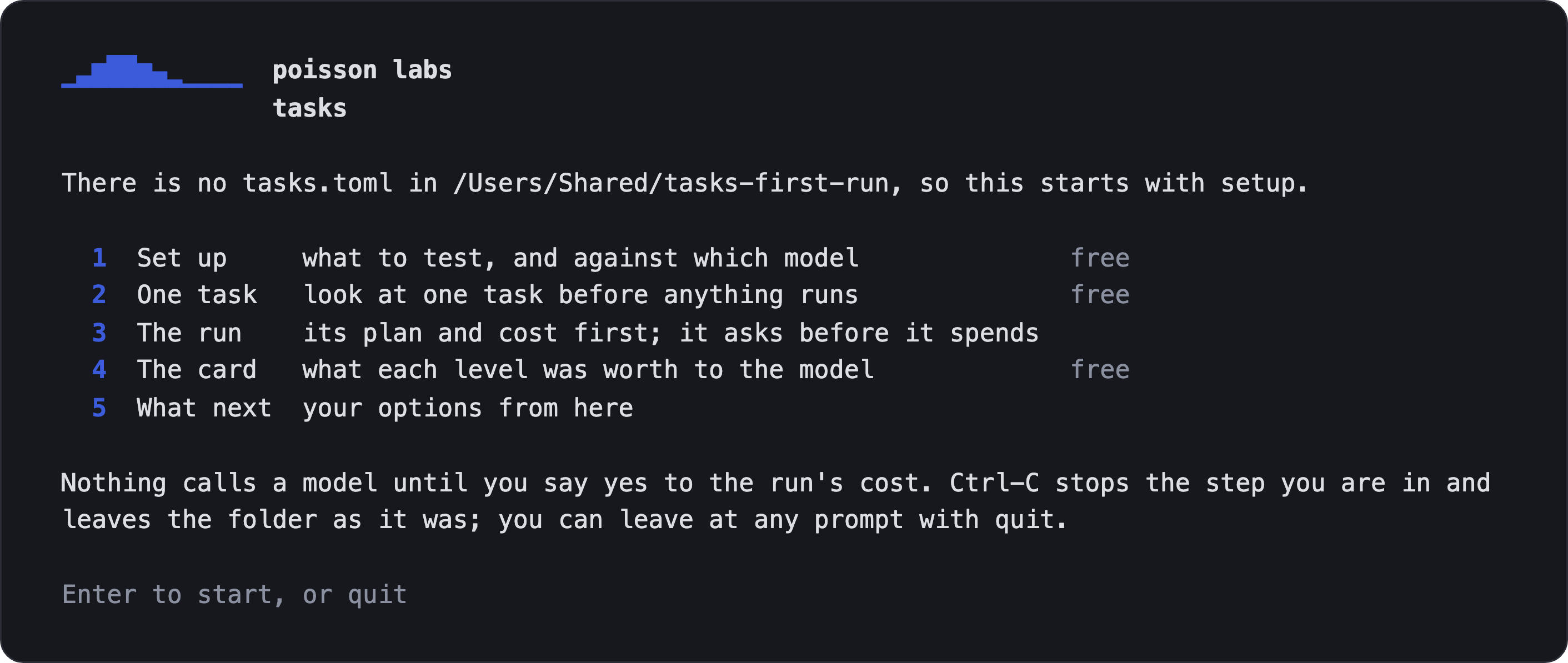
Each task asks a model to move one record of a small mock ledger up a ladder of stages, using only the tools it is given. Every task is generated with its own checker, so a run is scored exactly, with no judge model.
1. Install it. Needs Python 3.11 to 3.13; check with python3 --version (python.org has one, and so does uv python install 3.13).
pip install poisson-tasks
2. Open it. poisson-tasks with no command opens a guided session in your terminal. In a new folder it walks the first run through: what to test (a model on the built-in tasks, or on your own tools), one task to look at, the run with its cost shown before it asks, the card, and what to do next. In a folder already set up it shows where you are and offers the next steps. Nothing calls a model until you say yes to a run's cost.
poisson-tasks
The same steps as commands, for scripts and CI. Say what to test. init asks which model to test, which environment variable holds its key (it records the variable's name and never the key), and what to measure, and writes tasks.toml.
poisson-tasks init
Run it. run shows how many calls it will make and about what they will cost before it spends anything, and stops at your cap. Ctrl-C stops it; running it again picks up where it stopped.
poisson-tasks run
Read the card. card writes what each level was worth to that model, and what that does not tell you.
poisson-tasks card
Python 3.11 to 3.13, on macOS or Linux. A first run against gpt-5-nano is 30 episodes and costs about two cents.
Who it is for
People training models. Checkable tool-use tasks at a difficulty you choose, scored exactly, with a card for each model you run. poisson-tasks export --to verifiers hands the same tasks to verifiers to run under your own loop (verifiers-export.md).
Agent teams. Tasks built on your own tools. Bring an OpenAI tools file, an MCP tool list (or an MCP server, started with --mcp-command) or an OpenAPI document. Tasks simulates the responses from your schemas, never calls your backend, and the card shows where your setup breaks (own-tools.md).
Both start the same way: poisson-tasks on a terminal, or the commands above. For your own tools, one command sets up a folder: poisson-tasks init --own-file <your file> (the file beside tasks.toml; the session's setup asks the same, as its first question). If you ran the built-in tasks first and want your own tools next, poisson-tasks init --force asks its questions again, keeping the old tasks.toml as tasks.toml.bak, or run poisson-tasks init in a new folder.
What a task looks like
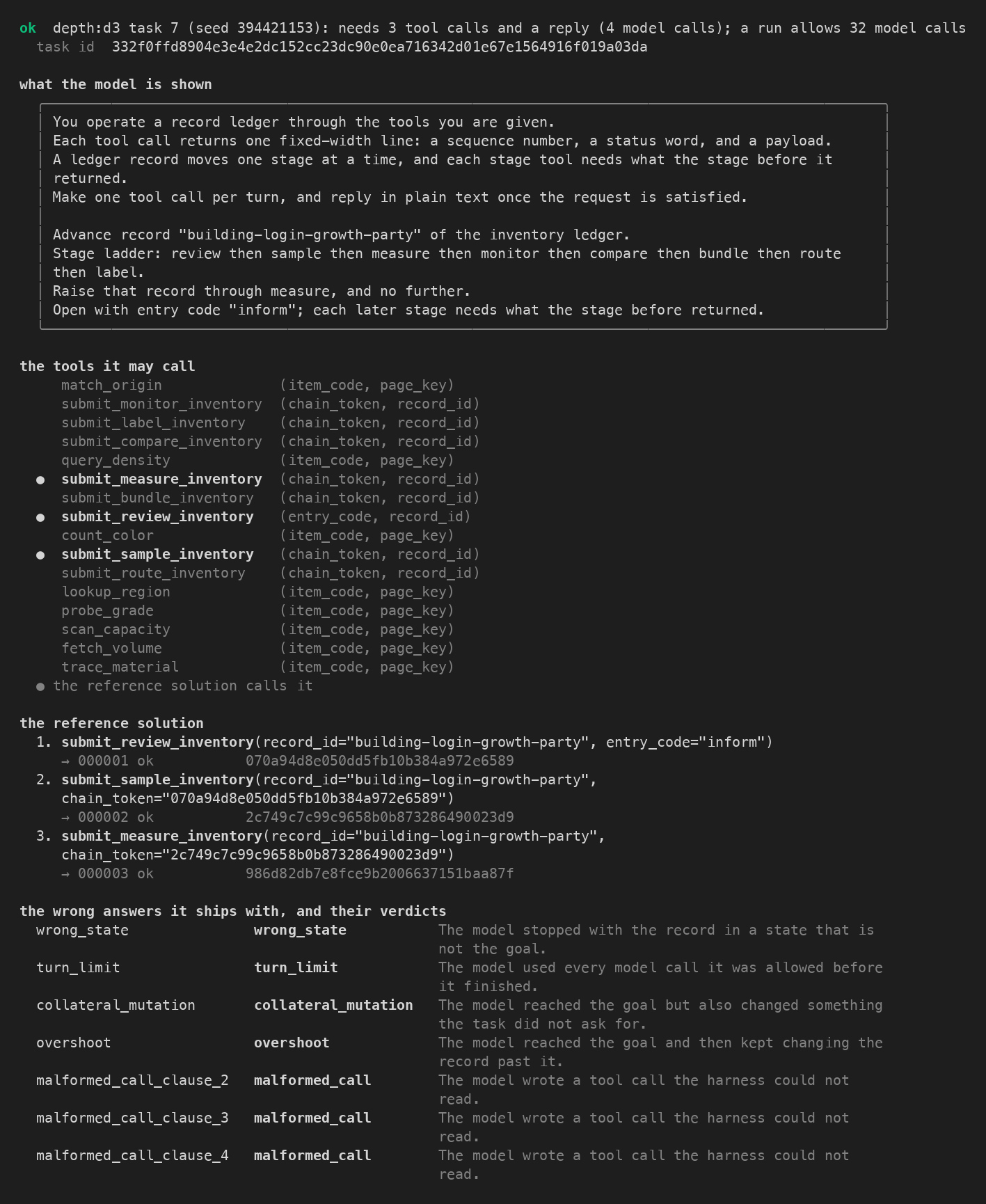
A task moves one record of a mock ledger up a fixed ladder of eight stages, with a block of sixteen tools. One call moves one record one stage, and every call after the first carries the token the previous call returned, so a task that is d stages deep takes at least d calls whatever the model already knows. The verdict on an episode is one of ten labels, and every episode is judged strict (the record ends exactly at the goal, nothing else moved, and the model ended with a reply) and leaky (reaching the goal is enough) at once. Generation makes no model calls and no network calls, and is byte-identical across runs, processes and platforms. the-task.md has the domain and the verdicts.
What a first run costs, and what it changes on your machine
Money. run prints its estimate before it asks, and the estimate names where it comes from (a published card, scaled to your plan). A first look is 30 episodes against gpt-5-nano: about two cents. Every run has a finite cap, by default the larger of $1.00 and twice the estimate, rounded up to a whole dollar. The cap is checked on measured usage, so a run can pass it by at most what the calls already in flight cost.
What gets written outside your folder. init and run write only to the folder you work in (tasks.toml, runs/, tasks/), apart from the following, which the first run does once or on every run:
- the tokenizer file, 3.6 MB, fetched once from openaipublic.blob.core.windows.net into the installed package (it is not shipped with the package;
poisson-tasks doctor --fixfetches it too); - on every run, the first episode runs the harness's setup: uv's installer from astral.sh puts
uvanduvxin~/.local/bin(and its receipt in~/.config/uv), replacing the uv already there when a newer one exists, and four packages and their dependencies come from PyPI into uv's cache.runsetsUV_NO_MODIFY_PATH=1so the installer does not edit your shell start-up files. The plan prints this in itsharnessline; - verifiers' cache, in
~/.cache/verifiers; - one
/tmp/vf-port-<hex>file per episode, which verifiers leaves behind; - one empty
uv-<16 hex>.lockfile in the temporary folder, which uv writes for the harness's script environment and keeps.
Your limit on open files. For its own length, run raises its process's limit on open files as far as your hard limit allows (macOS starts a shell at 256, and a run of 128 episodes at once needs up to 704), changes nothing outside that process, and when the hard limit is too low refuses before it starts, in one line saying how to raise it.
Installing the package also installs verifiers, and verifiers installs commands beside poisson-tasks: eval, init, debug, replay, validate, gepa and vf-*. A bare init is verifiers' command, not this package's; this package's is poisson-tasks init.
A run sends your key to your model's endpoint and nowhere else, and uploads nothing: it runs verifiers with push off. Generating tasks, generate, verify, export, card and doctor --offline open no connection to a model.
The dials
A knob is a dial you turn on purpose; an arm is one setting of a knob (depth:d3 is depth at level 3); a level is one setting of the knob. Two arms of one knob differ in that knob and in nothing else, which a set of thirty checks (the pin ledger) holds on every generated task (knobs-and-arms.md). There are twelve dials. Each is labelled with what the evidence says, and no more. Depth and the decoy-tools dial were measured on the two published cards; seven more by a knob probe on the same two models; the three added in 0.3.0 (timeouts, ratelimits and landed) have not been measured on any model yet, and are experimental until they are. "Bites" means a drop of at least 0.15 in strict pass@1 from the dial's lowest level to its highest, with a 95% interval that excludes zero (for faults, block and arguments, the control arm's drop too); the probe used 60 tasks and 2 attempts per arm.
| dial | varies | levels | what the evidence says |
|---|---|---|---|
depth |
how many chained calls the goal is away | 1, 2, 3, 5, 8 | Shown to make tasks harder on gpt-5-nano, in strict pass@1: 0.547 at d1, 0.237 at d3, 0.177 at d5, then 0.870 at d8, where no stage lies past the goal to go past (the card calls d1 to d2 and d2 to d3 different). On Qwen3-8B it did not make tasks harder: reaching the goal is 0.97 or more at every depth, and strict pass@1 climbs from 0.000 at d1 to 0.997 at d8, because Qwen goes past the goal at the low levels. Measured on the published cards. |
faults |
how many calls on the way answer "unavailable" and must be made again | 0, 1, 2, 4 | Shown to make tasks harder on Qwen3-8B · gpt-5-nano: does not bite; Qwen3-8B: bites |
history |
how many tokens of earlier tool work the conversation holds | 0, 300, 600, 1200, 2400 | Shown to make tasks harder on both models · gpt-5-nano: bites; Qwen3-8B: bites |
shape |
how many records four stage calls advance side by side | 1, 2, 4 | Shown to make tasks harder on Qwen3-8B (four wide the harder) · gpt-5-nano: does not bite; Qwen3-8B: bites |
distractor |
how many of the sixteen tools in the block are decoys | 0, 2, 4, 8, 14 | Experimental. Both published cards show it did not make tasks harder. |
similarity |
how many digits of the right tool's ledger number each lookalike tool shares | 0, 1, 2, 3 | Available · retested in v2 · gpt-5-nano: does not bite; Qwen3-8B: does not bite |
block |
how many tools are offered | 8, 16, 32, 64 | Available · retested in v2 · gpt-5-nano: does not bite; Qwen3-8B: does not bite |
arguments |
how many values each call must carry, copied from the request | 2, 4, 6, 8 | Available · retested in v2 · gpt-5-nano: does not bite; Qwen3-8B: does not bite |
spread |
how many tool answers the entry code is split across | 1, 2, 4 | Available · retested in v2 · gpt-5-nano: top easier; Qwen3-8B: cannot tell |
timeouts |
how many calls on the way time out, nothing having landed, and must be made again | 0, 1, 2, 4 | Experimental. Not measured on any model yet; added in 0.3.0 |
ratelimits |
how many calls on the way answer "rate limited" with a retry-after, and must be made again | 0, 1, 2, 4 | Experimental. Not measured on any model yet; added in 0.3.0 |
landed |
whether the write goes through but answers a timeout, so a blind retry is a duplicate; on your own tools | 0, 1 | Experimental. Not measured on any model yet; added in 0.3.0 |
Every dial has tasks, and --arm reaches all twelve (poisson-tasks generate --arm block:k32 --show, say; landed on your own tools, because the built-in ledger refuses a repeated stage call and changes nothing, so a write that landed has no duplicate there to catch). A run reaches depth through the first-look, planning, profile, card and custom recipes, the decoy-tools dial through card and custom, faults through error-recovery and profile, history through long-sessions and profile, shape through planning and profile, and timeouts and ratelimits through custom (--knob timeouts), on your own tools landed too; similarity, block, arguments and spread are on no recipe a run takes in this release. "Available · retested in v2" means that a later release measures those four dials again, on current models; until then they work, but are not shown to make tasks harder. "Cannot tell" means a drop of 0.15 could not show: the dial's base level passed less than 0.15 of the time on that model. knobs-and-arms.md has the probe's table, with every contrast and its interval, beside three things about how the probe ran that you should know.
On your own tools every dial but the decoy-tools dial is offered, within what your tools can support, and two of them, depth and shape, need flows. A flow is a link you declare between two of your tools: which field of one tool's answer goes into which argument of the next (--own-flow to init, or [[own.flow]] in tasks.toml). Tasks will not guess one, so without flows depth and shape are listed as unavailable (own-tools.md).
What a card says, and what it does not
A card says, for each level of each knob you ran, what the level was worth to the model: strict pass@1 with its 95% interval, leaky pass@1, how often the model carried the record past the goal, and what an episode cost. It names the model, where it was served and what produced the run, so a change between two cards can be traced to a changed tool contract or generator rather than the model. It refuses to publish at all when more than 10% of the attempts at a level made no tool call, because that measures whether the model starts, not how hard the level is. And it ends with what it does not claim: it is one model's result on these tasks, and ranks no models. reading-a-card.md explains every column and every line a card can carry.
The published cards
Two cards ship inside the package, for gpt-5-nano and Qwen3-8B: depth and the decoy-tools dial at every level, with their control arms, at 60 tasks per level and 5 attempts each, 4,200 episodes a card. Both were measured on an earlier build of the generator, so in this release card --published reads each not current, and a card from your own run is not set beside them (card --compare published says so in one line). A later release measures them again on the current generator. published-cards.md says what they show and where the two models agree, and calibration.md holds both in full.
The commands
poisson-tasks is one command with seven verbs:
poisson-tasks init: ask what to test, and writetasks.toml; spends nothing.poisson-tasks generate: make the plan's tasks with no model and no network, or show one task in full.poisson-tasks run: show the plan and its cost, ask, then run the tasks against the model.poisson-tasks card: build the card from a run, or rebuild the published cards, or compare two runs.poisson-tasks verify: judge an answer with the task's own verifier, with no model. In this release it refuses tasks made on your own tools, which verify does not judge on its own yet: a run's card judges every episode on them, by replay.poisson-tasks export: write the configs another runner reads (verifiers).poisson-tasks doctor: say whether this environment is ready, and what to do if not.
Every verb ends the same way: a result line first, problems on standard error, and an exit code that means the same everywhere. commands.md has each verb's help, what it writes and how it ends, and config.md every setting of tasks.toml.
Using it from Python, and under verifiers yourself
Everything the command does is a library: python.md shows how to make a task, judge an answer, check a contrast, rebuild a published card and read your own tools, and points to three short programs in the repository's examples folder as source to read. verifiers-export.md is for running the tasks under verifiers' own eval: the taskset's id, the signals it reports, the harness the numbers were measured under, and why eval has to be run by its path.
What is not claimed
- No dial is claimed to work across models beyond the table above. Two models from two families were measured; a level's number is one model's, and none is claimed for a model that has not been run.
- The command has not been run against every provider for real. The test suite runs it against stand-in servers that speak the APIs of OpenAI, Anthropic, Ollama and vLLM, not against the real services; the published cards were measured against OpenAI's API (
gpt-5-nano) and a vLLM server (Qwen3-8B) through the same harness. A first run against a provider is worth a small cap. - A model you serve yourself is recorded as the server reports it, not as a pinned serving stack; the card says how the model was served is not recorded.
- Windows is not supported.
runrefuses there, because the harness uses a POSIX shell.
Contributing
Anyone can open an issue. Pull requests come from invited collaborators; to help, open an issue first.
CONTRIBUTING.md covers setting up a checkout, the tests and the rules the repository keeps. The changes are in CHANGELOG.md, and the third-party material is itemised in NOTICE.
Citation
@misc{kolasinski2026poissontasks,
  author = {Kolasinski, Taylor},
  title  = {poisson-tasks: deterministic tool-use tasks, each generated with its verifier},
  year   = {2026},
  howpublished = {\url{https://github.com/poisson-labs/tasks}},
  note   = {Poisson Labs}
}
Licence
MIT. See LICENSE. Third-party material is itemised in NOTICE.
1 maintainer

Metadata
1 maintainer
Release files for poisson-tasks 0.3.0
For a detailed explanation of source distributions (sdists) and built distributions (wheels), please see the package formats documentation.
Source distribution (sdist)
| File | Size | Uploaded | Provenance | Actions |
|---|---|---|---|---|
| poisson_tasks-0.3.0.tar.gz | 2.8 MB | Without provenance | Details for poisson_tasks-0.3.0.tar.gz |
Built distribution (wheel)
| File | Interpreter | ABI | Platform | Actions Reset |
|---|---|---|---|---|
| poisson_tasks-0.3.0-py3-none-any.whl | Python 3 | none | any | Details for poisson_tasks-0.3.0-py3-none-any.whl |
Total release size: 3.5 MB
Release files / poisson_tasks-0.3.0.tar.gz
| Download URL | poisson_tasks-0.3.0.tar.gz |
|---|---|
| Size | 2.8 MB |
| Tags | Source |
|
SHA-256 checksum How to use checksums |
5c8d7b41bf4828a1778f206b31bba6cf7fc510c08e41c47e11cdf62d4b974594
|
|
BLAKE2b-256 checksum How to use checksums |
20b9b5fb3031cfb074e101ce155c889fb95bb4c2c6861e70795df141c67b6983
|
| Upload date | |
|
Uploaded using Trusted Publishing? What is trusted publishing? |
No |
| Uploaded via |
twine/7.0.0 CPython/3.12.13
|
Release files / poisson_tasks-0.3.0-py3-none-any.whl
| Download URL | poisson_tasks-0.3.0-py3-none-any.whl |
|---|---|
| Size | 650.6 kB |
| Tags | Python 3 |
|
SHA-256 checksum How to use checksums |
6e3db0b57dd532fec55b68a33a89f4cb024b12b417ef59470b14f45609db9733
|
|
BLAKE2b-256 checksum How to use checksums |
a346d73771e92e63023db99a47cc3bccccad64b996ea0b525b9e6fa581ae9d82
|
| Upload date | |
|
Uploaded using Trusted Publishing? What is trusted publishing? |
No |
| Uploaded via |
twine/7.0.0 CPython/3.12.13
|
Security for poisson-tasks 0.3.0
Provenance
Provenance describes where a file came from. On PyPI, provenance is shared via attestations, which provide a verifiable record of the build or publishing details. View details, limitations and caveats.
No provenance found
None of the files in this release were uploaded with provenance metadata.
A note on package security
PyPI is a repository for distributing packages, not a service for auditing them. While third-party security researchers and our staff do their best to detect and remove malicious packages, PyPI cannot guarantee the quality, security or suitability of any given package.
To learn more about protecting yourself from malicious actors, visit our package security documentation.














