
Automated Non-Hermitian Spectral Graph Construction

Project description
Poly2Graph
Poly2Graph is a Python package for automatic non-Hermitian spectral graph construction. It takes in the characteristic polynomial and returns the spectral graph.
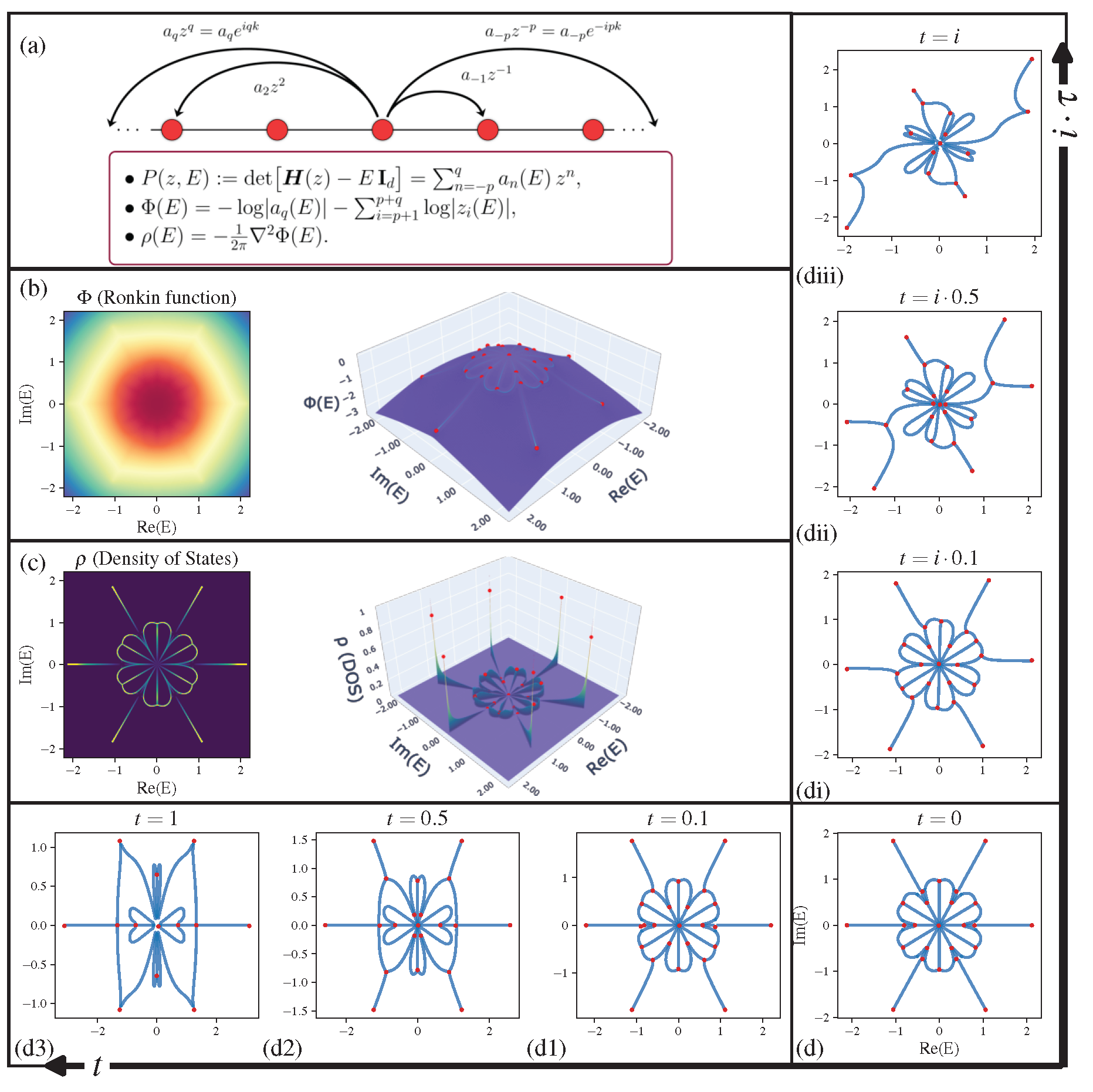
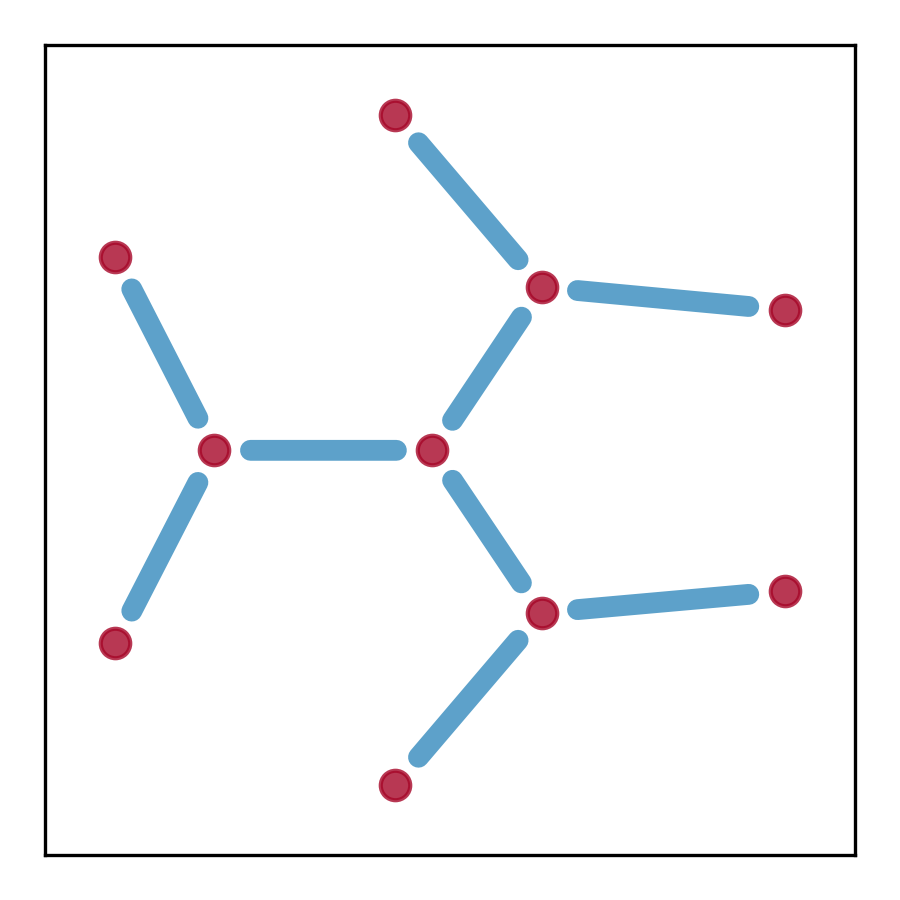
Topological physics is one of the most dynamic and rapidly advancing fields in modern physics. Conventionally, topological classification focuses on eigenstate windings, a concept central to Hermitian topological lattices (e.g., topological insulators). Beyond such notion of topology, we unravel a distinct and diverse graph topology emerging in non-Hermitian systems' energy spectra, featuring a kaleidoscope of exotic shapes like stars, kites, insects, and braids. The spectral graph solely depends on the algebraic form of characteristic polynomial.
Features
- Poly2Graph
- Fast construction of spectral graph from and one-dimensional models
- Support for generic one-band and multi-band models
- Adaptive resolution to reduce floating operation cost and memory usage
- Automatic spectral boundary inference
- Convert a skeleton image to its graph representation
Installation
First make sure you have installed tensorflow according to your machine specifics. This module is tested on Python >= 3.12, tensorflow >=2.10.
tensorflow is required for the optimization of computation bottleneck.
You can install the package via pip:
$ pip install poly2graph
or clone the repository and install it manually:
$ git clone https://github.com/sarinstein-yan/poly2graph.git
$ cd poly2graph
$ pip install .
Check the installation:
import poly2graph as p2g
print(p2g.__version__)
Usage
See the Poly2Graph Tutorial JupyterNotebook.
import numpy as np
import networkx as nx
import tensorflow as tf
import sympy as sp
from sympy.polys.polytools import Poly
import matplotlib.pyplot as plt

# always start by initializing the symbols for k, z, and E
k = sp.symbols('k', real=True)
z, E = sp.symbols('z E', complex=True)
A generic one-band example:
characteristic polynomial:
$$P(E,z) := h(z) - E = z^4 -z -z^{-2} -E$$
Its Bloch Hamiltonian (Fourier transformed Hamiltonian in momentum space) is a scalar function:
$$h(z) = z^4 - z - z^{-2}$$
where the phase factor is defined as $z:=e^{ik}$.
Expressed in terms of crystal momentum $k$:
$$h(k) = e^{4ik} - e^{ik} - e^{-2ik}$$
The valid input formats to initialize a p2g.SpectralGraph object are:
- Characteristic polynomial in terms of
zandE:- as a string of the Poly in terms of
zandE - as a
sympy'sPoly(sympy.polys.polytools.Poly) with {z,1/z,E} as generators
- as a string of the Poly in terms of
- Bloch Hamiltonian in terms of
korz- as a
sympyMatrixin terms ofk - as a
sympyMatrixin terms ofz
- as a
All the following characteristics are valid and will initialize to the same characteristic polynomial and therefore produce the same spectral graph:
char_poly_str = '-z**-2 - E - z + z**4'

char_poly_Poly = Poly(
    -z**-2 - E - z + z**4,
    z, 1/z, E # generators are z, 1/z, E
)

phase_k = sp.exp(sp.I*k)
char_hamil_k = sp.Matrix([-phase_k**2 - phase_k + phase_k**4])

char_hamil_z = sp.Matrix([-z**-2 - E - z + z**4])
Let us just use the string to initialize and see a set of properties that are computed automatically:
sg = p2g.SpectralGraph(char_poly_str, k=k, z=z, E=E)
Characteristic polynomial:
sg.ChP
>>> $\text{Poly}(z^{4}-z-\frac{1}{z^{2}}-E,z,\frac{1}{z},E,\mathbb{Z})$
Bloch Hamiltonian:
- For one-band model, it is a unique, rank-0 matrix (scalar)
sg.h_k
>>>
$$\begin{bmatrix}e^{4 i k} - e^{i k} - e^{- 2 i k}\end{bmatrix}$$
sg.h_z
>>>
$$\begin{bmatrix}- \frac{- z^{6} + z^{3} + 1}{z^{2}}\end{bmatrix}$$
The Frobenius companion matrix of P(E)(z):
- treating
Eas parameter andzas variable - Its eigenvalues are the roots of the characteristic polynomial at a fixed complex energy
E. Thus it is useful to calculate the GBZ (generalized Brillouin zone), the spectral potential (Ronkin function), etc.
sg.companion_E
>>>
$$\begin{bmatrix}0 & 0 & 0 & 0 & 0 & 1 \ 1 & 0 & 0 & 0 & 0 & 0 \ 0 & 1 & 0 & 0 & 0 & E \ 0 & 0 & 1 & 0 & 0 & 1 \ 0 & 0 & 0 & 1 & 0 & 0 \ 0 & 0 & 0 & 0 & 1 & 0\end{bmatrix}$$
Number of bands & hopping range:
print('Number of bands:', sg.num_bands)
print('Max hopping length to the right:', sg.poly_p)
print('Max hopping length to the left:', sg.poly_q)
>>>
Number of bands: 1
Max hopping length to the right: 2
Max hopping length to the left: 4
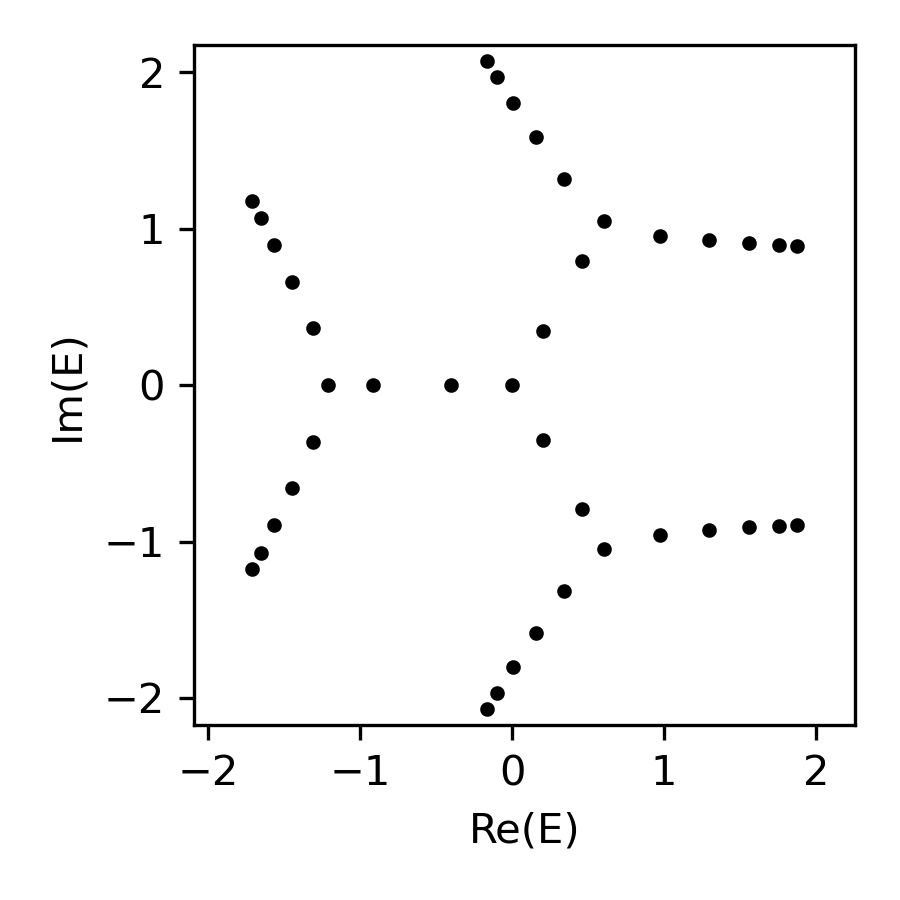
A real-space Hamiltonian of a finite chain and its energy spectrum:
H = sg.real_space_H(
    N=40,        # number of unit cells
    pbc=False,   # open boundary conditions
    max_dim=500  # maximum dimension of the Hamiltonian matrix (for numerical accuracy)
)

energy = np.linalg.eigvals(H)

fig, ax = plt.subplots(figsize=(3, 3))
ax.plot(energy.real, energy.imag, 'k.', markersize=5)
ax.set(xlabel='Re(E)', ylabel='Im(E)', \
xlim=sg.spectral_square[:2], ylim=sg.spectral_square[2:])
plt.tight_layout(); plt.show()
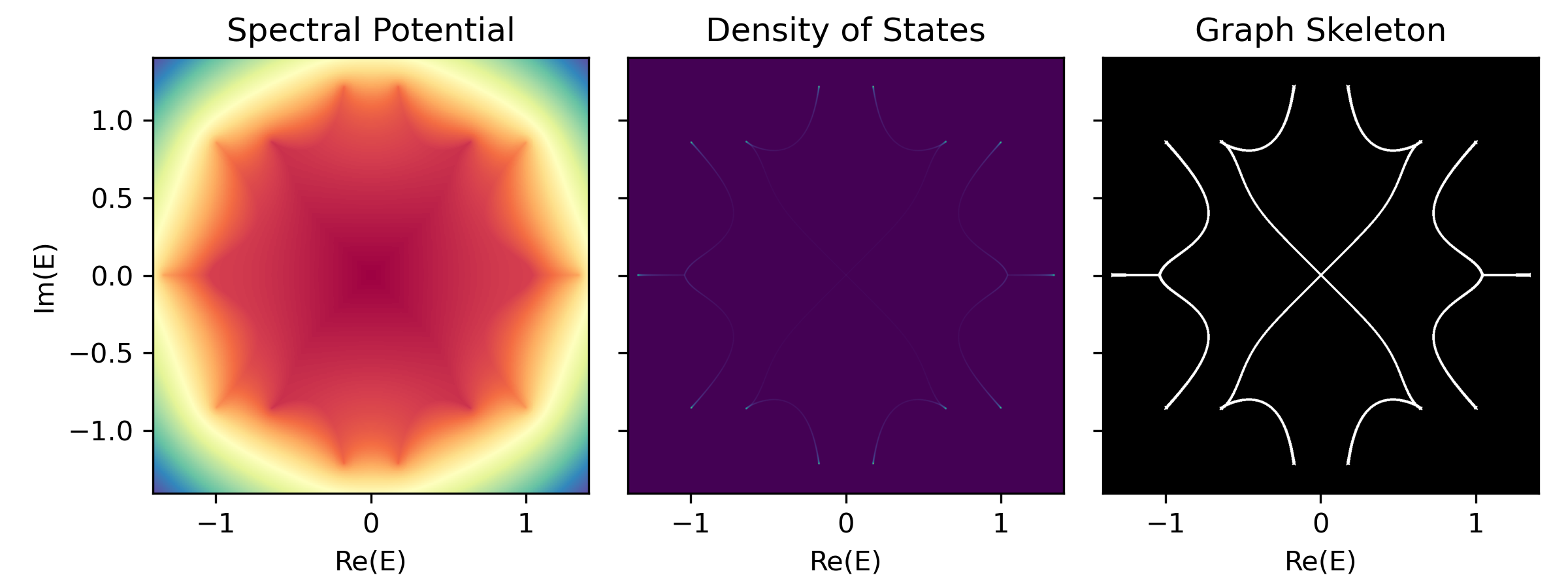
The Set of Spectral Functions
(whose values plotted on the complex energy square, returned as a 2D array)
-
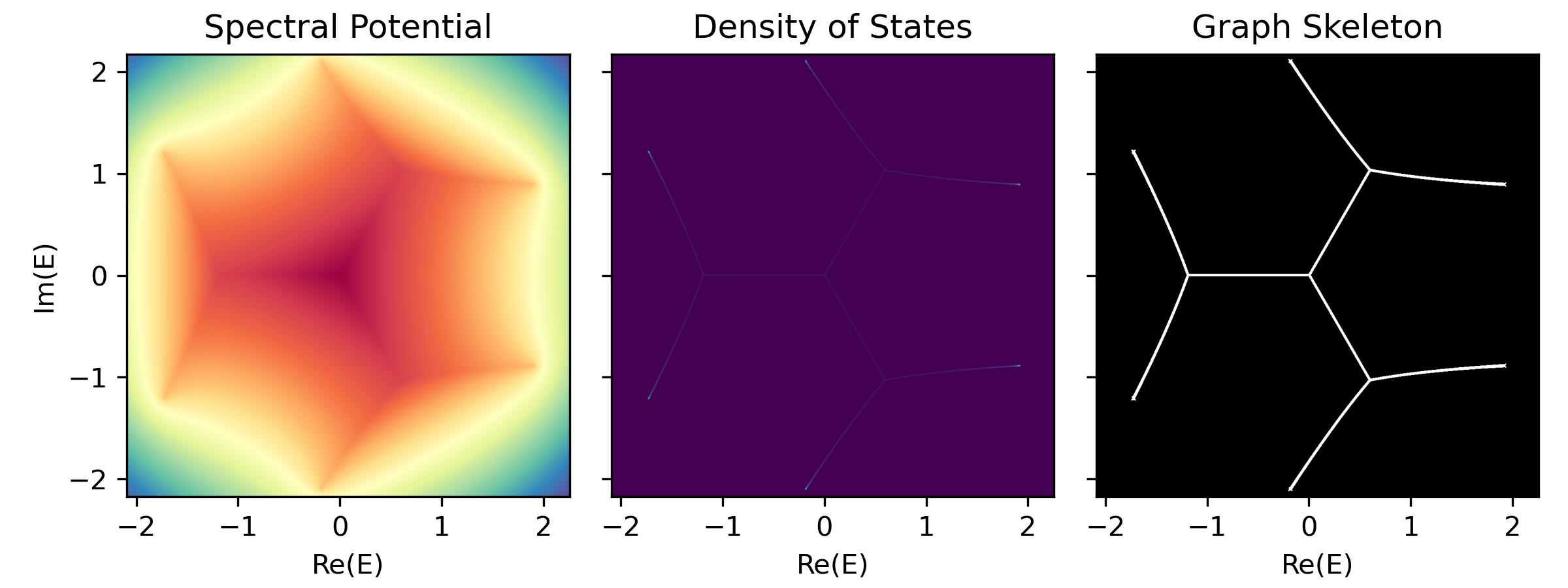
Density of States (DOS)
Defined as the number of states per unit energy area in the complex energy plane.
$$\rho(E) = \lim_{N\to\infty}\sum_n \frac{1}{N} \delta(E-\epsilon_n)$$
where $\epsilon_n$ are the eigenvalues of the Hamiltonian $H$.
Imagine to assign electric charge $1/N$ to each eigenvalue $\epsilon_n$, then the density of states $\rho(E)$ is treated as a charge density, therefore can be interpreted as the laplacian of a spectral potential $\Phi(E)$:
$$\rho(E) = -\frac{1}{2\pi} \Delta \Phi(E)$$
$\Delta = \partial_{\text{Re} E}^2 + \partial_{\text{Im} E}^2$ is the Laplacian operator on the complex energy plane. Laplacian operator extracts curvature; thus, geometrically speaking, the loci of spectral graph $\mathcal{G}$ resides on the ridges of the Coulomb potential landscape.
-
Spectral Potential (Ronkin function)
It can be proven that the spectral potential $\Phi(E)$ can be efficiently computed from the roots $|z_i(E)|$ of the characteristic polynomial $P(E)(z)$ and the leading coefficient $a_q(E)$ at a complex energy $E$:
$$\Phi(E) = - \lim_{N\to\infty} \sum_{\epsilon_n} \log|E-\epsilon_n| \ = - \int \rho(E')\log|E-E'| d^2E' \ = - \log|a_q(E)| - \sum_{i=p+1}^{p+q} \log|z_i(E)|$$
-
Graph Skeleton (Binarized DOS)
phi, dos, binaried_dos = sg.spectral_images(device='/gpu:0') # default is '/cpu:0'
# the computation bottleneck is implemented in tensorflow

fig, axes = plt.subplots(1, 3, figsize=(8, 3), sharex=True, sharey=True)
axes[0].imshow(phi, extent=sg.spectral_square, cmap='terrain')
axes[0].set(xlabel='Re(E)', ylabel='Im(E)', title='Spectral Potential')
axes[1].imshow(dos, extent=sg.spectral_square, cmap='viridis')
axes[1].set(xlabel='Re(E)', title='Density of States')
axes[2].imshow(binaried_dos, extent=sg.spectral_square, cmap='gray')
axes[2].set(xlabel='Re(E)', title='Graph Skeleton')
plt.tight_layout()
plt.show()
The spectral graph $\mathcal{G}$
graph = sg.spectral_graph(
    device='/gpu:0', # default is '/cpu:0'
    short_edge_threshold=20,
    # ^ node pairs or edges with distance < threshold pixels are merged
)

fig, ax = plt.subplots(figsize=(3, 3))
pos = nx.get_node_attributes(graph, 'pos')
nx.draw_networkx_nodes(graph, pos, alpha=0.8, ax=ax,
            node_size=50, node_color='#A60628')
nx.draw_networkx_edges(graph, pos, alpha=0.8, ax=ax,
            width=5, edge_color='#348ABD')
plt.tight_layout(); plt.show()
A generic multi-band example:
characteristic polynomial (four bands):
$$P(E,z) := \det(\textbf{h}(z) - E;\textbf{I}) = z^2 + 1/z^2 + E z - E^4$$
One of its possible Bloch Hamiltonians in terms of $z$:
$$\textbf{h}(z)=\begin{bmatrix} 0 & 0 & 0 & z^2 + 1/z^2 \ 1 & 0 & 0 & z \ 0 & 1 & 0 & 0 \ 0 & 0 & 1 & 0 \ \end{bmatrix}$$
sg_multi = p2g.SpectralGraph("z**2 + 1/z**2 + E*z - E**4", k, z, E)
Characteristic polynomial:
sg_multi.ChP
>>> $\text{Poly}{\left( z^{2} + zE + \frac{1}{z^{2}} - E^{4}, z, \frac{1}{z}, E, domain=\mathbb{Z} \right)}$
Bloch Hamiltonian:
- For multi-band model, if the
p2g.SpectralGraphis not initialized with asympyMatrix, thenpoly2graphwill use the companion matrix of the characteristic polynomialP(z)(E)(treatingzas parameter andEas variable) as the Bloch Hamiltonian -- this is one of the set of possible band Hamiltonians that possesses the same energy spectrum and thus the same spectral graph.
sg_multi.h_k
>>>
$$\begin{bmatrix}0 & 0 & 0 & 2 \cos{\left(2 k \right)} \ 1 & 0 & 0 & e^{i k} \ 0 & 1 & 0 & 0 \ 0 & 0 & 1 & 0\end{bmatrix}$$
sg_multi.h_z
>>>
$$\begin{bmatrix}0 & 0 & 0 & -1 \ 1 & 0 & 0 & 0 \ 0 & 1 & 0 & E^{4} \ 0 & 0 & 1 & - E\end{bmatrix}$$
The Frobenius companion matrix of P(E)(z):
sg_multi.companion_E
>>>
$$\begin{bmatrix}0 & 0 & 0 & z^{2} + \frac{1}{z^{2}} \ 1 & 0 & 0 & z \ 0 & 1 & 0 & 0 \ 0 & 0 & 1 & 0\end{bmatrix}$$
Number of bands & hopping range:
print('Number of bands:', sg_multi.num_bands)
print('Max hopping length to the right:', sg_multi.poly_p)
print('Max hopping length to the left:', sg_multi.poly_q)
>>>
Number of bands: 4
Max hopping length to the right: 2
Max hopping length to the left: 2
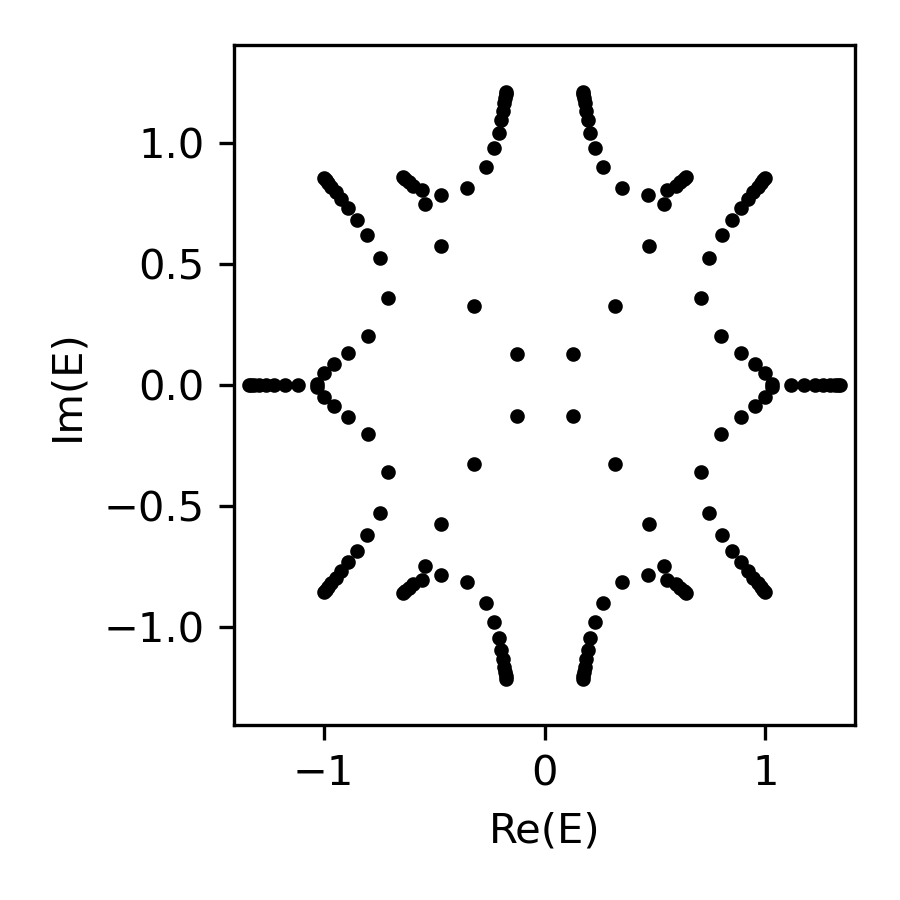
A real-space Hamiltonian of a finite chain and its energy spectrum:
H_multi = sg_multi.real_space_H(
    N=40,        # number of unit cells
    pbc=False,   # open boundary conditions
    max_dim=500  # maximum dimension of the Hamiltonian matrix (for numerical accuracy)
)

energy_multi = np.linalg.eigvals(H_multi)

fig, ax = plt.subplots(figsize=(3, 3))
ax.plot(energy_multi.real, energy_multi.imag, 'k.', markersize=5)
ax.set(xlabel='Re(E)', ylabel='Im(E)', \
xlim=sg_multi.spectral_square[:2], ylim=sg_multi.spectral_square[2:])
plt.tight_layout(); plt.show()
The Set of Spectral Functions
phi_multi, dos_multi, binaried_dos_multi = sg_multi.spectral_images(device='/gpu:0') # default is '/cpu:0'
# the computation bottleneck is implemented in tensorflow

fig, axes = plt.subplots(1, 3, figsize=(8, 3), sharex=True, sharey=True)
axes[0].imshow(phi_multi, extent=sg_multi.spectral_square, cmap='terrain')
axes[0].set(xlabel='Re(E)', ylabel='Im(E)', title='Spectral Potential')
axes[1].imshow(dos_multi, extent=sg_multi.spectral_square, cmap='viridis')
axes[1].set(xlabel='Re(E)', title='Density of States')
axes[2].imshow(binaried_dos_multi, extent=sg_multi.spectral_square, cmap='gray')
axes[2].set(xlabel='Re(E)', title='Graph Skeleton')
plt.tight_layout(); plt.show()
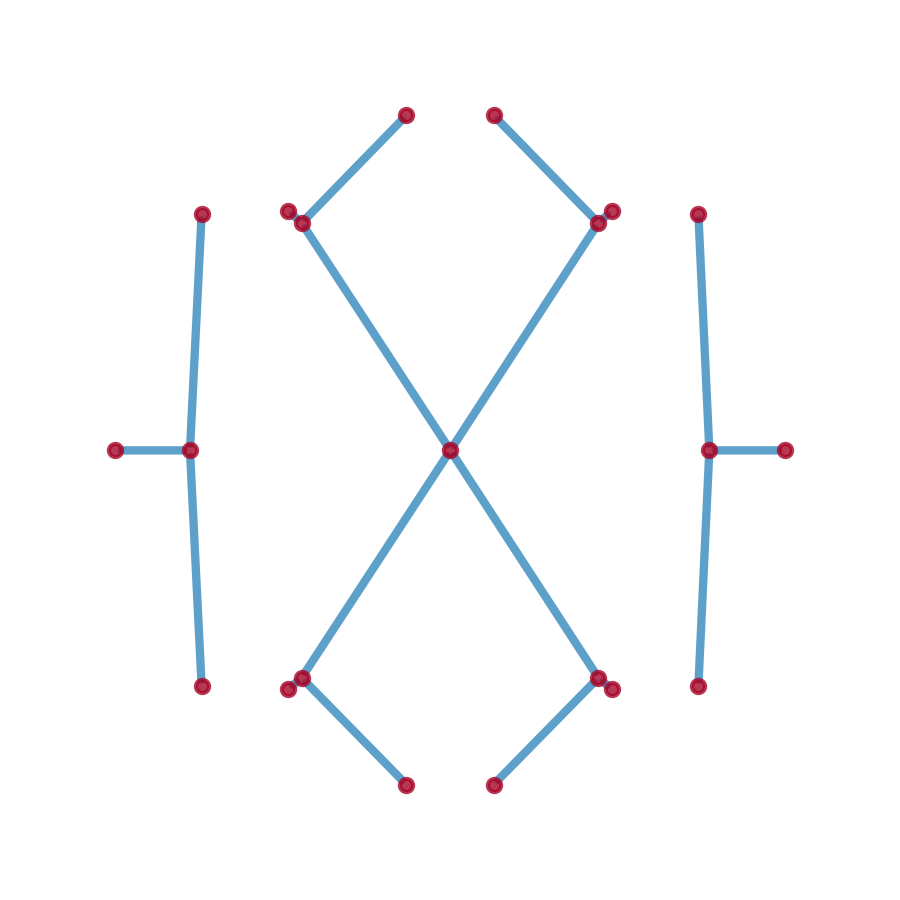
The spectral graph $\mathcal{G}$
graph_multi = sg_multi.spectral_graph(
    device='/gpu:0', # default is '/cpu:0'
    short_edge_threshold=20,
    # ^ node pairs or edges with distance < threshold pixels are merged
)

fig, ax = plt.subplots(figsize=(3, 3))
pos_multi = nx.get_node_attributes(graph_multi, 'pos')
nx.draw(graph_multi, pos_multi, ax=ax,
        node_size=10, node_color='#A60628',
        edge_color='#348ABD', width=2, alpha=0.8)
plt.tight_layout(); plt.show()
Node and Edge Attributes of the Spectral Graph Object
The spectral graph is a networkx.MultiGraph object.
- Node Attributes
pos: (2,)-numpy array- the position of the node $(\text{Re}(E), \text{Im}(E))$
dos: float- the density of states at the node
potential: float- the spectral potential at the node
- Edge Attributes
weight: float- the weight of the edge, which is the length of the edge in the complex energy plane
pts: (w, 2)-numpy array- the positions of the points constituting the edge, where
wis the number of points along the edge, i.e., the length of the edge, equalsweight
- the positions of the points constituting the edge, where
avg_dos: float- the average density of states along the edge
avg_potential: float- the average spectral potential along the edge
node_attr = dict(graph.nodes(data=True))
edge_attr = list(graph.edges(data=True))
print('The attributes of the first node\n', node_attr[0], '\n')
print('The attributes of the first edge\n', edge_attr[0][-1], '\n')
>>>
The attributes of the first node
 {'pos': array([-0.20403848, -2.11668106]),
  'dos': 0.0011466597206890583,
  'potential': -0.655870258808136}

The attributes of the first edge
 {'weight': 1.4176547247784077,
  'pts': array([[-2.04038482e-01, -2.11668106e+00],
       [-1.99792382e-01, -2.11243496e+00],
       ...
       [ 5.94228396e-01, -1.02967935e+00]]),
  'avg_dos': 0.10761458,
  'avg_potential': -0.5068641}
Release history Release notifications | RSS feed


Download files
Download the file for your platform. If you're not sure which to choose, learn more about installing packages.
Source Distribution
Built Distribution
Filter files by name, interpreter, ABI, and platform.
If you're not sure about the file name format, learn more about wheel file names.
Copy a direct link to the current filters
File details
Details for the file poly2graph-0.1.0.tar.gz.
File metadata
- Download URL: poly2graph-0.1.0.tar.gz
- Upload date:
- Size: 3.2 MB
- Tags: Source
- Uploaded using Trusted Publishing? No
- Uploaded via: python-httpx/0.28.1
File hashes
| Algorithm | Hash digest | |
|---|---|---|
| SHA256 |
fb7354d5a12edcd87ee9a8bb612cc3bbc5c65317cb1197f64523afb74709e768
|
|
| MD5 |
76c33ef09f9da2f3f1e865a87bc2fe5a
|
|
| BLAKE2b-256 |
5e53a595ca5a0b842cb0ac0f60f104c0ef37a1057f3b484ae00eb90c74bb174b
|
File details
Details for the file poly2graph-0.1.0-py3-none-any.whl.
File metadata
- Download URL: poly2graph-0.1.0-py3-none-any.whl
- Upload date:
- Size: 29.8 kB
- Tags: Python 3
- Uploaded using Trusted Publishing? No
- Uploaded via: python-httpx/0.28.1
File hashes
| Algorithm | Hash digest | |
|---|---|---|
| SHA256 |
1df759b43b5822fca4952633ef99b38e19f54d77eca5493ed39c595254dae2dd
|
|
| MD5 |
f2cb42a6995e93f540f2f447265166dd
|
|
| BLAKE2b-256 |
99f47a68d267b3cfb02a346028417b8a6643c39a0c8bfa19978a0f856a093c6a
|






