
Automated Non-Hermitian Spectral Graph Construction

Project description
Poly2Graph



Poly2Graph is a Python package for automatic Hamiltonian spectral graph construction. It takes in the characteristic polynomial and returns the spectral graph.
Topological physics is one of the most dynamic and rapidly advancing fields in modern physics. Conventionally, topological classification focuses on eigenstate windings, a concept central to Hermitian topological lattices (e.g., topological insulators). Beyond such notion of topology, we unravel a distinct and diverse graph topology emerging in 1D crystal's energy spectra (under open boundary condition). Particularly, for non-Hermitian crystals, their spectral graphs features a kaleidoscope of exotic shapes like stars, kites, insects, and braids.
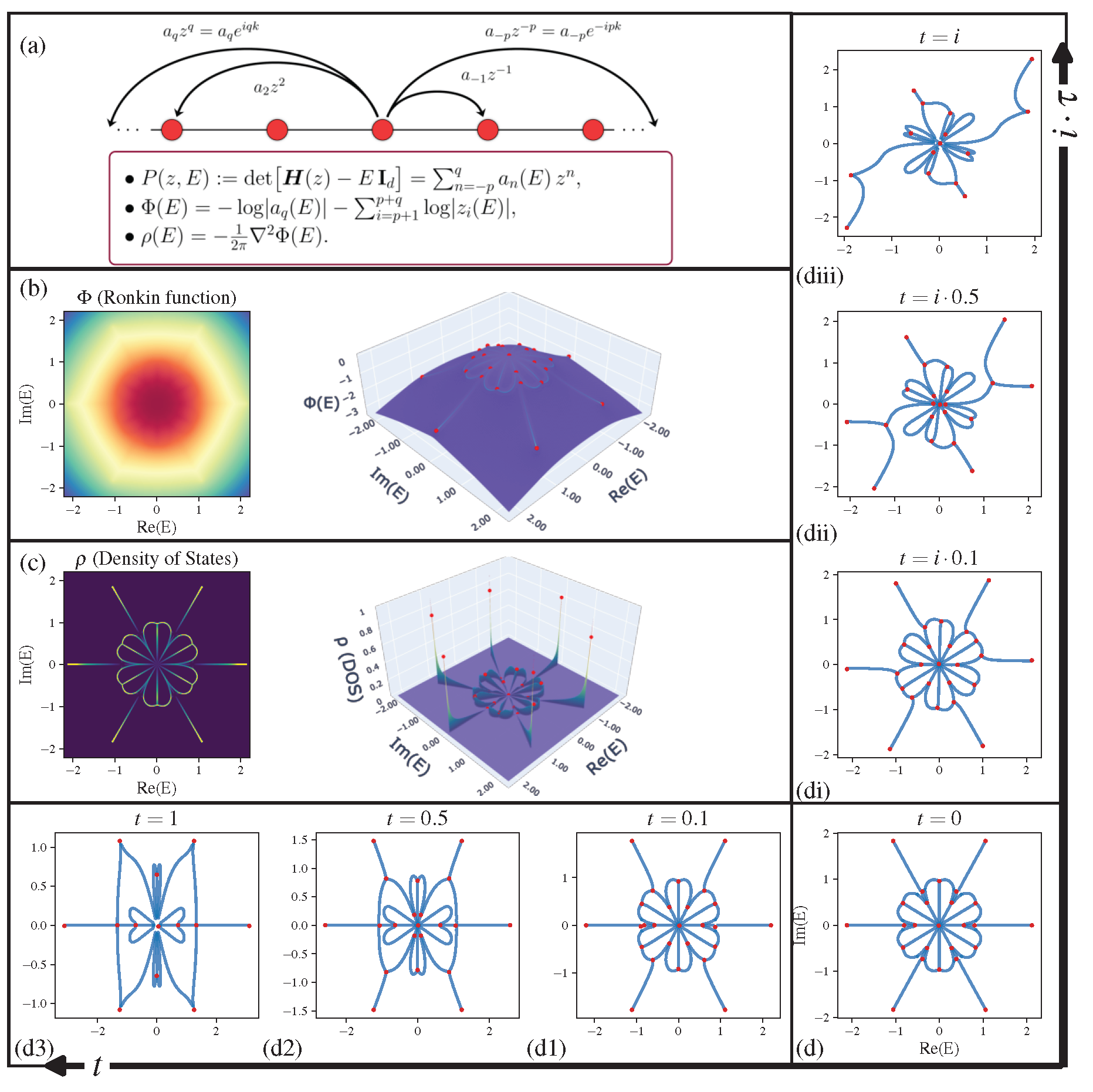
Figure: Poly2Graph Pipeline — (a) Starting from a 1-D crystal Hamiltonian $H(z)$ in momentum space — or, equivalently, its characteristic polynomial $P(z,E)=\det[\mathbf{H}(z)-E\mathbf{I}]$. The crystal’s open-boundary spectrum solely depends on $P(z,E)$. (b) The spectral potential $\Phi(E)$ (Ronkin function) is computed from the roots of $P(z,E)=0$, following recent advances in non-Bloch band theory. (c) The density of states $\rho(E)$ is obtained as the Laplacian of $\Phi(E)$. (d) The spectral graph is extracted from $\rho(E)$ via a morphological computer-vision pipeline. Varying the coefficients of $P(z,E)$ produces diverse graph morphologies in the real domain (d1)–(d3) and imaginary domain (di)–(diii).
Features
- Poly2Graph
- High-performance
- Fast construction of spectral graph from any one-dimensional models
- Adaptive resolution to reduce floating operation cost and memory usage
- Automatic backend for computation bottleneck. If
tensorflow/torchis available, any device (e.g. '/GPU:0', '/TPU:0', 'cuda:0', etc.) that they support can be used for acceleration.
- Cover generic topological lattices
- Support generic one-band and multi-band models
- Flexible multiple input choices, be they characteristic polynomials or Bloch Hamiltonians; formats include strings,
sympy.Poly, andsympy.Matrix
- Automatic and Robust
- By default, no hyper-parameters are needed. Just input the characteristic of your model and
poly2graphhandles the rest - Automatic spectral boundary inference
- Relatively robust on multiband models that are prone to "component fragmentation"
- By default, no hyper-parameters are needed. Just input the characteristic of your model and
- Helper functionalities generally useful
skeleton2graphmodule: Convert a skeleton image to its graph representationhamiltonianmodule: Conversion among different Hamiltonian representations and efficient computation of a range of properties
- High-performance
Installation
You can install the package via pip:
$ pip install poly2graph
or clone the repository and install it manually:
$ git clone https://github.com/sarinstein-yan/poly2graph.git
$ cd poly2graph
$ pip install .
Optionally, if TensorFlow or PyTorch is available, poly2graph will make use of them automatically to accelerate the computation bottleneck. Priority: tensorflow > torch > numpy.
This module is tested on Python >= 3.11.
Check the installation:
import poly2graph as p2g
print(p2g.__version__)
Usage
See the Poly2Graph Tutorial JupyterNotebook.
p2g.SpectralGraph and p2g.CharPolyClass are the two main classes in the package.
p2g.SpectralGraph investigates the spectral graph topology of a specific given characteristic polynomial or Bloch Hamiltonian. p2g.CharPolyClass investigates a class of parametrized characteristic polynomials or Bloch Hamiltonians, and is optimized for generating spectral properties in parallel.
import numpy as np
import networkx as nx
import sympy as sp
import matplotlib.pyplot as plt

# always start by initializing the symbols for k, z, and E
k = sp.symbols('k', real=True)
z, E = sp.symbols('z E', complex=True)
A generic one-band example (p2g.SpectralGraph):
characteristic polynomial:
$$P(E,z) := h(z) - E = z^4 -z -z^{-2} -E$$
Its Bloch Hamiltonian (Fourier transformed Hamiltonian in momentum space) is a scalar function:
$$h(z) = z^4 - z - z^{-2}$$
where the phase factor is defined as $z:=e^{ik}$.
Expressed in terms of crystal momentum $k$:
$$h(k) = e^{4ik} - e^{ik} - e^{-2ik}$$
The valid input formats to initialize a p2g.SpectralGraph object are:
- Characteristic polynomial in terms of
zandE:- as a string of the Poly in terms of
zandE - as a
sympy.Polywith {z,1/z,E} as generators
- as a string of the Poly in terms of
- Bloch Hamiltonian in terms of
korz- as a
sympy.Matrixin terms ofk - as a
sympy.Matrixin terms ofz
- as a
All the following characteristics are valid and will initialize to the same characteristic polynomial and therefore produce the same spectral graph:
char_poly_str = '-z**-2 - E - z + z**4'

char_poly_Poly = sp.Poly(
    -z**-2 - E - z + z**4,
    z, 1/z, E # generators are z, 1/z, E
)

phase_k = sp.exp(sp.I*k)
char_hamil_k = sp.Matrix([-phase_k**2 - phase_k + phase_k**4])

char_hamil_z = sp.Matrix([-z**-2 - E - z + z**4])
Let us just use the string to initialize and see a set of properties that are computed automatically:
sg = p2g.SpectralGraph(char_poly_str, k=k, z=z, E=E)
Characteristic polynomial:
sg.ChP
>>> $\text{Poly}{\left( z^{4} - z -\frac{1}{z^{2}} - E, ~ z, \frac{1}{z}, E, ~ domain=\mathbb{Z} \right)}$
Bloch Hamiltonian:
- For one-band model, it is a unique, rank-0 matrix (scalar)
sg.h_k
>>>
$$\begin{bmatrix}e^{4 i k} - e^{i k} - e^{- 2 i k}\end{bmatrix}$$
sg.h_z
>>>
$$\begin{bmatrix}- \frac{- z^{6} + z^{3} + 1}{z^{2}}\end{bmatrix}$$
The Frobenius companion matrix of P(E)(z):
- treating
Eas parameter andzas variable - Its eigenvalues are the roots of the characteristic polynomial at a fixed complex energy
E. Thus it is useful to calculate the GBZ (generalized Brillouin zone), the spectral potential (Ronkin function), etc.
sg.companion_E
>>>
$$\begin{bmatrix}0 & 0 & 0 & 0 & 0 & 1 \ 1 & 0 & 0 & 0 & 0 & 0 \ 0 & 1 & 0 & 0 & 0 & E \ 0 & 0 & 1 & 0 & 0 & 1 \ 0 & 0 & 0 & 1 & 0 & 0 \ 0 & 0 & 0 & 0 & 1 & 0\end{bmatrix}$$
Number of bands & hopping range:
print('Number of bands:', sg.num_bands)
print('Max hopping length to the right:', sg.poly_p)
print('Max hopping length to the left:', sg.poly_q)
>>>
Number of bands: 1
Max hopping length to the right: 2
Max hopping length to the left: 4
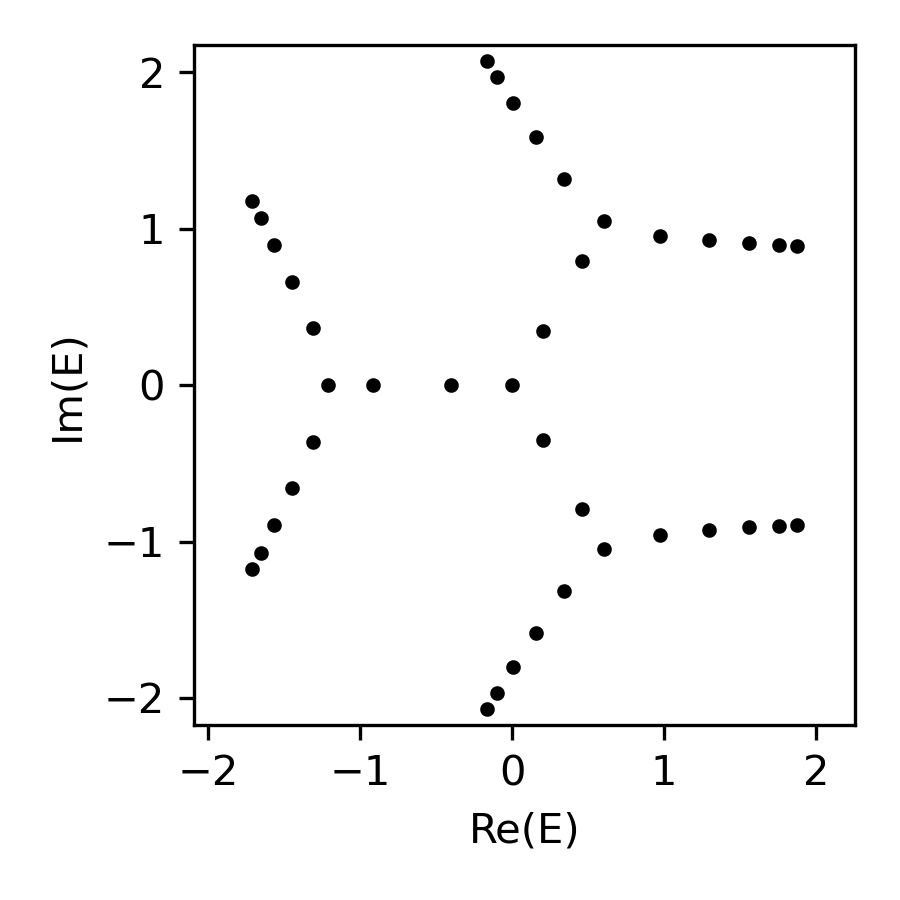
A real-space Hamiltonian of a finite chain and its energy spectrum:
H = sg.real_space_H(
    N=40,        # number of unit cells
    pbc=False,   # open boundary conditions
    max_dim=500  # maximum dimension of the Hamiltonian matrix (for numerical accuracy)
)

energy = np.linalg.eigvals(H)

fig, ax = plt.subplots(figsize=(3, 3))
ax.plot(energy.real, energy.imag, 'k.', markersize=5)
ax.set(xlabel='Re(E)', ylabel='Im(E)', \
xlim=sg.spectral_square[:2], ylim=sg.spectral_square[2:])
plt.tight_layout(); plt.show()
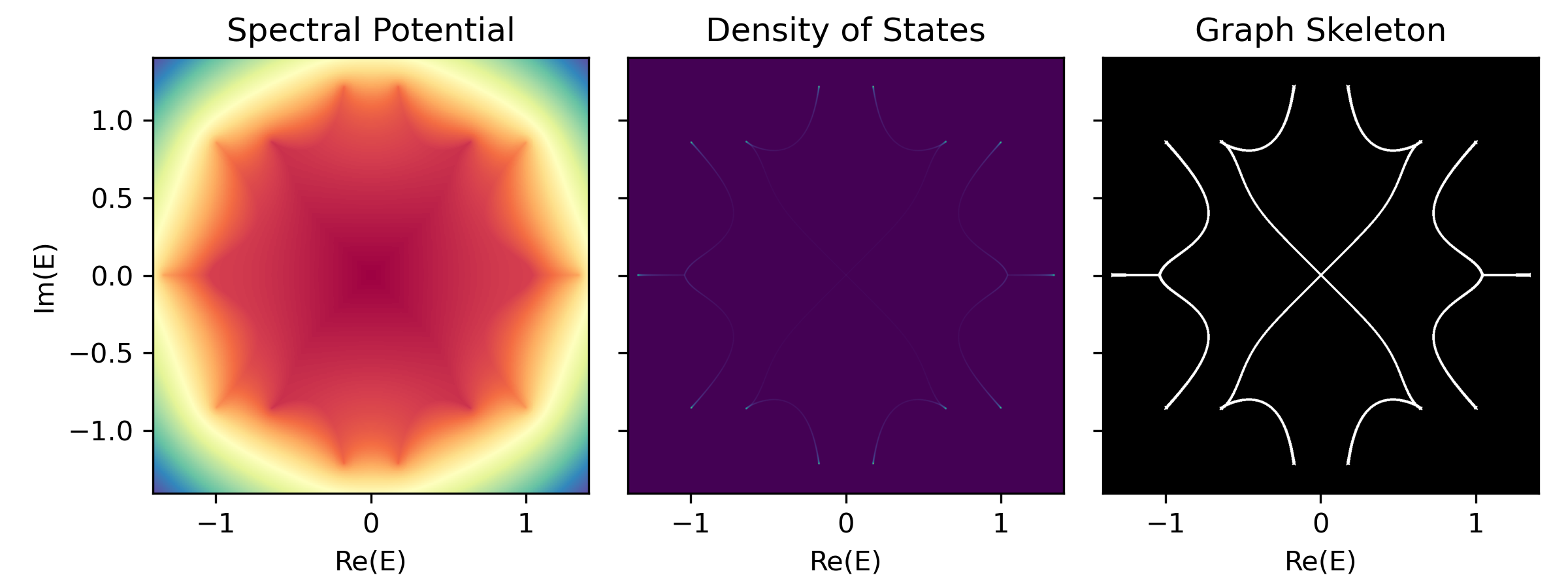
The Set of Spectral Functions
(whose values plotted on the complex energy square, returned as a 2D array)
-
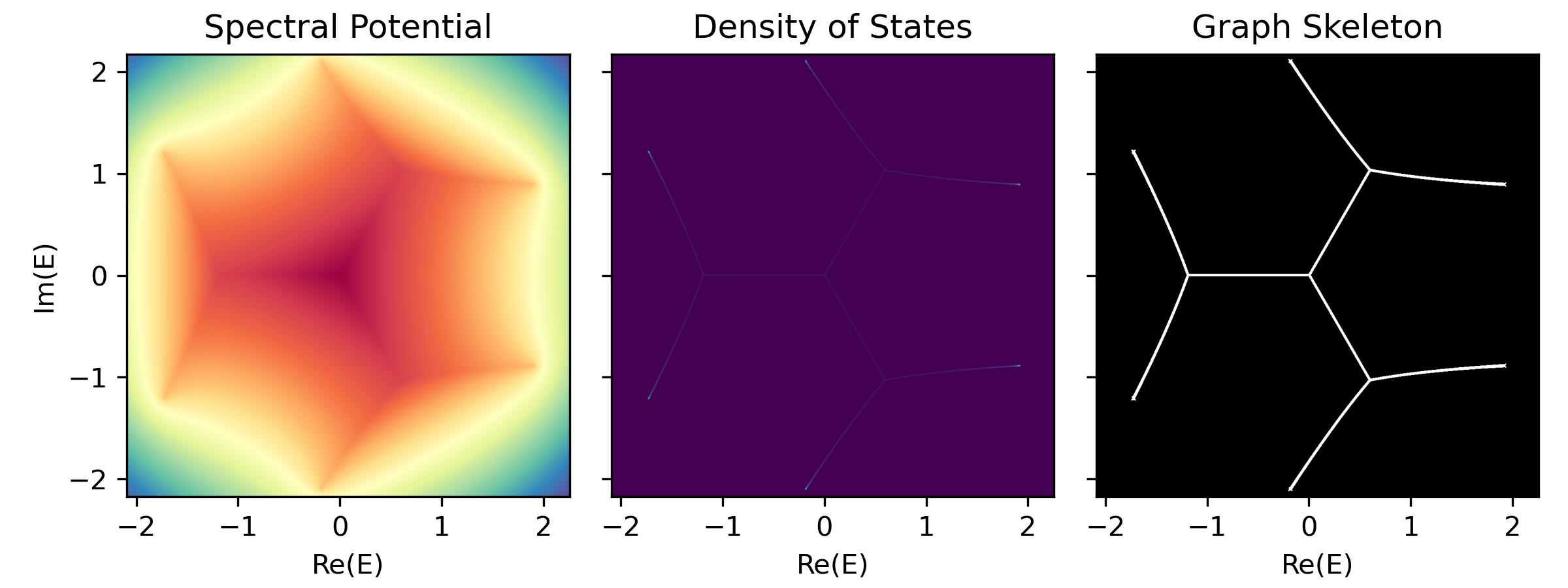
Density of States (DOS)
Defined as the number of states per unit energy area in the complex energy plane.
$$\rho(E) = \lim_{N\to\infty}\sum_n \frac{1}{N} \delta(E-\epsilon_n)$$
where $\epsilon_n$ are the eigenvalues of the Hamiltonian $H$.
Imagine to assign electric charge $1/N$ to each eigenvalue $\epsilon_n$, then the density of states $\rho(E)$ is treated as a charge density, therefore can be interpreted as the laplacian of a spectral potential $\Phi(E)$:
$$\rho(E) = -\frac{1}{2\pi} \Delta \Phi(E)$$
$\Delta = \partial_{\text{Re} E}^2 + \partial_{\text{Im} E}^2$ is the Laplacian operator on the complex energy plane. Laplacian operator extracts curvature; thus, geometrically speaking, the loci of spectral graph $\mathcal{G}$ resides on the ridges of the Coulomb potential landscape.
-
Spectral Potential (Ronkin function)
It can be proven that the spectral potential $\Phi(E)$ can be efficiently computed from the roots $|z_i(E)|$ of the characteristic polynomial $P(E)(z)$ and the leading coefficient $a_q(E)$ at a complex energy $E$:
$$\Phi(E) = - \lim_{N\to\infty} \sum_{\epsilon_n} \log|E-\epsilon_n| \ = - \int \rho(E')\log|E-E'| d^2E' \ = - \log|a_q(E)| - \sum_{i=p+1}^{p+q} \log|z_i(E)|$$
-
Graph Skeleton (Binarized DOS)
phi, dos, binaried_dos = sg.spectral_images()

fig, axes = plt.subplots(1, 3, figsize=(8, 3), sharex=True, sharey=True)
axes[0].imshow(phi, extent=sg.spectral_square, cmap='terrain')
axes[0].set(xlabel='Re(E)', ylabel='Im(E)', title='Spectral Potential')
axes[1].imshow(dos, extent=sg.spectral_square, cmap='viridis')
axes[1].set(xlabel='Re(E)', title='Density of States')
axes[2].imshow(binaried_dos, extent=sg.spectral_square, cmap='gray')
axes[2].set(xlabel='Re(E)', title='Graph Skeleton')
plt.tight_layout()
plt.show()
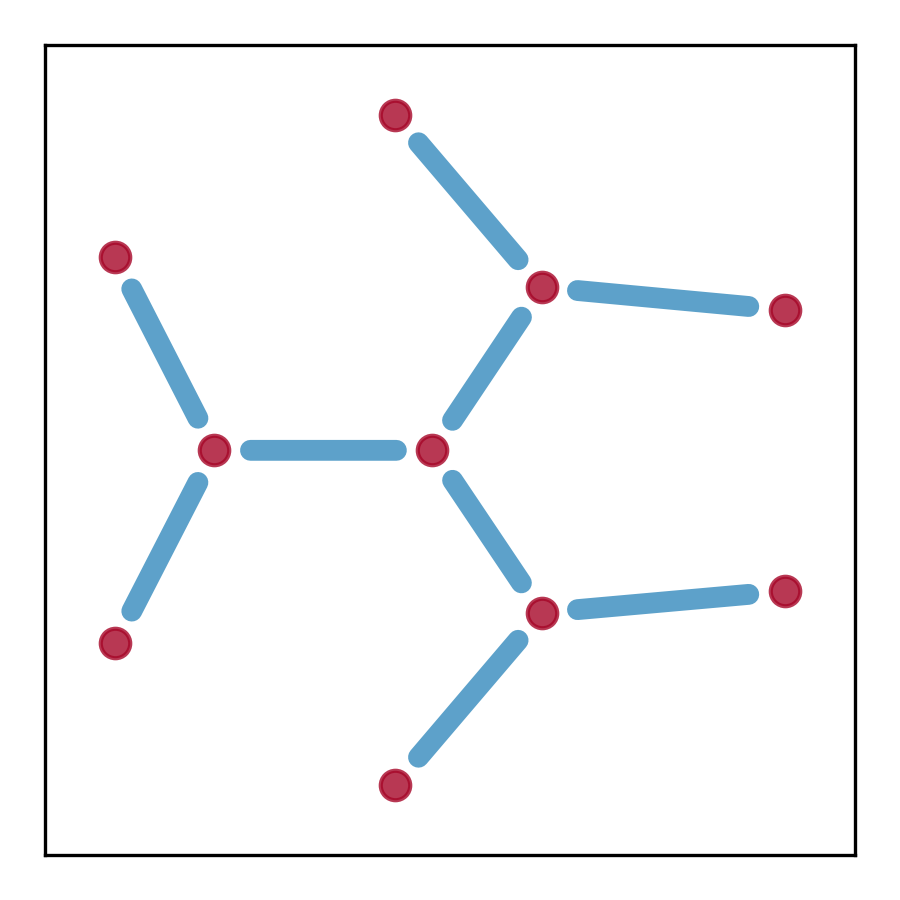
The spectral graph $\mathcal{G}$
graph = sg.spectral_graph()

fig, ax = plt.subplots(figsize=(3, 3))
pos = nx.get_node_attributes(graph, 'pos')
nx.draw_networkx_nodes(graph, pos, alpha=0.8, ax=ax,
            node_size=50, node_color='#A60628')
nx.draw_networkx_edges(graph, pos, alpha=0.8, ax=ax,
            width=5, edge_color='#348ABD')
plt.tight_layout(); plt.show()
[!TIP] If
tensorflowortorchis available,poly2graphwill automatically use them and run on CPU by default. If other device, e.g. GPU / TPU is available, one can passdevice = {device string}to the methodspectral_imagesandspectral_graph:SpectralGraph.spectral_images(device='/cpu:0') SpectralGraph.spectral_graph(device='/gpu:1') SpectralGraph.spectral_images(device='cpu') SpectralGraph.spectral_graph(device='cuda:0') ...However, some functions may not have gpu kernel in
tf/torch, in which case the computation will fallback to CPU.
A generic multi-band example (p2g.SpectralGraph):
characteristic polynomial (four bands):
$$P(E,z) := \det(\textbf{h}(z) - E;\textbf{I}) = z^2 + 1/z^2 + E z - E^4$$
One of its possible Bloch Hamiltonians in terms of $z$:
$$\textbf{h}(z)=\begin{bmatrix} 0 & 0 & 0 & z^2 + 1/z^2 \ 1 & 0 & 0 & z \ 0 & 1 & 0 & 0 \ 0 & 0 & 1 & 0 \ \end{bmatrix}$$
sg_multi = p2g.SpectralGraph("z**2 + 1/z**2 + E*z - E**4", k, z, E)
Characteristic polynomial:
sg_multi.ChP
>>> $\text{Poly}{\left( z^{2} + zE + \frac{1}{z^{2}} - E^{4}, ~ z, \frac{1}{z}, E, ~ domain=\mathbb{Z} \right)}$
Bloch Hamiltonian:
- For multi-band model, if the
p2g.SpectralGraphis not initialized with asympyMatrix, thenpoly2graphwill use the companion matrix of the characteristic polynomialP(z)(E)(treatingzas parameter andEas variable) as the Bloch Hamiltonian -- this is one of the set of possible band Hamiltonians that possesses the same energy spectrum and thus the same spectral graph.
sg_multi.h_k
>>>
$$\begin{bmatrix}0 & 0 & 0 & 2 \cos{\left(2 k \right)} \ 1 & 0 & 0 & e^{i k} \ 0 & 1 & 0 & 0 \ 0 & 0 & 1 & 0\end{bmatrix}$$
sg_multi.h_z
>>>
$$\begin{bmatrix}0 & 0 & 0 & z^{2} + \frac{1}{z^{2}} \ 1 & 0 & 0 & z \ 0 & 1 & 0 & 0 \ 0 & 0 & 1 & 0\end{bmatrix}$$
The Frobenius companion matrix of P(E)(z):
sg_multi.companion_E
>>>
$$\begin{bmatrix}0 & 0 & 0 & -1 \ 1 & 0 & 0 & 0 \ 0 & 1 & 0 & E^{4} \ 0 & 0 & 1 & - E\end{bmatrix}$$
Number of bands & hopping range:
print('Number of bands:', sg_multi.num_bands)
print('Max hopping length to the right:', sg_multi.poly_p)
print('Max hopping length to the left:', sg_multi.poly_q)
>>>
Number of bands: 4
Max hopping length to the right: 2
Max hopping length to the left: 2
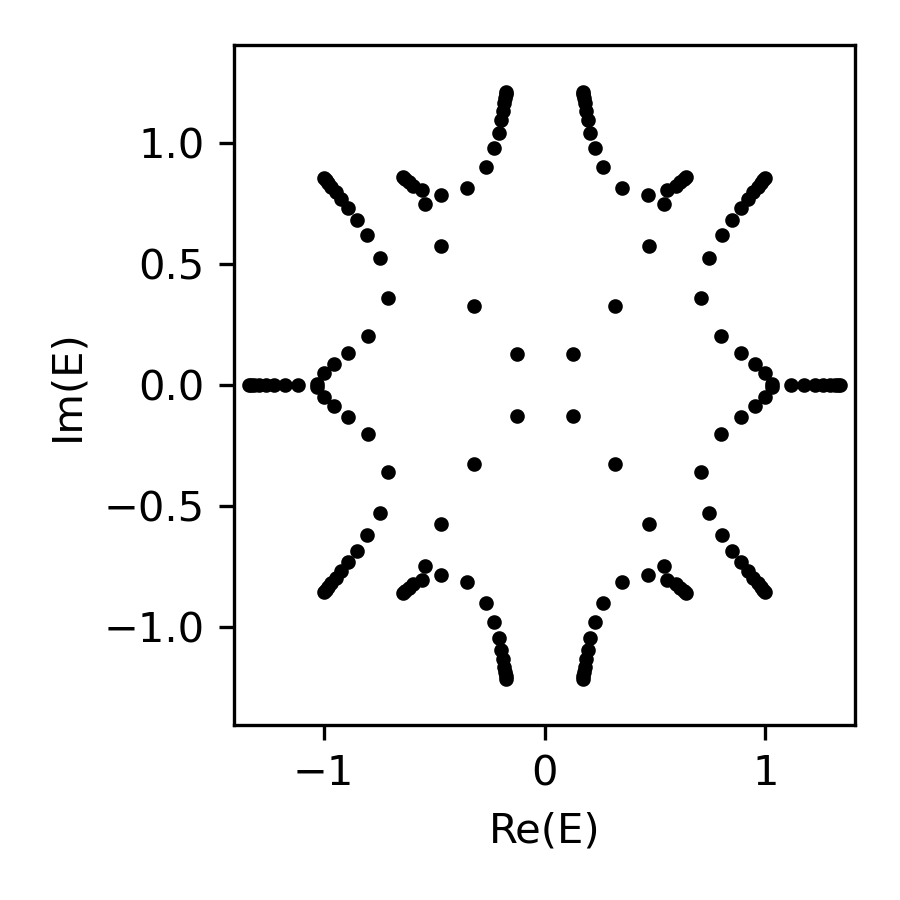
A real-space Hamiltonian of a finite chain and its energy spectrum:
H_multi = sg_multi.real_space_H(
    N=40,        # number of unit cells
    pbc=False,   # open boundary conditions
    max_dim=500  # maximum dimension of the Hamiltonian matrix (for numerical accuracy)
)

energy_multi = np.linalg.eigvals(H_multi)

fig, ax = plt.subplots(figsize=(3, 3))
ax.plot(energy_multi.real, energy_multi.imag, 'k.', markersize=5)
ax.set(xlabel='Re(E)', ylabel='Im(E)', \
xlim=sg_multi.spectral_square[:2], ylim=sg_multi.spectral_square[2:])
plt.tight_layout(); plt.show()
The Set of Spectral Functions
phi_multi, dos_multi, binaried_dos_multi = sg_multi.spectral_images(device='/cpu:0')

fig, axes = plt.subplots(1, 3, figsize=(8, 3), sharex=True, sharey=True)
axes[0].imshow(phi_multi, extent=sg_multi.spectral_square, cmap='terrain')
axes[0].set(xlabel='Re(E)', ylabel='Im(E)', title='Spectral Potential')
axes[1].imshow(dos_multi, extent=sg_multi.spectral_square, cmap='viridis')
axes[1].set(xlabel='Re(E)', title='Density of States')
axes[2].imshow(binaried_dos_multi, extent=sg_multi.spectral_square, cmap='gray')
axes[2].set(xlabel='Re(E)', title='Graph Skeleton')
plt.tight_layout(); plt.show()
The spectral graph $\mathcal{G}$
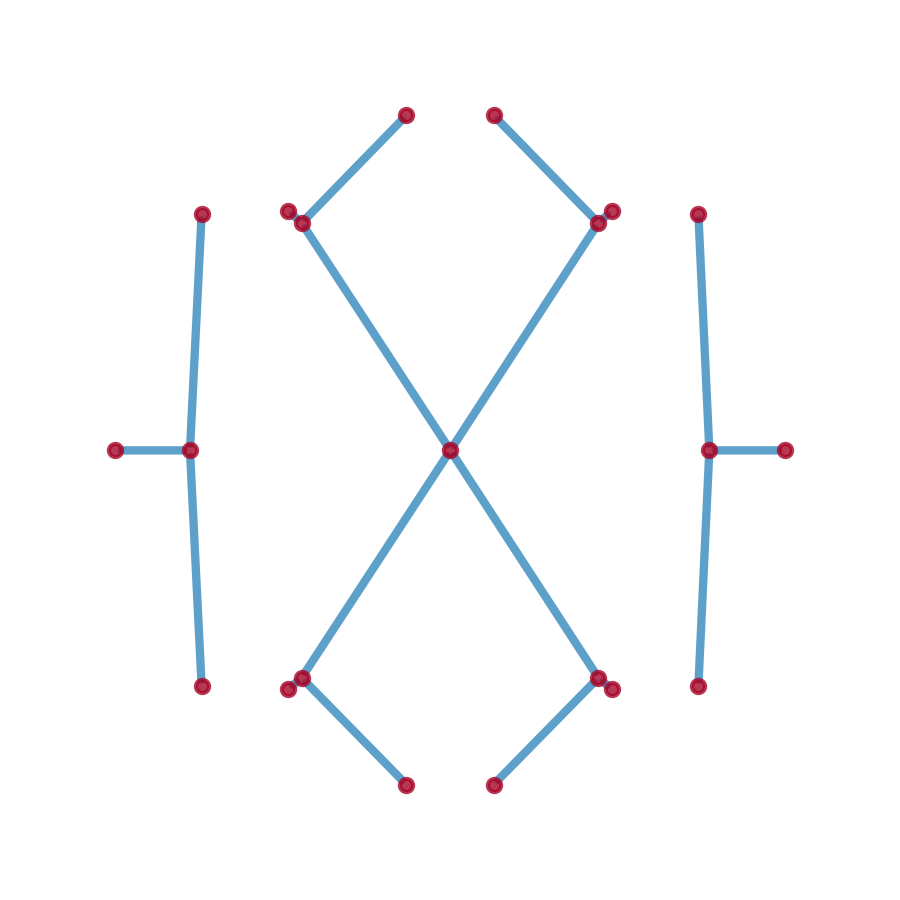
graph_multi = sg_multi.spectral_graph(
    short_edge_threshold=20,
    # ^ node pairs or edges with distance < threshold pixels are merged
)

fig, ax = plt.subplots(figsize=(3, 3))
pos_multi = nx.get_node_attributes(graph_multi, 'pos')
nx.draw(graph_multi, pos_multi, ax=ax,
        node_size=10, node_color='#A60628',
        edge_color='#348ABD', width=2, alpha=0.8)
plt.tight_layout(); plt.show()
Node and Edge Attributes of the Spectral Graph Object
The spectral graph is a networkx.MultiGraph object.
- Node Attributes
pos: (2,)-numpy array- the position of the node $(\text{Re}(E), \text{Im}(E))$
dos: float- the density of states at the node
potential: float- the spectral potential at the node
- Edge Attributes
weight: float- the weight of the edge, which is the length of the edge in the complex energy plane
pts: (w, 2)-numpy array- the positions of the points constituting the edge, where
wis the number of points along the edge, i.e., the length of the edge, equalsweight
- the positions of the points constituting the edge, where
avg_dos: float- the average density of states along the edge
avg_potential: float- the average spectral potential along the edge
node_attr = dict(graph.nodes(data=True))
edge_attr = list(graph.edges(data=True))
print('The attributes of the first node\n', node_attr[0], '\n')
print('The attributes of the first edge\n', edge_attr[0][-1], '\n')
>>>
The attributes of the first node
 {'pos': array([-0.20403848, -2.11668106]),
  'dos': 0.0011466597206890583,
  'potential': -0.655870258808136}

The attributes of the first edge
 {'weight': 1.4176547247784077,
  'pts': array([[-2.04038482e-01, -2.11668106e+00],
       [-1.99792382e-01, -2.11243496e+00],
       ...
       [ 5.94228396e-01, -1.02967935e+00]]),
  'avg_dos': 0.10761458,
  'avg_potential': -0.5068641}
A generic multi-band class (p2g.CharPolyClass):
Let us add two parameters {a,b} to the aforementioned multi-band example and construct a p2g.CharPolyClass object:
a, b = sp.symbols('a b', real=True)

cp = p2g.CharPolyClass(
    "z**2 + a/z**2 + b*E*z - E**4",
    k=k, z=z, E=E,
    params={a, b}, # pass parameters as a set
)
>>>
Derived Bloch Hamiltonian `h_z` with 4 bands.
View a few auto-computed properties
Characteristic polynomial:
cp.ChP
>>> $\text{Poly}{\left( z^{2} + a \frac{1}{z^{2}} + b zE - E^{4}, z, \frac{1}{z}, E, domain=\mathbb{Z}\left[a, b\right] \right)}$
Bloch Hamiltonian:
cp.h_k
>>>
$$\begin{bmatrix} 0 & 0 & 0 & (a + e^{4 i k})e^{- 2 i k} \ 1 & 0 & 0 & b e^{i k} \ 0 & 1 & 0 & 0 \ 0 & 0 & 1 & 0 \end{bmatrix}$$
cp.h_z
>>>
$$\begin{bmatrix} 0 & 0 & 0 & \frac{a}{z^{2}} + z^{2} \ 1 & 0 & 0 & b z \ 0 & 1 & 0 & 0 \ 0 & 0 & 1 & 0 \end{bmatrix}$$
The Frobenius companion matrix of P(E)(z):
cp.companion_E
>>>
$$\begin{bmatrix} 0 & 0 & 0 & -a \ 1 & 0 & 0 & 0 \ 0 & 1 & 0 & E^{4} \ 0 & 0 & 1 & - E b \end{bmatrix}$$
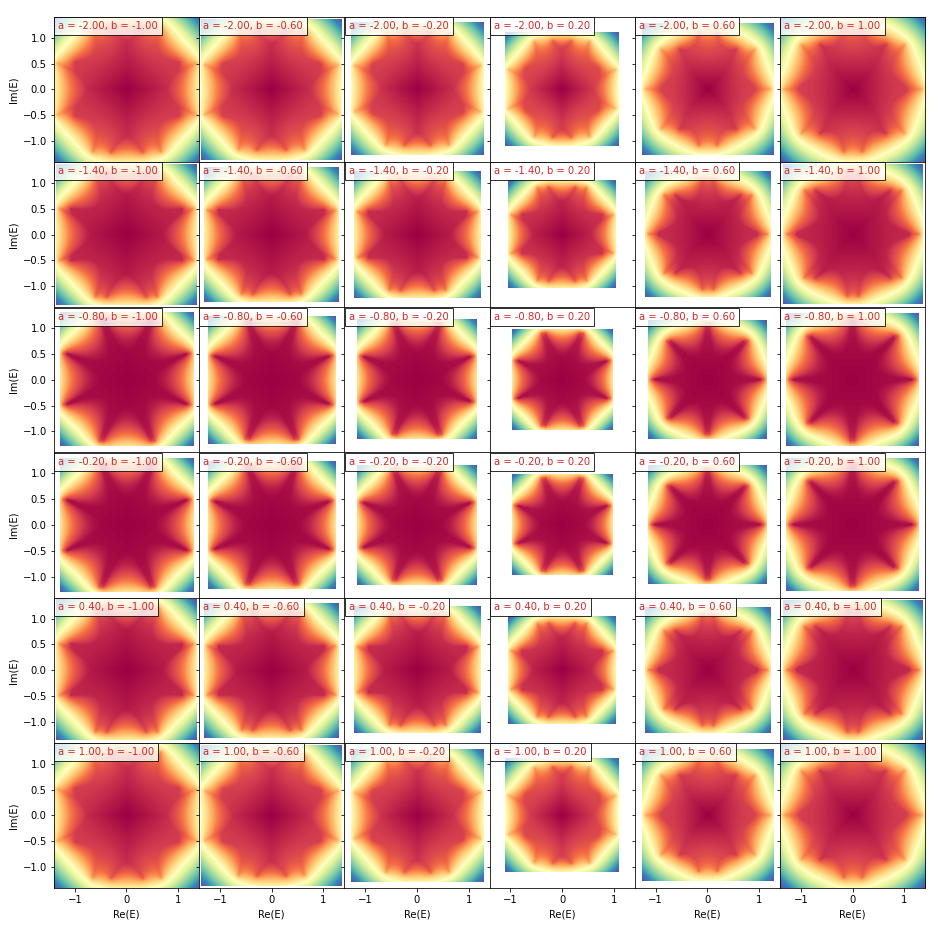
An Array of Spectral Functions
To get an array of spectral images or spectral graphs, we first prepare the values of the parameters {a,b}
a_array = np.linspace(-2, 1, 6)
b_array = np.linspace(-1, 1, 6)
a_grid, b_grid = np.meshgrid(a_array, b_array)
param_dict = {a: a_grid, b: b_grid}
print('a_grid shape:', a_grid.shape,
    '\nb_grid shape:', b_grid.shape)
>>>
a_grid shape: (6, 6)
b_grid shape: (6, 6)
Note that the value array of the parameters should have the same shape, which is also the shape of the output array of spectral images
phi_arr, dos_arr, binaried_dos_arr, spectral_square = \
    cp.spectral_images(param_dict=param_dict)
print('phi_arr shape:', phi_arr.shape,
    '\ndos_arr shape:', dos_arr.shape,
    '\nbinaried_dos_arr shape:', binaried_dos_arr.shape)
>>>
phi_arr shape: (6, 6, 1024, 1024)
dos_arr shape: (6, 6, 1024, 1024)
binaried_dos_arr shape: (6, 6, 1024, 1024)
from mpl_toolkits.axes_grid1 import ImageGrid

fig = plt.figure(figsize=(13, 13))
grid = ImageGrid(fig, 111, nrows_ncols=(6, 6), axes_pad=0,
                 label_mode='L', share_all=True)

for ax, (i, j) in zip(grid, [(i, j) for i in range(6) for j in range(6)]):
    ax.imshow(phi_arr[i, j], extent=spectral_square[i, j], cmap='terrain')
    ax.set(xlabel='Re(E)', ylabel='Im(E)')
    ax.text(
        0.03, 0.97, f'a = {a_array[i]:.2f}, b = {b_array[j]:.2f}',
        ha='left', va='top', transform=ax.transAxes,
        fontsize=10, color='tab:red',
        bbox=dict(alpha=0.8, facecolor='white')
    )

plt.tight_layout()
plt.savefig('./assets/ChP_spectral_potential_grid.png', dpi=72)
plt.show()
An Array of Spectral Graphs
graph_flat, param_dict_flat = cp.spectral_graph(param_dict=param_dict)
print(graph_flat, '\n')
print(param_dict_flat)
[<networkx.classes.multigraph.MultiGraph object at 0x000001966DFCD190>,
<networkx.classes.multigraph.MultiGraph object at 0x000001966DFCECF0>,
...
<networkx.classes.multigraph.MultiGraph object at 0x000001966DFCE750>]

{a:
array([-2. , -1.4, -0.8, -0.2,  0.4,  1. , -2. , -1.4, -0.8, -0.2,  0.4,
        1. , -2. , -1.4, -0.8, -0.2,  0.4,  1. , -2. , -1.4, -0.8, -0.2,
        0.4,  1. , -2. , -1.4, -0.8, -0.2,  0.4,  1. , -2. , -1.4, -0.8,
       -0.2,  0.4,  1. ]),
b:
array([-1. , -1. , -1. , -1. , -1. , -1. , -0.6, -0.6, -0.6, -0.6, -0.6,
       -0.6, -0.2, -0.2, -0.2, -0.2, -0.2, -0.2,  0.2,  0.2,  0.2,  0.2,
        0.2,  0.2,  0.6,  0.6,  0.6,  0.6,  0.6,  0.6,  1. ,  1. ,  1. ,
        1. ,  1. ,  1. ])}
[!NOTE] The spectral graph is a
networkx.MultiGraphobject, which cannot be directly returned as a multi-dimensional numpy array ofMultiGraph, except for the case of 1D array. Instead, we return a flattened list ofnetworkx.MultiGraphobjects, and the accompanyingparam_dict_flatis the dictionary that contains the corresponding flattened parameter values.
[!TIP] It's recommended to pass the values of the parameters as
vectors(1D arrays) instead of higher dimensionalND arraysto avoid the overhead of reshaping the output and the difficulty to retrieve / postprocess the spectral graphs.
Citation
If you find this work useful, please cite our paper:
@misc{yan2025hsg12mlargescalespatialmultigraph,
      title={HSG-12M: A Large-Scale Spatial Multigraph Dataset},
      author={Xianquan Yan and Hakan Akgün and Kenji Kawaguchi and N. Duane Loh and Ching Hua Lee},
      year={2025},
      eprint={2506.08618},
      archivePrefix={arXiv},
      primaryClass={cs.LG},
      url={https://arxiv.org/abs/2506.08618},
}
Release history Release notifications | RSS feed


Download files
Download the file for your platform. If you're not sure which to choose, learn more about installing packages.
Source Distribution
Built Distribution
Filter files by name, interpreter, ABI, and platform.
If you're not sure about the file name format, learn more about wheel file names.
Copy a direct link to the current filters
File details
Details for the file poly2graph-0.2.1.tar.gz.
File metadata
- Download URL: poly2graph-0.2.1.tar.gz
- Upload date:
- Size: 38.3 kB
- Tags: Source
- Uploaded using Trusted Publishing? No
- Uploaded via: Hatch/1.16.2 cpython/3.12.12 HTTPX/0.28.1
File hashes
| Algorithm | Hash digest | |
|---|---|---|
| SHA256 |
df6bbdc02cfc6798d2d02d01c9a6bf48650594f01c53fe1faf6c46707264d055
|
|
| MD5 |
e289f5b22f50643c9391ff400b487f60
|
|
| BLAKE2b-256 |
cfd539fcd4ac6cc9642cbd1a089d232eead5819b5770238703c4f8c69860ad6b
|
File details
Details for the file poly2graph-0.2.1-py3-none-any.whl.
File metadata
- Download URL: poly2graph-0.2.1-py3-none-any.whl
- Upload date:
- Size: 42.7 kB
- Tags: Python 3
- Uploaded using Trusted Publishing? No
- Uploaded via: Hatch/1.16.2 cpython/3.12.12 HTTPX/0.28.1
File hashes
| Algorithm | Hash digest | |
|---|---|---|
| SHA256 |
9e0205d4726d187d707d4929f13602dcc57740a6a11d6bc901655456559a42b2
|
|
| MD5 |
7b2052535614c2741be0fb1ec769a261
|
|
| BLAKE2b-256 |
465893e493b13b761b3f941c6c6381ea21076e6820831f7529133b7ce3ede2ca
|






