poseaudit





How far off are the joint angles, tilts and lengths you read from a pose model? OKS and mAP say whether the points land near the right place; poseaudit says whether the angle you compute from them is good enough to use. It judges your model against your labels as a scale is validated: bias (the mean offset), limits of agreement (where 95% of the differences fall), ICC (agreement, 1 at best) and how often it is off by too much.
Joint angles already computed (Pose2Sim, Sports2D, OpenSim, your own code) against motion
capture or a goniometer? poseaudit paired --table angles.csv --big-error 5 reads a long CSV
(subject, trial, frame, measure, pred, ref, unit; --column ref=Goniometer for other
names), and --pred-mot/--ref-mot read OpenSim .mot files, with intervals by subject (paired values).
What plain numpy misses
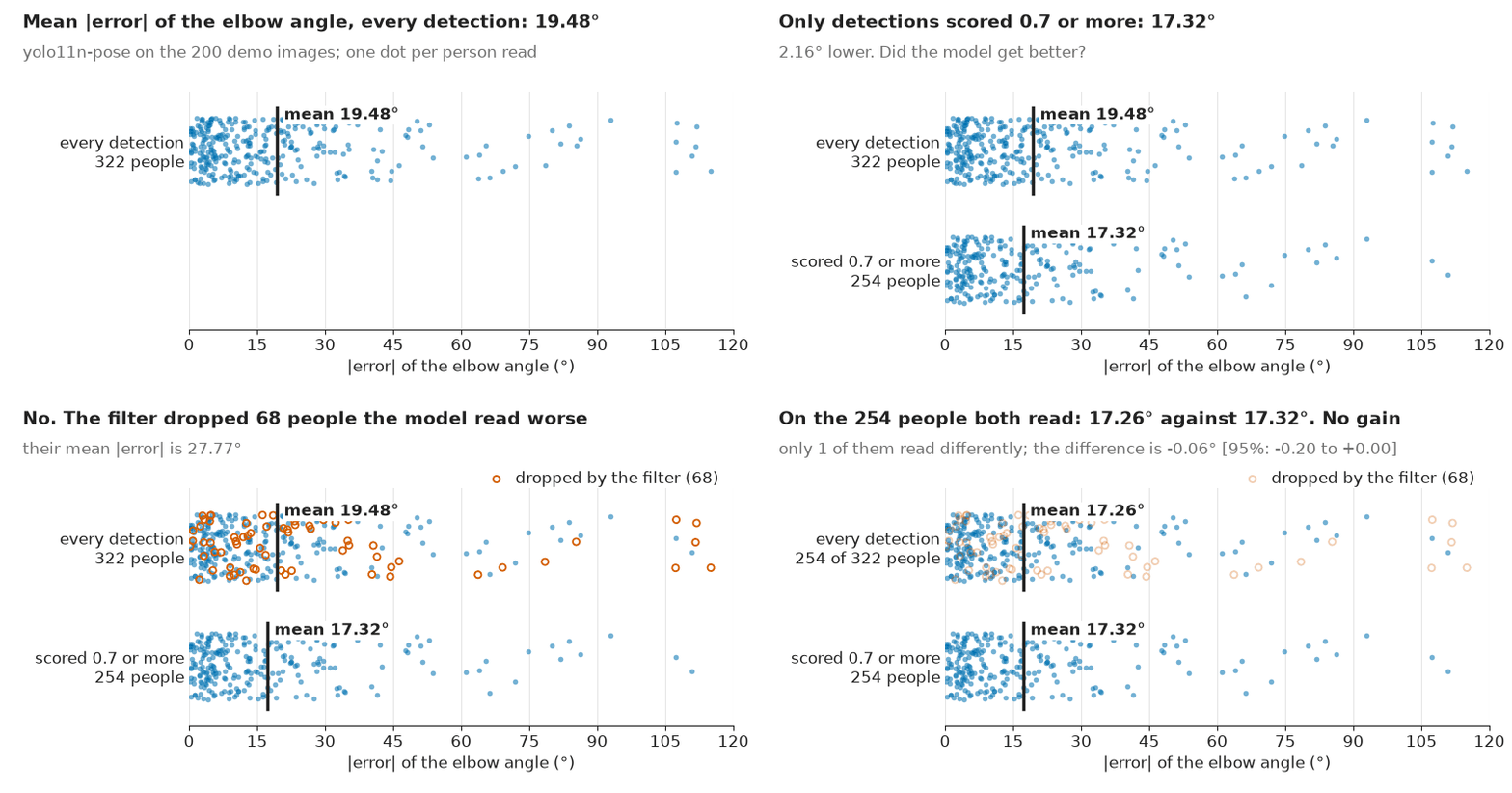
The mean |error| is one line of numpy. The work is around it (brackets are 95% intervals):
- Who was skipped. Keep only the detections
yolo11n-posescored 0.7 or more and its mean elbow error drops from 19.48° to 17.32°: the filter dropped 68 people it read worse. The 254 people both settings read were read alike but for one, and on them the difference, every detection minus filtered, is -0.06° [-0.20 to +0.00]. Models given as--pred a=a.json --pred b=b.jsonare compared the same way, on what both read. - Pairing. People are matched to labels image by image by box overlap; points left unlabelled in the truth stay out of the count instead of counting as errors.
- Honest intervals. Readings from one image, or from one subject with
--cluster, are resampled together. - Where it goes wrong. 58% of elbows disagree with COCO's labels by 15° or more when the arm segments average under 30 px, against 26% above 60 px. Across all arms 43% disagree, and the labels' own spread alone would put 25.9 to 39.9% there (statistics).
Install
python -m pip install poseaudit
That needs only NumPy and runs every audit. python -m pip install "poseaudit[plot]" adds
--plot (Matplotlib); the extra [images] adds --images, which reads YOLO image sizes
from the images (Pillow), and [supervision] adds pa.from_supervision.
Quick start
git clone https://github.com/8rulerstar/poseaudit   # the demo data (or GitHub's Code > Download ZIP)
cd poseaudit/examples/coco_elbow
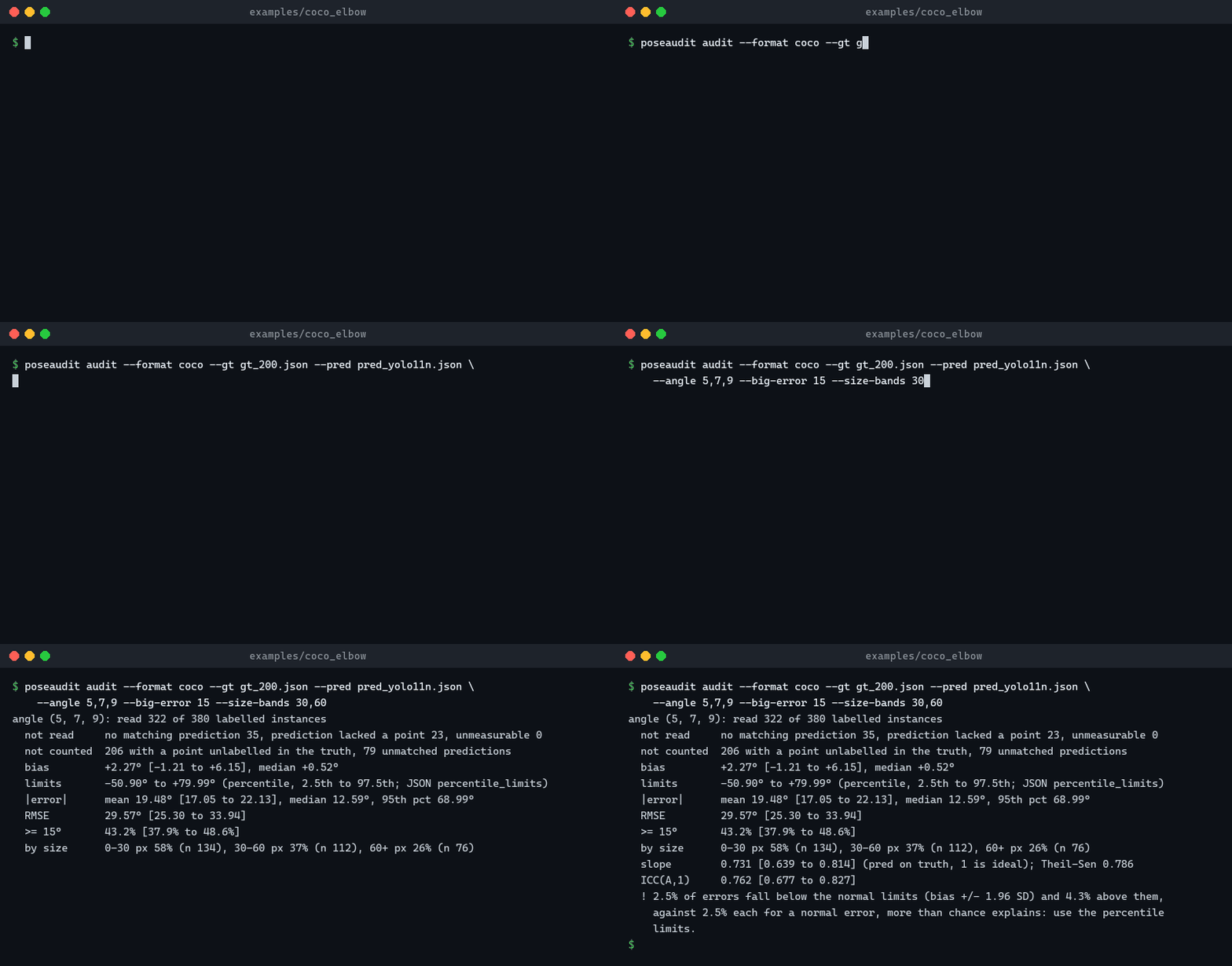
poseaudit audit --format coco --gt gt_200.json --pred pred_yolo11n.json --angle 5,7,9 --big-error 15 --size-bands 30,60
This prints the summary in the GIF above: the left elbow angle of yolo11n-pose against
COCO's labels on 200 val2017 images. Keypoints count from 0 in COCO's order (5, 7, 9: left
shoulder, elbow, wrist; 11, 13, 15: left hip, knee, ankle; each right-side point is one
higher). --big-error is required: the error that counts as large, in the measure's unit.
Add --report report.md for a report that explains every line, --full for every statistic
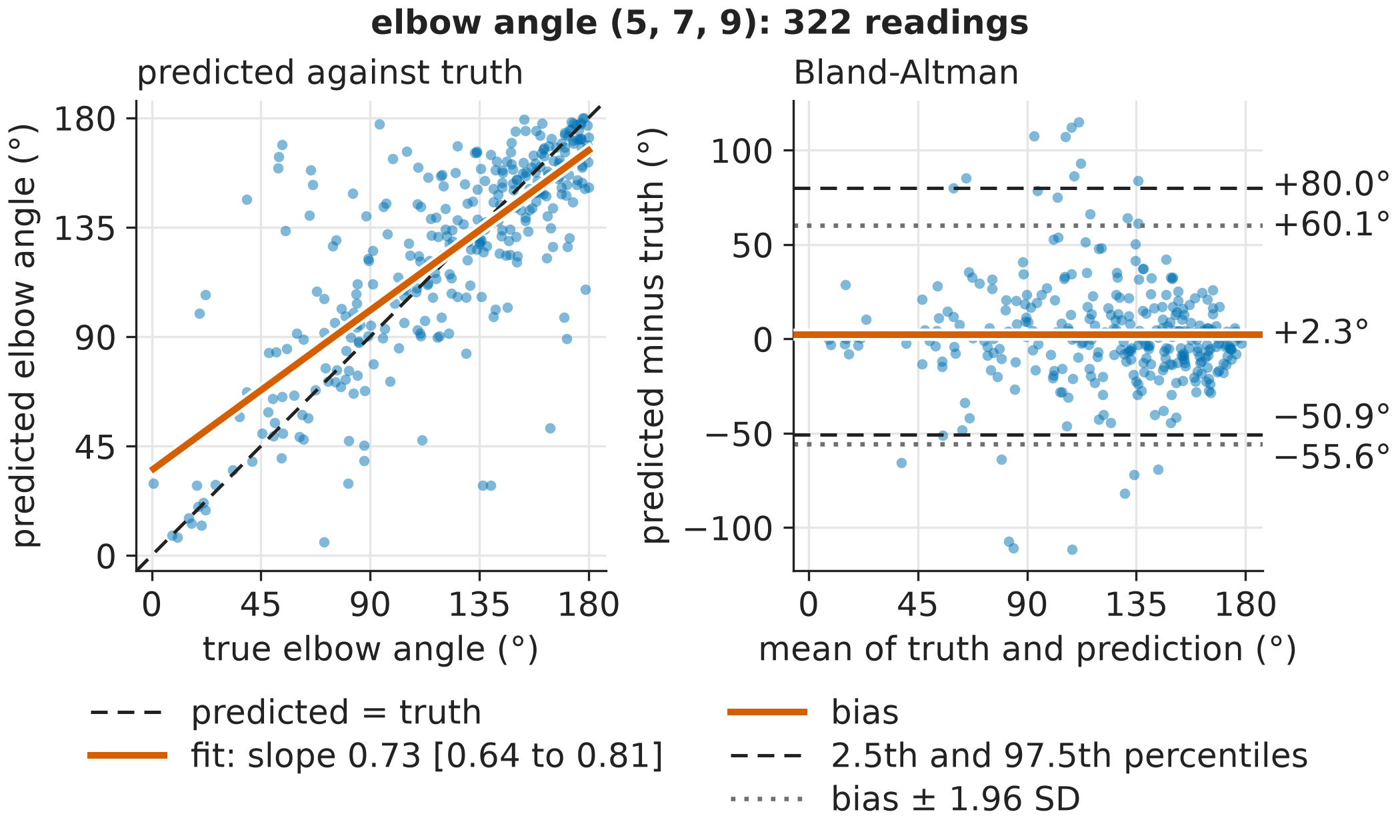
and --plot panels.png for this figure (with [plot]). If poseaudit is not found, use python -m poseaudit.
For a validation paper
poseaudit audit --format coco --gt labels.json --pred results.json --angle 5,7,9 --big-error 15 --full --json figures.json --report report.md --plot panels.png
--gt takes COCO keypoint annotations and --pred a COCO results file (or, with
--format yolo, YOLO label folders). Report how many were read, the bias with its limits of
agreement, the mean absolute error, ICC and the large-error rate, each with its interval;
docs/statistics.md
words this for the demo. Frames of one video are not independent: if image names carry the
clip or participant, as clip3_000123.jpg does, add --cluster "^(clip\d+)_" (its first
group names the cluster), or the intervals come out far too narrow.
As a CI gate
poseaudit audit --format coco --gt labels.json --pred results.json --angle 5,7,9 --big-error 15 --json figures.json
jq -e '(.mean_abs_error_ci[1] // 1e9) <= 25 and (.big_error_rate_ci[1] // 1) <= 0.5' figures.json
It fails unless the 95% intervals end at or below 25° of mean |error| and 50% of large errors.
Resampling is seeded, so reruns agree; one image or --cluster group gives null, which fails.
How large must a limb be
poseaudit budget --format coco --gt labels.json --pred results.json --angle 5,7,9 --big-error 15
gives the smallest limb, in pixels, whose angle is off by 15° or more in at most 20% of
readings, for that model on images like those, after checking its fit on readings it did
not see (to within at least 6 percentage points, so a size can miss the target by that
much). It needs about 140 readings of the joint, or 140 subjects or clips with --cluster,
in each of its two groups (straight and bent limbs): on the 200-image demo it gives no size
and says why. On COCO val2017, over four YOLO11 models at these settings, the check passed
all 16 elbow groups, 11 of which gave a size (the others never get below 20%), and 3 of 16
knee groups; one elbow group passed in only 10 of 20 redraws of the data (--redraw)
(budget).
Caveats
- The figures are agreement with one human label, not error against the world (demo).
- 2D angles read off an image are not 3D joint angles.
- Name the subject (
subjectcolumn,--cluster), or every frame counts as independent. - The jitter check in
--fullis experimental and assumes labels much cleaner than the model.
What is new versus OKS, PCK and pycocotools
They score where the points land, yet points scattered by the label spread OKS is built on turn these elbow angles by 11 to 16° on average. poseaudit scores the angle itself, with the statistics clinicians use to compare two measuring devices, from COCO, YOLO or supervision.
More
docs/README.md indexes the docs: every option, comparing models, the Python API, the statistics, the JSON output, the limitations and the CHANGELOG.
Code: MIT. Demo data: a subset of COCO's 2017 keypoint labels
(© COCO Consortium, CC BY 4.0) and predictions
from Ultralytics yolo11n-pose (AGPL-3.0), which poseaudit does not depend on or include.
1 maintainer

Metadata
1 maintainer
Release files for poseaudit 0.5.0
For a detailed explanation of source distributions (sdists) and built distributions (wheels), please see the package formats documentation.
Source distribution (sdist)
| File | Size | Uploaded | |
|---|---|---|---|
| poseaudit-0.5.0.tar.gz | 215.4 kB | Details |
Built distribution (wheel)
| File | Interpreter | ABI | Platform | Reset |
|---|---|---|---|---|
| poseaudit-0.5.0-py3-none-any.whl | Python 3 | none | any | Details |
Total release size: 327.3 kB
Release files / poseaudit-0.5.0.tar.gz
| Download URL | poseaudit-0.5.0.tar.gz |
|---|---|
| Size | 215.4 kB |
| Tags | Source |
|
SHA-256 checksum How to use checksums |
67faae51511b6fa9088b32cd46c506ec81f7d7525a6b18c51fe0eed85caffb51
|
|
BLAKE2b-256 checksum How to use checksums |
53f17c6fd2ed8140fa530dca8a5e00b9253d301eea422a2ae07c3318637dfbd6
|
| Upload date | |
|
Uploaded using Trusted Publishing? What is trusted publishing? |
Yes |
| Uploaded via |
twine/7.0.0 CPython/3.13.14
|
Provenance
Provenance describes where a file came from. On PyPI, provenance is shared via attestations, which provide a verifiable record of the build or publishing details. View details, limitations and caveats.


PyPI Publish Attestation
PyPI verified that this artifact, at this checksum, originated from the publisher listed below.
Signed by GitHub Actions, verified by PyPI on Oct 12, 2026.
Transparency logRelease files / poseaudit-0.5.0-py3-none-any.whl
| Download URL | poseaudit-0.5.0-py3-none-any.whl |
|---|---|
| Size | 111.9 kB |
| Tags | Python 3 |
|
SHA-256 checksum How to use checksums |
5695eed113663f974ea5140189b94101c051f9a03d46eb15818f25fe0cfc1848
|
|
BLAKE2b-256 checksum How to use checksums |
d035c623f2f2c0a312ca4f9637b7bd88c4219e0e9d4a53124de1af454c8ebbe2
|
| Upload date | |
|
Uploaded using Trusted Publishing? What is trusted publishing? |
Yes |
| Uploaded via |
twine/7.0.0 CPython/3.13.14
|
Provenance
Provenance describes where a file came from. On PyPI, provenance is shared via attestations, which provide a verifiable record of the build or publishing details. View details, limitations and caveats.
PyPI Publish Attestation
PyPI verified that this artifact, at this checksum, originated from the publisher listed below.
Signed by GitHub Actions, verified by PyPI on Oct 12, 2026.
Transparency log