

Privyx
Keep secrets and personal data out of LLM prompts.





Documentation · Quickstart · Tutorials · Integrations
Privyx is a proxy between your tools and an AI provider. It replaces the API keys, passwords, email addresses, and other sensitive values it detects in a request with placeholders, and puts the originals back into the reply. The only thing that changes in your client is its base URL.

Quick start
Privyx is available as privyx on PyPI and needs Python 3.12 or newer.
Install it with uv or pip:
# With uv.
uv tool install privyx       # Install the privyx command globally.
uv add privyx                # Or add it to your project, then use `uv run privyx`.

# With pip.
pip install privyx
Or run it without installing, with
uvx: uvx privyx in place of
privyx in the commands below. See
Installation for extras,
Docker, and upgrades.
With a coding agent. privyx run starts a proxy, launches the tool through
it, and stops the proxy when the tool exits:
privyx run claude # Claude Code; also: codex, gemini, opencode, aider, pi
With an application or any other client. Start the proxy, then change the client's base URL. The client keeps its own API key, which Privyx relays:
privyx proxy --upstream https://api.openai.com
export OPENAI_BASE_URL=http://localhost:8000/v1
For Anthropic: --upstream https://api.anthropic.com and
ANTHROPIC_BASE_URL=http://localhost:8000.
On a text. See what would be masked. Nothing is sent anywhere:
$ uvx privyx detect --transform "DB_PASSWORD=hunter2 deploy to 10.0.4.17, cc dana@acme.example"
    12:19    SECRET            'hunter2'
    30:39    IP_ADDRESS        '10.0.4.17'
    44:61    EMAIL             'dana@acme.example'

DB_PASSWORD=<PRIVYX_SECRET_A2907293658B4995> deploy to <PRIVYX_IP_ADDRESS_C8E127AF2D5584C3>, cc <PRIVYX_EMAIL_19ECE4788CA5AE6F>
The Quickstart walks
through each of these, and there is a Docker image:
ohp1x/privyx.
How it works
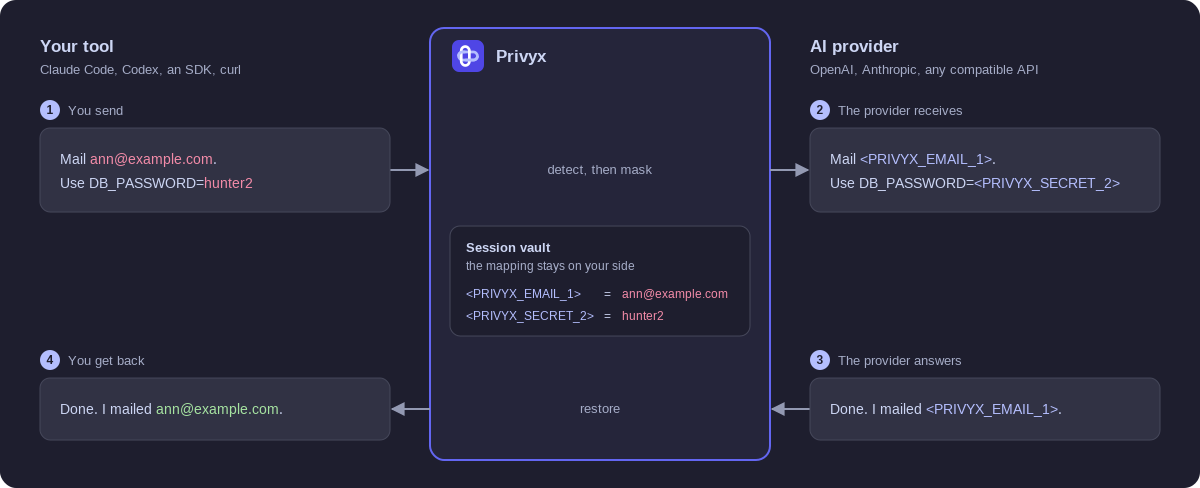
The model works with <PRIVYX_EMAIL_F04C885A31827851>: it can reason about
it, repeat it, and hand it to a tool. The mapping back to the real value stays with Privyx.
More in How it works.
Who it is for
- You use a coding agent. Claude Code, Codex, Gemini CLI, or aider reads
your
.env, your logs, and your git history, and sends them to a provider. Coding agents - You build an application. Your prompts carry your users' data. Keep it out of them with the OpenAI or Anthropic SDK, LangChain, LlamaIndex, LiteLLM, or the Vercel AI SDK. An app on the OpenAI or Anthropic SDK
- You run a gateway for a team. One proxy for everyone, with a shared vault, TLS, and an audit trail. A shared gateway for a team
- You want to mask files. Logs, JSON, and datasets, in a script or in CI, without a proxy. Files and logs in a pipeline
What it does
- Masks secrets and personal data. Built-in patterns cover email addresses, phone numbers, card numbers, IP addresses, API keys, tokens, private keys, and passwords. Add your own word lists and patterns, or a detector that understands names: Presidio or an LLM.
- Restores the reply. In batch and streaming responses, in reasoning text, and in tool-call arguments, so your tools receive real values.
- Drops in. It speaks OpenAI Chat Completions and Responses, Anthropic Messages, Gemini, and Ollama, so compatible clients can point at the proxy.
- Wraps coding agents.
privyx runstarts a proxy, launches Claude Code, Codex, Gemini CLI (with an API key), opencode, aider, pi, or any tool with a base-URL variable through it, and cleans up afterwards. - Checks what slips past.
privyx scanfinds the names a project should mask (git authors, remotes,.envvalues),privyx lintlists spellings of your terms that would get through, andprivyx install-hookstops a commit holding a secret or a placeholder. - Keeps sessions your way. One mapping per request, per client, or per conversation, in memory, SQLite, or Redis.
- Shows what it did. A PII-safe audit trail and Prometheus metrics count what was masked, without recording any of it.
- Fails closed. A request it cannot mask is not forwarded.
- Extends. Plugins add detectors, operators, policies, vaults, and providers.
What it does not do
Privyx reduces what a provider sees. It does not make a prompt safe by itself:
- Names, organizations, and project terms are only masked once you configure a word list or a detector for them.
- Only configured masking routes are inspected: chat, Responses, legacy completions, embeddings, and supported token-counting and compaction requests, including native Gemini and Ollama formats. Other paths, such as file uploads, are forwarded as sent unless you refuse them.
- Images, audio, and other binary content are not inspected.
- The proxy has no authentication of its own. Keep it on
127.0.0.1, or put something in front of it that authenticates callers.
Limitations has the full list, and the threat model says what Privyx protects against.
Documentation
The documentation is at ohp1x.github.io/privyx:
- Quickstart and tutorials
- Concepts: detection, masking, sessions, and the proxy
- How-to guides: agent profiles, deployment, and troubleshooting
- Integrations with providers and frameworks
- Reference for configuration, the CLI, and errors
- The FAQ
Its source is in docs/.
Project
Privyx is in its 0.1.x series; the
changelog lists what
each release changed.
- Questions and ideas: Discussions
- Bugs: Issues
- Security: report privately; see the security policy
- Contributing: CONTRIBUTING.md
License
1 maintainer

Metadata
1 maintainer
Release files for privyx 0.2.0
For a detailed explanation of source distributions (sdists) and built distributions (wheels), please see the package formats documentation.
Source distribution (sdist)
| File | Size | Uploaded | Provenance | Actions |
|---|---|---|---|---|
| privyx-0.2.0.tar.gz | 1.8 MB | With provenance | Details for privyx-0.2.0.tar.gz |
Built distribution (wheel)
| File | Interpreter | ABI | Platform | Actions Reset |
|---|---|---|---|---|
| privyx-0.2.0-py3-none-any.whl | Python 3 | none | any | Details for privyx-0.2.0-py3-none-any.whl |
Total release size: 2.2 MB
Release files / privyx-0.2.0.tar.gz
| Download URL | privyx-0.2.0.tar.gz |
|---|---|
| Size | 1.8 MB |
| Tags | Source |
|
SHA-256 checksum How to use checksums |
f480a98cb01de3814e2266bfaf7a23ee831a7ceb287e1cdb67f4ff068db4951a
|
|
BLAKE2b-256 checksum How to use checksums |
110fa69cf62fe274ae29ba29fd6bc189eeab960f90ec880dcaac39ab39fc0c22
|
| Upload date | |
|
Uploaded using Trusted Publishing? What is trusted publishing? |
Yes |
| Uploaded via |
twine/7.0.0 CPython/3.13.16
|
Provenance
Provenance describes where a file came from. On PyPI, provenance is shared via attestations, which provide a verifiable record of the build or publishing details. View details, limitations and caveats.


PyPI Publish Attestation
PyPI verified that this artifact, at this checksum, originated from the publisher listed below.
Signed by GitHub Actions, verified by PyPI on Nov 18, 2026.
Transparency logRelease files / privyx-0.2.0-py3-none-any.whl
| Download URL | privyx-0.2.0-py3-none-any.whl |
|---|---|
| Size | 329.9 kB |
| Tags | Python 3 |
|
SHA-256 checksum How to use checksums |
02c9a99bd8e241a839ce13574abc6c41a5f1ec9f0161aad887bc09acb1db21ec
|
|
BLAKE2b-256 checksum How to use checksums |
872bf9d39c4fe4d3c9a435180c75097af31ac23fe26dfd2a086e023c5c17bdad
|
| Upload date | |
|
Uploaded using Trusted Publishing? What is trusted publishing? |
Yes |
| Uploaded via |
twine/7.0.0 CPython/3.13.16
|
Provenance
Provenance describes where a file came from. On PyPI, provenance is shared via attestations, which provide a verifiable record of the build or publishing details. View details, limitations and caveats.
PyPI Publish Attestation
PyPI verified that this artifact, at this checksum, originated from the publisher listed below.
Signed by GitHub Actions, verified by PyPI on Nov 18, 2026.
Transparency logSecurity for privyx 0.2.0
Provenance
Provenance describes where a file came from. On PyPI, provenance is shared via attestations, which provide a verifiable record of the build or publishing details. View details, limitations and caveats.
Full provenance
Both files in this release have been uploaded with provenance metadata.
Attestation for privyx-0.2.0.tar.gz
PyPI Publish Attestation
PyPI verified that this artifact, at this checksum, originated from the publisher listed below.
Signed by GitHub Actions, verified by PyPI on Nov 18, 2026.
Transparency logA note on package security
PyPI is a repository for distributing packages, not a service for auditing them. While third-party security researchers and our staff do their best to detect and remove malicious packages, PyPI cannot guarantee the quality, security or suitability of any given package.
To learn more about protecting yourself from malicious actors, visit our package security documentation.














