
Shared memory foundation for AI development teams

Project description

project-bedrock: A project cockpit for your AI agents.
Every session starts with context.
Every important decision leaves a trail.
Every session leaves the project smarter.
robotaitai




AI can write code fast.
What it does not do well by default is leave behind clear, shared project understanding.
Decisions disappear into chat history.
Architecture gets rediscovered.
New sessions start from zero.
And the next developer, human or AI, has to figure out again what changed, where, and why.
Project Bedrock turns your repo into a project cockpit for AI agents: what we know, what matters now, and what to load next.
It works like the operating discipline of a strong team lead:
- every session starts with context
- every important change leaves a trail
- stable knowledge gets written down where the next developer can find it
- the project becomes easier to understand over time, not harder
With one command, your project gets:
- PROJECT-SHAPED MEMORY for architecture, decisions, conventions, and domain context
- A SMALL WORK LAYER for current focus, open loops, and recommended next actions
- PROJECT-LOCAL integration for Claude Code, Cursor, and Codex
- lightweight git-friendly markdown that LIVES WITH THE REPO
- HTML, graph, and Obsidian-ready VIEWS for human inspection
Under the hood, it is just markdown files and a CLI.
No database. No server. No hosted backend. No black box.
The result: your AI developers stop behaving like disconnected sessions, and start behaving more like a team.
📦 Install
Option A — let your agent do it (no pip knowledge needed):
Paste this into Claude Code, Cursor, or any capable agent:
Install the `project-bedrock` CLI on this machine so `bedrock --version` works. Handle Python and pipx installation if missing. Fix any errors along the way. Don't stop until it's working.
The agent detects your OS, installs Python + pipx if needed, installs the package, and verifies it. Works on macOS, Linux, and Windows.
Option B — one-liner (Mac / Linux):
curl -fsSL https://raw.githubusercontent.com/robotaitai/project-bedrock/main/install.sh | bash
Auto-detects uv → pipx → pip in that order.
Option C — pick your tool:
uv tool install project-bedrock   # fastest, isolated (recommended)
pipx install project-bedrock      # isolated
pip install project-bedrock       # classic
PyPI:
project-bedrock· CLI:bedrock· alias:agent-knowledge(deprecated)
🚀 Quick Start
1. Initialize the project (run once in your project folder):
cd your-project
bedrock init
2. Onboard your agent — paste this into chat:
Read AGENTS.md and ./bedrock/STATUS.md, then onboard this project.
That's it. The agent writes stable knowledge into Memory/, current priorities into Work/, and every future session starts with better context automatically.
What init does in one shot
| Step | What happens |
|---|---|
| 1 | Creates ./bedrock/ as a real directory inside the repo (git-tracked) |
| 2 | Registers the project in ~/agent-os/projects/<slug>/ so every project shows up in one place -- open it in Obsidian for a unified cross-project vault |
| 3 | Adds noisy generated subfolders (Evidence/raw/, Views/site/, ...) to .gitignore automatically |
| 4 | Installs project-local integration for Claude Code and Cursor |
| 5 | Detects Codex and installs its bridge files if present |
| 6 | Bootstraps the project cockpit (Memory/, Work/, Views/) and marks onboarding as pending |
| 7 | Imports repo history into Evidence/ and backfills lightweight history from git |
💾 Storage Modes
By default, knowledge lives inside the repo (git-tracked). Curated knowledge is committed normally; noisy subfolders are gitignored.
# Default: in-repo (recommended)
bedrock init

# External: knowledge outside the repo (not committed)
bedrock init --external

# Convert external -> in-repo later
bedrock migrate-to-local
🧠 How It Works
Think of the vault as your team's shared project cockpit. The goal is not more documentation for agents to blindly read. The goal is less context, loaded better.
Project Cockpit
| Folder | What goes here | Canon? | |
|---|---|---|---|
| 📘 | Memory/ |
What the project knows -- stable, durable, project-shaped knowledge | Yes |
| 🎯 | Work/ |
What matters now -- current focus, next actions, open questions, risks | Yes |
| 👁️ | Views/ |
Human inspection views -- generated site and graph output | No |
| 📅 | History/ |
Legacy diary layer -- still supported | Yes |
| 📎 | Evidence/ |
Raw imports: docs, ADRs, PRs, screenshots -- captured context | No |
| 📊 | Outputs/ |
Legacy generated artifacts -- still supported | No |
The rule: stable facts go into
Memory/, current priorities go intoWork/, and generated views stay inViews/. Imported or generated material is never canon by itself.
Memory Is Project-Shaped
Bedrock does not force every repo into the same documentation template.
- A robotics repo may organize Memory around
perception/,navigation/,localization/, andsafety/ - A SaaS repo may organize Memory around
frontend/,backend/,auth/,billing/, anddata/ - Bedrock itself may organize Memory around
product/,runtime/,cli/,integrations/,memory-model/, andviews/
🔌 Project-Local Integration
The project carries everything it needs. Claude Code, Cursor, and Codex all get integration installed automatically on init -- hooks, runtime contracts, and slash commands. No global config.
Platform & Tool Support
 |
 |
 |
|
|---|---|---|---|
 |
 |
|
 |
 |
|
|
|
 |
|
|
|
init -- hooks fire automatically, slash commands active, bedrock doctor validates health.
AGENTS.md installed when .codex/ detected -- agent loads memory context, no automated hooks.
CI matrix: ubuntu-latest + macos-latest, Python 3.9 / 3.12 / 3.13. Windows: Git Bash auto-detected; forward-slash paths and UTF-8 subprocess encoding fixed in v0.4.0.
Claude Code .claude/
| File | Purpose |
|---|---|
settings.json |
Lifecycle hooks: sync on SessionStart, Stop, PreCompact |
CLAUDE.md |
Runtime contract: knowledge layers, session protocol, onboarding |
commands/memory-update.md |
/memory-update slash command |
commands/system-update.md |
/system-update slash command |
commands/absorb.md |
/absorb <file/folder> slash command |
Cursor .cursor/
| File | Purpose |
|---|---|
rules/bedrock.mdc |
Always-on rule: loads memory context on every session |
hooks.json |
Lifecycle hooks: sync on start, update on write, sync on stop/compact |
commands/memory-update.md |
/memory-update slash command |
commands/system-update.md |
/system-update slash command |
commands/absorb.md |
/absorb <file/folder> slash command |
Codex .codex/ (installed when detected)
| File | Purpose |
|---|---|
AGENTS.md |
Agent contract with knowledge layer instructions |
⚡ Session Lifecycle
Hooks fire automatically -- zero manual intervention:
| Event | Claude Code | Cursor | What runs |
|---|---|---|---|
| Session start | SessionStart |
session-start |
bedrock sync |
| File saved | -- | post-write |
bedrock update |
| Task complete | Stop |
stop |
bedrock sync |
| Context compaction | PreCompact |
preCompact |
bedrock sync |
The agent reads STATUS.md, Memory/PROJECT.md, and Work/NOW.md at the start of every session, with no prompting required.
💬 Slash Commands
These are how the team writes to the logbook. Both work in Claude Code and Cursor -- init installed them.
| Command | When to use it |
|---|---|
/memory-update |
End of session, before logging off. The agent updates the project cockpit: stable facts in Memory/, current priorities in Work/, and a short summary of what changed. |
/system-update |
After upgrading project-bedrock. Refreshes hooks, rules, commands. Purely infrastructure -- never touches knowledge content. |
A developer should never finish a session without updating the cockpit. The point is not to save everything. The point is to save the next useful context.
🩺 Integration Health
bedrock doctor
Reports whether all integration files are installed and current. If anything is stale or missing, doctor tells you exactly what to run.
🔮 Obsidian-Ready
Each project's ./bedrock/ is a valid Obsidian vault on its own. But the real payoff is ~/agent-os/projects/: every project you've ever run init in is registered there. Open that folder in Obsidian and you have a unified vault across all your teams' projects -- backlinks, graph view, and full-text search spanning every codebase you manage.
One window. Every team.

bedrock export-canvas
# produces: bedrock/Views/graph/knowledge-export.canvas
Obsidian is optional. Works without it too.
🛠️ Commands
| Command | What it does |
|---|---|
init |
Set up a project -- one command, no arguments |
sync |
Full sync: memory, history, git evidence, index |
ship |
Validate + sync + commit + push |
view |
Build site and open in browser |
doctor |
Validate setup, integration health, note staleness |
All commands
absorb · search · export-html · export-canvas · clean-import · refresh-system · backfill-history · compact · migrate-to-local · init --external
All write commands support --dry-run and --json. Run bedrock --help for the full list.
More
- Static site export --
bedrock viewbuilds an interactive HTML site from your vault - Automatic capture -- every sync event is recorded as lightweight evidence
- Progressive retrieval -- agents load only the branches they need
- Clean web import -- import a URL as cleaned markdown evidence
- Project history -- lightweight event log auto-backfilled from git
- Keeping up to date --
pip install -U project-bedrock+bedrock refresh-system - Migrating from agent-knowledge-cli -- 3-step migration to
project-bedrockand thebedrockCLI - Custom knowledge home -- change where
~/agent-os/lives - Troubleshooting -- common issues and fixes
- Platform support -- macOS, Linux, Windows, Python 3.9+
- Development -- contributing and running tests
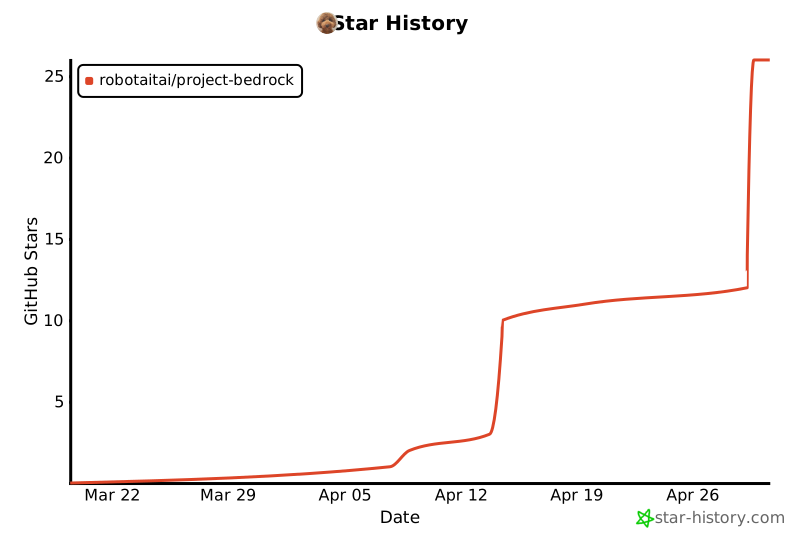
Star History
Release history Release notifications | RSS feed


Download files
Download the file for your platform. If you're not sure which to choose, learn more about installing packages.
Source Distribution
Built Distribution
Filter files by name, interpreter, ABI, and platform.
If you're not sure about the file name format, learn more about wheel file names.
Copy a direct link to the current filters
File details
Details for the file project_bedrock-0.4.16.tar.gz.
File metadata
- Download URL: project_bedrock-0.4.16.tar.gz
- Upload date:
- Size: 359.6 kB
- Tags: Source
- Uploaded using Trusted Publishing? No
- Uploaded via: twine/6.2.0 CPython/3.13.3
File hashes
| Algorithm | Hash digest | |
|---|---|---|
| SHA256 |
3b3ef2a01912a3f60b24d2b810b663aada38ee8f76f8f5222e8c3dbdc783772e
|
|
| MD5 |
188188163f82c6c643fbd66976a119c5
|
|
| BLAKE2b-256 |
a5c5ca2d0799ad2d0a4e7877c1c05fe775f0df8efe4cee460e8826a90ecfff26
|
File details
Details for the file project_bedrock-0.4.16-py3-none-any.whl.
File metadata
- Download URL: project_bedrock-0.4.16-py3-none-any.whl
- Upload date:
- Size: 227.6 kB
- Tags: Python 3
- Uploaded using Trusted Publishing? No
- Uploaded via: twine/6.2.0 CPython/3.13.3
File hashes
| Algorithm | Hash digest | |
|---|---|---|
| SHA256 |
52fa6c414bce7dcb0ed9cc41cedae1fb33f587b3870fd1b57e22610da2cf18af
|
|
| MD5 |
a6acf7a6d4f472c80922a344d9594520
|
|
| BLAKE2b-256 |
a3bf0e8af9d6c8497f5e618b1b3b78b153f40485e3562bb0f79239b0d2e787ff
|






