
promoterai-torch



A PyTorch port of PromoterAI v1 from Illumina — a deep learning model that predicts the regulatory impact of promoter DNA variants on gene expression.
[!Important] This is not an official Illumina product or publication. The contents of this package are solely the responsibility of the authors/maintainers and its release should not be construed as being supported/endorsed by Illumina or the original authors of PromoterAI.
The official PromoterAI codebase is released under the PolyForm Strict License 1.0.0. The pretrained models and precomputed variant scores are released separately under Illumina's own academic-only-use data license (see their github for instructions on academic/commercial licensing). This package is MIT-licensed and contains no Illumina code, models, or scores, but if you convert and use the original PromoterAI weights, you — not this project — are responsible for complying with Illumina's license terms. Please do not redistribute converted checkpoints.
Install
Python 3.10, 3.11, 3.12, and 3.13 are supported.
For variant scoring, embedding extraction, and ordinary PyTorch inference from an already-converted checkpoint, install the core package:
pip install promoterai-torch
Or with uv:
uv add promoterai-torch
Optional workflows are split into extras so inference installs do not pull in TensorFlow, HDF5/BigWig tooling, or attribution libraries:
| Extra | Enables |
|---|---|
convert |
Convert Keras/TensorFlow SavedModels to PyTorch checkpoints |
train |
Preprocess data, train from scratch, or fine-tune |
wandb |
Weights & Biases logging (combine with train) |
interpret |
Run DeepLIFT/SHAP interpretation with tangermeme |
uv add is for installing into an existing project; for a
cloned checkout with development dependencies, see
CONTRIBUTING.md.
Convert a pretrained Keras model
First install the [convert] extra (see above), then download the pretrained PromoterAI SavedModel from Illumina/PromoterAI and convert it to a PyTorch checkpoint:
pip install "promoterai-torch[convert]"
# or
uv add promoterai-torch --extra convert
promoterai-torch convert \
    --keras_model models/promoterAI_v1_hg38_mm10_finetune \
    --output models/promoterAI_v1_hg38_mm10_finetune.pt \
    --input_length 20480 \
    --output_length 4096
Architecture parameters (num_blocks, model_dim, output_dims) are inferred automatically from the Keras model. --input_length and --output_length are optional metadata.
Usage
Score variants
Given a pretrained checkpoint and a variant TSV with columns chrom, pos, ref, alt, strand:
promoterai-torch score \
    --model_checkpoint models/promoterAI_v1_hg38_mm10_finetune.pt \
    --var_file variants.tsv \
    --fasta_file hg38.fa \
    --input_length 20480
Scores are written by default to variants.{model_name}.tsv as a new score column in [−1, 1] (or to a file path provided by --output). Thresholds: ±0.1 (weak effect), ±0.2 (moderate), ±0.5 (strong).
Run inference on a genomic sequence
One can also generate predictions for all the tracks that PromoterAI was trained on (these are aggregated and diff'ed to generate the variant scores).
import torch
from promoterai_torch.dataset import onehot_encode
from promoterai_torch.utils import load_pretrained

model, args = load_pretrained("models/promoterAI_v1_hg38_mm10_finetune.pt")
model.eval()

# One-hot encode a DNA sequence → (L, 4), add batch dim → (1, L, 4)
# Use the full input_length the model was trained on (20480 bp for the published model)
seq = "ACGT" * (args["input_length"] // 4)   # replace with your sequence
x = torch.from_numpy(onehot_encode(seq)).unsqueeze(0)

with torch.no_grad():
    predictions = model(x)   # tuple of (1, output_length, n_tracks) per output head

track_predictions = predictions[0]   # (1, output_length, n_tracks) — arcsinh-scale signal
The output is one tensor per species head. Each tensor has shape (batch, output_length, n_tracks) where n_tracks=498 for the published human head (histone marks, TF ChIP-seq, ATAC-seq, RNA-seq) and n_tracks=472 for the mouse head (per Illumina's released data/bigwig/mm10.tsv track list).
Extract embeddings
import torch
from promoterai_torch.dataset import onehot_encode
from promoterai_torch.utils import load_pretrained

model, args = load_pretrained("model.pt")
model.eval()

seq = "ACGT" * (args["input_length"] // 4)   # replace with your sequence
x = torch.from_numpy(onehot_encode(seq)).unsqueeze(0)

with torch.no_grad():
    embeddings = model.encode(x)   # (1, input_length, model_dim)
model.encode() returns the final MetaFormer block output — a per-position representation of shape (B, L, model_dim) suitable for downstream tasks.
DeepLIFT/SHAP attribution
Install the optional interpretation dependencies first:
pip install "promoterai-torch[interpret]"
# or
uv add promoterai-torch --extra interpret
The architecture uses named nn.ReLU() module instances (one per non-linearity) so it is compatible with tangermeme's deep_lift_shap. Wrap the model to transpose the channels-first input expected by tangermeme and reduce the output to (batch, 1) (we average over positions and tracks in the demo script):
import torch
import torch.nn as nn
from tangermeme.deep_lift_shap import deep_lift_shap
from promoterai_torch.utils import load_pretrained

model, args = load_pretrained("model.pt")
model.eval()

class PromoterAIWrapper(nn.Module):
    def __init__(self, model):
        super().__init__()
        self.model = model

    def forward(self, x):                           # x: (B, 4, L) channels-first
        out = self.model(x.transpose(1, 2))         # PromoterAI expects (B, L, 4)
        out = out[0].mean(dim=(1, 2)).unsqueeze(1)  # (B, 1) — mean over positions and tracks
        return out

wrapper = PromoterAIWrapper(model)

# x: (B, 4, input_length) one-hot, channels-first
x = torch.zeros(1, 4, args["input_length"])
x[0, 0, :] = 1.0  # replace with your sequences

attributions = deep_lift_shap(wrapper, x, n_shuffles=20, device="cuda", batch_size=1)
# attributions: (B, 4, input_length) — per-position, per-base importance
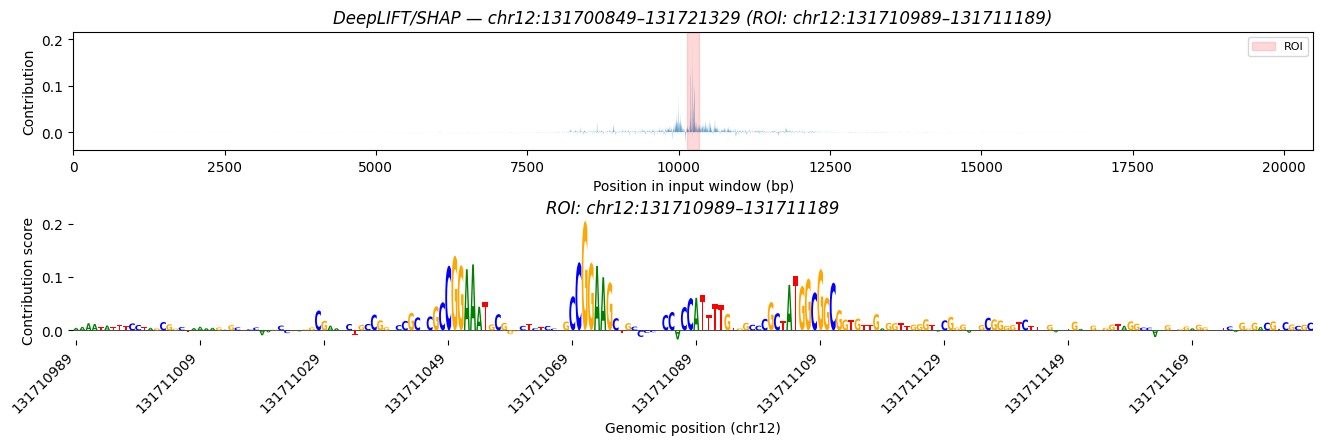
Do note that calculating DeepLIFT/SHAP on this model is quite expensive: with TF32, n_shuffles=20, and batch_size=1, it takes ~92s/sequence with ~71GB VRAM used on an A100 80GB.
Numerical equivalence
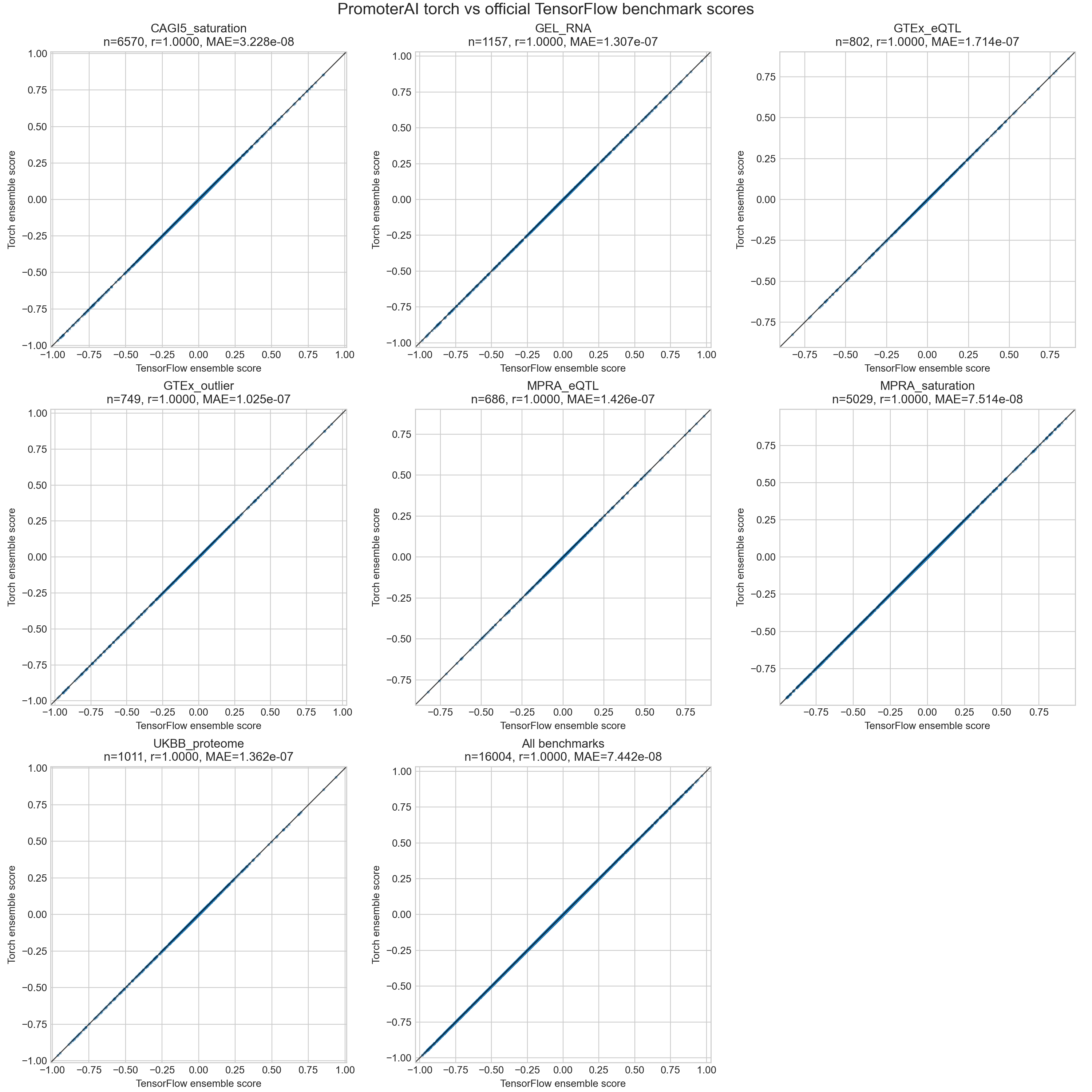
This port produces near-identical scores and regulatory track predictions to the original TensorFlow/Keras implementation, matching the published AUROCs. See docs/numerical-equivalence.md for benchmark reproduction steps, per-variant concordance results, and full-track comparison scripts.
Training models
Fine-tuning or training from scratch using the built-in scripts requires the
train extra described in Install (with an optional wandb extra
for wandb.ai integration. See docs/training.md for data
preprocessing, training from scratch, fine-tuning on variants, and multi-GPU usage.
Development
See CONTRIBUTING.md for setting up a local development environment and running the test suite.
Reference
Jaganathan, Ersaro, Novakovsky et al. Science (2025) Predicting expression-altering promoter mutations with deep learning. doi:10.1126/science.ads7373
Original TF implementation: Illumina/PromoterAI
Citation metadata for this software is available in CITATION.cff.
1 maintainer

Metadata
1 maintainer
Release files for promoterai-torch 0.3.0
For a detailed explanation of source distributions (sdists) and built distributions (wheels), please see the package formats documentation.
Source distribution (sdist)
| File | Size | Uploaded | |
|---|---|---|---|
| promoterai_torch-0.3.0.tar.gz | 77.1 kB | Details |
Built distribution (wheel)
| File | Interpreter | ABI | Platform | Reset |
|---|---|---|---|---|
| promoterai_torch-0.3.0-py3-none-any.whl | Python 3 | none | any | Details |
Total release size: 124.3 kB
Release files / promoterai_torch-0.3.0.tar.gz
| Download URL | promoterai_torch-0.3.0.tar.gz |
|---|---|
| Size | 77.1 kB |
| Tags | Source |
|
SHA-256 checksum How to use checksums |
e39d28342cae70dfd8d76d641e314da913d3fec09377b32ed74966088a1c429a
|
|
BLAKE2b-256 checksum How to use checksums |
98e223d4e77bad7226ea87798bdd11ab7af111026fcc519fbf0f394a8ed5a192
|
| Upload date | |
|
Uploaded using Trusted Publishing? What is trusted publishing? |
Yes |
| Uploaded via |
twine/7.0.0 CPython/3.13.14
|
Provenance
Provenance describes where a file came from. On PyPI, provenance is shared via attestations, which provide a verifiable record of the build or publishing details. View details, limitations and caveats.


PyPI Publish Attestation
PyPI verified that this artifact, at this checksum, originated from the publisher listed below.
Signed by GitHub Actions, verified by PyPI on Aug 29, 2026.
Transparency logRelease files / promoterai_torch-0.3.0-py3-none-any.whl
| Download URL | promoterai_torch-0.3.0-py3-none-any.whl |
|---|---|
| Size | 47.2 kB |
| Tags | Python 3 |
|
SHA-256 checksum How to use checksums |
93ef279bb3788a7956be686283c9173b503dce76c19b9f74923c23aba0e60996
|
|
BLAKE2b-256 checksum How to use checksums |
1c53e222700866fccbbd36ff9dd11eb5b8ae08d11a66c08bea3428c49edb6987
|
| Upload date | |
|
Uploaded using Trusted Publishing? What is trusted publishing? |
Yes |
| Uploaded via |
twine/7.0.0 CPython/3.13.14
|
Provenance
Provenance describes where a file came from. On PyPI, provenance is shared via attestations, which provide a verifiable record of the build or publishing details. View details, limitations and caveats.
PyPI Publish Attestation
PyPI verified that this artifact, at this checksum, originated from the publisher listed below.
Signed by GitHub Actions, verified by PyPI on Aug 29, 2026.
Transparency log













