
prompt-flamegraph




Lightweight, zero-dependency Python package to profile LLM prompt tokens with interactive flamegraphs, waste detection, prompt diffs and HTML/SVG/Markdown/JSON/terminal exports. Works with raw OpenAI/Anthropic request payloads.
What it does
prompt-flamegraph takes a structured prompt (system prompt, tools, RAG context, chat history) and shows you where the tokens go, in an interactive flamegraph.
It is intentionally lightweight: no proxy, no server, no dashboard, no telemetry. One function call, one output file.
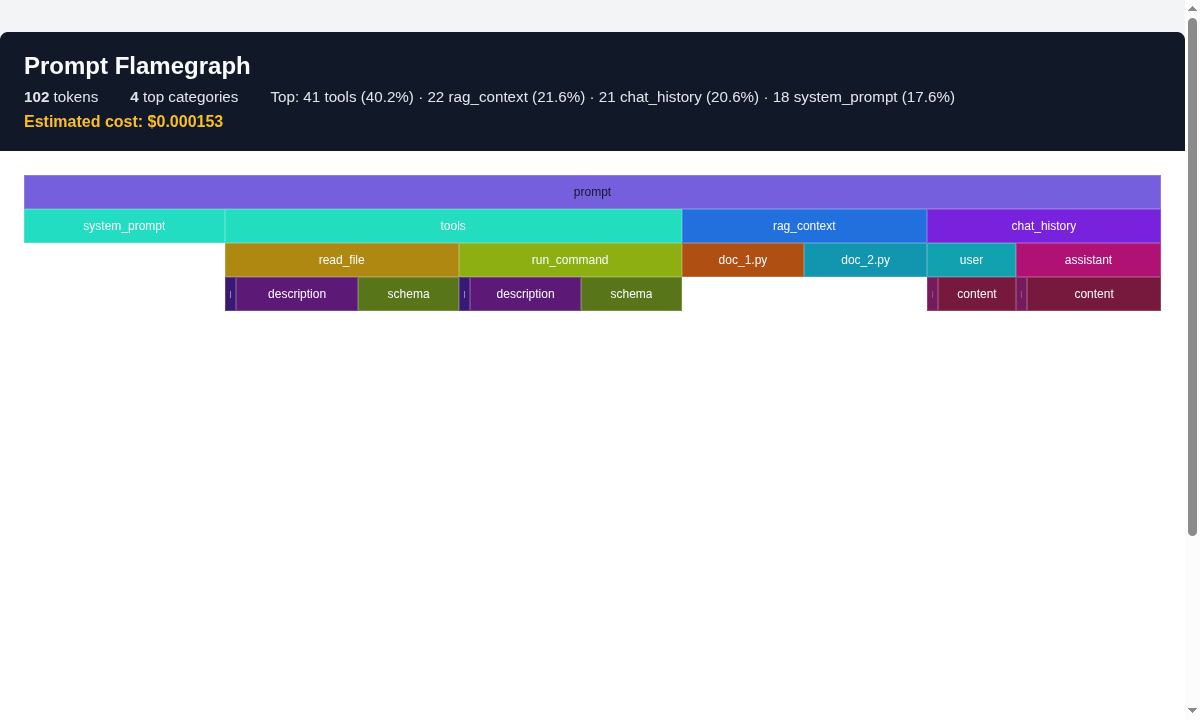
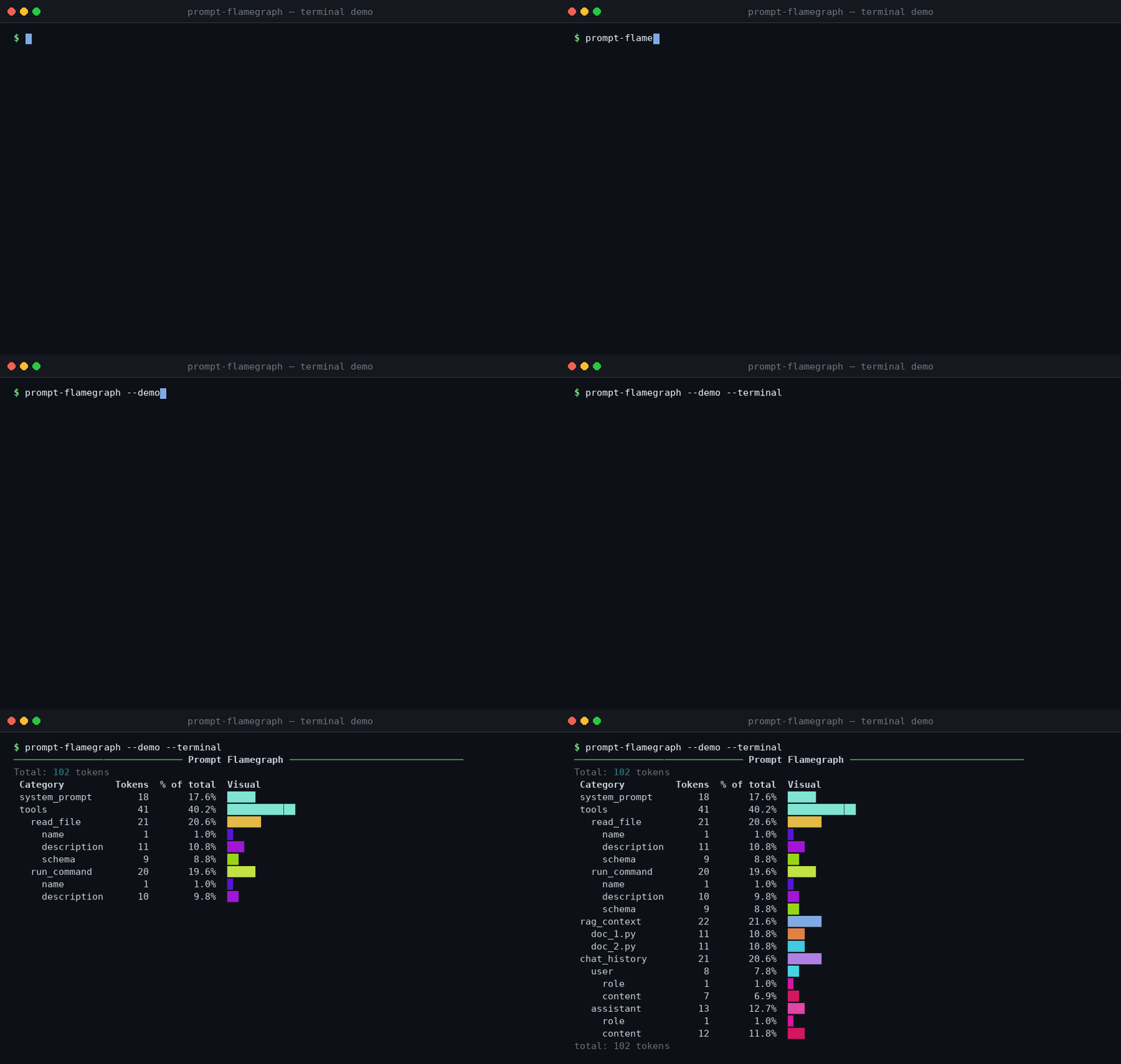
Reading the flamegraph: bar width = token share. Hover any bar — even a sub-pixel sliver — for its real name, token count, and text. Nodes too thin to draw (<2% of their parent or <26px, or deeper than max_depth=8) are folded into striped · N more · buckets whose tooltip lists what they contain; pass --no-aggregate (or aggregate=False) to draw every node.
Install
pip install prompt-flamegraph
Extras:
pip install prompt-flamegraph[tiktoken]   # accurate OpenAI-style token counts
pip install prompt-flamegraph[rich]       # prettier terminal output
Quick start
from prompt_flamegraph import profile_prompt

prompt = {
    "system_prompt": "You are a helpful coding assistant.",
    "tools": ["..."],
    "rag_context": {"doc_1": "..."},
    "chat_history": ["..."],
}

profile_prompt(prompt, output="context.html")
Open context.html in your browser.
Works with OpenAI/Anthropic payloads
You don't have to restructure your data first. normalize() auto-detects common API request bodies — OpenAI {"messages": [...], "tools": [...]}, Anthropic {"system": "...", "messages": [...]}, or a bare message list — and converts them:
from prompt_flamegraph import normalize, profile_prompt

payload = {
    "system": "You are a helpful assistant.",
    "messages": [{"role": "user", "content": "Hello!"}],
}

profile_prompt(normalize(payload), output="context.html")
Or build the structure yourself with from_messages(messages, tools=..., system_prompt=...). The CLI applies normalize() automatically to any input.
Works with LangChain & friends
Framework objects are converted by duck-typing — LangChain is never imported and is not a dependency:
from prompt_flamegraph import profile_any

# ChatPromptValue, rendered prompt templates, BaseMessage lists...
profile_any(chat_prompt_value, output="context.html", model="gpt-4o")
profile_any() auto-detects the shape: LangChain-style objects (to_messages(), .messages, .type/.content) go through from_langchain(), API payloads go through normalize(). LiteLLM message lists work via from_litellm_messages() (OpenAI shape).
CI budget gate
Fail a pipeline when a prompt grows past a token budget — exit code 3 when exceeded:
prompt-flamegraph prompt.json --budget 100000 --format json -o report.json
A ready-to-copy GitHub Actions workflow lives in .github/workflows/prompt-budget.yml.example.
Waste detection
Identify token waste before sending the prompt to an API:
from prompt_flamegraph import build_tree, detect_waste

prompt = {
    "system_prompt": "You are a helpful coding assistant.",
    "tools": ["read_file", "write_file", "run_command", "search_web", "send_email", "create_ticket"],
    "rag_context": {
        "doc_1.py": "def helper():\n    return 'value'\n",
        "doc_2.py": "def helper():\n    return 'value'\n",
        "doc_3.py": "def helper():\n    return 'value'\n",
    },
    "chat_history": ["Hi!"] * 10,
}

tree = build_tree(prompt, name="prompt")
report = detect_waste(tree)

print(f"Wasted: {report.wasted_tokens} / {report.total_tokens} tokens ({report.waste_ratio:.1%})")
for finding in report.findings:
    print(f"- {finding.kind}: {finding.message}")
Example output:
Wasted: 36 / 60 tokens (60.0%)
- duplicate: 3× duplicate text ("def helper():     return 'value' ") — keep only one
- duplicate: 10× duplicate text ('Hi!') — keep only one
- too_many_tools: 6 tools defined — only declare the ones the model actually calls
- long_history: chat history is 33.3% of the total context (20 tokens) — consider truncation
Pass detect_waste=True to profile_prompt() to include findings directly in the HTML report.
CLI
# HTML flamegraph
prompt-flamegraph prompt.json -o context.html --cost 1.5e-6

# Terminal bar chart
prompt-flamegraph prompt.json --terminal

# Diff between two prompts (green = added, red = removed, orange = changed)
prompt-flamegraph v1.json --diff v2.json -o diff.html

# SVG, Markdown or JSON export
prompt-flamegraph prompt.json --format svg -o context.svg
prompt-flamegraph prompt.json --format md -o context.md
prompt-flamegraph prompt.json --format json -o report.json

# Draw every node, even sub-pixel ones (default groups them into "· N more ·" buckets)
prompt-flamegraph prompt.json --no-aggregate -o context.html

# Read from stdin (a raw API request body works too)
cat openai_request.json | prompt-flamegraph - --terminal
cat anthropic_request.json | prompt-flamegraph

# Model-aware: tokenizer encoding, pricing and context-window usage
prompt-flamegraph prompt.json --model gpt-4o

# List supported models
prompt-flamegraph --list-models

# CI gate: exit 3 when over budget
prompt-flamegraph prompt.json --budget 100000 --format json -o report.json

# Demo
prompt-flamegraph --demo --cost 1.5e-6
Terminal example
────────────────────────────── Prompt Flamegraph ───────────────────────────────
Total: 102 tokens
 Category         Tokens  % of total  Visual
 system_prompt        18       17.6%  █████
 tools                41       40.2%  ████████████
   read_file          21       20.6%  ██████
   run_command        20       19.6%  █████
 rag_context          22       21.6%  ██████
   doc_1.py           11       10.8%  ███
   doc_2.py           11       10.8%  ███
 chat_history         21       20.6%  ██████
   …                  (nested rows truncated)
Real output also lists each leaf (name, description, schema, role, content, …) indented under its category — shown here truncated.
Model pricing
--model prices and context windows ship as a bundled snapshot, so cost estimates work offline out of the box. To refresh them, fetch LiteLLM's crowd-updated pricing table into your user cache ($XDG_CACHE_HOME/prompt-flamegraph/models.json):
prompt-flamegraph --update-models
The cache extends --model and --list-models to hundreds of additional models — bundled entries always win on name conflicts, and --list-models shows the cache age. Normal runs never touch the network; only --update-models does. Set PROMPT_FLAMEGRAPH_OFFLINE=1 (or pass --offline) to ignore the cache entirely and use bundled data only.
All prices — bundled and cached — are community-sourced estimates (via LiteLLM's table), not official provider quotes; check your provider's pricing page for billing-grade numbers.
Features
- Pure Python, no required dependencies.
- Optional
tiktokensupport. - Pluggable tokenizer.
- Cost estimation.
- Token waste detection: duplicates, oversized RAG, long history, too many tools, context-window usage.
- Prompt diff: compare two prompts and visualize token changes.
- Terminal output: colored ASCII/Rich bar chart.
- Export formats: HTML, SVG, Markdown, JSON.
- API adapters: feed raw OpenAI/Anthropic request payloads or message lists directly.
- Framework adapters: LangChain-style objects via
from_langchain/profile_any(duck-typed — langchain is never imported). - CI budget gate:
--budget Nexits with code 3 when the prompt exceeds N tokens. - Model presets:
--modelselects the tokenizer encoding, pricing and context window. - stdin input: pipe payloads straight into the CLI.
- Works with nested
dict,listandstrstructures.
API
profile_prompt(data, output=..., title=None, tokenizer=None, model=None, cost_per_token=None, detect_waste=True, context_window=None, width=1200, height=720)
Build a prompt token tree and render it to a standalone HTML flamegraph; returns the HTML string and also writes it to output (pass output=None to skip the file).
data— nesteddict/list/strprompt structure (runnormalize()first for raw API payloads).output— output file path.title— report title.tokenizer—None(auto: tiktoken when installed, else a built-in estimator), astr -> intcallable, or a name:"tiktoken","words","cl100k…","o200k…","model:<name>".cost_per_token— USD per token for cost estimates.detect_waste— include waste findings in the report (defaultTrue).context_window— model context size; adds a usage finding above 80%.width/height— graph dimensions in pixels.model— model name, e.g.profile_prompt(data, model="gpt-4o")— auto-derivestokenizer,cost_per_tokenandcontext_windowfrom the model registry (mutually exclusive withtokenizer; warns and falls back to the estimator when the encoding needs tiktoken).
diff_prompts(v1, v2, output="prompt_diff.html", title=None, tokenizer=None, cost_per_token=None, width=1200, height=720)
Render a diff flamegraph between two prompts; returns the HTML string.
detect_waste(tree, context_window=None)
Analyze a tree and return a WasteReport with findings.
build_tree(data, name="prompt", tokenizer=None, model=None)
Build the internal token tree without rendering. model resolves the tokenizer the same way as in profile_prompt (mutually exclusive with tokenizer).
to_html / to_svg / to_markdown / to_json
Render a build_tree result to a standalone HTML string, SVG string, Markdown table, or machine-readable JSON report:
from prompt_flamegraph import build_tree, to_json, to_svg

tree = build_tree(prompt)
svg = to_svg(tree, title="Prompt Flamegraph", width=1200)
report = to_json(tree, cost_per_token=2.5e-6)
Signatures: to_html(tree, title=..., cost_per_token=None, waste_report=None, width=1200, height=720, max_depth=8, aggregate=True), to_svg(tree, title=..., width=1200, row_height=34, max_depth=8, aggregate=True), to_markdown(tree, title=..., cost_per_token=None), to_json(tree, title=..., cost_per_token=None, waste_report=None). Nodes thinner than 2% of their parent or 26px — or deeper than max_depth — are grouped into "· N more ·" buckets (their tooltip lists what was folded); pass aggregate=False to draw every node.
count_tokens(text, tokenizer=None) / get_tokenizer(tokenizer=None)
Count tokens in a string, or resolve a tokenizer argument (callable or name) into a str -> int callable.
from_messages(messages, tools=None, system_prompt=None)
Convert an OpenAI/Anthropic-style message list into the structured prompt dict. role in ("system", "developer") messages are merged into system_prompt; the rest become chat_history entries.
normalize(data)
Auto-detect common API payload shapes (OpenAI chat body, Anthropic body, bare message list) and convert to the structured prompt dict. Extra top-level keys on a recognized payload are preserved ("model" is dropped — it is not part of the prompt); anything else is returned unchanged.
from_langchain(obj) / from_litellm_messages(messages, **kwargs) / profile_any(obj, output=None, model=None, **kwargs)
Framework adapters. from_langchain converts LangChain-style objects by duck-typing (to_messages(), .messages, .type/.content — the framework is never imported). from_litellm_messages handles LiteLLM message lists. profile_any auto-detects the input shape and renders a flamegraph in one call.
resolve_model(name) / list_models()
Look up a ModelSpec (encoding, $/Mtok pricing, context window) by model name, or list all supported models.
Resources
- Website / documentation: https://fjjjuv.github.io/prompt-flamegraph/index.html
- Dev.to article with a step-by-step walkthrough: Stop Guessing Where Your LLM Prompt Tokens Go: prompt-flamegraph
- PyPI package page: https://pypi.org/project/prompt-flamegraph/
- Companion optimizer: prompt-optimizer — generate optimization recommendations and trim your prompts automatically.
Source
https://github.com/fjjjuv/prompt-flamegraph
License
This project is licensed under the GNU Lesser General Public License v3.0 or later — free to import into proprietary code; modifications to the library itself stay open.
See the LICENSE file for details (the full GPLv3 it builds on is in LICENSE.GPL).
1 maintainer

Metadata
1 maintainer
Release files for prompt-flamegraph 0.3.0
For a detailed explanation of source distributions (sdists) and built distributions (wheels), please see the package formats documentation.
Source distribution (sdist)
| File | Size | Uploaded | |
|---|---|---|---|
| prompt_flamegraph-0.3.0.tar.gz | 63.6 kB | Details |
Built distribution (wheel)
| File | Interpreter | ABI | Platform | Reset |
|---|---|---|---|---|
| prompt_flamegraph-0.3.0-py3-none-any.whl | Python 3 | none | any | Details |
Total release size: 122.0 kB
Release files / prompt_flamegraph-0.3.0.tar.gz
| Download URL | prompt_flamegraph-0.3.0.tar.gz |
|---|---|
| Size | 63.6 kB |
| Tags | Source |
|
SHA-256 checksum How to use checksums |
672bef8c01c132ddcb34603bca00e8025f9e86716f5bad1f7ebb44ed38a93c19
|
|
BLAKE2b-256 checksum How to use checksums |
ec988d8a631a63fb020ed9446474ad58acf445ac35d9ccd9da3c135702c7eee9
|
| Upload date | |
|
Uploaded using Trusted Publishing? What is trusted publishing? |
No |
| Uploaded via |
twine/7.0.0 CPython/3.14.6
|
Release files / prompt_flamegraph-0.3.0-py3-none-any.whl
| Download URL | prompt_flamegraph-0.3.0-py3-none-any.whl |
|---|---|
| Size | 58.4 kB |
| Tags | Python 3 |
|
SHA-256 checksum How to use checksums |
e08ad3a03f00be410abf1c11111a686686204532b0b8d1f1997a181f64f63b9b
|
|
BLAKE2b-256 checksum How to use checksums |
35b45ada456c82ba06ca6462612c47eeb8d604dda454f6d7d4bd3f6cb6ec3630
|
| Upload date | |
|
Uploaded using Trusted Publishing? What is trusted publishing? |
No |
| Uploaded via |
twine/7.0.0 CPython/3.14.6
|














