
The Proxmox MCP you can hand the keys — VE + Backup Server + Mail Gateway + Datacenter Manager on one clean surface: every dangerous op planned, undoable, and audited.
Verified details
These details have been verified by PyPIProject links
GitHub Statistics
Maintainers

Project description










Quickstart · Setup · Trust layer · Demo · Tools · Install · Security · Docs
The Proxmox MCP you can hand the keys.
The others make you choose: a read-only inspector that's safe because it can't touch anything — or a loaded gun aimed at a cluster you care about. Proximo refuses the trade. Every dangerous move is planned (see the blast radius first) and proven (a tamper-evident record of every move), and undoable wherever the platform can snapshot (it snapshots before it acts) — trust built into the substrate, not bolted on after. Hand an AI agent the keys; keep the receipts.
Sovereign and agent-agnostic: your metal, your token, a ledger you own — no cloud, no phone-home, no standing server unless you opt in. Don't take our word for any of it — verify it yourself.
Verify in 60 seconds — three receipts, no trust required
# 1. The tool count is real — ask the server itself, cold (=> 715).
#    (in a clone of this repo, after `uv sync`)
uv run python -c "import asyncio; from proximo import server; \
print(len(asyncio.run(server.mcp.list_tools())))"

# 2. The container image is what the repo built — sigstore provenance (exit 0 = verified):
gh attestation verify oci://ghcr.io/john-broadway/proximo:latest --owner john-broadway

# 3. The security posture is graded by a third party, not by us:
#    https://scorecard.dev/viewer/?uri=github.com/john-broadway/proximo
The rest — forge a ledger byte and watch verify() refuse, grep the outbound surface for
phone-home (there is none) — is in VERIFY.md. These checks work on any tool,
from any vendor. Demand them everywhere.
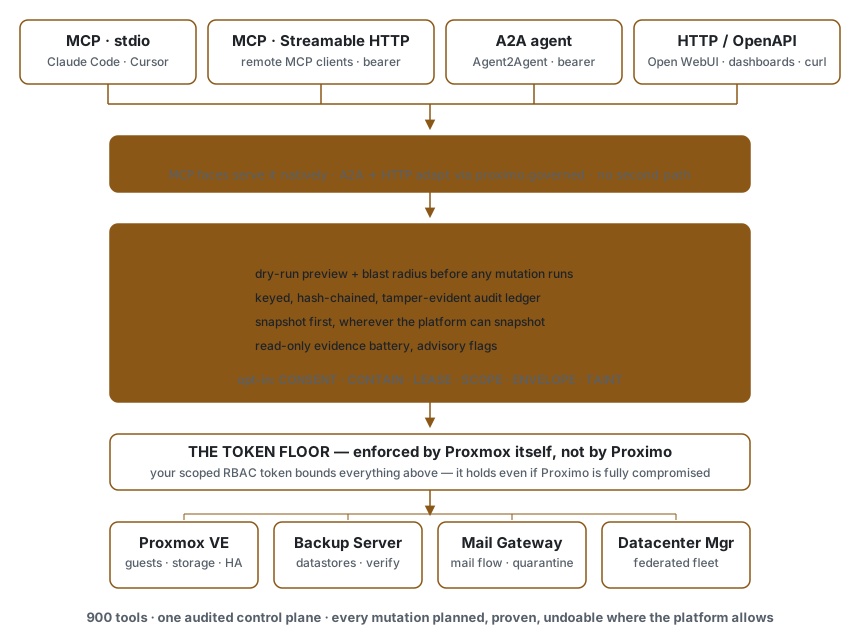
Every transport enters one governed dispatch and crosses the same trust spine; the token floor beneath it all is enforced by Proxmox itself. Watch it hold, live, in the Demo.
What it does
Ask, in plain English, "why is ct 105 thrashing?" — and an AI agent pulls node and guest status, tails the logs, and runs a diagnostic inside the container to find out. If there's a fix, it shows you the plan before it touches anything, snapshots first, applies, and hands you a signed receipt of exactly what changed.
That's the product: a hypervisor an AI can operate without being able to wreck it. Read-only by default. No mutation runs on the first call — it returns its blast radius as a plan for you to see first. A tamper-evident receipt for every change. The comparison isn't Proximo vs. the GUI — it's Proximo vs. handing an LLM your root token and hoping.
Quickstart
// your MCP client config (Claude Desktop / Claude Code / Cursor / …)
{
  "mcpServers": {
    "proximo": {
      "command": "uvx",
      "args": ["proximo-proxmox"],
      "env": {
        "PROXIMO_API_BASE_URL": "https://your-pve:8006/api2/json",
        "PROXIMO_NODE": "your-node",
        "PROXIMO_TOKEN_PATH": "/path/to/token-file"   // USER@REALM!TOKENID=SECRET — by reference, never inlined
      }
    }
  }
}
Or install with one click:


Both prompt for the token file path — the secret never lands in client config. No token yet? uvx proximo-proxmox mint prints the least-privilege runbook.
Then preflight what your token can actually do (read-only):
uvx proximo-proxmox doctor
Start with a read-only token — Proximo is useful long before you grant it write. Full token-first walkthrough: docs/SETUP.md · more install paths: Install & run.
Why Proximo exists
The Proxmox MCP landscape is split: API-based servers manage nodes and VMs but structurally cannot run a command inside an LXC (the REST API has no exec endpoint); SSH-based servers can, through broad shell access with little scoping. Proximo builds the principled whole — both halves, one audited surface, least-privilege, trust by construction:
| Read-only inspector | Full-access executor | Proximo | |
|---|---|---|---|
| Can mutate | no — that's the safety | yes | yes — plan recorded first, then confirm=true |
| Preview before a change | n/a | rarely | default — blast radius + live state, every mutation |
| Record of what happened | no | app logs, editable | keyed hash-chained ledger, tamper-evident, on by default |
| Undo | n/a | rare | snapshot-first, wherever the platform can snapshot |
| Command inside an LXC | no | broad SSH | opt-in, fail-closed CTID allowlist |
| Products covered | usually PVE | usually PVE | PVE + PBS + PMG + PDM — one audited plane |
| Verify the artifact you run | varies | varies | signed image · PyPI provenance · SBOM · Scorecard |
(The archetype columns describe the split above, not any specific project. There is no official Proxmox MCP; Proximo is a community project, standing on its own.)
The trust layer — what makes Proximo different
Four controls on by default:
| Control | What it does |
|---|---|
| PLAN | Every mutation first returns a recorded preview — the exact change, live state, blast radius, an advisory risk rating. Nothing mutates without its plan recorded; one confirm=true call records and performs. |
| PROVE | Keyed (HMAC-SHA256), hash-chained audit ledger — audit_verify catches edits, reordering, insertion. Pin the head off-box (expected_head) to catch truncation too: that's the strong guarantee, and it's opt-in. |
| UNDO | Snapshot-first, fail-closed where the platform can snapshot: auto-snapshot before risky exec, config-revert, pve_rollback. Planes with no snapshot primitive (firewall/SDN/ACL) have no rollback — said plainly. |
| DIAGNOSE | Read-only evidence battery + node health → advisory flags that surface incompleteness too, so an empty list never reads as a false clean bill. |
Six more ship off until you configure them — per-plan CONSENT, a CONTAIN kill-switch, an arm-LEASE, an arm-time SCOPE, a FORBID/RATE ENVELOPE, and TAINT (the prompt-injection mitigation). What each one actually defends against: SECURITY.md.
Honesty note (load-bearing): risk ratings are an advisory heuristic, not a sandbox —
LOWmeans "no state change," not "safe," and the absence of aHIGHflag is not a safety signal. Review every change yourself. The floor beneath it all is the token you mint: Proxmox RBAC holds even if Proximo's process is fully compromised — a stronger guarantee than anything Proximo's own code provides. Scope it to exactly what you mean to grant: SECURITY.md.
Hold any tool to this — including this one: The Keys Test — ten questions to ask before you hand an AI agent real infrastructure, Proximo's own scorecard published, partials included. And watch the spine hold, live:

41 seconds, recorded live with a write-scoped token on a throwaway guest — real mutations, real receipts, nothing staged.
Reproduce it: scripts/demo/hand_the_keys.py --live.
Demo
The record defends itself:
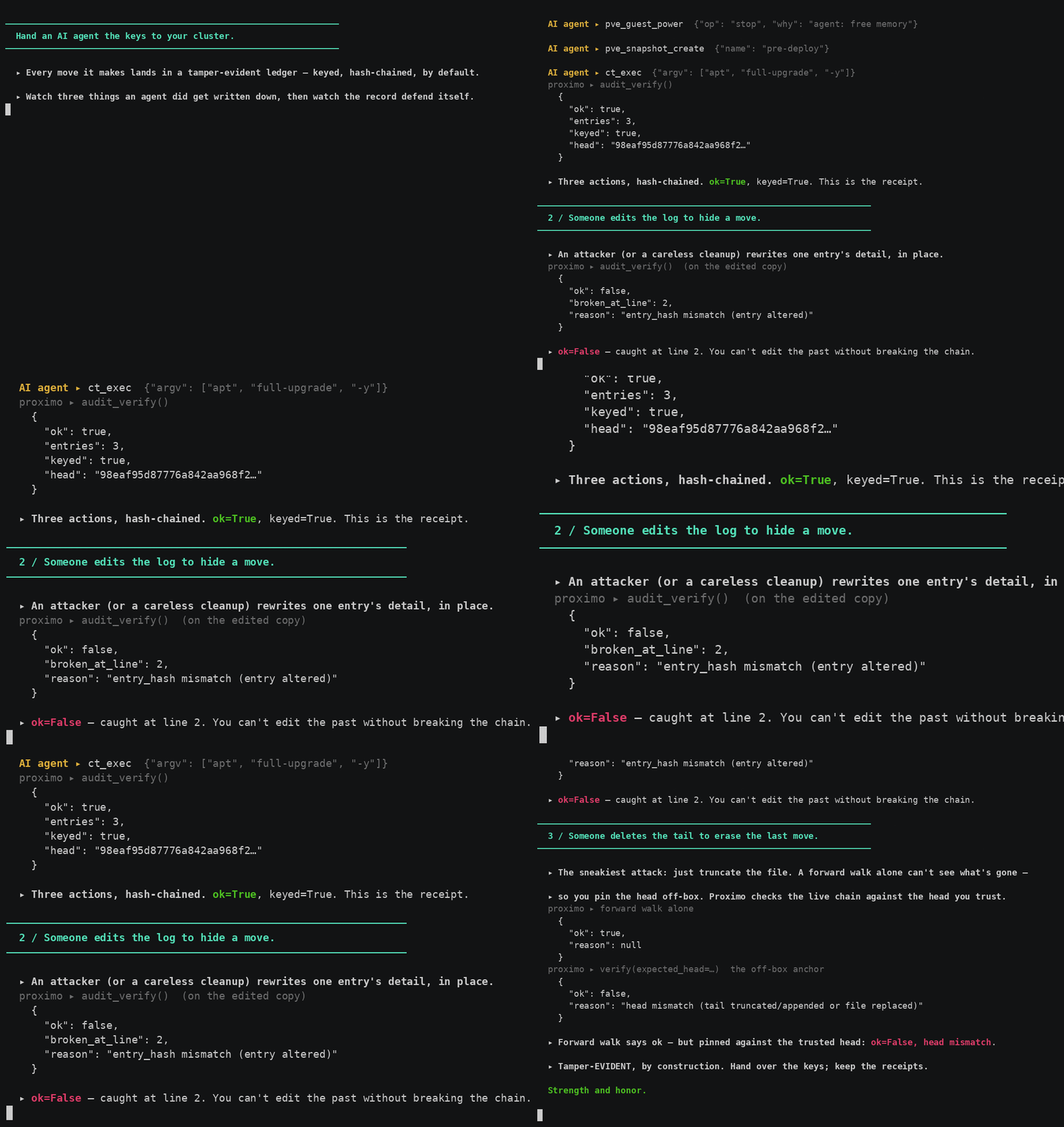
Three agent moves land in the ledger; one entry gets edited in place — audit_verify() breaks at the exact line, ok=False; the truncation a forward walk would miss is caught against the pinned head.
Source: docs/demo/ledger-tamper.cast · run the checks yourself: VERIFY.md.
A second cut — doctor preflight, a destructive delete answered with a PLAN, the ledger verifying clean — recorded live against real PVE 9.2 with a read-only token: docs/demo/demo.svg · scripts/demo/demo.py.
Surfaces & tools — one control plane
| Surface | Backend | For |
|---|---|---|
| Proxmox VE | REST API + scoped token | node/guest lifecycle, storage, SDN, identity, HA, firewall |
| Proxmox Backup Server | REST API + scoped token | datastores, namespaces, snapshots, sync, GC, verify, tape |
| Proxmox Mail Gateway | Ticket auth | mail flow, quarantine, filtering rules, domains, services |
| Proxmox Datacenter Manager | API token | federated fleet — reads plus governed control (power/snapshot/migrate, dry-run-first) |
| Container exec | ssh → pct exec |
run-command-in-container, psql, log tailing — what the API structurally can't do |
Those backends are deliberately boring — anyone can call them. The product is the trust layer over them.
715 tools is an estate, not a starting point. Where an operator actually starts:
| You want to… | Start with | Worth knowing |
|---|---|---|
| See the whole cluster at once | pve_cluster_resources, pve_list_guests |
one call, every node |
| Find out why a container is sick | ct_diagnose, ct_logs, pve_guest_status |
read-only evidence battery |
| Preflight a token / config | proximo doctor (CLI) or pve_doctor, pve_overbroad_grants |
run this before wiring an agent |
| Power / lifecycle | pve_guest_power |
returns a PLAN first — nothing moves without confirm=true |
| Snapshot before touching anything | pve_snapshot_create, pve_rollback |
UNDO's foundation |
| Check backups are actually fresh | pve_backup_freshness, pbs_snapshots_list |
walks real archives — "task OK" is never evidence |
| Run a command in a container | ct_exec |
opt-in (PROXIMO_ENABLE_EXEC=1), fail-closed allowlist |
| Trace / release mail | pmg_tracker_list, pmg_quarantine_spam |
full PMG plane behind it |
| Operate the federated fleet | pdm_resources_list, pdm_pve_lxc_list |
governed control, dry-run-first |
| Prove the record wasn't touched | audit_verify |
registered on every surface, always |
Every tool, grouped by surface, with typed inputs: docs/TOOLS.md.
Install & run
📦
0.24.0— on PyPI, GitHub, and GHCR (signed multi-arch image).New in 0.24.0 — Ceph + SDN deep. 603 → 715 tools. The full Ceph plane (OSD/mon/mgr/mds lifecycle, pools, CephFS — destroy previews quote Ceph's own
cmd-safetyverdict) and the deep SDN surface (controllers, DNS, IPAMs, fabrics, vnet firewall, prefix-lists, route-maps — with SDNdry-runin apply previews, the global lock as a never-ledgered capability token, androllbackas a real undo for staged SDN config). Both planes closed by exit-code-gated audits (48/48 + 90/90 methods, 0 undocumented). Schema-built, not yet live-proven — docstrings say which.Recent: 0.23.0 — the PBS plane closed: 493 → 603, tape/S3/metrics/pull-push, coverage proven by audit (349 endpoints, 0 gaps). See SECURITY.md for what each control honestly holds.
Proximo runs on your machine, on demand — no daemon, no open port.
uvx proximo-proxmox            # zero-install run (PyPI package: proximo-proxmox; command stays `proximo`)
# or: pip install proximo-proxmox            the MCP core
# or: pip install "proximo-proxmox[a2a]"     + the optional A2A face
# or: pip install "proximo-proxmox[http]"    + the optional HTTP/OpenAPI face
# or, from source:  git clone https://github.com/john-broadway/proximo.git && cd proximo && uv pip install -e .
Wire it into your MCP client as the command proximo, with the PROXIMO_* env vars — see packaging/proximo.env.example.
Docker (GHCR): docker run -i --rm … ghcr.io/john-broadway/proximo:latest — multi-arch, SBOM, sigstore-signed provenance (gh attestation verify oci://ghcr.io/john-broadway/proximo --owner john-broadway). Mirrored to Docker Hub (docker.io/jebroadway/proximo, identical digest); GHCR stays the signed primary.
Safe by default: API-only out of the box. The two near-root edges are opt-in and say so loudly — LXC exec (
PROXIMO_ENABLE_EXEC=1, near-root on the host) and the qemu-guest-agent edge (PROXIMO_ENABLE_AGENT=1, near-root in a guest) — each scoped by its own fail-closed allowlist.Big surface, scoped context: you don't have to load the whole estate.
PROXIMO_SURFACES=pve,execregisters only those planes (that pair = 202 tools) — unpicked planes never touch your context window;audit_verifyalways stays; a typo'd surface refuses startup.
The network faces (experimental, opt-in): proximo-a2a speaks Agent2Agent; proximo-http serves plain HTTP + generated /openapi.json for no-code clients. Both serve the full surface through the same governed dispatch as MCP — no second code path, trust spine and token scope inherited. Fail-closed perimeter: loopback, bearer-token required off-localhost, DNS-rebind and CSRF defended. Details: SECURITY.md.
At scale
One container is the demo. A cluster is the point.
- The whole cluster in one call —
pve_cluster_resources: every VM, node, storage pool, SDN object. - One tamper-evident record across every node — "show me every state-changing action this month, and prove the log wasn't touched" becomes a query you can actually answer. No human at the CLI walks away with that.
- Where the time comes back — on one node a senior at the CLI is faster, and that's fine; across a dozen nodes and hundreds of guests, a bounded, audited agent earns its keep.
Many boxes, one Proximo: register remotes in a TOML file (secrets by reference, never inlined), point PROXIMO_TARGETS at it, aim any tool with proximo_target="edge-pve". The target travels with the call — PLAN and EXECUTE hit the same box, the ledger records which, cross-plane calls error. Config shape: packaging/targets.example.toml.
Status — the arena record
- 🩸 0.24.0 — Ceph + SDN deep: 603 → 715 tools — the full Ceph plane (destroys quote Ceph's own cmd-safety verdict in the preview) and deep SDN (fabrics, vnet firewall, routing policy, plus dry-run/lock/rollback as first-class governance). Both closed by exit-code-gated audits (48/48 + 90/90, 0 undocumented). Every chunk adversarially reviewed; the reviews caught real defects every time — including a lock-token echo — all fixed before ship.
Every release before it — every pillar, every redteam, every fix — lives in CHANGELOG.md.
The numbers, honestly: 715 MCP tools, proved in two deliberate layers — 9,100+ in-process tests (ruff + pyright clean) pin every tool's shape, and a separate live-smoke harness drives real Proxmox hardware: a 3-node PVE 9.2 cluster, PBS 4.2, PMG 9.1, PDM 1.1.4, a real cross-datacenter move. The two are kept apart on purpose — passing shape tests never gets to masquerade as "works on a real host." And this workspace administers its own Proxmox estate through Proximo daily (dogfood). The blast-radius engine carries the destructive surface: across eleven op-classes it names the specific guests, nodes, principals, or disks at risk — nothing falls back to a bare confirm.
Proven live (not mocks): the trust spine end-to-end; identity/storage/SDN/firewall/HA create→read→delete with the ledger verified throughout; offline + online live-migration and HA fencing (softdog) on a real 3-node cluster; full PBS/PMG/PDM planes including a real cross-datacenter move.
Not yet proven — said plainly: hardware-watchdog fencing (needs physical iTCO/IPMI) and behavior at production scale. The unrecoverable ops (SDN apply, etc.) are deliberately never fired live — proven by plan, held back by design, not a gap. Per-surface detail: CHANGELOG.md.
Documentation
| Document | What it answers |
|---|---|
| Setup | Token-first walkthrough: mint a least-privilege token, verify it, widen deliberately. |
| Verify | Every trust claim paired with the command that proves it — run them cold. |
| Security | The two-deployment trust model, all ten controls, what each honestly holds, reporting. |
| Threat model | What Proximo defends against, what it doesn't, where the boundaries sit. |
| Tools | All 715 tools, grouped by surface, typed inputs. |
| Agents | The page written for the agent itself — Proximo's sharp edges, stated first. |
| Known issues | What's broken or odd right now, said plainly. |
| Contributing | Dev setup, the CI gates, what a PR is expected to keep intact. |
| Changelog | Every release, every redteam, every fix — the full build history. |
License
Apache-2.0 — chosen for the patent grant that suits infrastructure tooling. Full text in LICENSE.
Credits
Named for Proximo, the lanista of Gladiator — the story is the design, joint for joint. He armed his fighter with exactly what he needed, never more, and answered for every move in the arena: a lanista, not a jailer. The Spaniard doesn't get his name up front — he earns it, by conduct, on the record: the helmet that comes off (truth said plainly, at cost — the "not yet proven, said plainly" section, and AGENTS.md leading with Proximo's own sharp edges). His last act opened the cages, holding the wooden sword of his own freedom. A tool should hope to end that well.
"Win the crowd and you will win your freedom."
Built by John Broadway with Claude and Maude — a human–AI partnership, and the first thing we made on this box to give away to the world. Claude Opus 4.8 built the trust pillars and the original tool surface and has carried the work since; Claude Fable 5 ran the 101-agent release audit and the first publish. Every commit carries its co-author trailer.
"Are you not entertained?" — stars, issues, and sparring partners welcome. Strength and honor. ⚔️
Project details
Verified details
These details have been verified by PyPIProject links
GitHub Statistics
Maintainers
Release history Release notifications | RSS feed


Download files
Download the file for your platform. If you're not sure which to choose, learn more about installing packages.
Source Distribution
Built Distribution
Filter files by name, interpreter, ABI, and platform.
If you're not sure about the file name format, learn more about wheel file names.
Copy a direct link to the current filters
File details
Details for the file proximo_proxmox-0.24.0.tar.gz.
File metadata
- Download URL: proximo_proxmox-0.24.0.tar.gz
- Upload date:
- Size: 870.4 kB
- Tags: Source
- Uploaded using Trusted Publishing? Yes
- Uploaded via: twine/6.1.0 CPython/3.13.13
File hashes
| Algorithm | Hash digest | |
|---|---|---|
| SHA256 |
ac3c06c39287b5eadf83c5830c70e94656ed0a912e54014ab1ed65f6aa20cb7b
|
|
| MD5 |
4c7301f3c020ee793b422af8e4e23860
|
|
| BLAKE2b-256 |
422680fa4055647c9e61aa2d1b04236303bb49df53cdab4379dbb9105daab2a2
|
Provenance
The following attestation bundles were made for proximo_proxmox-0.24.0.tar.gz:
Publisher:
release-pypi.yml on john-broadway/proximo
-
Statement:
-
Statement type:
https://in-toto.io/Statement/v1 -
Predicate type:
https://docs.pypi.org/attestations/publish/v1 -
Subject name:
proximo_proxmox-0.24.0.tar.gz -
Subject digest:
ac3c06c39287b5eadf83c5830c70e94656ed0a912e54014ab1ed65f6aa20cb7b - Sigstore transparency entry: 2188478944
- Sigstore integration time:
-
Permalink:
john-broadway/proximo@04b15f187a86e8f90ab38ccef3eec35fba8c06b9 -
Branch / Tag:
refs/tags/v0.24.0 - Owner: https://github.com/john-broadway
-
Access:
public
-
Token Issuer:
https://token.actions.githubusercontent.com -
Runner Environment:
github-hosted -
Publication workflow:
release-pypi.yml@04b15f187a86e8f90ab38ccef3eec35fba8c06b9 -
Trigger Event:
release
-
Statement type:
File details
Details for the file proximo_proxmox-0.24.0-py3-none-any.whl.
File metadata
- Download URL: proximo_proxmox-0.24.0-py3-none-any.whl
- Upload date:
- Size: 891.9 kB
- Tags: Python 3
- Uploaded using Trusted Publishing? Yes
- Uploaded via: twine/6.1.0 CPython/3.13.13
File hashes
| Algorithm | Hash digest | |
|---|---|---|
| SHA256 |
a51daecc827ab7f0569cbbd311a8ba612c9bc7e88793ab7bfb50f9e842d7f9a1
|
|
| MD5 |
6febbc351707fce6ab44e27138a933a6
|
|
| BLAKE2b-256 |
6744db6411040b3f87a445630ebc0ca95cc17d5f20ed8b2686b68c3d124113f4
|
Provenance
The following attestation bundles were made for proximo_proxmox-0.24.0-py3-none-any.whl:
Publisher:
release-pypi.yml on john-broadway/proximo
-
Statement:
-
Statement type:
https://in-toto.io/Statement/v1 -
Predicate type:
https://docs.pypi.org/attestations/publish/v1 -
Subject name:
proximo_proxmox-0.24.0-py3-none-any.whl -
Subject digest:
a51daecc827ab7f0569cbbd311a8ba612c9bc7e88793ab7bfb50f9e842d7f9a1 - Sigstore transparency entry: 2188478955
- Sigstore integration time:
-
Permalink:
john-broadway/proximo@04b15f187a86e8f90ab38ccef3eec35fba8c06b9 -
Branch / Tag:
refs/tags/v0.24.0 - Owner: https://github.com/john-broadway
-
Access:
public
-
Token Issuer:
https://token.actions.githubusercontent.com -
Runner Environment:
github-hosted -
Publication workflow:
release-pypi.yml@04b15f187a86e8f90ab38ccef3eec35fba8c06b9 -
Trigger Event:
release
-
Statement type:







