
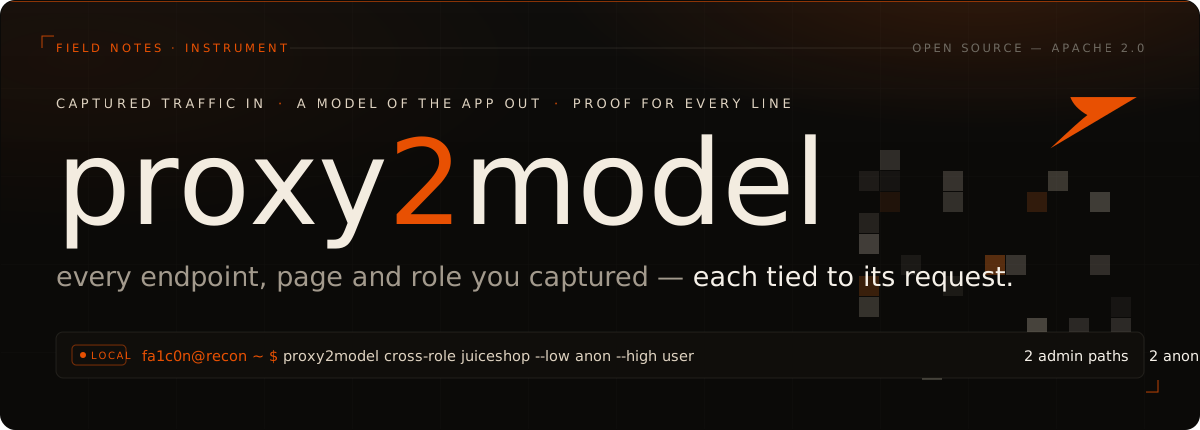
// the instrument
Every claim cites the request that proves it, and the model names what the capture could not see. proxy2model turns the traffic you already capture into a model of the web app: its endpoints, pages, parameters and roles. It compares what each role reached and hands an AI cited evidence instead of raw traffic. It does not scan or attack, and it never calls anything a vulnerability: it gives hypotheses and the next safe check.




git clone https://github.com/falc0n-researcher/proxy2model && cd proxy2model && ./demo.sh
Sixty seconds, nothing to install, no network: four recorded OWASP Juice Shop sessions are modelled, anonymous is compared with a signed-in user, the surface the login opened is diffed, and the report opens.
// cross-role — what each role should not have reached
Record the app once per role (--role anon, --role user, ...) and ask what the lower one reached:
$ proxy2model cross-role juiceshop --low anon --high user
anon vs user: 2 privileged-looking reached · 3 object reads to test · 2 writes by anon · 31 untested · 12 enforced

'anon' reached privileged-looking endpoints (2)  [function-level authorization (OWASP API5)]
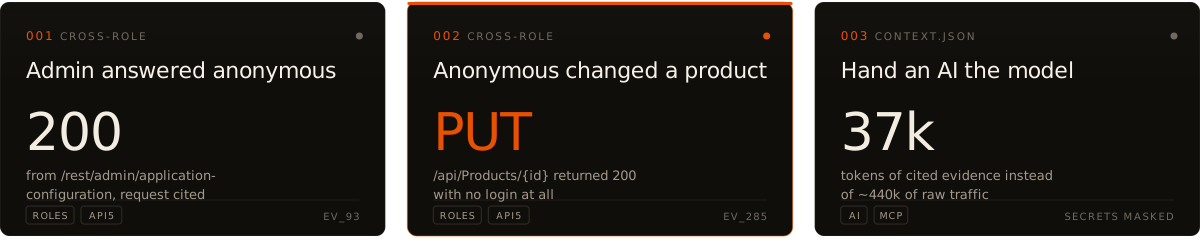
  GET /rest/admin/application-configuration    ev_93  anon=[200] user=[200]
    unknown: whether the low-role response was authorised or a leak · next: compare 'anon' and 'user' response bodies

'anon' changed state (2)  [function-level authorization (OWASP API5)]
  PUT /api/Products/{id}                       ev_285  anon=[200]
    unknown: whether 'anon' may PUT here on a record it does not own · next: confirm in the app's design ...
Each divergence is named for the question it raises:
| Intent | What it means | The next safe check |
|---|---|---|
| privileged-looking reached | the low role got through to an admin-style path | compare both roles' response bodies |
| object reads | the low role read an object by id (a BOLA question) | ask for another account's id as the low role |
| writes | the low role changed state and got a 2xx | confirm the design allows it, on a record you own |
| untested | only the high role ever tried it | replay it as the low role |
| enforced | 401/403 for the low role, 2xx for the high | the control every other replay is compared with |
// hand an AI the model, not the traffic
Raw traffic pasted into an LLM is huge, full of secrets, and invites guessing. context.json is the
model packed for an AI: about 37k tokens for the Juice Shop capture instead of ~440k, every value
masked, every fact tied to an evidence id, and rules the model must follow:
Cite an evidence id (ev_N) for every claim; each id is resolved in `evidence`.
Never name an endpoint, route or parameter that is not in this package.
State unknowns explicitly; do not guess authorization behaviour.
Treat an absence in this package as an absence in the capture, never in the target.
Or let an agent ask the model itself over MCP (proxy2model mcp): the same cited answers as the CLI,
read-only. The skill is the method as a playbook an AI follows, nothing to install.
// diff — what changed since the last capture
Every build is kept. Capture the app again next week, or as another role, and ask what moved:
$ proxy2model diff juiceshop demo-anon demo-user
  1 new workflow(s) · 24 new · 42 changed · 3 gone
  ▸ route /profile  (79 things: 2 routes, 29 endpoints, 45 parameters, 2 auths, 1 role)
      /profile → /rest/user/change-password → DELETE /api/Addresss/{id} → ...
New workflows, changed fingerprints and what is gone, each with its requests: drift, never findings.
proxy2model watch builds every export dropped into a folder and prints the change.
// intake
| Traffic from | Command |
|---|---|
| Burp (Save items XML), Logger++ CSV, Caido (JSON or CSV), or a HAR (browser, ZAP, mitmproxy) | proxy2model FILE -w app |
| A browser it opens and records while you use the app | proxy2model browse |
| A crawl of a running app | proxy2model crawl URL -w app --yes |
Every value is masked as it is read. One model comes out: a report, a SQLite graph you can query, OpenAPI, and a compact package for an AI. Runs locally.
pip install proxy2model
proxy2model history.xml -w shop     # build from an export
proxy2model browse                  # or open a browser and use the app (asks for URL, scope, mode)

proxy2model query shop help         # ask the model; answers cite requests, no AI involved
proxy2model mcp --out "$PWD/proxy2model-out"   # or let an AI agent ask (see Using it with an AI)
proxy2model on its own lists the everyday commands; proxy2model <command> --help explains each.
// what comes out
proxy2model-out/shop/
├── report.html     interactive report: overview, what to check, endpoints, map, every request, query console
├── model.json      the model, and the request behind every claim
├── openapi.json    the observed API, OpenAPI 3.0
├── context.json    what to hand an AI instead of raw traffic
├── graph.db        SQLite graph, queried with `proxy2model q`
├── exports/        graph.json · graph.graphml · build.svg
└── inputs/         masked records of every capture, merged on rebuild
// boundaries
| It does | It never |
|---|---|
| Read traffic you captured | Upload, forward or replay it |
| Mask every value before the first write | Store a token, cookie, key or PII value |
| Say what it could not observe | Claim coverage it did not have |
| Offer hypotheses and the evidence to test them | Call anything a vulnerability |
A plain build is offline. crawl, browse --active and osint send requests of their own: use
them only on systems you are authorized to test. CI plants fake secrets in the samples and fails if
one reaches any output.
// field manual
- 01 · Capturing traffic — Burp, Caido, HAR,
browse, roles. - 02 · Crawling a running app —
crawland scripted journeys. - 03 · How it works — what is in the model and how it is built.
- 04 · Querying the model —
query, BQL, graph reach, diffs between builds. - 05 · Using it with an AI —
context.jsonand the MCP server. - Skill — the same method as a playbook for an AI, nothing to install.
fa1c0n@recon ~ $ every claim cites a request · every gap is named
1 maintainer

Metadata
1 maintainer
Release files for proxy2model 2.1.0
For a detailed explanation of source distributions (sdists) and built distributions (wheels), please see the package formats documentation.
Source distribution (sdist)
| File | Size | Uploaded | Provenance | Actions |
|---|---|---|---|---|
| proxy2model-2.1.0.tar.gz | 1.9 MB | With provenance | Details for proxy2model-2.1.0.tar.gz |
Built distribution (wheel)
| File | Interpreter | ABI | Platform | Actions Reset |
|---|---|---|---|---|
| proxy2model-2.1.0-py3-none-any.whl | Python 3 | none | any | Details for proxy2model-2.1.0-py3-none-any.whl |
Total release size: 2.4 MB
Release files / proxy2model-2.1.0.tar.gz
| Download URL | proxy2model-2.1.0.tar.gz |
|---|---|
| Size | 1.9 MB |
| Tags | Source |
|
SHA-256 checksum How to use checksums |
9be854ecc4fadddbd44fac502a1e061e093ac187f49245de46acb1ba8b23fd71
|
|
BLAKE2b-256 checksum How to use checksums |
62fa16b625154871cff9b5d434cc48a3b5a1ddf50ec47dce4eb21f50721c2af9
|
| Upload date | |
|
Uploaded using Trusted Publishing? What is trusted publishing? |
Yes |
| Uploaded via |
twine/7.0.0 CPython/3.13.16
|
Provenance
Provenance describes where a file came from. On PyPI, provenance is shared via attestations, which provide a verifiable record of the build or publishing details. View details, limitations and caveats.


PyPI Publish Attestation
PyPI verified that this artifact, at this checksum, originated from the publisher listed below.
Signed by GitHub Actions, verified by PyPI on Nov 5, 2026.
Transparency logRelease files / proxy2model-2.1.0-py3-none-any.whl
| Download URL | proxy2model-2.1.0-py3-none-any.whl |
|---|---|
| Size | 494.8 kB |
| Tags | Python 3 |
|
SHA-256 checksum How to use checksums |
e8a6e950334615183c2f43ef9cd236be44aa74087cd53dcb01e381037cbea1b4
|
|
BLAKE2b-256 checksum How to use checksums |
25cf54d58bb977f01ba1419fa51817ce273706cff33e09649a690913158fc94a
|
| Upload date | |
|
Uploaded using Trusted Publishing? What is trusted publishing? |
Yes |
| Uploaded via |
twine/7.0.0 CPython/3.13.16
|
Provenance
Provenance describes where a file came from. On PyPI, provenance is shared via attestations, which provide a verifiable record of the build or publishing details. View details, limitations and caveats.
PyPI Publish Attestation
PyPI verified that this artifact, at this checksum, originated from the publisher listed below.
Signed by GitHub Actions, verified by PyPI on Nov 5, 2026.
Transparency logSecurity for proxy2model 2.1.0
Provenance
Provenance describes where a file came from. On PyPI, provenance is shared via attestations, which provide a verifiable record of the build or publishing details. View details, limitations and caveats.
Full provenance
Both files in this release have been uploaded with provenance metadata.
Attestation for proxy2model-2.1.0.tar.gz
PyPI Publish Attestation
PyPI verified that this artifact, at this checksum, originated from the publisher listed below.
Signed by GitHub Actions, verified by PyPI on Nov 5, 2026.
Transparency logA note on package security
PyPI is a repository for distributing packages, not a service for auditing them. While third-party security researchers and our staff do their best to detect and remove malicious packages, PyPI cannot guarantee the quality, security or suitability of any given package.
To learn more about protecting yourself from malicious actors, visit our package security documentation.














