
2D View Factor Model to calculate the irradiance incident on various surfaces of PV arrays


Project description




pvfactors is a tool used by PV professionals to calculate the irradiance incident on surfaces of a photovoltaic array. It relies on the use of 2D geometries and view factors integrated mathematically into systems of equations to account for reflections between all of the surfaces.
pvfactors was originally ported from the SunPower developed ‘vf_model’ package, which was introduced at the IEEE PV Specialist Conference 44 2017 (see [1] and link to paper).
Documentation
The documentation can be found here. It includes a lot of tutorials that describe the different ways of using pvfactors.
Quick Start
Given some timeseries inputs:
# Import external libraries
from datetime import datetime
import pandas as pd

# Create input data
df_inputs = pd.DataFrame(
    {'solar_zenith': [20., 50.],
     'solar_azimuth': [110., 250.],
     'surface_tilt': [10., 20.],
     'surface_azimuth': [90., 270.],
     'dni': [1000., 900.],
     'dhi': [50., 100.],
     'albedo': [0.2, 0.2]},
    index=[datetime(2017, 8, 31, 11), datetime(2017, 8, 31, 15)])
df_inputs
solar_zenith |
solar_azimuth |
surface_tilt |
surface_azimuth |
dni |
dhi |
albedo |
|
|---|---|---|---|---|---|---|---|
2017-08-31 11:00:00 |
20.0 |
110.0 |
10.0 |
90.0 |
1000.0 |
50.0 |
0.2 |
2017-08-31 15:00:00 |
50.0 |
250.0 |
20.0 |
270.0 |
900.0 |
100.0 |
0.2 |
And some PV array parameters
pvarray_parameters = {
    'n_pvrows': 3,            # number of pv rows
    'pvrow_height': 1,        # height of pvrows (measured at center / torque tube)
    'pvrow_width': 1,         # width of pvrows
    'axis_azimuth': 0.,       # azimuth angle of rotation axis
    'gcr': 0.4,               # ground coverage ratio
}
The user can quickly create a PV array with pvfactors, and manipulate it with the engine
from pvfactors.geometry import OrderedPVArray
# Create PV array
pvarray = OrderedPVArray.init_from_dict(pvarray_parameters)
from pvfactors.engine import PVEngine
# Create engine
engine = PVEngine(pvarray)
# Fit engine to data
engine.fit(df_inputs.index, df_inputs.dni, df_inputs.dhi,
df_inputs.solar_zenith, df_inputs.solar_azimuth,
df_inputs.surface_tilt, df_inputs.surface_azimuth,
df_inputs.albedo)The user can then plot the PV array geometry at any given time of the simulation:
# Plot pvarray shapely geometries
f, ax = plt.subplots(figsize=(10, 5))
pvarray.plot_at_idx(1, ax)
plt.show()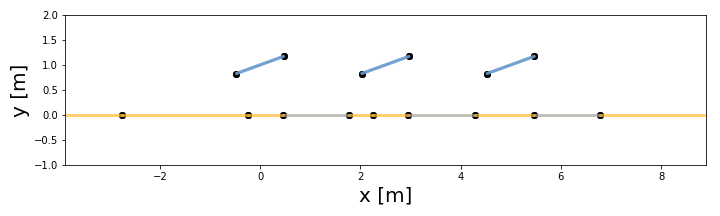
It is then very easy to run simulations using the defined engine:
pvarray = engine.run_full_mode(fn_build_report=lambda pvarray: pvarray)And inspect the results thanks to the simple geometry API
print("Incident irradiance on front surface of middle pv row: {} W/m2"
      .format(pvarray.ts_pvrows[1].front.get_param_weighted('qinc')))
print("Reflected irradiance on back surface of left pv row: {} W/m2"
      .format(pvarray.ts_pvrows[0].back.get_param_weighted('reflection')))
print("Isotropic irradiance on back surface of right pv row: {} W/m2"
      .format(pvarray.ts_pvrows[2].back.get_param_weighted('isotropic')))
Incident irradiance on front surface of middle pv row: [1034.968 886.377] W/m2 Reflected irradiance on back surface of left pv row: [112.139 86.404] W/m2 Isotropic irradiance on back surface of right pv row: [0.116 1.849] W/m2
The users can also create a “report” while running the simulations that will rely on the simple API shown above, and which will look like whatever the users want.
# Create a function that will build a report
def fn_report(pvarray): return {'total_incident_back': pvarray.ts_pvrows[1].back.get_param_weighted('qinc'),
                                'total_absorbed_back': pvarray.ts_pvrows[1].back.get_param_weighted('qabs')}

# Run full mode simulation
report = engine.run_full_mode(fn_build_report=fn_report)

# Print results (report is defined by report function passed by user)
df_report = pd.DataFrame(report, index=df_inputs.index)
df_report
total_incident_back |
total_absorbed_back |
|
|---|---|---|
2017-08-31 11:00:00 |
106.627832 |
103.428997 |
2017-08-31 15:00:00 |
79.668878 |
77.278812 |
Installation
pvfactors is currently compatible and tested with Python 2 and 3, and is available in PyPI. The easiest way to install pvfactors is to use pip as follows:
$ pip install pvfactorsThe package wheel files are also available in the release section of the Github repository.
Requirements
Requirements are included in the requirements.txt file of the package. Here is a list of important dependencies:
Citing pvfactors
We appreciate your use of pvfactors. If you use pvfactors in a published work, we kindly ask that you cite:
Anoma, M., Jacob, D., Bourne, B.C., Scholl, J.A., Riley, D.M. and Hansen, C.W., 2017. View Factor Model and Validation for Bifacial PV and Diffuse Shade on Single-Axis Trackers. In 44th IEEE Photovoltaic Specialist Conference.
Contributing
Contributions are needed in order to improve pvfactors. If you wish to contribute, you can start by forking and cloning the repository, and then installing pvfactors using pip in the root folder of the package:
$ pip install .To install the package in editable mode, you can use:
$ pip install -e .References
Release history Release notifications | RSS feed


Download files
Download the file for your platform. If you're not sure which to choose, learn more about installing packages.
Source Distribution
Built Distribution
Filter files by name, interpreter, ABI, and platform.
If you're not sure about the file name format, learn more about wheel file names.
Copy a direct link to the current filters
File details
Details for the file pvfactors-1.4.0.tar.gz.
File metadata
- Download URL: pvfactors-1.4.0.tar.gz
- Upload date:
- Size: 81.7 kB
- Tags: Source
- Uploaded using Trusted Publishing? No
- Uploaded via: twine/1.14.0 pkginfo/1.5.0.1 requests/2.22.0 setuptools/41.2.0 requests-toolbelt/0.9.1 tqdm/4.35.0 CPython/3.6.9
File hashes
| Algorithm | Hash digest | |
|---|---|---|
| SHA256 |
6db2d26c0da56e15e24869b486b790de5fbd02c84e87726e44463d2abde10532
|
|
| MD5 |
f495512fcde937aae9bd050db7754e92
|
|
| BLAKE2b-256 |
780309999e099d6da5a56468cc6f2f288786188e80a45101cb2f3b4352aea944
|
File details
Details for the file pvfactors-1.4.0-py2.py3-none-any.whl.
File metadata
- Download URL: pvfactors-1.4.0-py2.py3-none-any.whl
- Upload date:
- Size: 72.0 kB
- Tags: Python 2, Python 3
- Uploaded using Trusted Publishing? No
- Uploaded via: twine/1.14.0 pkginfo/1.5.0.1 requests/2.22.0 setuptools/41.2.0 requests-toolbelt/0.9.1 tqdm/4.35.0 CPython/3.6.9
File hashes
| Algorithm | Hash digest | |
|---|---|---|
| SHA256 |
deff820a34289b2af451bbb5a978547d542e4928638e5b110b814da427f1d59a
|
|
| MD5 |
7c50b445b4a5287aac138bcbb70057b6
|
|
| BLAKE2b-256 |
fa929413c743a5d7488b23da40712d16b2425ecd2c1e479c03aa35fd1c65af39
|






