
PyChebyshev


A fast Python library for multi-dimensional Chebyshev tensor interpolation with analytical derivatives
PyChebyshev provides a fully optimized Python implementation of the Chebyshev tensor method, demonstrating that it achieves comparable speed and accuracy to the state-of-the-art MoCaX C++ library for European option pricing via Black-Scholes — with pure Python and NumPy only.
Performance Comparison
Based on standardized 5D Black-Scholes tests (test_5d_black_scholes() with S, K, T, σ, r):
| Method | Price Error | Greek Error | Build Time | Query Time | Notes |
|---|---|---|---|---|---|
| Analytical | 0.000% | 0.000% | N/A | ~10μs | Ground truth (blackscholes library) |
| Chebyshev Barycentric | 0.000% | 1.980% | ~0.35s | ~0.065ms | Full tensor, analytical derivatives |
| Chebyshev TT | 0.014% | 0.029% | ~0.35s | ~0.004ms | TT-Cross, ~7,400 evals (vs 161k full) |
| MoCaX Standard | 0.000% | 1.980% | ~1.04s | ~0.47ms | Proprietary C++, full tensor (161k evals) |
| MoCaX TT | 0.712% | 1.604% | ~5.73s | ~0.25ms | Proprietary C++, ALS (8k evals) |
| FDM | 0.803% | 2.234% | N/A | ~0.5s/case | PDE solver, no pre-computation |
Key Insights:
- Chebyshev Barycentric: spectral accuracy (0.000% price error) with analytical derivatives
- Chebyshev TT: only 7,400 evaluations (vs 161,051 full tensor), 50x more accurate than MoCaX TT
- Build time: 0.35s (PyChebyshev) vs 1.04--5.73s (MoCaX)
- Query time: 0.004ms batch (TT) / 0.065ms single (barycentric) vs 0.25--0.47ms (MoCaX)
Visual Comparison: Spectral Convergence
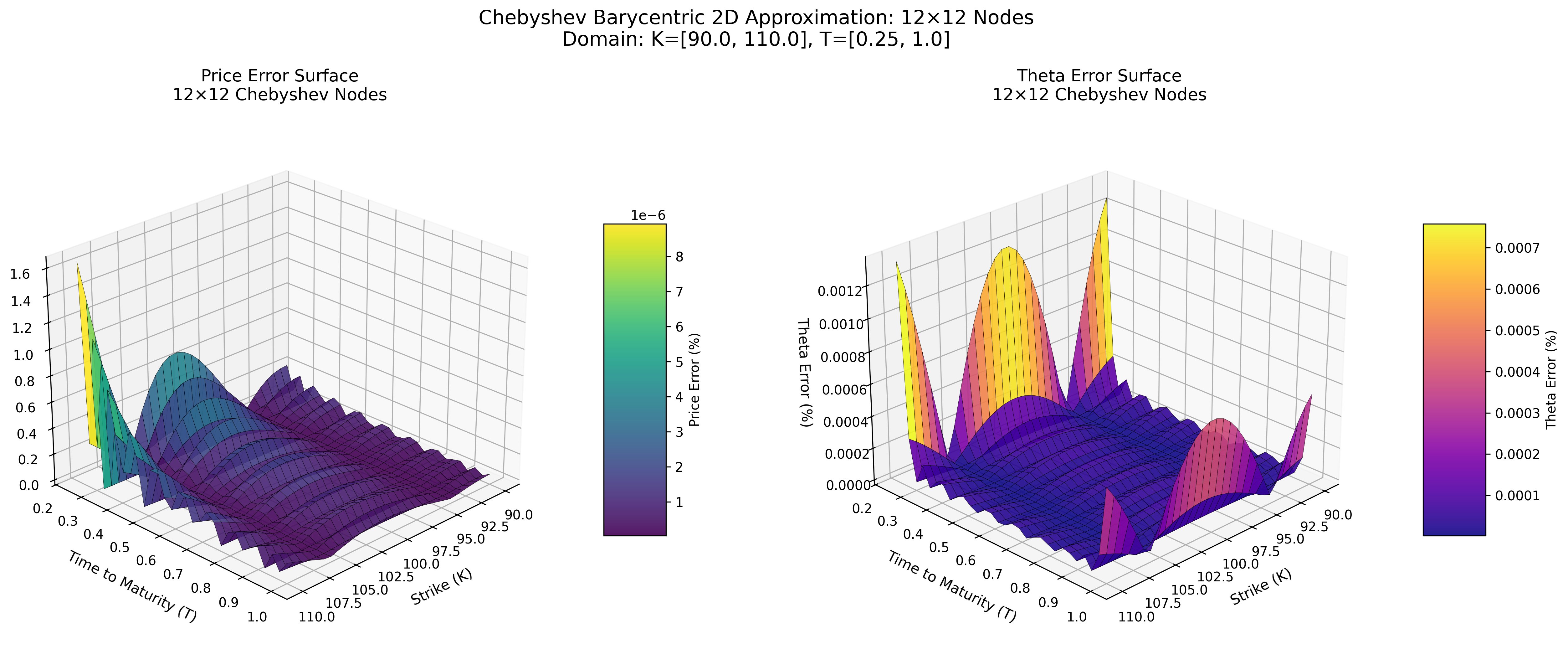
Error Surface at 12×12 Nodes
Chebyshev Barycentric (Python)
MoCaX Standard (C++)
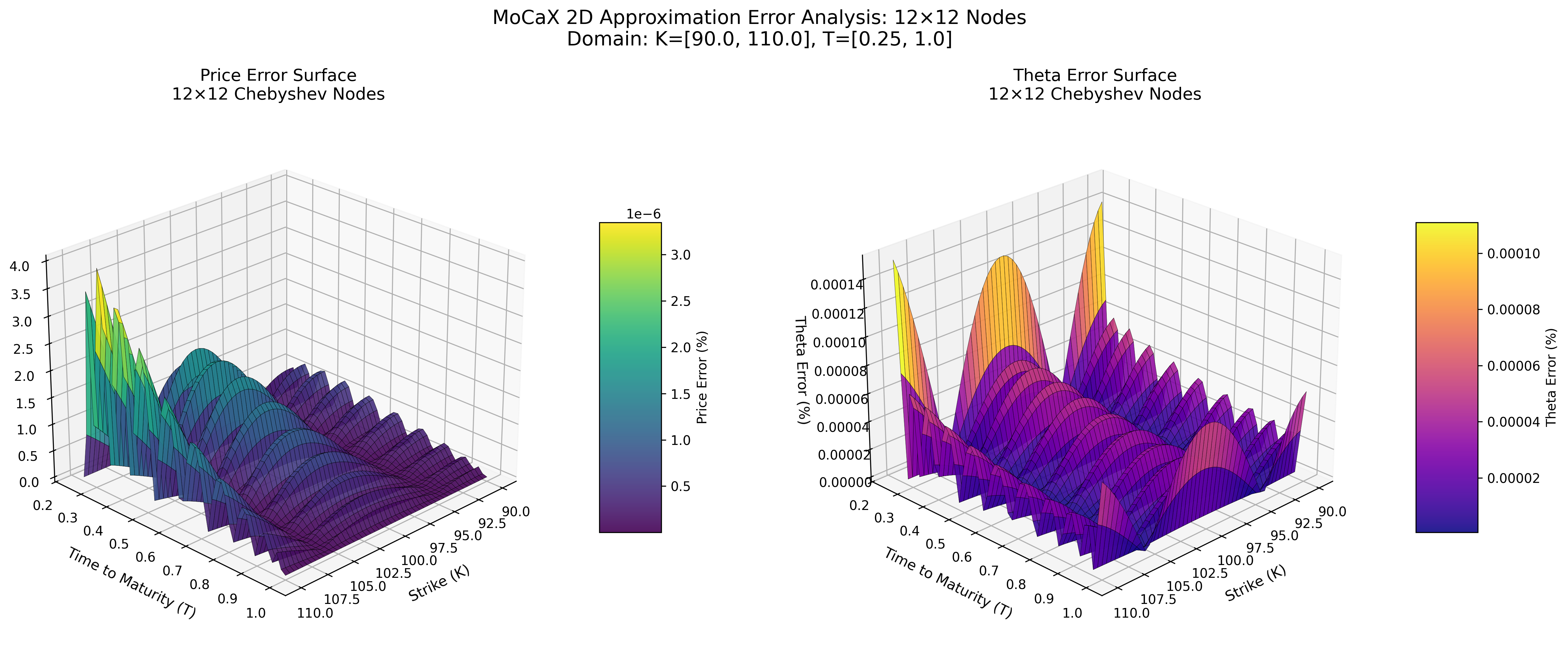
Both methods achieve spectral accuracy (exponential error decay) with identical node configurations, demonstrating that the pure Python implementation successfully replicates the MoCaX algorithm's mathematical foundation.
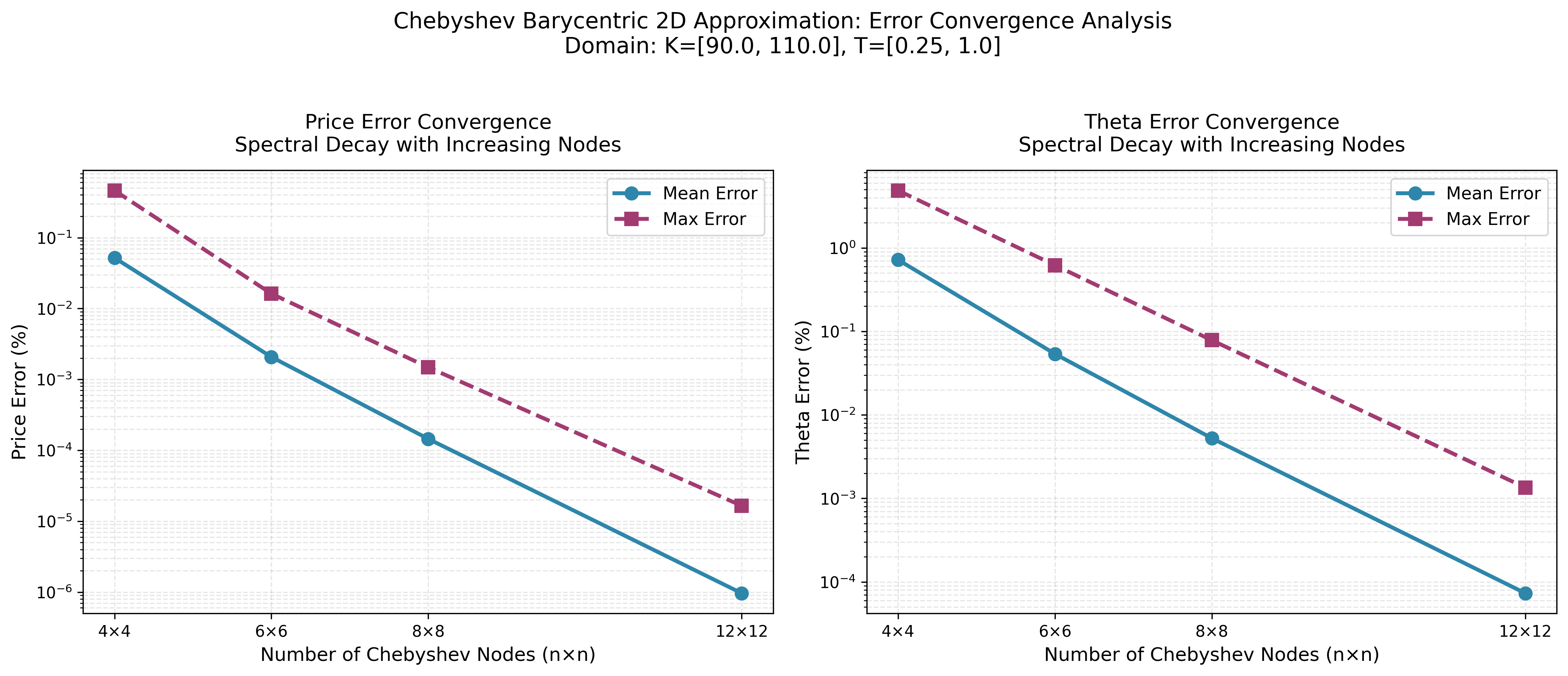
Convergence Analysis
Chebyshev Barycentric
MoCaX Standard
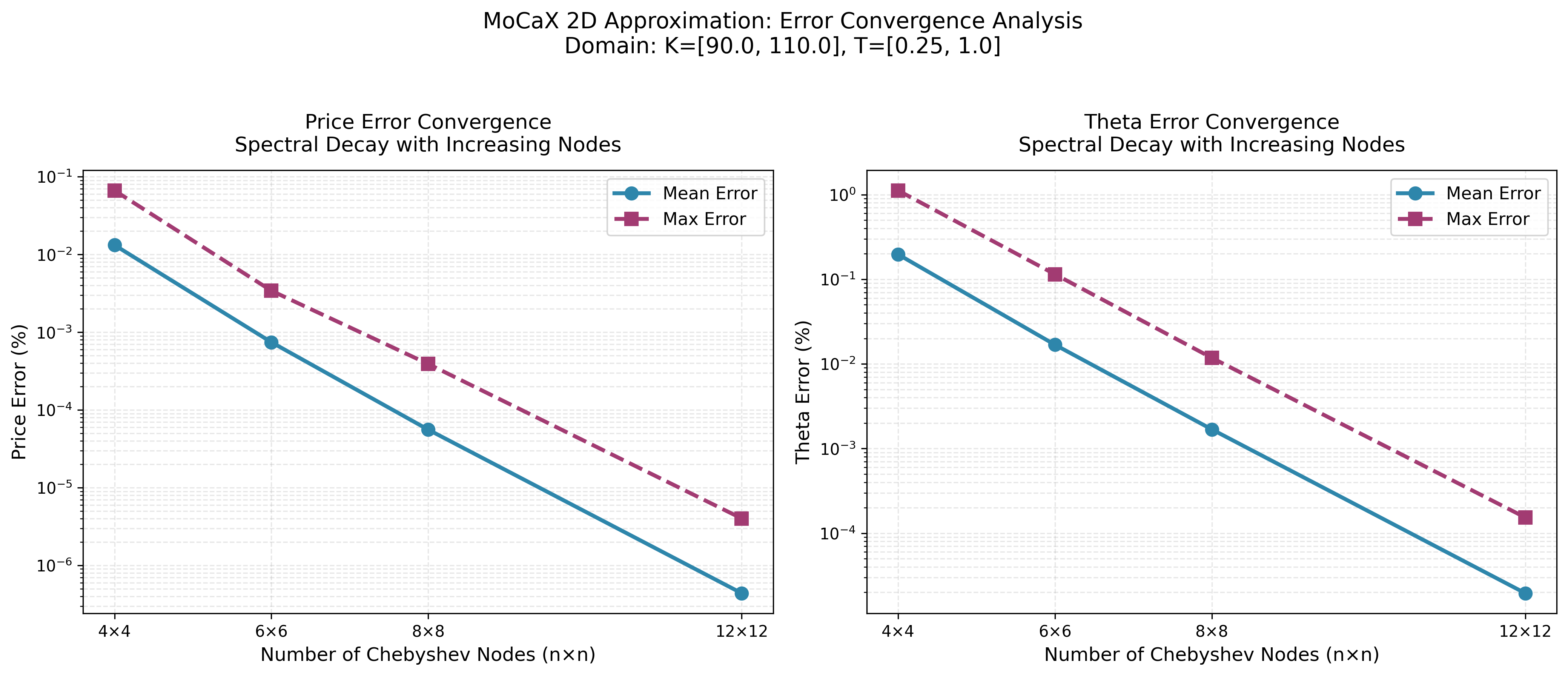
The convergence plots demonstrate exponential error decay as node count increases, confirming the spectral accuracy predicted by the Bernstein Ellipse Theorem. Errors drop rapidly from 4×4 to 12×12 nodes, reaching near-machine precision for this analytic function.
Features
- Full tensor interpolation via
ChebyshevApproximation— spectral accuracy for up to ~5 dimensions - Piecewise Chebyshev (splines) via
ChebyshevSpline— knots at kinks/discontinuities restore spectral convergence for non-smooth functions - Tensor Train decomposition via
ChebyshevTT— TT-Cross builds from O(d·n·r²) evaluations for 5+ dimensions - Tensor Train ALS and algebra —
method='als'rank-adaptive build,run_completion()to sharpen any TT without rebuilding, TT-levelinner_product()andorth_left/orth_rightcanonicalization sweeps. - Sliding technique via
ChebyshevSlider— additive decomposition for separable high-dimensional functions - Arithmetic operators (
+,-,*,/) — combine interpolants into portfolio-level proxies with no re-evaluation - Extrusion & slicing — add or fix dimensions to combine interpolants across different risk-factor sets
- Integration, rootfinding & optimization — spectral calculus directly on interpolants, no re-evaluation needed
- Analytical derivatives via spectral differentiation matrices (no finite differences)
- Vectorized evaluation using BLAS matrix-vector products (~0.065ms/query)
- Error-driven construction — pass
error_threshold=εand PyChebyshev auto-picks node counts per dimension - Special points in the core API — declare kinks directly on
ChebyshevApproximationviaspecial_points=[[...]]; auto-dispatches to a piecewise Chebyshev spline. - Portable
.pcbbinary format for cross-language model sharing (C, Rust, Julia consumers can read PyChebyshev interpolants without Python). - MoCaX-style ergonomics (v0.15):
additional_data=ctor kwarg, descriptor, derivative-id registry, and introspection (get_used_ns,get_constructor_type,is_construction_finished). - Pure Python — NumPy + SciPy only, no compiled extensions needed
Acknowledgments
Special thanks to MoCaX for their high-quality videos on YouTube explaining the mathematical foundations behind their library. These resources were invaluable for understanding and implementing the barycentric Chebyshev interpolation algorithm.
Getting Started
Installation
pip install pychebyshev
Quick Example
import math
from pychebyshev import ChebyshevApproximation

# Approximate any smooth function
def my_func(x, _):
    return math.sin(x[0]) * math.exp(-x[1])

cheb = ChebyshevApproximation(
    my_func,
    num_dimensions=2,
    domain=[[-1, 1], [0, 2]],
    n_nodes=[15, 15],
)
cheb.build()

# Evaluate function value
value = cheb.vectorized_eval([0.5, 1.0], [0, 0])

# Analytical first derivative w.r.t. x[0]
dfdx = cheb.vectorized_eval([0.5, 1.0], [1, 0])

# Price + all derivatives at once (shared weights, ~25% faster)
results = cheb.vectorized_eval_multi(
    [0.5, 1.0],
    [[0, 0], [1, 0], [0, 1], [2, 0]],
)
High-Dimensional Functions (Tensor Train)
For 5+ dimensional functions where full tensor grids are too expensive, use ChebyshevTT with TT-Cross:
from pychebyshev import ChebyshevTT

tt = ChebyshevTT(
    my_func, num_dimensions=5,
    domain=[[-1, 1]] * 5,
    n_nodes=[11] * 5,
    max_rank=10,
)
tt.build()
val = tt.eval([0.5] * 5)

# Batch evaluation (much faster per point)
import numpy as np
points = np.random.uniform(-1, 1, (1000, 5))
vals = tt.eval_batch(points)
Note:
ChebyshevTTuses finite differences for derivatives (not analytical spectral differentiation). First-order Greeks are typically accurate to ~0.03%; see the docs for details.
Separable Functions (Sliding Technique)
For functions that decompose additively, use ChebyshevSlider:
from pychebyshev import ChebyshevSlider

slider = ChebyshevSlider(
    my_func, num_dimensions=10,
    domain=[[-1, 1]] * 10,
    n_nodes=[11] * 10,
    partition=[[0, 1], [2, 3], [4, 5], [6, 7], [8, 9]],
    pivot_point=[0.0] * 10,
)
slider.build()
val = slider.eval([0.5] * 10, [0] * 10)
See the documentation for full API reference and usage guides.
How It Works
PyChebyshev uses Chebyshev tensor interpolation to pre-compute fast approximations of smooth functions. The approach generalizes to all analytic functions, as proven by Gaß et al. (2018), which establishes (sub)exponential convergence rates for Chebyshev interpolation of parametric conditional expectations.
Four approaches for different scales
| Class | Approach | Build Cost | Eval Cost | Derivatives |
|---|---|---|---|---|
ChebyshevApproximation |
Full tensor + barycentric weights | $n^d$ evals | $O(d \cdot n)$ via BLAS GEMV | Analytical (spectral) |
ChebyshevSpline |
Piecewise Chebyshev at knots | $\text{pieces} \times n^d$ evals | $O(d \cdot n)$ via BLAS GEMV | Analytical (per piece) |
ChebyshevTT |
TT-Cross + maxvol pivoting | $O(d \cdot n \cdot r^2)$ evals | $O(d \cdot n \cdot r^2)$ via einsum | Finite differences |
ChebyshevSlider |
Additive decomposition into slides | Sum of slide grids | Sum of per-slide evals | Analytical (per-slide) |
Key ideas
Barycentric interpolation (ChebyshevApproximation): The barycentric formula separates node positions from function values — weights $w_i = 1/\prod_{j \neq i}(x_i - x_j)$ depend only on nodes and can be fully pre-computed. This enables $O(N)$ evaluation for all dimensions (vs. $O(N \log N)$ for polynomial coefficient approaches) and analytical derivatives via spectral differentiation matrices — no finite differences needed.
Tensor Train decomposition (ChebyshevTT): The full $n^d$ tensor is never formed. Instead, TT-Cross builds a chain of small 3D cores from strategically selected function evaluations (maxvol pivot selection), reducing 161,051 evaluations to ~7,400 for 5D Black-Scholes.
BLAS vectorization: All evaluation paths route tensor contractions through optimized BLAS routines (numpy.dot, numpy.einsum), achieving ~150x speedup over scalar loops.
For the full mathematical foundation — Chebyshev nodes, Bernstein ellipse theorem, barycentric formula, spectral differentiation matrices, and TT-Cross algorithm — see the documentation.
1 maintainer

Metadata
1 maintainer
Release files for pychebyshev 0.21.1
For a detailed explanation of source distributions (sdists) and built distributions (wheels), please see the package formats documentation.
Source distribution (sdist)
| File | Size | Uploaded | Provenance | Actions |
|---|---|---|---|---|
| pychebyshev-0.21.1.tar.gz | 17.7 MB | Without provenance | Details for pychebyshev-0.21.1.tar.gz |
Built distribution (wheel)
| File | Interpreter | ABI | Platform | Actions Reset |
|---|---|---|---|---|
| pychebyshev-0.21.1-py3-none-any.whl | Python 3 | none | any | Details for pychebyshev-0.21.1-py3-none-any.whl |
Total release size: 17.8 MB
Release files / pychebyshev-0.21.1.tar.gz
| Download URL | pychebyshev-0.21.1.tar.gz |
|---|---|
| Size | 17.7 MB |
| Tags | Source |
|
SHA-256 checksum How to use checksums |
1ac7f8e8353fe0883dd708b5ecd4a962e47a1f1e043f82687dfae1a2843f7ee0
|
|
BLAKE2b-256 checksum How to use checksums |
19c97954eeaefa6524d430af2e687c76ab9b6dc8f10a7d967fc13900a2147fe5
|
| Upload date | |
|
Uploaded using Trusted Publishing? What is trusted publishing? |
Yes |
| Uploaded via |
uv/0.11.8 {"installer":{"name":"uv","version":"0.11.8","subcommand":["publish"]},"python":null,"implementation":{"name":null,"version":null},"distro":{"name":"Ubuntu","version":"24.04","id":"noble","libc":null},"system":{"name":null,"release":null},"cpu":null,"openssl_version":null,"setuptools_version":null,"rustc_version":null,"ci":true}
|
Release files / pychebyshev-0.21.1-py3-none-any.whl
| Download URL | pychebyshev-0.21.1-py3-none-any.whl |
|---|---|
| Size | 115.8 kB |
| Tags | Python 3 |
|
SHA-256 checksum How to use checksums |
1c2d70814c7ab382fdc1582a1e4d7f021563ee8539ad78c475057795b59b55bf
|
|
BLAKE2b-256 checksum How to use checksums |
18f196ab7a7a26211e9b94ed947b0c9b265e4065f16ee54c7c361e73da58a00e
|
| Upload date | |
|
Uploaded using Trusted Publishing? What is trusted publishing? |
Yes |
| Uploaded via |
uv/0.11.8 {"installer":{"name":"uv","version":"0.11.8","subcommand":["publish"]},"python":null,"implementation":{"name":null,"version":null},"distro":{"name":"Ubuntu","version":"24.04","id":"noble","libc":null},"system":{"name":null,"release":null},"cpu":null,"openssl_version":null,"setuptools_version":null,"rustc_version":null,"ci":true}
|
Security for pychebyshev 0.21.1
Provenance
Provenance describes where a file came from. On PyPI, provenance is shared via attestations, which provide a verifiable record of the build or publishing details. View details, limitations and caveats.
No provenance found
None of the files in this release were uploaded with provenance metadata.
A note on package security
PyPI is a repository for distributing packages, not a service for auditing them. While third-party security researchers and our staff do their best to detect and remove malicious packages, PyPI cannot guarantee the quality, security or suitability of any given package.
To learn more about protecting yourself from malicious actors, visit our package security documentation.














